≡ Menu

My thoughts on trading Darrelle Revis

There are four things the Jets could do with Darrelle Revis.

Option 1: Trade him before the draft to the team (not in the AFC East or in New York) willing to offer the most.

Option 2: Trade him during the five-month period after the draft but before the trading deadline, under the assumption that Revis will be able to fetch more in return once he is healthy and playing at his old level (assumption #2). [Update: As pointed out to me on twitter, the Jets will also incur the $9M penalty discussed in Option 3 if Revis is traded after June 1st.]

Option 3: Have Revis play out his contract, and then watch him sign with another team in the off-season (or enter a bidding war and try to win Revis on the open market). In return, the Jets will receive a compensatory draft pick, roughly the 100th pick in the 2015 draft. And, since Revis was given an $18M bonus on a six-year deal in 2011 — a deal that Revis has the option of voiding after this season — the Jets will also incur a nine million dollar cap penalty in 2014.

Option 4: Re-sign Revis to a mega deal now. The Jets will get a slight discount off the enormous contract Revis would get on the open market based on the questions about his knee and the fact that he’s due to make “only” $9M in 2012.
[continue reading…]

{ 7 comments }

On Tuesday, I discussed the RSP Football Writers Project, a 32-team start-up draft of every player in the NFL.  I was assigned the 32nd pick, which does bring with it one advantage.  In order to balance the values assigned with the random draft order, the selection picks for the third round is “reversed”, a common fantasy football technique known as 3rd Round Reversal.  So while I picked last in round one after 18 quarterbacks had been drafted, I got to pick first in rounds two and three.

As you now know, I drafted Josh Freeman and Julio Jones with picks 32 and 33.  At 65, there were several ways I could go.

  • I think it’s hard to overestimate the value of a great passing game, so adding a receiver or tight end isan attractive option. That’s doubly true when Brandon Marshall and Aaron Hernandez were still available. Marshall was my highest-ranked receiver from last year and is relatively young; he turns 29 this month. Hernandez is 23 and is an incredible asset in the passing game.
  • If you think of the big positions in the NFL as quarterback, pass rusher, and left tackle, then you probably want to fill those slots as quickly as possible. At left tackle, Duane Brown, Joe Thomas, Matt Kalil, and Nate Solder are gone. Michael Roos is a solid pick, but at 31 in October, does he fit my model of fielding a young team? Ryan Clady was a player I might have taken, but he was selected just a few picks before I was up. I didn’t see an elite player available, so I crossed this off the list (a few picks later, Matt Waldman selected Russell Okung.)
  • On the pass-rusher front, Von Miller, Aldon Smith, Clay Matthews, Cameron Wake, Jason Pierre-Paul, DeMarcus Ware, Charles Johnson are all gone, as are 3-4 defensive ends J.J. Watt, Calais Campbell, Muhammad Wilkerson and Justin Smith. While there were some attractive options out there, my hope is one of them will be around when I pick again. The most interesting option was Mario Williams, a player I really wanted to take, but his struggles in 2012 were too significant to overlook.

[continue reading…]

{ 1 comment }

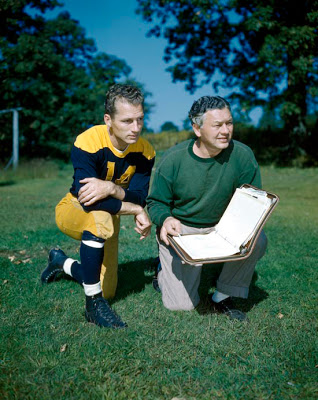
Don Hutson and Curly Lambeau

Don Hutson is down with era adjustments.

I’ve written several posts about how to grade wide receivers and did a three-part series on one ranking system two weeks ago. Grading wide receivers requires one to adjust for era, but there are many different ways to do that.

Calvin Johnson caught 122 passes last year for 1,964 yards and five touchdowns. In 1973, Harold Carmichael had 67 receptions, 1,116 yards and nine scores. Which season was better? You might be inclined to think Johnson’s season was much better regardless of era, but both receivers led their respective leagues in both receptions and receiving yards. But let’s think about it another way.

In 1973, all the players on the 26 teams in the NFL combined for a total of 4,603 catches and 58,009 receiving yards. That means Carmichael was responsible for 1.46% of all receptions and 1.92% of all receiving yards. Of course, with only 26 teams, we need to multiply those numbers by 26/32 make for an apples-to-apples comparison of the modern environment. If we want to transport Carmichael into 2012, that means he needs to be credited with 1.18% of all receptions and 1.56% of all receiving yards accumulated last year. That would give him 128 catches and 1,970 receiving yards, and thanks to recording 1.93% of all receiving touchdowns in 2012, 14.6 touchdowns.

This analysis is actually unfair to active players, as there are more three-, four-, and five-wide receiver sets than ever before. Elroy Hirsch gained 1,495 receiving yards in 12 games — an outstanding rate of production in any era — but that translates to an absurd 2,667 receiving yards in 2012. In Don Hutson’s magical 1942 season, after multiplying by 10/32, he gained 2.3% of the league’s receptions, 2.8% of the receiving yards, and 4.9% of the touchdowns — for a 254/3501/37 stat line.
[continue reading…]

{ 6 comments }

Matt Waldman and Sigmund Bloom are once again running the RSP Football Writers Project this off-season. Last year, a salary cap value was assigned to each player and we were asked to assemble our team within the confines of a salary cap. You can see my team here, but my basic philosophy was to invest heavily in building an elite passing offense. One of the questions we had to answer was who were our stars and why did we pick them? I wrote:

Peyton Manning is the key. With an elite quarterback and competent weapons, you can just about pencil your team in for the playoffs. With Jimmy Graham and Victor Cruz, I’ve got one player who ranked in the top three in receptions and one in the top three in receiving yards in 2011. Those three can form the cornerstone of the offense for the next three-to-five years.

This year, the RSP Football Writers Project (you can see the draft recap here or follow the picks on twitter here) is being run as a 32-team start-up draft with fantasy football style serpentine order that includes a third-round reversal. Trades are not allowed and the player pool will consist of veterans only (i.e., no players available in the 2013 draft).

We were told the draft order was random, although I choose to believe that I was assigned pick #32 because of my performance in last year’s project. Having the 32nd and 33rd picks in the draft placed me in a unique position, and I figured I’d explain my team-building methods here.
[continue reading…]

{ 6 comments }

Smith kept a low profile during his playing days.

Smith kept a low profile during his playing days.

Jacksonville’s Jimmy Smith was first eligible for the Hall of Fame in 2011. He was cut early in the process, failing to be one of the 26 semifinalists selected. A year later, he again failed to make the cut to 26, and was shut out at the same stage a few months ago, too.

To the extent that the Hall of Fame is supposed to mirror the consensus view, Smith’s absence from Canton is justified. But that’s only because he’s tragically underrated. If you take a normative view of how the Hall of Fame should operate, then the lack of traction Smith’s case has made is downright appalling.

No wide receiver of his caliber has ever been so overlooked. Even Art Monk was a finalist for the HOF every single year he was eligible until being inducted in 2008. Ditto Cris Carter, who was a finalist the first five years he was eligible before being selected for the Class of 2013. Tim Brown has been a finalist each of the first four years in which he’s been eligible. Smith, on the other hand, appears to have fallen through Canton’s cracks.

When I came up with my era-adjusted career rankings, Smith came in as the 12th best wide receiver in history. The issue with Smith has never been production but perception. Let’s go through the reasons Smith’s been overlooked.
[continue reading…]

{ 39 comments }

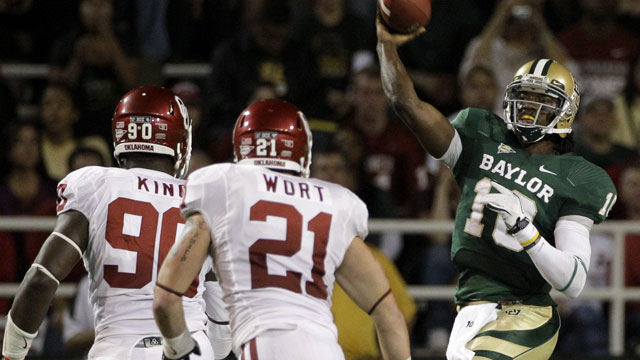
Griffin against the Sooners.

Griffin against the Sooners.

This week, I looked at the best college quarterback seasons in 2012 and over the last eight years. Today I’m going to do a quick data dump on the top passing performances by a college quarterback since 2005. I’ll be using the same formula as I did before, so check there if you want to read the fine print. As before, the data below is courtesy of cfbstats.com.

I’m not too surprised to see Geno Smith‘s game last year come in as the top game over the last eight years. And seeing Robert Griffin III come in with the third best passing game since 2005 isn’t too surprising, either. He threw for 479 yards and 4 touchdowns — including a memorable game-winner — on just 34 passes against the #5 team in the country. But #2 on the list is a game I doubt many remember. UCLA’s Drew Olson put together one of the craziest stat lines you’ll ever see in a 45-35 victory over Arizona State. Olson threw just 27 passes but racked up 510 passing yards and 5 touchdowns, en route to a ridiculous 21.5 ANY/A average. A future Jacksonville Jaguar had a big game for Olson, but it wasn’t Maurice Jones-Drew; Marcedes Lewis caught 7 passes for 108 yards and two touchdowns.

The full list of the top 400 games, below:
[continue reading…]

{ 0 comments }

Not the answer.

Not the answer.

Kurt Warner will be eligible for the Hall of Fame in 2 years, making him a potential member of the Class of 2015. Warner is an interesting candidate, and while I suspect he does get in on the first ballot, it’s certainly not a given. Warner won more than 8 games just four times in his career, and he had a relatively nondescript six-year stretch from 2002 to 2007.

But I suspect Warner makes it on his first try because he was a two-time AP MVP choice, he appeared in three Super Bowls, revived two franchises, and he used to bag groceries. Few have a story as incredible as Warner’s, and sportswriters seem to love the guy, so I don’t expect there to be too many hurdles. If he doesn’t get in on the first ballot, he’ll certainly get in eventually.

And that would be a pretty rare feat. Can you name the last quarterback to be selected to the Hall of Fame who was not as a first-ballot choice?

Trivia hint 1 Show


Trivia hint 3 Show


Click 'Show' for the Answer Show

{ 10 comments }

Update: Miss on a first round QB, get fired

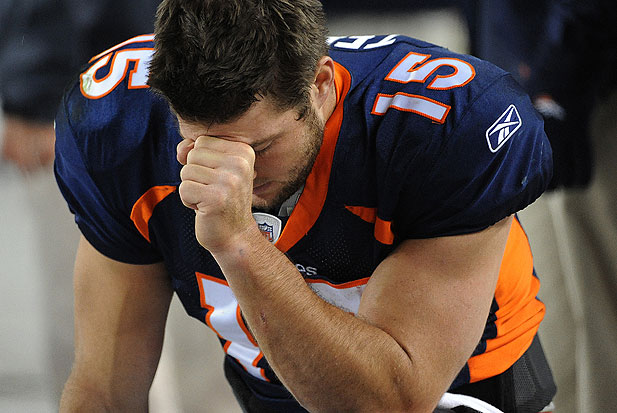
Tim Tebow prays for not Josh McDaniels' job security.

Tim Tebow prays for not Josh McDaniels' job security.

In October, I examined the data supporting the intuitive notion that when an organization misses on a first round quarterback, the axe must fall on someone. From 1998 to 2010, there were 35 quarterbacks selected in the first round of the draft. I labeled 14 [1]Ryan Leaf, Akili Smith, Cade McNown, Tim Couch, Joey Harrington, Patrick Ramsey, David Carr, Kyle Boller, Rex Grossman, J.P. Losman, Matt Leinart, Brady Quinn, JaMarcus Russell, and Tim Tebow. as clear busts, and in 10 of those situations, the head coach and offensive coordinator were both gone within two years. The outcome wasn’t much rosier in the other four instances. In Chicago and Baltimore, a Coach of the Year award and Super Bowl title helped insulate Dick Jauron and Brian Billick, but their offensive coordinators were fired within two years of their teams drafting Cade McNown and Kyle Boller, respectively. In Denver, head coach Josh McDaniels lasted only one year after drafting Tim Tebow, although his offensive coordinator has managed to rebound nicely. Only in expansion Houston was the axe delayed, although OC Chris Palmer was fired after year 3 and HC Dom Capers after year 4 following the David Carr pick.

With 2012 in the books, I wanted to provide a quick update. While Cam Newton is not a bust and the jury is still out on Christian Ponder (although some are calling for OC Bill Musgrave to be fired), it’s worth noting the situation of the other two first round quarterbacks. In Tennessee, OC Chris Palmer was fired in part for yet again failing to develop a rookie quarterback, this time with Jake Locker as the prized pupil. And in Jacksonville, a year after HC Jack Del Rio and OC Dirk Koetter were shown the door for largely non-Gabbert-based reasons, the GM who selected Blaine Gabbert — Gene Smith — has been fired, along with the 2012 HC (Mike Mularkey).
[continue reading…]

{ 9 comments }

The origin of the name ‘Redskins’

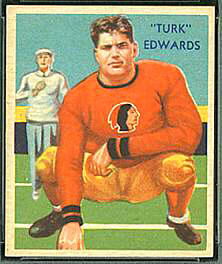
The uniform worn by the Boston Redskins in 1935

The debate concerning whether the Washington Redskins should change its name has resurfaced in recent weeks. I have my opinion as to whether a name change is appropriate, but nobody cares to read that. Instead, I’d like to recount the history behind the name.

The nickname ‘Redskins’ predates the team playing football in Washington. The organization began playing football in 1932 — in Boston — under the nickname Braves. That was changed in 1933 to Redskins, and the franchise moved to Washington in 1937.

So where did the name Braves come from? The NFL was a fledgling league in the ’20s and ’30s, and teams in that era often chose names synonymous with the local baseball team. George Halas saw the success of the Cubs and named his team the Bears. When the Portsmouth Spartans moved to Detroit in 1934, the name “Lions” made sense for a city that already loved the Tigers. Major League Baseball’s San Francisco Giants began playing in New York in the 19th century, so it didn’t take the football team long to come up with a nickname in 1925. Like the Giants, the Boston football team simply copied one of the baseball team’s names — and they didn’t pick ‘Red Sox’. In 1932, the Atlanta Braves were still playing in Boston at Braves Field, and since that’s where the football team was scheduled to play, I imagine the team spent all of several seconds coming up with a name.
[continue reading…]

{ 80 comments }

Yesterday, I ranked every quarterback in college football last season. Today, I’ll do the same for every quarterback since 2005. If you read yesterday’s article, you can skip the next three paragraphs, which explain the system I used.

These guys were great in college.

These guys were great in college.

I start by calculating each quarterback’s Adjusted Net Yards per Attempt, done by starting with passing yards per attempt, adding 20 yards for each touchdown and subtracting 45 yards for each interception, and subtracting sack yards lost from the numerator and adding sacks to the denominator. Because the NCAA treats sack stats as rushing data, and because the game logs I have (courtesy of cfbstats.com) only show separate sack data on the team level, some estimation is involved in coming up with player sacks. Each quarterback is assigned X% of the sacks his team’s offense suffered in each game, with X equaling the number of pass attempts thrown by that player divided by his team’s total number of pass attempts.

Once I have calculate the ANY/A for each player, I then adjusted their ratings for strength of schedule. This involves an iterative process I described here and is virtually identical to how I calculate SRS ratings in college football on the team level. You adjust each quarterback’s ANY/A (weighted by number of pass attempts) for the qualify of the defense, which is adjusted by the quality of the quarterbacks it faced, which is adjusted by the quality of all the defenses all of those quarterbacks faced, and so on. After awhile, the ratings converge, and you come up with final, SOS-adjusted ANY/A ratings.
[continue reading…]

{ 4 comments }

The Chiefs play the Baylor game on an endless loop for the other 31 teams.

The Chiefs play the Baylor game on an endless loop for the other 31 teams.

A few weeks ago, I discovered cfbstats.com, which has made available for download an incredible amount of college football statistics from the last eight seasons. Thanks to them, I plan to apply some of the same techniques I’ve used on NFL numbers over the years to college statistics. If you’re a fan of college football, you’re probably already reading talented writers like Bill Connelly and Brian Fremeau, but hopefully I can bring something new to the table for you to enjoy.

There are many differences between college and professional football, but many of the same stats still matter. For quarterbacks, Adjusted Net Yards per Attempt is still the king of the basic stats [1]For the uninitiated, ANY/A is calculated by starting with passing yards per attempt, adding 20 yards for each touchdown and subtracting 45 yards for each interception, and subtracting sack yards lost … Continue reading, and it is arguably even more important in college where teams play at varying different paces.

There’s a small problem, however, if you want to calculate ANY/A at the college level: the NCAA counts sacks as rush attempts and sack yards lost as negative rushing yards. I manually overrode [2]Unfortunately, some estimation was involved. The player game logs at cfbstats do not identify quarterback sacks, but the team game logs do. So for each quarterback, we know how many passes he threw … Continue reading that decision in my data set, so going forward, all rushing and passing data will include sack data in the preferred manner (keep this in mind when you compare the statistics I present to the “official” ones).
[continue reading…]

References

References
1 For the uninitiated, ANY/A is calculated by starting with passing yards per attempt, adding 20 yards for each touchdown and subtracting 45 yards for each interception, and subtracting sack yards lost from the numerator and adding sacks to the denominator.
2 Unfortunately, some estimation was involved. The player game logs at cfbstats do not identify quarterback sacks, but the team game logs do. So for each quarterback, we know how many passes he threw in the game and how many times his team was sacked. For quarterbacks who threw 100% of their team’s passes in a game, this is easy. However, for quarterbacks who threw fewer than 100% of their team’s passes, they were assigned a pro-rata number of their team’s sacks.
{ 10 comments }

In the pre-season, I wrote three pieces on Cleveland Browns rookie Trent Richardson.  As part of a thought experiment, I wondered who would lead the NFL in rushing yards from 2012 to 2021? I narrowed my finalists to LeSean McCoy, Beanie Wells (was I drunk?), DeMarco Murray (ouch), Richardson and the rest of the rookies, and then a few college running backs. I concluded that Richardson was the obvious frontrunner, with McCoy, Doug Martin, and Marcus Lattimore (double ouch) as the next best bets. I’m not really sure 2012 helped clarify the issue, although Martin and Alfred Morris certainly raised their chances.

Then in August, I looked at the production of the highest drafted running back in each draft class.  I discovered that slightly fewer than half of the highest drafted running backs led their class [1]Note that this only includes drafted running backs. in rushing yards as a rookie; as you can see, “the field” also turned out to be a better bet than Richardson in 2012:

RkPlayerYearDraftTmGAttYdsY/ATDY/G
1Alfred Morris20126-173WAS1633516134.8113100.8
2Doug Martin20121-31TAM1631914544.561190.9
3Trent Richardson20121-3CLE152679503.561163.3
4Vick Ballard20125-170IND162118143.86250.9
5Bryce Brown20127-229PHI161155644.9435.3
6Bernard Pierce20123-84BAL161085324.93133.3
7Daryl Richardson20127-252STL16984754.85029.7
8David Wilson20121-32NYG16713585.04422.4
9Robert Turbin20124-106SEA16803544.43022.1
10Ronnie Hillman20123-67DEN14843273.89123.4
11Brandon Bolden2012udfaNWE10562744.89227.4
12Lamar Miller20124-97MIA13512504.9119.2
13LaMichael James20122-61SFO4271254.63031.3
14Chris Rainey20125-159PIT16261023.9226.4
15Jeremy Stewart2012udfaOAK4251014.04025.3

In that post, I also noted that the running back drafted first in his class was slightly less successful over the course of his career: only one-third of the highest-drafted running backs finished with the most career rushing yards in their class.

The final post on the topic ended up being more relevant to Alfred Morris than Richardson. In August, I compared how the top rookie running back performed over the rest of his career relative to the other members of his class. From 1992 to 2002, 10 of the 11 backs to lead their class in rushing yards as rookies ended up finishing with the most career rushing yards. But in recent years, that trend has reversed itself: the odds are long that Ben Tate (2011), LeGarrette Blount (2010), Knowshon Moreno (2009 and competing with Arian Foster and LeSean McCoy), or Steve Slaton (2008) will also finish with the best careers from their class.

So where do we stand on Richardson and Morris? A year later, how much credit do we give Richardson for having been the #3 pick in the draft? For Morris, how much do we downgrade him for being a 6th round pick? And how does the presence of Robert Griffin III complicate things?
[continue reading…]

References

References
1 Note that this only includes drafted running backs.
{ 10 comments }

Trivia of the Day – Sunday, February 24th

The GSOT

The GSOT.

Eight teams in NFL history have rostered five players who — at some point in their career — gained at least 1,000 receiving yards in a season. The most recent three teams were the 2003-2005 Rams, who had Torry Holt, Isaac Bruce, Marshall Faulk, Kevin Curtis, and Mike Furrey. Furrey wouldn’t record 1,000 yards until he joined the Lions in 2006, while Curtis’ only 1,000-yard season came in 2007 with the Eagles. But they qualify, as the question doesn’t concern itself with when that 1,000-yard season occurred.

From 1995 to 1997, the Denver Broncos also pulled off this feat. You could probably guess Shannon Sharpe, Rod Smith, and Ed McCaffrey, but they were joined by Vance Johnson and Anthony Miller in ’95, Miller and Patrick Jeffers (!) the following season, and Jeffers and Flipper Anderson (!!) in 1997.

That leaves just two teams. Bill Belichick’s Cleveland Browns are one of them, as Eric Metcalf, Derrick Alexander, Mark Carrier, Michael Jackson, and Keenan McCardell were all on the 1994 team. Today’s trivia question focuses on the first team to roster five players who, before or after, had a 1,000-yard receiving season.

As this question is, well, impossible, I’ll simply list the players from “least useful” to “most useful” in terms of guessing the team and year. Post in the comments after which player you figured it out!

Reveal Player 1 Show


Reveal Player 2 Show


Reveal Player 3 Show


Reveal Player 4 Show


Reveal Player 5 Show


Trivia Answer Show

{ 6 comments }

Trivia of the Day – Saturday, February 23rd

And you thought the 'Luck' puns were bad...

And you thought the 'Luck' puns were bad...

Last year, Stanford’s David DeCastro was considered one of the safest picks in the draft. But despite being a dominant player that nearly every scout loved, because he was a guard, DeCastro fell to the Steelers with the 24th pick. This year, Alabama guard Chance Warmack projects to be an even better player, and some think he’ll crack the top ten.

Guards generally don’t get drafted so early. It’s not always easy to typecast a player as a guard (as opposed to a center or tackle), but according to Pro-Football-Reference, Chris Naeole (Colorado) is the last guard to be selected in the top 10, when the Saints took him at 10 in 1997. Before that, you have to go back to 1988, when Dave Cadigan (USC) and Eric Moore (Indiana) went to the Jets and Giants. The last guard selected in the top five was Bill Fralic of Pittsburgh, who was taken by the Falcons with the second pick in the 1985 draft.

But when it comes to guards, there’s an even rarer feat than landing in the top five of the draft. The last time any rookie made the Pro Bowl at guard – regardless of draft position – came in 1983. Can you name him?

Trivia hint 1 Show


Trivia hint 2 Show


Trivia hint 3 Show


Click 'Show' for the Answer Show

{ 8 comments }

All your NFL draft needs

All your NFL draft needs will not by satisfied by Football Perspective. I’ll be writing some meta draft articles, discussing draft pick value, historical expectations, and the like, but I won’t delve too deeply into the current crop of prospects for the 2013 draft. Fortunately, there are many excellent resources out there. I asked Sigmund Bloom and Matt Waldman for their thoughts on some of the best writers covering the 2013 draft. Listed below are their excellent recommendations (along with a few of my own) that should serve your draft needs well; I have also provided links to the twitter accounts of each writer (click on the person’s name for their twitter feed) for the more social media-friendly readers out there:

[continue reading…]

{ 0 comments }

Russell Wilson is too awesome for snide comments.

Russell Wilson is too awesome for snide comments.

Since 1990, there have been 48 rookie quarterbacks that threw at least 224 pass attempts, the necessary amount to qualify for the league’s efficiency ratings. There are many conventional ways to measure rookie quarterbacks, but the off-season lets us play around with more obscure measures.

For example, have you ever considered how rookie quarterbacks performed compared to how their teams passed in the prior year? David Carr, Tim Couch, and Kerry Collins took over expansion teams, but we can compare the passing stats of the other 45 rookie quarterbacks to the team stats from the prior season. To compare across eras, I am grading each individual and team relative to the league average each season.

Let’s start with Net Yards per Attempt. Ben Roethlisberger averaged 7.41 NY/A in 2004 when the league average was 6.14; therefore, Roethlisberger was at 121% of league average. Meanwhile, the 2003 Steelers under Tommy Maddox were at 99% of league average. For each of the 45 rookie quarterbacks, I plotted them in the graph below. The Y-axis shows how the quarterback performed as a rookie, while the X-axis shows how his team performed in the prior season. Because it makes sense to think of “up and to the right” as positive, the X-axis goes in reverse order. Take a look – I have an abbreviation for each quarterback next to his data point:
[continue reading…]

{ 2 comments }

On Monday, I explained my methodology for ranking every wide receiver in football history, and yesterday, I presented a list of the best single seasons of all time. Today the career list of the top 150 wide receivers. As usual, I implemented a 100/95/90 formula, giving a player credit for 100% of his production in his best season, 95% of his value in his second-best season, 90% in his third year, and so on. The table below is fully sortable and lists the first and last year each person played wide receiver [1]Note that I have excluded seasons where a wide receiver played running back or tight end. This is generally not a big deal, but does hurt someone like Lenny Moore.; you can use the search feature to find the best receiver to ever play for each team (for example, typing ‘ram’ for the Rams ‘clt’ for the Colts.)
[continue reading…]

References

References
1 Note that I have excluded seasons where a wide receiver played running back or tight end. This is generally not a big deal, but does hurt someone like Lenny Moore.
{ 55 comments }

Yesterday, I explained my methodology for ranking every wide receiver in football history. Today I’m going to present a list of single-season leaders, which presents some problems.

I think the method I described yesterday does a good job adjusting for era, as receivers are only given credit for their yards above the baseline, which is different each season. But there are some other complicating factors unique to football. Seasons have had varying lengths: a receiver who plays 12 games in a 12-game season can’t be penalized the way you would penalize a receiver who only plays in 12 games now. Since older receivers are generally at a disadvantage for many reasons, I decided to simply pro-rate the value for all non-16 game seasons as if it was a 16-game season. However, I have also included downward adjustments for players in other leagues and during World War II. [1]The fine print: For players in 1943, 1944, and 1945, and for players in the AAFC, I only gave the receivers credit for 60% of the value they created. For the AFL, I gave players 60% of their value in … Continue reading

The table below lists the top 200 wide receiver seasons of all-time.
[continue reading…]

References

References
1 The fine print: For players in 1943, 1944, and 1945, and for players in the AAFC, I only gave the receivers credit for 60% of the value they created. For the AFL, I gave players 60% of their value in 1960 and 1961, 70% in 1962, 80% in 1963, 90% in 1964, and 100% in 1965 through 1969. In case it wasn’t obvious, all of these adjustments are arbitrary.
{ 12 comments }

We know how this story will end.

We know how this story will end.

Regular readers know that one of my projects this off-season is to come up with a better way to grade wide receivers. I first attempted to rank every wide receiver four years ago. That study, which I will reproduce this week, has some positives and negatives. My goal is to eventually come up with four or five different ranking systems, so consider the series this week to be the first of several ranking systems to come.

The first step in this system is to combine the three main stats — receptions, receiving yards and receiving touchdowns — into one stat: Adjusted Catch Yards. We know that a passing touchdown is worth about 20 yards, so I’m crediting a receiver with 20 yards for every touchdown reception. Next, we need to decide on an appropriate bonus for each reception.

We want to give receivers credit for receptions because, all else being equal, a receiver with more receptions is providing more value because he’s likely generating more first downs. I looked at all receivers over a 12-year period who picked up at least 30 receiving first downs. I then used the number of receptions and receiving yards those players had as inputs, and performed a regression to estimate how many first downs should be expected. The best-fit formula was:
[continue reading…]

{ 6 comments }

Trivia of the Day – Sunday, February 17th

Those are some clutch shirts

Those are some clutch shirts.

We all know that Tom Brady set the single-season passing touchdowns record in 2007, when he threw 50 touchdowns as the New England Patriots went 16-0. That broke Peyton Manning‘s mark of 49 touchdowns in 2004. And I think most of us know that prior to Manning, Dan Marino had set the NFL record with 48 touchdowns in 1984.

Marino’s touchdown record stood for 20 years, but do you know who held the record before Marino? Believe it or not, the previous record stood for even longer. Before we get to the hints, here are two freebies.

The quarterback still holds his franchise’s record for passing touchdowns in a season. And he is the last quarterback to set the single-season passing touchdowns record twice in his career.

Trivia hint 1 Show


Trivia hint 2 Show


Trivia hint 3 Show


Click 'Show' for the Answer Show

{ 6 comments }

Trivia of the Day – Saturday, February 16th

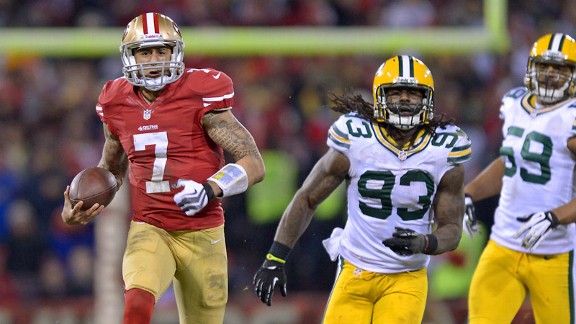
The Packers tried to stop the 49ers with predictable results.

The Packers forgot to tackle the quarterback.

It’s hard not to be amazed by the seasons that Colin Kaepernick, Robert Griffin III and Russell Wilson had as first-year starters in 2012. It’s playing around with the cut-offs to an absurd degree, but prior to 2012, only six men in NFL history had ever:

  • Averaged 7.9 yards per attempt on at least 200 passes
  • Average at least 5.0 yards per carry on at least 50 rushes

You probably wouldn’t be surprised to know that Fran Tarkenton, Steve Young, Daunte Culpepper, Michael Vick, and Aaron Rodgers were five of the players to accomplish this feat. Then, in 2012, Kaepernick, Griffin, and Wilson joined the list, as did Cam Newton.

But can you name the remaining member of the 7.9/200/5.0/50 club?

Trivia hint 1 Show


Trivia hint 2 Show


Trivia hint 3 Show


Click 'Show' for the Answer Show

{ 11 comments }

The predictive value of target data, part II

On Monday, I argued that target data has some predictive value. I wanted to update that post with a few observations.

Wide Receiver Targets

In the original post, I looked at year-to-year data for all players with at least 500 receiving yards in Year N and at least 8 games played for the same team in Years N and N+1. But it makes more sense to limit the sample to only wide receivers if we want to predict how wide receivers project in the next season.

There are 554 pairs of wide receiver seasons that meet the above criteria. [1]I have again pro-rated all seasons to sixteen games. The best fit formula to project future receptions based on prior receptions and prior targets is:

Year N+1 Receptions = 14.0 + 0.547 * Yr_N_Rec + 0.124 * Yr_N_Tar

The R^2 is 0.39, and while the receptions variable is statistically significant by any measure, the targets variable just barely qualifies (p = 0.044) as such. Still, this tells us that for every 8 additional targets a receiver sees in Year N, we can expect one more reception in Year N+1, holding his number of receptions equal.

If we want to project receiving yards instead of receptions, we get:

Year N+1 Receiving Yards = 180.3 + 0.434 * Yr_N_RecYd + 2.55 * Yr_N_Tar

The R^2 is 0.33, implying a slightly less strong relationships, which makes sense: yards are more variable to large outliers than receptions, so you would expect receiving yards to be slightly harder to predict. Another interesting note: the targets variable here is statistically significant at the p = 0.0003 level, and as expected, the receiving yards variable is statistically significant at all levels. Holding receiving yards equal, a receiver would need an additional 19 targets to increase his projected number of receiving yards by 50, so the practical effect may not be all that large.

Addressing the multicollinearity problem
[continue reading…]

References

References
1 I have again pro-rated all seasons to sixteen games.
{ 2 comments }

There have been 35 quarterbacks in NFL history to throw for at least 30,000 yards. Given enough time, you could probably guess that Drew Bledsoe, Jim Kelly, and Steve McNair are three of them. All three have something else in common: they were all born on February 14th.

If we drop the cut-off to 16,000 yards, we jump to 125 quarterbacks but get to include David Garrard, another Valentine’s Day baby. With 366 possible birthdays, it’s pretty incredible that four out of a random group of 125 people would have the same birthday. Consider that no one born on any the following seven days — January 30th, March 4th and 30th, April 9th and 13th, and June 12th and 21st — has ever gained a single passing yard in NFL history. [1]Even February 29th has a couple of representatives, led by Dick Wood and his 7,153 passing yards.

But wait, there’s more: If we drop the threshold to 3,500 passing yards, we get to include Patrick Ramsey and Anthony Wright. Those guys may not impress you, but consider that only 310 players have thrown for 3,500 yards. That means dozens of days have zero quarterbacks with 3,500 yards, so slotting in Ramsey and Wright as QB5 and QB6 on your birthday dream team is pretty damn good. February 13th, for example, has Jim Youel as its top passer, and he only collected 849 yards. Yesterday’s number two slot goes to the greatest receiver of all-time to ever play with Aaron Brooks (106 yards), outpacing Drew Henson and his 98 career yards. Clearly, passing yardage is for lovers. [2]Long-time readers will recognize that this post is a blatant ripoff of Doug’s classic Passing Yardage is for Lovers, published five years ago to the day.
[continue reading…]

References

References
1 Even February 29th has a couple of representatives, led by Dick Wood and his 7,153 passing yards.
2 Long-time readers will recognize that this post is a blatant ripoff of Doug’s classic Passing Yardage is for Lovers, published five years ago to the day.
{ 17 comments }

The History of Black Quarterbacks in the NFL

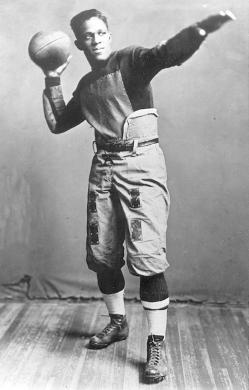
Fritz Pollard, the first African American coach and quarterback in the NFL.

Fritz Pollard, the first African American coach and quarterback in the NFL.

Five years ago, I wrote a four part series detailing the history of the black quarterback. With February being Black History Month and Super Bowl XLVII marking the 25th anniversary of Doug Williams becoming the first black quarterback to win a Super Bowl, I figured it was worth another trip down memory lane.

The history of black quarterbacks in professional football is complicated. As recently as 2007, the New York Giants had never had a black quarterback throw even a single pass. On the other hand, as far back as 1921, Frederick Douglass “Fritz” Pollard not only quarterbacked the Akron Pros, but was also the first black head coach in NFL history.  A year earlier, Pollard and Bobby Marshall were the first two black players in professional football history and helped the Pros win the championship in the NFL’s inaugural season. [1]At the time, the NFL went by the name the American Professional Football Association. It was not known as the NFL until 1922. The Pros ran the single-wing, and Pollard was the player lined up behind the center who received the snaps. At the time the forward pass was practically outlawed, so Pollard barely resembles the modern quarterback outside of the fact that he threw a few touchdown passes during his career. [2]In addition to his NFL exploits, Pollard also achieved a great deal of fame for leading Brown to back-to-back road wins over the powerhouse schools of the time, Yale and Harvard, in 1916. He would … Continue reading

According to the great Sean Lahman, at least one African American played in the NFL in every year from 1920 to 1933, although Pollard was the only quarterback. [3]It wasn’t just African Americans that had full access during this era: Jim Thorpe coached and starred in a team composed entirely of Native Americans called the Oorang Indians in 1922 and 1923. Beginning in 1934, that there was an informal ban on black athletes largely championed by Washington Redskins owner George Marshall.   It wasn’t until 1946 that black players were re-admitted to the world of professional football, when UCLA’s Kenny Washington [4]Who occupied the same backfield with the Bruins as Jackie Robinson. and Woody Strode were signed by the Los Angeles Rams; in the AAFC, Bill Willis and Marion Motley were signed by Paul Brown’s Cleveland Browns that same season.
[continue reading…]

References

References
1 At the time, the NFL went by the name the American Professional Football Association. It was not known as the NFL until 1922.
2 In addition to his NFL exploits, Pollard also achieved a great deal of fame for leading Brown to back-to-back road wins over the powerhouse schools of the time, Yale and Harvard, in 1916. He would become the first African American to be named an All-American and the prior season, he lead Brown to the Rose Bowl.
3 It wasn’t just African Americans that had full access during this era: Jim Thorpe coached and starred in a team composed entirely of Native Americans called the Oorang Indians in 1922 and 1923.
4 Who occupied the same backfield with the Bruins as Jackie Robinson.
{ 38 comments }

Analyzing the leaders in targets in 2012

Reggie Wayne led the NFL in targets last year, but that’s a little misleading since the Colts ranked 6th in pass attempts. As a percentage of team targets, Wayne ranked second in the league, but he was a distant number two to Brandon Marshall, who saw two out of every five Bears passes in 2013.

But that doesn’t make him the best receiver. It was easier for Marshall to receive a high number of targets because the rest of the Chicago supporting cast was weak, so Jay Cutler consistently looked Marshall’s way. Chicago ranked 25th last year in Adjusted Net Yards per Attempt, so essentially we have a player on a bad passing offense receiving a ton of targets. It’s not all that obvious how you compare a player like that to Roddy White, who deserves credit for being in a great passing offense but loses targets because of the presence of Julio Jones and Tony Gonzalez (of course, without them, would Matt Ryan start looking like Jay Cutler?)

I identified the leader in targets for each team, and then calculated the percentage of team targets each leading receiver had in 2012. The table below lists that percentage on the Y-Axis; the X-Axis represents the number of ANY/A that player’s team averaged. Someone like Marshall (represented by the first four letters of his last name and the first two letters of his first name, MarsBr) will therefore be high and to the left, while Randall Cobb is low and to the right:

2012 targets
[continue reading…]

{ 16 comments }

The predictive value of target data

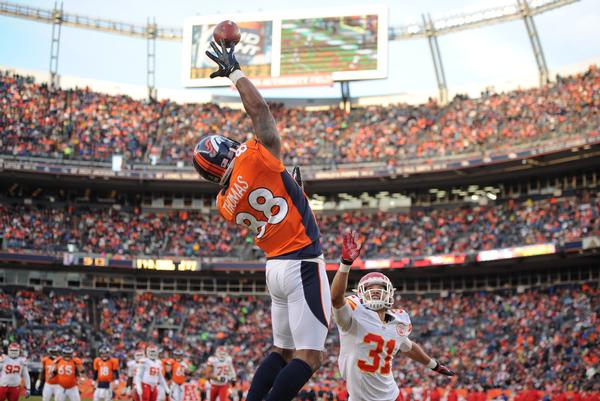
Demaryius Thomas made the most of his targets in 2012.

Demaryius Thomas made the most of his targets in 2012.

In 2007, Doug Drinen and I wrote a pair of articles discussing our views on targets. I’m working on a wide receiver project this off-season, and a complete discussion of receiving statistics includes a discussion of targets.

Let me start with the prevailing few: targets are important, and if two receivers have the same production on a different number of targets, the one who produced on fewer targets is better/more valuable. Similarly, if all else is equal, the receiver with a higher catch rate — calculated as catches/target — is the better/more valuable one.

There are some problems with the prevailing view. By placing targets in the denominator of a formula, we’re implying that targets are a bad thing, or at a minimum, an opportunity wasted. But targets aren’t like pass attempts. Pro Football Focus has a stat called yards per pass route run, and that actually is the receiver version of yards per pass attempt. [1]Unfortunately, yards per pass route run is not going to help us if we want to grade receivers on a historical basis.

But targets don’t help identify the player who deserves blame: on a random incomplete pass, assume three receivers are running routes, and one of them is targeted. Absent a drop, I have a hard time saying that of the three wide receivers, the targeted one did the worst of the three. If we grade a receiver by his yards per route run, each receiver is equally penalized with one route run on the play; if we grade a receiver by yards per target, the two wide receivers that did not get open are not penalized, while the one that was targeted is penalized. That seems fundamentally wrong to me.

Here’s another problem: In a broad sense, the player with more targets (or percentage of his team’s targets) is in a very real sense a bigger part of his team’s offense. Either he’s open more often, or the quarterback is throwing in his direction even when he’s not open (whether because the coaches call more plays for him or because he’s earned the quarterback’s trust). In any event, the target itself is an indicator of quality, and penalizing a player — which is what you do when you place targets in the denominator — for an event that is highly correlated with quality is not something I’m comfortable doing.
[continue reading…]

References

References
1 Unfortunately, yards per pass route run is not going to help us if we want to grade receivers on a historical basis.
{ 12 comments }

Trivia: Single-season Leaders in Yards per Target

San Diego’s Danario Alexander caught 37 passes for 658 yards and 7 touchdowns in 10 games last year. Those might not look like great numbers, but when Philip Rivers looked his way, Alexander tended to produce. Alexander only saw 62 targets last season, but led the league with a 10.6 yards-per-target average (minimum 50 targets). Since 2000, there have been 21 receivers to average at least 11 yards per target on 50 targets.

RankPlayerYearTmAgeGTarRecYdsY/TR/T
1200813.956.1%
2200613.859.3%
3Jordy Nelson2011GNB26169668126313.270.8%
4Mike Wallace2010PIT24169960125712.760.6%
5Malcom Floyd2011SDG3012704385612.261.4%
6Antonio Gates2010SDG301065507821276.9%
7Dennis Northcutt2002CLE2513503959111.878%
8Torry Holt2000STL241614082164311.758.6%
9Victor Cruz2011NYG251613283154511.762.9%
10James Jones2011GNB2716553863511.569.1%
11Plaxico Burress2004PIT2711613569811.457.4%
12Robert Meachem2009NOR2516644572611.370.3%
13Anthony Gonzalez2007IND2313513757611.372.5%
14Lee Evans2004BUF2316754884311.264%
15Randy Moss2000MIN231612978143811.160.5%
16Steve Smith2008CAR291412978143211.160.5%
17Santana Moss2005WAS261613484148511.162.7%
18DeSean Jackson2010PHI2414964710601149%
19Santonio Holmes2007PIT231386539421161.6%
20Greg Jennings2007GNB241384539201163.1%
21Joe Horn2006NOR341062386791161.3%

I’ve blanked out the first two rows, because the same player has recorded the two highest yards/target seasons over the last thirteen years. Can you guess who it is?
[continue reading…]

{ 10 comments }

Manhattan Bar Trivia, Football Edition

In an effort to prove that bloggers actually go to bars and to reassure you that you know more about football than your average bar patron…

I was at a bar the other night when it was revealed that it was Trivia Night. Once I heard that the first category was NFL, I decided to throw my hat into the ring. The topic was “2013 Hall of Fame candidates.” (this was before the 2013 Class was announced.)

I feel pretty confident that the average Football Perspective reader would have no trouble answer these questions, although I will admit that they struck me as slightly harder than the level of questions I would expect at a typical bar trivia night.

Question 1: Which six-time Pro Bowl running back started his career in Los Angeles and ended it in the Super Bowl?

Show


Question 2: Which eleven-time Pro Bowler played his entire career with the Baltimore Ravens?

Show
{ 2 comments }

Does pre-season strength of schedule matter?

NFL.com posted an article yesterday looking at the strength of schedule for each team in 2013. We have known each team’s opponents since the end of the regular season, and while the full schedule won’t come out until April, it’s simple to calculate a team’s strength of schedule for 2013. Usually, the media reports this by looking at the win-loss record of each opponent from the prior season. Here are the projected SOSs for each team next season:

TeamSOSOpponent record
Carolina Panthers0.543138-116-2
Detroit Lions0.539138-118-0
New Orleans Saints0.539137-117-2
St. Louis Rams0.539137-117-2
Baltimore Ravens0.535137-119-0
Green Bay Packers0.533136-119-1
Arizona Cardinals0.52131-121-4
Miami Dolphins0.52133-123-0
San Francisco 49ers0.52132-122-2
Minnesota Vikings0.516132-124-0
Seattle Seahawks0.516130-122-4
Cincinnati Bengals0.508130-126-0
Jacksonville Jaguars0.508129-125-2
New England Patriots0.508130-126-0
Atlanta Falcons0.504128-126-0
Chicago Bears0.502128-127-1
Tampa Bay Buccaneers0.5127-127-2
Washington Redskins0.498127-128-1
New York Jets0.496127-129-0
Philadelphia Eagles0.496127-129-0
Cleveland Browns0.492126-130-0
Pittsburgh Steelers0.496126-130-0
Tennessee Titans0.488124-130-2
New York Giants0.48123-133-0
Dallas Cowboys0.48121-134-1
Buffalo Bills0.473121-135-0
Houston Texans0.473120-134-2
Kansas City Chiefs0.473121-135-0
Oakland Raiders0.469120-136-0
Indianapolis Colts0.461117-137-2
San Diego Chargers0.457117-139-0
Denver Broncos0.43110-146-0

[continue reading…]

{ 9 comments }

The table below lists every retired number for each of the 32 franchises. It also lists each player’s career AV (starting in 1950), position(s), and years with the team. Each column is sortable, and you can use the search box to search by team (or uniform number, or position, or anything else); you can also change how many rows are shown by clicking on the dropdown box on the left.

FranchisePlayerNumberPosAVFirst YrLast Yr
Arizona CardinalsJ.V. Cain88TE-WR2119741977
Arizona CardinalsMarshall Goldberg99B019391948
Arizona CardinalsStan Mauldin77T019461948
Arizona CardinalsPat Tillman40DB1619982001
Arizona CardinalsLarry Wilson8DB9619601972
Atlanta FalconsWilliam Andrews31RB6819791986
Atlanta FalconsSteve Bartkowski10QB7019751985
Atlanta FalconsTommy Nobis60LB6319661976
Atlanta FalconsJeff Van Note57C-G-LB7719691986
Baltimore RavensNone
Buffalo BillsJim Kelly12QB10319861996
Carolina PanthersSam Mills51LB10019951997
Chicago BearsDick Butkus51LB9719651973
Chicago BearsWillie Galimore28HB3419571963
Chicago BearsBill George61LB-G-MG-DT13219521965
Chicago BearsRed Grange77HB-BB-DB-TB019251934
Chicago BearsGeorge Halas7E019201928
Chicago BearsBill Hewitt56E-DE019321936
Chicago BearsSid Luckman42QB-HB-DB119391950
Chicago BearsGeorge McAfee5HB-DB819401950
Chicago BearsBronko Nagurski3FB-LB-T019301943
Chicago BearsWalter Payton34RB12819751987
Chicago BearsBrian Piccolo41RB719661969
Chicago BearsGale Sayers40RB5419651971
Chicago BearsBulldog Turner66C-T-LB-G2019401952
Cincinnati BengalsBob Johnson54C5719681979
Cleveland BrownsJim Brown32FB10619571965
Cleveland BrownsDon Fleming46DB1919601962
Cleveland BrownsOtto Graham14QB-DB8419461955
Cleveland BrownsLou Groza76T-C-DT-K10019461967
Cleveland BrownsErnie Davis45RB019621962
Dallas CowboysNone
Denver BroncosJohn Elway7QB13819831998
Denver BroncosFloyd Little44RB7119671975
Detroit LionsLem Barney20DB11119671977
Detroit LionsDutch Clark7TB-DB019311938
Detroit LionsChuck Hughes85WR719701971
Detroit LionsBobby Layne22QB10719501958
Detroit LionsBarry Sanders20RB12219891998
Detroit LionsJoe Schmidt56LB11919531965
Detroit LionsBilly Sims20RB5819801984
Detroit LionsDoak Walker37HB-DB5819501955
Green Bay PackersTony Canadeo3HB-TB-FB-DB1819411952
Green Bay PackersDon Hutson14E-DB-DE019351945
Green Bay PackersRay Nitschke66LB10219581972
Green Bay PackersBart Starr15QB10019561971
Green Bay PackersReggie White92DE-DT16319931998
Houston TexansNone
Indianapolis ColtsRaymond Berry82E10219551967
Indianapolis ColtsArt Donovan70DT-T8819531961
Indianapolis ColtsPeyton Manning18QB16519982011
Indianapolis ColtsGino Marchetti89DE-T-DT12119531966
Indianapolis ColtsLenny Moore24HB-FL9619561967
Indianapolis ColtsJim Parker77T-G10219571967
Indianapolis ColtsJohnny Unitas19QB14119561972
Indianapolis ColtsBuddy Young22HB-FB-DB3019531955
Jacksonville JaguarsNone
Kansas City ChiefsBobby Bell78LB-DE10519631974
Kansas City ChiefsBuck Buchanan86DT10119631975
Kansas City ChiefsLen Dawson16QB10019621975
Kansas City ChiefsAbner Haynes28HB3619601964
Kansas City ChiefsMack Lee Hill36FB-HB1319641965
Kansas City ChiefsWillie Lanier63LB9919671977
Kansas City ChiefsJan Stenerud3K819671979
Kansas City ChiefsDerrick Thomas58LB10619891999
Kansas City ChiefsEmmitt Thomas18DB7819661978
Kansas City ChiefsStone Johnson33HB-KR019631963
Miami DolphinsLarry Csonka39RB7219681979
Miami DolphinsBob Griese12QB10519671980
Miami DolphinsDan Marino13QB14619831999
Minnesota VikingsCris Carter80WR9819902001
Minnesota VikingsJim Marshall70DE10719611979
Minnesota VikingsAlan Page88DT15719671978
Minnesota VikingsKorey Stringer77T4519952000
Minnesota VikingsFran Tarkenton10QB13919611978
Minnesota VikingsMick Tingelhoff53C10219621978
New England PatriotsBruce Armstrong78T-G8719872000
New England PatriotsGino Cappelletti20FL-SE-DB-WR-K4119601970
New England PatriotsBob Dee89DE-DT4719601967
New England PatriotsJohn Hannah73G10619731985
New England PatriotsMike Haynes40DB10919761982
New England PatriotsJim Hunt79DT-DE4719601970
New England PatriotsSteve Nelson57LB7019741987
New Orleans SaintsDoug Atkins81DE12019671969
New Orleans SaintsJim Taylor31FB7019671967
New York GiantsAl Blozis32T019421944
New York GiantsCharlie Conerly42QB7619481961
New York GiantsRay Flaherty1E-DE019281935
New York GiantsFrank Gifford16HB-FL-DB-WR8819521964
New York GiantsMel Hein7C-LB019311945
New York GiantsTuffy Leemans4FB-TB-DB-QB019361943
New York GiantsJoe Morrison40HB-FL-FB4219591972
New York GiantsPhil Simms11QB9119791993
New York GiantsKen Strong50FB-TB-HB-WB-DB-K019331947
New York GiantsLawrence Taylor56LB13919811993
New York GiantsY.A. Tittle14QB11219611964
New York JetsDennis Byrd90DT-DE1919891992
New York JetsJoe Klecko73DT-NT-DE7619771987
New York JetsCurtis Martin28RB10019982005
New York JetsDon Maynard13E-FL-HB7019601972
New York JetsJoe Namath12QB9019651976
Oakland RaidersNone
Philadelphia EaglesChuck Bednarik60LB-C13319491962
Philadelphia EaglesTom Brookshier40DB5619531961
Philadelphia EaglesJerome Brown99DT4819871991
Philadelphia EaglesBrian Dawkins20DB10119962008
Philadelphia EaglesPete Retzlaff44E-HB-TE7119561966
Philadelphia EaglesSteve Van Buren15HB1219441951
Philadelphia EaglesReggie White92DE-DT16319851992
Philadelphia EaglesAl Wistert70T-G-DT2419431951
Pittsburgh SteelersErnie Stautner70DT-DE-G11219501963
San Diego ChargersLance Alworth19FL-WR7819621970
San Diego ChargersDan Fouts14QB12219731987
San Diego ChargersJunior Seau55LB12519902002
San Francisco 49ersJohn Brodie12QB8819571973
San Francisco 49ersDwight Clark87WR6119791987
San Francisco 49ersJimmy Johnson37DB-HB10819611976
San Francisco 49ersCharlie Krueger70DT-DE7919591973
San Francisco 49ersRonnie Lott42DB11719811990
San Francisco 49ersHugh McElhenny39HB8819521960
San Francisco 49ersJoe Montana16QB12319791992
San Francisco 49ersLeo Nomellini73DT-T11619501963
San Francisco 49ersJoe Perry34FB7519481963
San Francisco 49ersJerry Rice80WR16019852000
San Francisco 49ersBob St. Clair79T8019531963
San Francisco 49ersSteve Young8QB13519871999
Seattle SeahawksFans (12th man)12
Seattle SeahawksWalter Jones71T9619972008
Seattle SeahawksCortez Kennedy96DT9719902000
Seattle SeahawksSteve Largent80WR10319761989
St. Louis RamsIsaac Bruce80WR10219942007
St. Louis RamsEric Dickerson29RB9119831987
St. Louis RamsMarshall Faulk28RB13319992005
St. Louis RamsDeacon Jones75DE11219611971
St. Louis RamsMerlin Olsen74DT13919621976
St. Louis RamsJackie Slater78T-G9319761995
St. Louis RamsBob Waterfield7QB3519451952
St. Louis RamsJack Youngblood85DE12219711984
Tampa Bay BuccaneersLee Roy Selmon63DE-DT8119761984
Tennessee TitansElvin Bethea65DE8919681983
Tennessee TitansEarl Campbell34RB6819781984
Tennessee TitansBruce Matthews74G-C-T12119832001
Tennessee TitansWarren Moon1QB11919841993
Tennessee TitansMike Munchak63G8419821993
Tennessee TitansJim Norton43DB-P4419601968
Washington RedskinsSammy Baugh33QB-TB1819371952

[continue reading…]

{ 13 comments }
Next Posts Previous Posts