
On Monday, I explained my methodology for ranking every wide receiver in football history, and yesterday, I presented a list of the best single seasons of all time. Today the career list of the top 150 wide receivers. As usual, I implemented a 100/95/90 formula, giving a player credit for 100% of his production in his best season, 95% of his value in his second-best season, 90% in his third year, and so on. The table below is fully sortable and lists the first and last year each person played wide receiver1; you can use the search feature to find the best receiver to ever play for each team (for example, typing ‘ram’ for the Rams ‘clt’ for the Colts.)
Rank | Name | Value | First | Last | Teams |
|---|---|---|---|---|---|
| 1 | Jerry Rice | 8023 | 1985 | 2004 | sfo-rai-sea |
| 2 | Don Hutson | 7839 | 1935 | 1945 | gnb |
| 3 | Marvin Harrison | 5884 | 1996 | 2008 | clt |
| 4 | Terrell Owens | 5540 | 1996 | 2010 | sfo-phi-dal-buf-cin |
| 5 | Randy Moss | 5397 | 1998 | 2012 | min-rai-nwe-oti-sfo |
| 6 | Lance Alworth | 4996 | 1962 | 1972 | sdg-dal |
| 7 | Michael Irvin | 4892 | 1988 | 1999 | dal |
| 8 | Steve Largent | 4596 | 1976 | 1989 | sea |
| 9 | Steve Smith | 4578 | 2001 | 2012 | car |
| 10 | Andre Johnson | 4535 | 2003 | 2012 | htx |
| 11 | Tim Brown | 4024 | 1988 | 2004 | rai-tam |
| 12 | Jimmy Smith | 4009 | 1995 | 2005 | jax |
| 13 | James Lofton | 3941 | 1978 | 1993 | gnb-rai-buf-ram-phi |
| 14 | Torry Holt | 3930 | 1999 | 2009 | ram-jax |
| 15 | Cris Carter | 3926 | 1987 | 2002 | phi-min-mia |
| 16 | Paul Warfield | 3895 | 1964 | 1977 | cle-mia |
| 17 | Herman Moore | 3805 | 1991 | 2001 | det |
| 18 | Rod Smith | 3681 | 1995 | 2006 | den |
| 19 | Henry Ellard | 3578 | 1983 | 1998 | ram-was-nwe |
| 20 | Bob Hayes | 3562 | 1965 | 1975 | dal-sfo |
| 21 | Chad Johnson | 3529 | 2001 | 2011 | cin-nwe |
| 22 | Hines Ward | 3509 | 1998 | 2011 | pit |
| 23 | Harold Jackson | 3499 | 1969 | 1983 | phi-ram-nwe-sea |
| 24 | Charley Taylor | 3463 | 1966 | 1977 | was |
| 25 | Cliff Branch | 3437 | 1972 | 1984 | rai |
| 26 | Isaac Bruce | 3430 | 1994 | 2009 | ram-sfo |
| 27 | Reggie Wayne | 3419 | 2001 | 2012 | clt |
| 28 | Don Maynard | 3407 | 1958 | 1973 | nyg-nyj-crd |
| 29 | Brandon Marshall | 3269 | 2006 | 2012 | den-mia-chi |
| 30 | Otis Taylor | 3199 | 1965 | 1974 | kan |
| 31 | Raymond Berry | 3185 | 1955 | 1967 | clt |
| 32 | John Stallworth | 3178 | 1974 | 1987 | pit |
| 33 | Stanley Morgan | 3173 | 1977 | 1990 | nwe-clt |
| 34 | Jim Benton | 3169 | 1938 | 1947 | ram-chi |
| 35 | Gary Clark | 3148 | 1985 | 1995 | was-crd-mia |
| 36 | Art Monk | 3141 | 1980 | 1995 | was-nyj-phi |
| 37 | Roddy White | 2991 | 2005 | 2012 | atl |
| 38 | Sterling Sharpe | 2976 | 1988 | 1994 | gnb |
| 39 | Larry Fitzgerald | 2959 | 2004 | 2012 | crd |
| 40 | Wes Welker | 2947 | 2005 | 2012 | mia-nwe |
| 41 | Andre Reed | 2913 | 1985 | 2000 | buf-was |
| 42 | Billy Wilson | 2858 | 1951 | 1960 | sfo |
| 43 | Wes Chandler | 2819 | 1978 | 1988 | nor-sdg-sfo |
| 44 | Derrick Mason | 2797 | 1997 | 2011 | oti-rav-nyj-htx |
| 45 | Elroy Hirsch | 2773 | 1948 | 1957 | cra-ram |
| 46 | Harold Carmichael | 2739 | 1972 | 1984 | phi-dal |
| 47 | John Gilliam | 2572 | 1967 | 1977 | nor-crd-min-atl |
| 48 | Anquan Boldin | 2571 | 2003 | 2012 | crd-rav |
| 49 | Billy Howton | 2549 | 1952 | 1963 | gnb-cle-dal |
| 50 | Andre Rison | 2549 | 1989 | 2000 | clt-atl-cle-gnb-jax-kan-rai |
| 51 | Joe Horn | 2547 | 1996 | 2007 | kan-nor-atl |
| 52 | Calvin Johnson | 2536 | 2007 | 2012 | det |
| 53 | Cris Collinsworth | 2531 | 1981 | 1988 | cin |
| 54 | Gene A. Washington | 2524 | 1969 | 1979 | sfo-det |
| 55 | Harlon Hill | 2461 | 1954 | 1962 | chi-pit |
| 56 | Fred Biletnikoff | 2456 | 1965 | 1978 | rai |
| 57 | Art Powell | 2442 | 1960 | 1968 | nyj-rai-buf-min |
| 58 | Buddy Dial | 2439 | 1959 | 1966 | pit-dal |
| 59 | Dante Lavelli | 2437 | 1946 | 1956 | cle |
| 60 | Del Shofner | 2433 | 1958 | 1967 | ram-nyg |
| 61 | Wesley Walker | 2428 | 1977 | 1989 | nyj |
| 62 | Mac Speedie | 2415 | 1946 | 1952 | cle |
| 63 | Hugh Taylor | 2400 | 1947 | 1954 | was |
| 64 | Tony Hill | 2319 | 1977 | 1986 | dal |
| 65 | Mark Clayton | 2296 | 1983 | 1993 | mia-gnb |
| 66 | Eric Moulds | 2293 | 1996 | 2007 | buf-htx-oti |
| 67 | Pete Pihos | 2274 | 1947 | 1955 | phi |
| 68 | Roy Green | 2253 | 1979 | 1992 | crd-phi |
| 69 | Muhsin Muhammad | 2245 | 1996 | 2009 | car-chi |
| 70 | Tommy McDonald | 2202 | 1958 | 1968 | phi-dal-ram-atl-cle |
| 71 | Tom Fears | 2176 | 1948 | 1956 | ram |
| 72 | Ken Burrough | 2126 | 1970 | 1981 | nor-oti |
| 73 | Drew Pearson | 2125 | 1973 | 1983 | dal |
| 74 | Bobby Mitchell | 2109 | 1962 | 1968 | was |
| 75 | Drew Hill | 2106 | 1979 | 1993 | ram-oti-atl |
| 76 | Nat Moore | 2102 | 1974 | 1986 | mia |
| 77 | Dwight Clark | 2084 | 1979 | 1987 | sfo |
| 78 | Mike Quick | 2062 | 1982 | 1990 | phi |
| 79 | Lynn Swann | 2053 | 1974 | 1982 | pit |
| 80 | Mel Gray | 2022 | 1971 | 1982 | crd |
| 81 | Gary Garrison | 2000 | 1966 | 1977 | sdg-oti |
| 82 | Joey Galloway | 1994 | 1995 | 2010 | sea-dal-tam-nwe-was |
| 83 | Santana Moss | 1983 | 2001 | 2012 | nyj-was |
| 84 | Anthony Miller | 1957 | 1988 | 1997 | sdg-den-dal |
| 85 | Eric Martin | 1935 | 1985 | 1994 | nor-kan |
| 86 | Mal Kutner | 1899 | 1946 | 1950 | crd |
| 87 | Roy Jefferson | 1889 | 1965 | 1976 | pit-clt-was |
| 88 | Alfred Jenkins | 1887 | 1975 | 1983 | atl |
| 89 | Steve Watson | 1862 | 1979 | 1987 | den |
| 90 | Homer Jones | 1858 | 1964 | 1970 | nyg-cle |
| 91 | Mark Duper | 1847 | 1983 | 1992 | mia |
| 92 | Keenan McCardell | 1842 | 1992 | 2007 | cle-jax-tam-sdg-was |
| 93 | John Jefferson | 1834 | 1978 | 1985 | sdg-gnb-cle |
| 94 | Plaxico Burress | 1814 | 2000 | 2012 | pit-nyg-nyj |
| 95 | Charlie Brown | 1801 | 1982 | 1987 | was-atl |
| 96 | Lionel Taylor | 1773 | 1960 | 1968 | den-oti |
| 97 | Lance Rentzel | 1742 | 1966 | 1974 | min-dal-ram |
| 98 | Laveranues Coles | 1732 | 2000 | 2009 | nyj-was-cin |
| 99 | Carl Pickens | 1721 | 1992 | 2000 | cin-oti |
| 100 | Darrell Jackson | 1717 | 2000 | 2008 | sea-sfo-den |
| 101 | Keyshawn Johnson | 1713 | 1996 | 2006 | nyj-tam-dal-car |
| 102 | Charley Hennigan | 1680 | 1960 | 1966 | oti |
| 103 | Antonio Freeman | 1678 | 1995 | 2003 | gnb-phi |
| 104 | Charlie Joiner | 1669 | 1969 | 1986 | oti-cin-sdg |
| 105 | Greg Jennings | 1660 | 2006 | 2012 | gnb |
| 106 | Sonny Randle | 1629 | 1959 | 1968 | crd-sfo-dal |
| 107 | T.J. Houshmandzadeh | 1611 | 2001 | 2011 | cin-sea-rav-rai |
| 108 | Carroll Dale | 1607 | 1963 | 1973 | ram-gnb-min |
| 109 | Gary Collins | 1606 | 1962 | 1971 | cle |
| 110 | Al Toon | 1605 | 1985 | 1992 | nyj |
| 111 | Isaac Curtis | 1591 | 1973 | 1984 | cin |
| 112 | Frank Lewis | 1565 | 1971 | 1983 | pit-buf |
| 113 | Terance Mathis | 1562 | 1990 | 2002 | nyj-atl-pit |
| 114 | Bob Chandler | 1543 | 1971 | 1981 | buf-rai |
| 115 | J.T. Smith | 1533 | 1979 | 1990 | kan-crd |
| 116 | David Boston | 1524 | 1999 | 2005 | crd-sdg-mia |
| 117 | Carlos Carson | 1486 | 1980 | 1989 | kan-phi |
| 118 | Eddie Brown | 1473 | 1985 | 1991 | cin |
| 119 | Anthony Carter | 1465 | 1985 | 1994 | min-det |
| 120 | Irving Fryar | 1426 | 1984 | 2000 | nwe-mia-phi-was |
| 121 | Max McGee | 1415 | 1954 | 1967 | gnb |
| 122 | Yancey Thigpen | 1412 | 1992 | 2000 | pit-oti |
| 123 | Rob Moore | 1400 | 1990 | 1999 | nyj-crd |
| 124 | Vincent Jackson | 1398 | 2005 | 2012 | sdg-tam |
| 125 | Donald Driver | 1371 | 1999 | 2012 | gnb |
| 126 | Louis Lipps | 1370 | 1984 | 1992 | pit-nor |
| 127 | Warren Wells | 1361 | 1964 | 1970 | det-rai |
| 128 | Marques Colston | 1354 | 2006 | 2012 | nor |
| 129 | Pat Tilley | 1346 | 1976 | 1986 | crd |
| 130 | Terry Glenn | 1346 | 1996 | 2006 | nwe-gnb-dal |
| 131 | Dwayne Bowe | 1332 | 2007 | 2012 | kan |
| 132 | Gaynell Tinsley | 1330 | 1937 | 1940 | crd |
| 133 | Gordie Soltau | 1313 | 1950 | 1958 | sfo |
| 134 | Tony Martin | 1310 | 1990 | 2001 | mia-sdg-atl |
| 135 | Reggie Rucker | 1305 | 1970 | 1981 | dal-nwe-nyg-cle |
| 136 | Jimmy Orr | 1278 | 1958 | 1970 | pit-clt |
| 137 | George Sauer | 1251 | 1965 | 1970 | nyj |
| 138 | Elbie Nickel | 1243 | 1947 | 1956 | pit |
| 139 | Cloyce Box | 1239 | 1950 | 1954 | det |
| 140 | Ed McCaffrey | 1236 | 1991 | 2003 | nyg-sfo-den |
| 141 | Dave Parks | 1230 | 1964 | 1973 | sfo-nor-oti |
| 142 | James Scott | 1224 | 1976 | 1982 | chi |
| 143 | Brett Perriman | 1217 | 1988 | 1997 | nor-det-mia-kan |
| 144 | Robert Brooks | 1200 | 1992 | 2000 | gnb-den |
| 145 | Perry Schwartz | 1184 | 1938 | 1946 | bkn-naa |
| 146 | Alyn Beals | 1179 | 1946 | 1951 | sfo |
| 147 | Sammy White | 1172 | 1976 | 1985 | min |
| 148 | Amani Toomer | 1161 | 1996 | 2008 | nyg |
| 149 | Red Phillips | 1150 | 1958 | 1967 | ram-min |
| 150 | Danny Abramowicz | 1147 | 1967 | 1974 | nor-sfo |
I have an entire post dedicated to Jimmy Smith, so I’ll leave his ranking alone for today. Let’s look at some other interesting results.
Rice vs. Huston
It’s difficult to compare Rice and Hutson, but it’s pretty obvious that they are the two greatest receivers of all time. What’s really amazing is how far ahead those two are compared to every other receiver that’s ever played.
Moss vs. Owens vs. Harrison
I was a little surprised to see that these three never finished 1-2-3 in the rankings, as it certainly seemed for a few years that they were head and shoulders above the rest of the league. In 2001, 2002, 2003, and 2005, they were the first three wide receivers selected in the average fantasy draft, and Harrison and Moss were the first two receivers off the board in 2000 and 2004, too. 2 Here is a look at the production of each player from 1996 to 2010; Harrison is in blue and white, Moss in purple and yellow, and Owens in red and gold.
Harrison had the longest sustained period of success: he was just outstanding from ’99 to ’06. On the other hand, he didn’t contribute much outside of those years. That’s why Harrison ranks “only” 6th in receiving yards, behind players like Tim Brown and Isaac Bruce. But among retired players, Harrison ranks 2nd in career receiving yards per game (Torry Holt), while Bruce is 12th (and Brown is way down the list due to some real junk years).
Moss had that three-year stretch during the middle of his career — an injury-plagued final year in Minnesota before his two seasons in Oakland — that really hurt his career numbers. Owens is a bit up and down, but antics aside, he was an outstanding receiver. It’s hard to really separate these three in my mind, and many will point to the quarterbacks when looking for ways to separate the trio.
When I broke the numbers down last summer, I found that Harrison had 87% of his yards from Peyton Manning and 8% from Jim Harbaugh, Moss had 38% from Daunte Culpepper, 19% from Tom Brady, 10% from Randall Cunningham, and 7% each from Kerry Collins, Jeff George, and Matt Cassel. Owens had the most eclectic group, with 34% from Jeff Garcia, 20% from Tony Romo, 15% from Steve Young, 12% from Donovan McNabb and 6% from Carson Palmer. All three should be in the Hall of Fame soon, with Harrison up for induction first. He’s actually eligible in the next class, but as we’ve seen, wide receivers often have to wait their turn to get to Canton.
Steve Smith and Andre Johnson lead active wide receivers
As with Jimmy Smith, I’ve got a Steve Smith rant coming for another day, but let’s just say this system validates his standing in my mind as the most under-appreciated receiver of his time. I was very surprised to see Andre Johnson come in at #10, but he’s had a pretty flawless career so far. His 2008 and 2009 seasons were top-80 seasons of all time, playing for a pass-happy Houston team that couldn’t stop anyone. And his production in 2007 was even better — he averaged 4.23 ACY/TmAtt, a career best — albeit he was limited to nine games. Then just when it seemed like Johnson might be entering the decline phase of his career, he came through with a dominant 2012 season. Johnson and Calvin Johnson are the only players to average over 80 receiving yards per game for their careers, although that will change for both players as they age. Perhaps more relevant: only Jerry Rice and Lance Alworth averaged more receiving yards per game through their first ten seasons.
Placing Paul Warfield in proper context
Mike Tanier recently wrote the following about Warfield:
Criticizing Warfield in any way is about the worst thing a football historian can ever do. I once compared a more contemporary receiver – it may have been Michael Irvin – on a message board devoted to pro football history, and was promptly pummeled into submission with a barrage of pish-poshes. No one can ever be compared to Paul Warfield. It should be noted that this particular site was the stomping ground for some spectacularly anti-stat thinkers, so Warfield was a patron saint to them: the receiver too amazing to do anything banal like catch passes.
Tanier’s correct: Warfield’s numbers underwhelm at first glance. He never led the league in receiving yards, finishied in the top five only twice, and finished in the top ten only four times (with three of those coming in the pre-merger era). But I take some pride in noting that Warfield ranks 16th in this system, impressive for a player who ranks 68th in career receiving yards and 164th career receptions. This system takes into account what everyone knows: Warfield played for a very run-heavy team in the worst passing era of the last 60 years. Warfield was the league’s best receiver in ’68 with the Browns and in ’71 with the Dolphins. He averaged 4.50 ACY/team attempt in 1971, which would be outstanding in today’s game.
Tim Brown vs. Cris Carter vs. Andre Reed
The logjam has been broken, of course, but this was the classic Hall of Fame debate for several years. My system has Brown slightly ahead of Carter, but places Reed as a distant third. I wrote a lengthy piece advocating for the same order a little over three years ago.
Anything but another Steeler in Canton
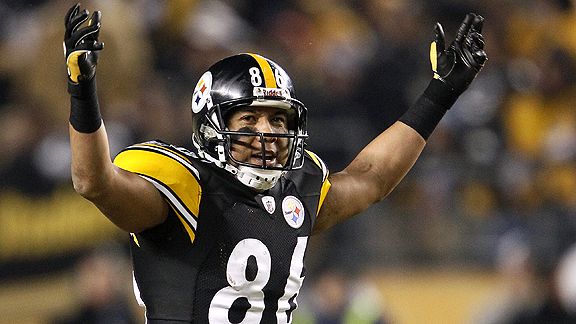
One side effect to an otherwise very enjoyable project of mine is the fact that Hines Ward comes across as a Hall of Fame-caliber player. All kidding aside, it does seem like Ward has a compelling HOF case. In addition to being the best blocker at any position ever and having won two Super Bowls and a Super Bowl MVP, Ward’s regular-season stats make him a top-25 career receiver. That’s largely because Ward played for very run-heavy teams, and this system (appropriately) credits him for putting up strong numbers on teams that rarely (for their era) passed. Considering the Steelers already have one Hall of Fame wide receiver and a second receiver also in the Hall of Fame, I don’t think anyone outside of Steelers Nation is particularly looking forward to the debates surrounding Ward once he’s eligible for the Hall. But they’re coming. Ward’s best year was a 4th-place ranking among wide receivers in 2002, but he also finished 6th, 8th, 9th, 12th, 14th, 15th, 19th, and 20th in other seasons.Wes Welker will drive Hall of Fame voters nuts
Welker has topped the 110-catch mark five times in his career, and no other player has done it more than twice. Welker has 672 receptions over the last six years, the most by any player in football history in a six-year period. But because the Patriots pass a ton and Welker’s yardage and touchdown totals are less impressive, he doesn’t stand out as great in this system (at least, yet). And that’s before you start with the Tom Brady adjustment. If Welker stays in New England, he may have a chance to finish with Hall of Fame numbers by any standard, but if switches teams this off-season, it’s hard to imagine him padding his resume that significantly. But if Hall of Fame voters look at the raw reception totals, Welker will be tough to keep out.
What stands out to you on the career list?
- Note that I have excluded seasons where a wide receiver played running back or tight end. This is generally not a big deal, but does hurt someone like Lenny Moore. [↩]
- In 2000, Isaac Bruce was WR3, and in 2004, Torry Holt was WR3 while Owens was WR4. [↩]


{ 51 comments… read them below or add one }
That site Tanier alluded to must have been PFRA. I wonder what his handle was there. I suppose it could have been at the old board. Everything before the November 2007 update is gone. Maybe his Warfield-Irvin post was from back then.
Yeah, that wasn’t particularly thinly veiled. And his recollection jives about 100% with how I would expect it to go down.
My comment of last night was written while I was half asleep. Now I do remember Mike Tanier posting at that forum. I remember him mentioning his PFRA experience on the Football Outsiders board.
On twitter, someone said they thought because of Alworth’s great six-year run from ’63 to ’68, they thought he’d rank in the top five. I’ll note that even without an AFL adjustment he’d still be a hair behind Moss, but it’s mostly because he didn’t have as sustained a peak period. If we look at the best six years for each receiver (not necessarily consecutive) and remove all War/AFL/AAFC adjustments (but still pro-rate to 16-game seasons), here are the top 20 receivers:
I would really like to know how different the game was in Hutson’s time. Was watching a Packers game unlike any other team in the NFL?
Jim Benton was the 2nd-best receiver on this list whose career overlapped Hutson’s at all. And he had less than 50% of Hutson’s “value”. Then third place is Gaynell Tinsley and he was less than 50% of Benton.
It’s just incomprehensible to see a player with that much black ink http://www.pro-football-reference.com/players/H/HutsDo00.htm in any sport in modern times.
Does anybody know of any good books about pre-war NFL history? I think it would be especially interesting to read a book that was written in the 50′s or 60′s (or even 40′s) – as opposed to more modern book that has the perspective of modern football.
The PFRA guys recommend this, although it was written in the ’80s.
http://www.amazon.com/What-Game-They-Played-Football/dp/0060153555
Thanks Chase. Like I said, Alworth was just so, so good that any ranking system that places a premium on peak is always going to have him at or near the top. That run was just sick. If he’d retired rather than gone to Dallas, I don’t know if anyone would touch that career ypg mark.
Don Hutson is a very interesting guy when it comes time to rank the receivers. He’s basically the football equivalent of Babe Ruth- era-adjusting his numbers just breaks the system because he was playing a modern game back while everyone else was still stuck in the past. Otto Graham is another guy like that- if you adjust his numbers for his era he looks like the greatest QB of all time, but that’s because he was really just the first player of the new era. If you want to compare him to his peers, you have to realize that his peers were not his contemporaries, but those who followed after, who imitated his innovations and applied them to their own game.
I think there are far too many questions about Hutson’s numbers to say he’s as good as they say he was. Obviously there was the war, but beyond that, he was playing in a segregated league against a bunch of part-timers, in an era where college football was king, and he was literally the only guy around who was actually running routes. On the other hand, you have to credit him for his impact on the game, and his role in ushering the passing era. It’s similar to Don Coryell- his coaching résumé doesn’t really stand out, but his impact on the game secures him his place among the all-time greats.
All your points are valid. It probably makes more sense to separate NFL history into pre- and post-1950, but if you want to talk about the “best wide receivers of all time” then you have to talk about Hutson. And I don’t see where you slot him if it’s not at 1 or 2.
Absolutely agreed. I’m just saying, when you’re looking strictly at his production on the field, and considering all the relevant context, I don’t know if his raw numbers are enough to get him there. Considering his historical contributions easily pushes him over the top. When I’ve brought up Hutson in the past and people have tried to talk about all the mitigating factors surrounding his numbers, I usually just respond with “I don’t care, he basically invented the position” and end it at that rather than mounting a spirited defense of his production (which is prodigious even if you compare him to the guys that followed him rather than his contemporaries- his TD record stood until the ’80s).
I would go even further and have pre/post 1975ish (I don’t have an exact cutoff). I consider the late 1960s early 1970s the transition to the modern game in terms of talent in the NFL.
I just found this video on NFL.com. For some reason it is title Don Hutson, but I don’t think Hutson is in the video. (Or maybe that’s him wearing #2.) http://www.nfl.com/videos/nfl-videos/09000d5d825e0b49/Vault-Keeper-Don-Hutson
That video implies that in order to tackle somebody you have to tackle them and land on them. #2 is tripped up by a defender at one point and falls to the ground. Today, that player would be down. But #2 gets up again and keeps running.
How can we really compare what Hutson was doing to what Marvin Harrison was doing?
Hutson’s production peaked in 41 and 42, before the draft really bit into the talent, so though he might be said to have benefitted from the war years he also produced before them (and after). Like most guys of the time, he probably would have had a longer career if he hadnt had to worry about making his post-living…
The segregation issue is a difficult one. Football wasnt completely segregated at the college level, and there were black teams & leagues playing semipro (and in the PCFL, from which the NFL integrated) but baseball was by far the sport of choice, and the Negro Leagues were a viable alternative. It wasnt like there was a huge ready pool of players waiting to upgrade the game the way baseball might have been. I’m not sure how much of an adjustment one would have to make.
Youre right about Hutson’s being a pioneer, but he also could play. He had 30 interceptions in the 7 seasons they kept records of it.
No doubt Hutson benefited from segregation, but there were also some issues he had to deal with — like a very unfriendly passing environment. I wouldn’t put him above Rice, but I do think he has to go ahead of the Harrison/Moss/Owens crew.
I’m impressed with what Chase’s system does with the AFL receivers. Alworth is obviously number one, and Otis Taylor was my number 2, but Don Maynard (who made the ‘official’ 1960-69 all-AFL team, ranks just ahead of Taylor. I usually figured Lionel Taylor as my third, but like Charley Hennigan and a few others, his production dropped as the AFL got stronger, whereas Maynard’s continued. It’s one of those small things that says the system’s on the right track. I’m also a little surprised the system adjusts so much for Hines Ward–I perceived the Steelers as a pass first team from about Ben’s third season or so…but that’s just subjective viewing.
Thanks. I’m a bit biased, but I think Maynard was outstanding, and actually expected him to rank a little higher in this system. Also love Otis Taylor. Hennigan is a bit like a Warren Wells (minus the reason for the shortened peak), in that they had some outstanding years. In Wells’ case, it came when the AFL was at its strongest, although Hennigan’s raw numbers were better.
Any system that ranks Steve Smith in the top ten is a system worth a serious look. He is definitely in the top ten of WRs I saw play (covers 1984 to present) and he might even make my top five if I took some time to come up with an order.
Thanks JWL. I’m such a huge Smith fan that I sometimes think I’m the only one who loves him. I suspect most people would find Smith’s high ranking as a knock on this system, but obviously I don’t.
Steve Smith remains to this very day the only guy I have ever seen a team decide to triple cover, not as an occasional option on high-leverage downs, but as a key component of the gameplan for an entire game. And it was the right decision! In the 2005 playoffs, with Smiff coming off a rare receiving triple crown season, Chicago (the league’s best passing defense by a significant margin, according to DVOA) tried to stop Smiff with a mostly straight gameplan with occasional double coverage, and Smiff torched them for 244 yards and 2 scores. The next week, Seattle came up with a “kitchen sink” defense, shut Steve Smith down, and bet that even with the rest of Carolina playing 9-on-8, they couldn’t get anything going. And it got them to the SB, because Steve Smith was the only guy in that entire offense who was any good at all.
Yes, I remember that 2005 postseason well. Smith was playing at Jerry Rice levels.
I think the system underrates receiving TDs. A TD requires a WR to either beat player(s) deep for a long TD or beat player(s) in a very confined space for a short TD. I think guys like Steve Smith, Andre Johnson, and Jimmy Smith *might* have a bit of a productivity drop when the field shortens. Without fighting PFR’s TD finder (which is buggy) I can’t really confirm this but I would bet that those top guys are fairly similar on a TD > 10 yards/reception. However, the Smith^2 and AJ don’t catch many TDs 10 yards or less.
Great work Chase…My browser is only showing the Top 150…any chance the table needs tweaked to show 151-200, or is it just my computer?
My fault — should only show the top 150. Sometimes I write these posts well in advance of crunching the numbers. Once I totaled the results, I realized going past 150 didn’t seem to add much value and would just further drag the loading time down.
What’s the rationale for the declining value of seasons? A good tenth best season is as valuable to a team as a good second best season. It would seem to punish a receiver who was good for a long time. Rice’s 10th best season is probably pretty decent
There’s always a trade-off involved when looking at peak vs. value. When Doug created version 1 of his AV system, it had Bruce Smith quite a bit ahead of Anthony Munoz. But when he asked people in the Footballguys Shark Pool (the name of the message board) which player they thought was better, most said Munoz. Here is Doug’s response:
So when Doug revised his career AV list, here is what he wrote:
Now I won’t argue with you if you said Doug pulled those numbers from thin air, and I’m doing the same. But I think it does strike the balance I desire between rewarding high peak guys and also rewarding players who were great for awhile. I don’t think Jerry Rice is underrated by this system. But someone like Lance Alworth would probably drop quite a bit (I’m guessing, I haven’t run the numbers) without it. Sterling Sharpe is #38 on here, and some would argue that’s already too low. Conversely, a player like Hines Ward would be even higher without the adjustment.
One last Alworth note and then I’m done. Has any player generated a more bizarre list of similarity scores on PFR? Alworth’s final career similarity scores don’t feature a single Hall of Famer (he’s the only HoF I’ve seen for which that is true). They do, however, feature Keyshawn Johnson, whose career high ypr average was 14.3. They also feature Anthony Miller, Donald Driver, Billy Wilson, Eric Martin, and Andre Rison. Basically, his best career comps are 7 mediocre-to-good possession WRs. Would anyone ever describe Lance Alworth to an 18 year old by saying “well, he was basically just a better version of Donald Driver, or a faster Keyshawn Martin”?
Three of the comps are decent stylistic fits (Drew Pearson, Gene A. Washington, and Plaxico Burress), but I would have figured more of the old bombs-away AFL guys would be showing up on his comps list. Someone like a Hennigan or a Maynard. I do like the Plax comp, though- he’s sort of like a very, very, very, very rich man’s Plaxico Burress.
The fine print on similarity scores:
Sweet. Cris Carter is the best Dolphins receiver ever!!
Steve Largent is one of the best two Seahawks receivers ever!
At least Rice broke 100 yards in his season there.
Again, not trying to hassle your work. Just poking fun at the ridiculousness of so many “hanging on” seasons. Didn’t Doug do a fun post about that one time – a list of guys who played a last forgettable season with another team?
No worries, Richie. I can’t recall if Jason or Doug (or neither of them) did that, but I know Football Outsiders is planning on doing something like this summer.
On the other hand, I guess there were plenty of times that a player could have been considered “hanging on” but played well instead.
Such as Randy Moss with the Patriots.
Maybe even Jerry Rice with the Raiders.
Jim Plunkett with the Raiders.
Peyton Manning with the Broncos.
but I digress.
Definitely Rice with the Raiders. At the age of 40 he put up a probowl season with 90+ receptions for 1200+ yards. The grand total of all other WRs in NFL history in terms of receptions and yards at the age of 40… zero.
I don’t recall the details of Rice’s departure from San Francisco. Was the consensus that he just didn’t have anything left, or was he cut for cap purposes?
Primarily cap space and the fact they had Terrell Owens. He still had something left – but he obviously wasn’t as much of an impact player as he was earlier in his career.
Steve Largent is the second best player to wear #80 for the Seahawks.
One more Alworth note: it’s so hard to think of truly comparable receivers because his talents were unique. Looking at the limited film of Hutson, he’s kind of a cross between Alworth and Berry. Hirsch might be the closest (and like Hirsch, Alworth was a halfback in college). He’s kind of a more explosive Warfield.
Chase, did u factor in schedule adjustments, like your rankings at pfr, blog post 1486?
this would greatly change hennigan, l taylor, hutson, fears, clayton, powell, and maynard downward
and dowler, mcgee, dial, dale, warfield, flatley, and n moore upward.
Thanks
I did not Ryan. Agree that it would help. My goal for now is to get comfortable with a set of rankings (or two or three) and then tweak later. SOS-adjustments can be a huge headache, so I’ve punted on that for now.
http://www.pro-football-reference.com/blog/?p=1486
Regarding the comments about Hines Ward being an excellent blocker, this should strongly aid his case.
Art Monk is underrated due to his usage patterns, referencing your comments from the pfr blog, in comparison with the other receivers mentioned above:
http://www.pro-football-reference.com/blog/?p=1888
I was very surprsed to see Bob Hayes at # 20. While he was one of my favorite players growing up, he really only had 6 very good to great seasons. Perhaps that was enough. I know he had a great YPC, total # TD’s and ratio of TD’s to # of catches.
I am hugely surprised at the rankings of the active receivers. I would not have been able to guess that Larry Fitzgerald was seventh. If I took the time to think about it, yeah, I would have realized that Reggie Wayne and Randy Moss ad to be ahead of him and that Andre Johnson was, too. Steve Smith, Brandon Marshall and Roddy White? Those surprised me a lot. For someone who is basically a consensus pick for top two or three WR every year, he’s getting beat by a lot of his contemporaries. I suppose the only way to reconcile these two views of his ability is to look at his QBs. Only so much a guy can do when the person throwing the ball is terrible at it.
Remember that this measurement essentially divides individual production by team production, meaning it penalizes receivers who shared the field with another legitimately great receiver. Larry spent the most productive part of his career sharing the field with Anquan Boldin, who is himself a top 50 receiver by this metric. The only other one of the six ahead of Fitz who lined up across from a legitimately great receiver was Reggie Wayne… and Wayne’s career was both three years longer and almost entirely spent catching balls from arguably the greatest QB to ever play. Other than that… Smiff spent a year or two with a solid Muhsin Muhammad, Roddy has played the last two years with an on-the-rise Julio Jones, Moss spent a couple years with Wes Welker, and the best WR Marshall or Andre ever played with is… who, Kevin Walter? Brian Hartline? A year of pre-implosion Javon Walker? Actually, the most productive pass catcher hurting either of their numbers was probably TE Owen Daniels, with a career high of 70 receptions for 860 yards.
You’d expect a metric like this to really hammer a guy like Fitz, who is one of the few great WRs who spent a large percentage of his career with both bad QB play and phenomenal WR play, doubly limiting his production per team pass attempt.
Kibbles is correct — I actually highlighted Fitzgerald at the end of post 1 on this topic: http://www.footballperspective.com/the-greatest-wide-receivers-ever-version-2-0-part-i-methodology/
That said, Reggie Wayne was 34 in 2002, Randy Moss was 35, Andre Johnson was 31, Steve Smith 33, and Roddy White 31. Only Marshall (28) was under 30 like Fitzgerald (29).
Holy comments explosion batman!
Broncos nerdiness: Surprising to me that Steve Watson comes in ahead of Lionel Taylor in the Broncos list. Taylor lead the league (AFL?) 5 out of 6 years with the Broncos.
Would Hutson rank above Rice if Rice retired a niner?
When a reciever is below the baseline does he get a 0 or does he actually get negative value?
There is an AFL adjustment, which downgrades a player like Taylor. Taylor ranked 2nd, 4th, 7th, 3rd, 9th, and 3rd in the first six years of the AFL, but that was it (and his 9th place ranking earns him a 0).
Yes, Rice didn’t beat Hutson by much. He was at 7782 before Oakland.
He gets a 0.
Kibbles, agreed on BMarshall/AJohnson…yikes, Eddie Royal in 2008 91/980/5 and Kevin Walter in 2008 60/899/8…both had Jabar Gaffney! Moss 1998-2000 was with a still highly productive Cris Carter. Roddy White has had the last 4 years with a good but not great Tony Gonzalez.
I’ve got to say, I’m glad to see someone who isn’t an obvious Panthers fan who appreciates Steve Smith. People seem put-off by his attitude, but there has not been a tougher football player over his career than him and, unlike many loudmouths, he puts his money where his mouth is. I remember one game where he broke his arm while catching a pass near the end zone, managed to hold on to the ball and score and then walk off. THAT takes toughness. And then of course you have his incredible vertical leap, size disadvantage, speed, and incredible route-running ability. The main reason he hasn’t had 1,500 yards every year is that he’s never been in a pass-happy system – the year he won the triple crown was a year where the Panthers rushed more than half the time despite averaging only 3-4 yards a carry, and the year he got 1,400 yards over over 14 games was one where the Panthers had 2,200+ rushing yards. If he was on, say, the Patriots or Packers he’d be easily over 15,000 yards or even 17,5000 yards at this point in his career.
{ 3 trackbacks }