≡ Menu

From the gut: My thoughts on NFC teams

It’s April, so most of these points will probably look silly in 9 months, but the NFC should be the class of the NFL in 2013. I think you can make a convincing case for practically every team in the NFC as a possible playoff contender, which means a lot of coaches in that conference are going to be wondering what went wrong by December. Here’s my quick thoughts on each team:

San Francisco 49ers – returning NFC Champions lost Dashon Goldson, Isaac Sopoaga, and Delanie Walker, but added Anquan Boldin, Nnamdi Asomugha, Glenn Dorsey, and Phil Dawson. With Colin Kaepernick entering his second season as starter and a roster full of first round talent, it’s hard to imagine anything shy of another double-digit win season and a Super Bowl run for the 49ers. And they have 13 picks in April’s draft. I still see them as having a chance to become this generation’s version of the Lombardi Packers.

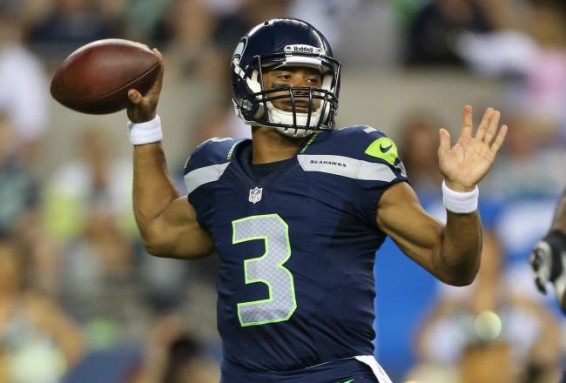
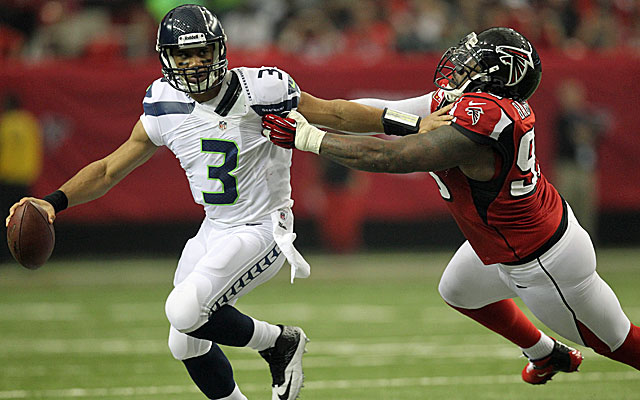
Wilson's arms are too short to stiff-arm opponents.

Wilson's arms are too short to stiff-arm opponents.

Seattle Seahawks – maybe the best team in the NFL by the end of last year, the Seahawks solved their two biggest problems in the first week of free agency. The Percy Harvin trade adds another dimension to one of the toughest offenses in the NFL to stop, while signing Cliff Avril and Michael Bennett significantly improves the pass rush. Seattle could challenge for the league lead in sacks. Having Bruce Irvin, Avril, and Bennett on the field on third downs — especially at CenturyLink Field — will be a nightmare for opposing offenses.

St. Louis Rams – the Rams went 4-1-1 in the division last year and Jeff Fisher did a fantastic job turning the culture around. There were some significant losses in the offseason — Steven Jackson, Danny Amendola, Bradley Fletcher and Brandon Gibson — but the two biggest moves were paying for Jake Long and Jared Cook. St. Louis has the 16th, 22nd, and 46th picks in the draft, so they should be better in a month. They have a brutal division, but it’s clear that they’re moving in the right direction. You could argue that three of the five best coaches in the NFL are in the NFC West, and that doesn’t include the reigning Coach of the Year.
[continue reading…]

{ 2 comments }

More division wins than non-division wins

The Rams finished with the best division record in the NFC West last year at 4-1-1, but St. Louis went only 3-7 in games against non-NFC West opponents. The Jaguars were 0-10 in non-division games last season, but beat both the Colts and Titans to finish 2-4 against the AFC South. Since the merger, three teams have won six more games against division rivals than against non-division opponents. Two of those teams did so in 1998, when the Cowboys went 10-6 thanks to a 8-0 record against the NFC East and a 2-6 mark against the rest of the league (in the playoffs that year, Dallas lost to an NFC East team, a choke that was presumably not Tony Romo’s fault). Over in the AFC, the Titans finished 7-1 against the AFC Central and 1-7 against the rest of the NFL. Technically, the ’82 Dolphins went 7-1 against the AFC East and 0-1 against Tampa Bay during the strike-shortened season, so they fit the criteria, too.

In the new eight-division, four-teams-per-division format, each team plays six games against division opponents and 10 games against non-division opponents. The table below shows all teams since 2002 that won more at least 1.5 more games against division rivals than non-division opponents:
[continue reading…]

{ 0 comments }

Yet another draft value chart

Last November, I provided an updated version of my own draft value chart where I measured the value provided by each draft pick to his Approximate Value over the course of his first five years. A week later I decided another change was needed. While AV measures the value provided by a player, the marginal value provided by a player is a better measure of the value of a draft pick. As a result, I re-did the chart and only gave players credit for their AV above 2 points of AV.

You can view the values for both of those charts and the Jimmy Johnson chart here. This week, I spoke with Peter Keating of ESPN the Magazine, who is working on an article regarding how teams should value draft picks. Keating asked if I could make two changes to the chart, and I was happy to do so (and thought you guys might be interested). First, I increased the measure of replacement-level AV from 2 to 3 points. Theoretically, this change would reward the best players, as the higher the value used for replacement level, the fewer players that will meet that threshold. The other change was to reduce the number of years measured from five to four, since that matches the length of the typical rookie contract under the new CBA. The chart below shows the raw data and a smoothed curve depicting the marginal AV (over 3) produced by draft picks in the first four years of their career over a 28-year period.
[continue reading…]

{ 8 comments }

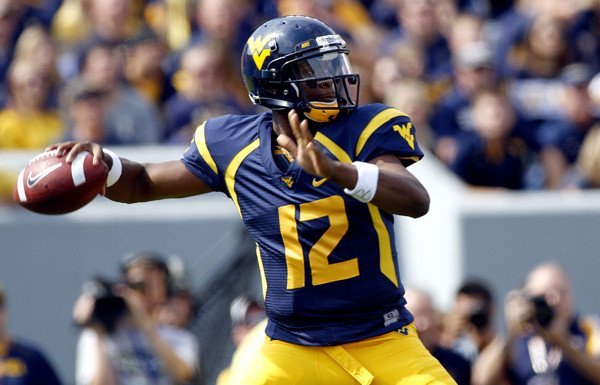
Quarterbacks wearing #12 have won 14 Super Bowls

Quarterbacks wearing #12 have won 14 Super Bowls.

What does it mean that Geno Smith comes from a long line of Mike Leach/Dana Holgorsen star quarterbacks? I don’t know. At a minimum, it means he’s part of a very interesting and distinguished set of college quarterbacks. Because few players have dominated college football over the last 15 years like quarterbacks under Mike Leach and Dana Holgorsen.

Leach is one of the most fascinating characters in recent college football history, and he’s been one of the most influential coaches in the modern passing game. That’s what tends to happen when your quarterbacks produce video game numbers practically every season. Leach was the offensive coordinator under Hal Mumme at Kentucky in 1997 and 1998, which is when the Air Raid offense arrived on the national radar. At the time, there hadn’t been any Wildcats drafted in the first round since running back George Adams in 1985. Twenty-six months after Leach and Mumme arrived in Lexington, Tim Couch was the first pick in the NFL draft.

Leach then spent a year as the offensive coordinator for the Oklahoma Sooners with Josh Heupel at quarterback. Heupel led the conference with 3,460 passing yards and 30 touchdowns, and also sported the highest completion percentage (62.0%) in the conference. Those were big numbers in a conference where only four players threw for even 1900 yards, and was enough to land Leach the head coaching job at Texas Tech after only a season in Norman. When Leach moved to Lubbock, Texas in 2000, the quarterback cupboard appeared bare. He took unheralded sophomore quarterback Kliff Kingsbury and shaped him into the player that led the NCAA in pass attempts in 2000, 2001, and 2002. Klingsbury led the Big 12 in passing yards in both 2000 and 2001, and then as a senior, became just the third player in college football history to pass for 5,000 yards in a season (after Ty Detmer and David Klingler). Klingsbury went on to have an unremarkable career in the NFL before excelling as an assistant coach with the Houston Cougars. He followed then-head coach Mike Sumlin to Texas A&M after the 2011 season, and after turning Johnny Manziel into a Heisman Trophy winner, Kingsbury is now the new head coach at his alma mater.
[continue reading…]

{ 4 comments }

Is Arian Foster declining?

[House-keeping note: I’ve added the Salary Cap Calculator to the gray header tabs at the top of each page, so you can now easily get there no matter what page you’re on at Football Perspective.]

A quick look at Arian Foster‘s statistics over the last three years paints a picture of a player in decline:

Year G Rsh RshYd RTD YPC YPG C/G Rec RecYd YPR TD YScm RRTD
2010*+ 16 327 1616 16 4.9 101.0 20.4 66 604 9.2 2 2220 18
2011* 13 278 1224 10 4.4 94.2 21.4 53 617 11.6 2 1841 12
2012* 16 351 1424 15 4.1 89.0 21.9 40 217 5.4 2 1641 17


Foster’s declined in rushing yards per game and yards per carry over the last two years, while his value in the receiving game fell off a cliff in 2012. One could reasonably conclude that Foster simply isn’t the same player he used to be, and that he could drop off even more in 2013.  But while the traditional statistics tell one story, what do the advanced metrics say?
[continue reading…]

{ 20 comments }

How much money *should* Tom Brady be paid? What are the appropriate cap figures for Tony Romo and Darrelle Revis? This series looks to derive the appropriate salary cap value for each player in the NFL.

Let’s start with the basics, which will include many generalities and rough estimates. I have chosen to ignore all players who are in the first three years of their rookie contracts; while we could try to determine the “fair market” cap values for Andrew Luck, Robert Griffin III and J.J. Watt, that would be nothing more than an academic exercise because their 2013 salary cap figures are set in stone. Instead, my goal is to determine the appropriate salary cap values for NFL Veterans (in this post, “Veterans” means all players with at least three prior years of NFL experience).

Note that ALL of the numbers in this post can be manipulated by each user thanks to the Salary Cap Calculator below. Your opinions regarding my assumptions should not interfere with your use of the salary cap calculator.

The salary cap in 2013 is $123.9M, but because players on injured reserve count against the cap, a buffer is needed to sign healthy players during the season. On average, each team will have placed on their roster 64 different players. Some of those players will be signed during the year and may only be on the team for a few weeks, so they won’t cost a significant percentage of the cap. On the other hand, a couple of players are usually on IR before the season even starts. Let’s assume that teams should spend 96% of their cap dollars on the healthy 53 players on their week 1 roster. The next step is figuring out how many of those salary cap dollars will go to non-Veterans.
[continue reading…]

{ 17 comments }

On Thursday, I looked at the increase in pick sixes per interception in the NFL. Brian Fremeau asked if that was also going on at the college level, so let’s take a look.

In 2012, there were 159 pick sixes according to cfbstats.com, matching the number provided at Sports-Reference.com. That’s right in line with previous numbers. The table below shows the number of pass attempts, interceptions, and pick sixes in major college football games since 2006, courtesy of cfbstats.com.

YearPick 6INTAttINT RatePick 6 Rt
20121591532545452.8%10.4%
20111591490513392.9%10.7%
20101591589497763.2%10%
20091581537498723.1%10.3%
20081621606498283.2%10.1%
20071671711529933.2%9.8%
20061631569460113.4%10.4%

It’s pretty interesting that the interception rates in college and the NFL are nearly identical. The interception rate in the NFL was 3.1% in 2007 and 2.9% in 2011, just about what it was in college football in those years. And with the exception of the crazy-high Pick Six rate in the NFL in 2012, both leagues see about 10% of all interceptions returned for touchdowns. Unfortunately, I don’t have the data to see if the Pick 6 rate was 5% in the ’50s in college football like it was in the NFL. But my guess is the trend would hold and that there’s an inverse relationship between interception rate and pick six rate.

{ 2 comments }

Yesterday, I asked how many wins a team full of recent draft picks and replacement-level NFL players would fare. I don’t think there’s a right answer to the question, but it might be a more important question than you think (and you’ll see why on Monday). But I have at least one way we can try to estimate how many games such a team would win.

Neil once explained how you can project a team’s probability of winning a game based on the Vegas pre-game spread. We can use the SRS to estimate a point spread, and if we know the SRS of our Replacement Team, we can then figure out how many projected wins such a team would have. How do we do that?

First, we need to come up with a mythical schedule. I calculated the average SRS rating (after adjusting for home field) of the best, second best, third best… and sixteenth best opponents for each team in the NFL from 2004 to 2011. The table below shows the “average” schedule for an average team:

[continue reading…]

{ 11 comments }

It’s been awhile, but time for another post in the Thought Experiments category. Assume the following:

  • On May 1st, 2013, an average owner, average general manager and average coach are assigned an expansion team. They are randomly assigned 24 players: one from each of the seven rounds of the 2011, 2012, and 2013 drafts. So this expansion team has a 1-in-32 shot at getting Cam Newton from the 2011 first round and a 1-in-32 chance of getting Green Bay offensive lineman Derek Sherrod.  There’s a 1-in-32 chance the sixth round pick from the 2012 draft lands on the Alfred Morris pocket, but more likely than not Lady Luck will give them a generic sixth rounder. As for the final three players, the team is randomly assigned from each draft class one of the X number of undrafted players that ended up making an opening day roster that year. So while it is technically possible this team could get someone like Vontaze Burfict, it’s much more likely to be a Junior Hemingway, David Douglas or Martell Webb. Finally, assume in this magical world that while random, the 24 picks work out in this team’s favor as far as spreading the roster: they don’t end up with 6 quarterbacks and zero defensive lineman, and instead things are magically balanced.
  • On May 2nd, this team is able to poach anyone on any roster provided that such player is making the veterans minimum. The team can also sign players currently not on any roster, but it must be of the veterans minimum variety. The team can sign anywhere from 29 to 50 of these minimum players, with the spread based on how many of the 24 players from above the team decides to roster (and they can roster more in training camp, but must be at 53 by the start of the season).

Suppose we simulate this process and play out the 2013 season 10,000 different times. On average, how many games does this mean win per season?

One thing that you might want to keep in mind. While some teams have gone 1-15 and the 2008 Detroit Lions went 0-16, those records do not represent the true winning percentages of those teams. If we simulated the 2008 Detroit Lions season 10,000 times, they wouldn’t go 0-160,000. When Neil talked about the Tangotiger Regression Model, he added 11 games of .500 football to get an estimate of a team’s true ability level. That would put the ’08 Lions at a .204 winning percentage, or 3.26 wins in a 16-game season. The Lions also has a Pythagorean record of 2.8-13.2, so perhaps we can say they were a 3-win team that was really unlucky. On the other hand, Brian Burke had those Lions at 1.8 wins and Football Outsiders had them at 2.1 wins.

Of course, there are many differences between the 2008 Lions and our mythical expansion team. Just food for thought.

{ 17 comments }

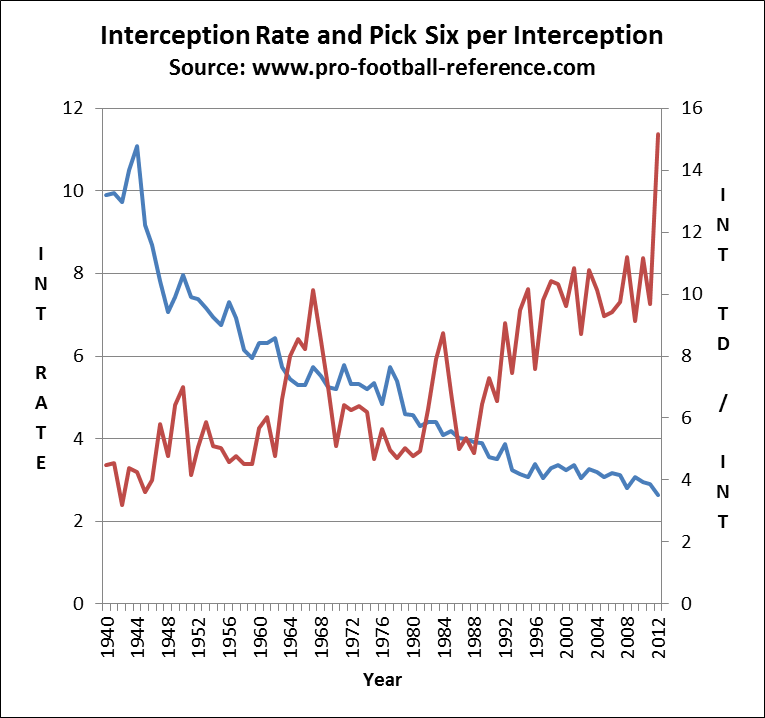
Good bit of trivia from my buddy Scott Kacsmar: there were 71 interceptions returned for touchdowns in 2012, the highest number in NFL history. Another interesting fact about the 2012 season: just 2.6 interceptions were thrown per 100 attempts, the lowest figure in NFL history.

We already know that the league-wide interception rate has been rapidly decreasing for years, but the significant increase in interceptions returned for touchdowns per interception is an under-reported story. Last year was the year of the Pick Six, but the Pick Six rate (INTs returned for touchdowns per interception) has been on the rise for several years. The graph below shows both the interception rate (100*INTs/Att) in blue (and measured against the left vertical axis) and the Pick Six rate (100*INT TDs/INT) in red (and measured against the right vertical axis):

Pick Six rate
[continue reading…]

{ 16 comments }

A closer look at Danny Amendola

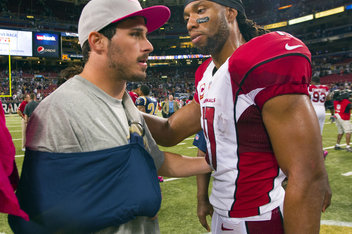
Amendola in his element

Amendola in his element.

Few get the statheads talking like Danny Amendola. Bill Barnwell wrote a free-agent book on Amendola in March, where he presented Amendola in the best possible light. Barnwell noted that over the last four years, Bradford has completed 66.5% of his passes aimed at Amendola compared to just 56.8% to all other targets. Barnwell further argued that since Amendola was much more productive in St. Louis than Wes Welker was in Miami, there is a good chance Amendola sees a big, Tom Brady-induced spike when he moves to New England, too.

Scott Kacsmar takes a slightly different view. First, the pro-Amendola argument: since 2010, the Rams are 12-15-1 (.446) when Amendola plays and 4-16 (.200) when he is out. Kacsmar also shows that the Rams averaged 18.9 PPG, 5.8 yards per pass attempt, and 312 yards per game, along with a 5.9% sack rate, in games with Amendola, versus averages of just 12.6, 5.6, 296, and 8.1%, respectively, in games that St. Louis played without Amendola. On the negative side, Kacsmar focused on Amendola’s miserable 8.81 yards-per-reception average, the lowest in history by a wide receiver with at least 100 receptions (by a pretty large margin). Another reason not to be impressed with Amendola’s high catch rate is that 29% of his receptions were “failed completions” [1]These are plays where the player fails to gain a minimum percentage of yards towards a first down (45 percent on first down, 60 percent on second down and 100 percent on third/fourth down. according to Kacsmar.

Amendola is a unique player in the same sense that Darren Sproles isn’t a traditional running back or Tim Tebow isn’t a traditional quarterback. Amendola’s a wide receiver, but he doesn’t operate the way wide receivers have for much of NFL history. According to Pro Football Focus, Amendola was in the slot on 85% of his routes over the last four years; that’s an enormous number, as even Wes Welker ran routes out of the slot on “only” 73.8% of his routes over that time period.
[continue reading…]

References

References
1 These are plays where the player fails to gain a minimum percentage of yards towards a first down (45 percent on first down, 60 percent on second down and 100 percent on third/fourth down.
{ 7 comments }

The best drafting teams from 2000 to 2007

In this post I derived the expected value of the contribution of each draft slot based on Pro-Football-Reference.com’s Approximate Value system. You can see the full draft chart here. Once you know what the expected value is for a draft pick, the next step to grading a draft pick is to measure how much actual value was provided. As before, I used the marginal Approximate Value generated by each player in each of his first five years, with the caveat that a player is only credited for his AV after his first two points of AV. Using that formula, Patrick Willis, LaDainian Tomlinson, and Maurice Jones-Drew come in as the three most valuable picks over that time period.

Since 2000, the team with the most amount of draft value in terms of picks was the 2002 Texans. Houston not only received the first pick in each round that year, but the expansion Texans were given several supplemental draft picks as well. The 2007 Raiders and 2000 Browns tied for the second mount amount of value in terms of raw draft picks, but both of those teams wound up with many more whiffs than hits.

The table below lists the best drafting teams from 2000 to 2007. I’ve also broken out each team’s AV above expectation for each year. If you click on any of the values in the columns from 2000 to 2007, you can see the players drafted by the team that year (one side effect of including this information: the columns do not sort correctly).

[continue reading…]

{ 34 comments }

The Time Value of Draft Picks

How do you compare the value of a draft pick this year compared to a draft pick next year? NFL teams have often used a “one round a year” formula, meaning a team would trade a 2nd, 3rd, or 4th round pick this year for a 1st, 2nd, or 3rd rounder next year. But to my knowledge, such analysis hasn’t evolved into anything more sophisticated than that.

So I decided to come up with a way to measure the time value of draft picks. First, I calculated how much Approximate Value each draft pick provided from 1970 to 2007 during their rookie season. Then, to calculate each player’s marginal AV, I only awarded each player credit for his AV over two points in each year. As it turns out, the player selected first will provide, on average, about 4 points of marginal AV during his rookie year. During his second season, his marginal value shoots up to about 5.5 points of AV, and he provides close to 6 points of marginal AV during his third and fourth seasons. In year five, the decline phase begins, and the first pick provides about 4.7 points of AV. You can read some more fine print here. [1]The charts in this post are “smoothed” charts using polynomial trend lines of the actual data. I have only given draft picks credit for the AV they produced for the teams that drafted … Continue reading

Here’s another way to think of it. The 1st pick provides 4.0 points of marginal AV as a rookie, the same amount the 15th pick provides during his second year, the 17th pick produces during his third year, the 16th pick during his fourth year, and the 8th pick during his fifth year. So the 15th pick this year should provide, on average, about the same value next year as the 1st pick in the 2014 draft (of course, that player might have something to say about that, too).

The graph below shows the marginal AV (on the Y-axis) provided by each draft selection (on the X-axis) in each of their first five years. The graphs get increasingly lighter in color, from black (as rookies) to purple, red, pink, and gray (in year five):
[continue reading…]

References

References
1 The charts in this post are “smoothed” charts using polynomial trend lines of the actual data. I have only given draft picks credit for the AV they produced for the teams that drafted them – that’s why the values are flatter (i.e., top picks are less valuable) than they were in this post. Finally, astute readers will note that the draft looks linear in the second half; that’s because if I kept a polynomial trend line all the way through pick 224, some later picks would have more value than some early picks
{ 5 comments }

I’m usually the one doing the talking, but we’ve got a long off-season ahead of us. I generally advise people interested in becoming writers to write what they want to write about, but it’s also important to give your audience the type of writing they want to read.

This week I looked at a wide range of topics. Monday’s post was about how can teams best take advantage of the rookie salary cap, which fits into the football strategy and theory parts of Football Perspective. On Tuesday, I went all statgeekery on you with a look at the youngest and oldest teams in the NFL last year.

I changed courses on Wednesday and went the player profile route with an in-depth look at Arrelious Benn, while on Thursday I did a social economics-style post when I examined the correlation between birth months and making the NFL. On Friday, I did the sort of data dump that was a specialty at PFR with a post about players who played with the most coaches.

Those are five very different types of posts, and I like to think that there’s generally an wide variety of posts at Football Perspective. But I’d like to make the site as reader-friendly as possible, and I know there are some devoted readers who check in every day. If I can produce content you’re interested in reading about, all the better.

So, how can I improve the site? What would you like to read about? Nothing is off-limits, so make your suggestions in the comments.

{ 30 comments }

I took this Sporcle quiz the other day on receivers to gain 1,000 yards with multiple teams. I did fine, I suppose, naming 22 of the 30 receivers. As I was going through the list, I kept looking at the rows for “Buccaneers, Panthers” and “Panthers, Cowboys” and my brain operated in this way:

Steve Smith never played for the Bucs or Cowboys. Neither did Muhsin Muhammad.”
….
Patrick Jeffers had a big year in 1999, but that was it for his career.”
….
“The Panthers have literally never had anyone resembling a competent wide receiver starting across from Smith in as long as I can remember (other than Muhammad).”
….
Wesley Walls didn’t play for Dallas or Tampa Bay. And I can’t think of a single other Panthers receiver from before 2000.”

“Let me try typing in Smith and Muhammad again.”

After the quiz, I checked the Panthers team page on PFR. The top nine receiving seasons were accomplished by either Smith or Muhammad, but there were in fact two other players to hit the 1,000-yard receiving mark for Carolina. Can you name them? If so, you’re a better man on Panthers wide receiver trivia than me.
[continue reading…]

{ 9 comments }

Playing with the most coaches on one team

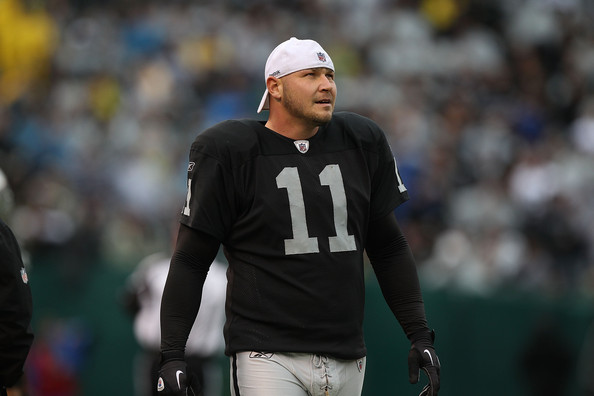
This man knows a coach when he sees one.

This man knows a coach when he sees one.

During the season, Mike Tanier noted that Shane Lechler has played for eight different coaches while being a member of the Raiders. When I read it, I thought that sounded like the start of a really good trivia question, and I put figuring out the answer to that question on my offseason to-do list. Sadly, the offseason is here.

Lechler and his special teams brother Sebastian Janikowski are two of only four players since 1960 to play for eight different coaches for the same franchise. Both Lechler and Janikowski were selected in the 2000 draft, and they each played under Jon Gruden, Bill Callahan, Norv Turner, Art Shell, Lane Kiffin, Tom Cable, Hue Jackson, and Dennis Allen.

You probably wouldn’t be surprised to find out that Jason Hanson, the Lions placekicker since 1874, has seen his share of head coaches come and go, too. The fourth player is Ernie McMillan, a four-time Pro Bowl tackle for the Cardinals in the ’60s and ’70s (and the father of Jets safety Erik McMillan), although he makes the list with an asterisk. McMillan played for Don Coryell in ’73 and ’74, Bob Hollway in ’71 and ’72, Charley Winner from ’66 to ’70 and Wally Lemm for four years before that. But in his rookie season of 1961, the Cardinals had four different head coaches, if you take a liberal definition of the word. St. Louis was coached by Pop Ivy for most of the season, but Chuck Drulis, Ray Prochaska, and Ray Willsey all served as the interim head coaches at the end of the year. In any event, I will include all co-coaches as separate coaches.

The table below shows all players to play under at least five different coaches for the same franchise since 1960. The first year with the team and the last year with a new coach for that team is indicated for each player, and I have taken the inclusive approach when it comes to co-coaches.
[continue reading…]

{ 6 comments }

In 2006, Doug looked into how much of a role the month in which you were born could play into your chances for athletic success later in life. Doug didn’t just ponder this out of thin air: a bit more research has been spent on this topic than you might think. Steve Levitt, of Freakonomics fame, found some evidence indicating that “older” kids in the same level of play — older by as much as 365 days, I suppose — tended to be more likely to become professional athletes. Basically, if you’re the oldest kid in your travel soccer team or 8th-grade basketball team, chances are you will be better than the other kids. This leads to a snowball effect, where you might be more likely to receive more personal coaching and your confidence should increase.

J.C. Bradury graphed the birth-month of over 16,000 major league baseball players. Take a look:
[continue reading…]

{ 5 comments }

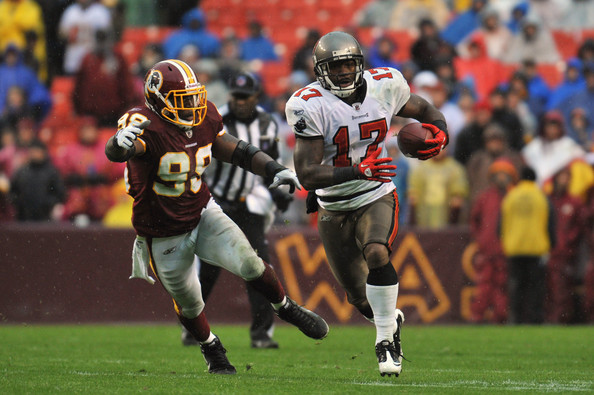
Benn against the Redskins

Benn against the Redskins.

To the casual fan, Arrelious Benn is one of many nondescript wide receivers in the NFL. The Buccaneers selected him in the second round of the 2010 Draft, he gained 862 yards in three seasons, and Tampa Bay just traded him to Philadelphia for a 7th round pick in the 2013 draft.

My curiosity with Benn dates back to his college days. He came to Illinois as a five-star recruit and he gained 676 yards and 2 touchdowns as a true freshman.   While that might not sound impressive, he gained more than twice as many receiving yards as any other player on the team, and his production earned him Big Ten Freshman of the Year honors. That 2007 Illini threw the fewest passes in the Big Ten, suppressing Benn’s numbers, but landed in the Rose Bowl based on a run-heavy attack led by Rashard Mendenhall. They were quarterbacked by Juice Williams, a running “quarterback” in name only, and coached by Ron Zook, the two men who would torpedo the Illinois offense over the next two seasons.

As a sophomore, Benn again more than doubled the production of the next best receiver on the Illini: he caught 67 passes for 1,066 yards and ran 23 times for 101 yards. Those numbers were good enough to lead the conference in receiving yards during the regular season, although Minnesota’s Eric Decker passed him in Minnesota’s Bowl game. Illinois didn’t have a Bowl game, as the team imploded and finished 5-7.
[continue reading…]

{ 3 comments }

The youngest and oldest NFL teams in 2012

Last August, I looked at the 2011 age-adjusted team rosters. I have reproduced the intro to that post below:

Measuring team age in the N.F.L. is tricky. Calculating the average age of a 53-man roster is misleading because the age of a team’s starters is much more relevant than the age of a team’s reserves. The average age of a team’s starting lineup isn’t perfect, either. The age of the quarterback and key offensive and defensive players should count for more than the age of a less relevant starter. Ideally, you would want to calculate a team’s average age by placing greater weight on the team’s most relevant players.

Using Pro-Football-Reference’s Approximate Value system, I calculated the weighted age of every team in 2012, with the weight for each player being proportionate to his contribution (as measured by AV) to his team. You don’t have to use AV — Danny Tuccitto did an excellent job producing age-adjusted team rosters based on the number of snaps each player saw — but since AV is what I’ve got, AV is what I’ll use.

The table below shows the total AV for each team in 2012. The table is sorted by the team’s average (AV-adjusted) age. I’ve also included the offensive and defensive AV scores and average ages for each team.

[continue reading…]

{ 14 comments }

[Special thanks goes out to my Footballguys.com co-writer Maurile Tremblay for his help in co-authoring this piece with me. Any points with which you may disagree are almost certainly due to my error, and not Maurile’s.]

The new NFL collective bargaining agreement that ended the 2011 lockout instituted some pretty big changes to the salary cap. When it comes to roster management, here are three ways the post-2011 NFL differs from how things were under the old CBA:

  • Rookies are now super cheap relative to their production, especially high first-round players (relative to their old cost)
  • Rookie contracts can not be renegotiated until three years after the player is drafted.
  • Over a four-year period, each team must spend 89% of the cap dollars available to them, and the league must spend 99% of the cap dollars available to the 32 teams.

Under the old system, contrary to popular belief, most (if not all) rookies were underpaid relative to their free market value. Then in 2011, the owners and NFLPA decided to rob the rookies to pay veterans even more money under the new CBA. Russell Wilson has three years remaining on his contract and will have an average cap figure of just $817,000 over those three years. Andrew Luck and Robert Griffin III will only cost their teams about 6 million cap dollars each per year from 2013 to 2015. The salary cap in the NFL in 2013 is $123M, making Luck and Griffin fantastic values, and Wilson perhaps the most valuable player in the league.
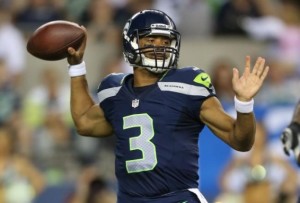
Wilson's paid in direct proportion to his height

Wilson's paid in direct proportion to his height.

What makes this especially juicy from the perspective of their general managers is that all three players are locked into their deals until 2015. Luck and Griffin actually are struck through 2016, as teams get club-options for a fifth year for the top picks. In Wilson’s case, after the 2014 season, he’ll be facing a contract that would pay him less than a million dollars in 2015 and then a possible franchise tag in 2016, meaning a maximum payout of probably 20 million dollars over two years (the tag in 2012 for quarterbacks was just under $15 million). That puts Wilson in a pretty poor position to bargain for a market deal: he’s going to sacrifice money in exchange for security. This means Seattle will get him for absurdly below-market rates in 2012, 2013, and 2014, and then will still have him on a very generous contract for the next few years after that.

In the case of Luck or Griffin, the Colts and Redskins essentially get a chance to use the tag twice; teams can turn the four-year rookie deals into a five-year deal by paying top-ten picks the average salary of the ten highest-paid players at their position; then the next year the franchise tag would be the average of the top five quarterbacks or a 20% increase on the salary from the previous year. So when they are up for renegotiation after year three, they’re looking at the team “forcing” them to stay for three years at roughly $42 million, with year one bringing just over three million. Luck and Griffin will have a little more bargaining power than Wilson, but not much. There’s no chance either player is going to play for $3 million in 2015 (remember, their cap hit will be a bit higher, but their base salaries will be around $3M in that season), so both will likely give up their freedom (which would be three years away, potentially) for security.
[continue reading…]

{ 26 comments }

Wait, how many USC quarterbacks are starting?

Wait, how many USC quarterbacks are starting?

There was a streak in jeopardy in week 17 of the 2012 season. With former Trojan Carson Palmer injured, the Raiders skipped over his former USC teammate, Matt Leinart, and started ex-Ohio State Buckeye Terrelle Pryor at quarterback for the season finale. Since the Chiefs had previously benched Matt Cassel for Brady Quinn, if it wasn’t for Greg McElroy missing the Jets last game against the Bills — which reinserted Mark Sanchez into the starting lineup for New York — USC’s streak of consecutive weeks with a starting quarterback in the NFL would have ended. Instead, the streak is now up to 81 weeks with at least one of Sanchez, Palmer, Cassel and/or Leinart starting.

As impressive as that might sound, it’s not even halfway to the record. You can take a second to think about which school had the longest run with at least one of its former players starting at quarterback, but first, another bit of trivia: I noticed that in week 12 of the 2009 season, Matt Leinart, Matt Cassel, Mark Sanchez, and Carson Palmer all started. But believe it or not, that’s not a record, either.

In week 13 of the 2000 season, five quarterbacks from the University of WashingtonWarren Moon, Mark Brunell, Damon Huard, Chris Chandler, and Brock Huard — were starting in the NFL. Add in Washington State’s Drew Bledsoe and Ryan Leaf, and seven quarterbacks that played college in the Evergreen State were starting in the NFL that weekend.
[continue reading…]

{ 7 comments }

With Anquan Boldin being traded to San Francisco, he’ll have the rare opportunity to win the Super Bowl in consecutive years with different teams. Here’s another bit of trivia: if Boldin makes it back to the Super Bowl, he’ll become just the 11th player to ever make Super Bowls with three different teams. (man, the Anquan Boldin tag at Football Perspective has gotten way more use than I ever expected).

NameTeam/Year(s)Team/Year(s)Team/Year(s)
Rod Woodson1995-pit2000-rav2002-rai
Bill Romanowskisfo-1988; 1989den-1997; 19982002-rai
Matt Millenrai-1980; 19831989-sfo1991-was
Ricky Proehlram-1999; 20012003-car2006-clt
Preston Pearson1968-clt1974-pitdal-1975; 1977; 1978
Harry Swayne1994-sdgden-1997; 19982000-rav
Clark Haggans2005-pit2008-crd2012-sfo
John Parrella1993-buf1994-sdg2002-rai
Joe Jurevicius2000-nyg2002-tam2005-sea
Jeff Rutledge1979-ram1986-nyg1991-was

[continue reading…]

{ 1 comment }
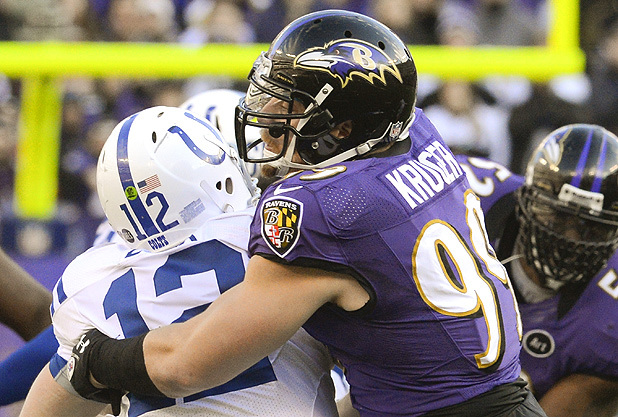
Kruger takes down Andrew Luck

Kruger takes down Andrew Luck.

Explanation of the RSP Writers Project and my picks in Round 1 and 2

After selecting Josh Freeman, Julio Jones and Brandon Marshall early in the draft, I needed to use my picks in rounds 4 and 5 to build the core of the rest of my team. The two most critical positions I had ignored were left tackle and pass rusher. Fortunately my need largely coincided with what was left: I didn’t see a true difference maker at corner or defensive tackle, so it was easy to focus on 3-4 outside linebackers and 4-3 ends.

On offense, my choice at left tackle was made easy once Jake Long, Trent Williams, and Tyron Smith went off the board at the end of round four. I had D’Brickashaw Ferguson with those four in my final tier of what I would consider above-average left tackles, and Ferguson ranked second to only Williams. His reputation took a bit of a hit with a a poor 2011 and the Jets general implosion since then, but Ferguson quietly had a nice rebound season last year. He allowed only two sacks in 2012 according to Pro Football Focus, and came in as PFF’s #7 left tackle. He’ll only turn 30 in December, so I think my team can count on him for another five years at least. He’s got size and great athleticism, and keeps himself in good shape, so he seems unlikely to fall off a click as he ages. As the 14th offensive tackle off the board, I think Ferguson represents strong value this late in the draft. He’s capable of being a franchise left tackle, which makes him a pick I can feel comfortable about at the end of the fourth round.
[continue reading…]

{ 3 comments }

Football Research Intern

If you’re a reader of this site and in college, chances are this opportunity might interest you.

An NFL team is looking for football research interns for the summer. There is a chance that the position could become full time after the summer if the candidate is outstanding.

All interested candidates should send a resume and cover letter to nflanalyticsintern [at] gmail [dot] com. In the cover letter, please detail any relevant analytics experience and describe one question you would like to study if you had access to an NFL team’s data. Special preference will be given to those with database and/or programming skills.

Best of luck to anyone who applies.

{ 1 comment }

Welker won't have any more "rare" drops in New England.

Welker won't have any more 'rare' drops in New England.

The craziness continues, with Wes Welker signing with the Denver Broncos being the big story of day two of the league year. The Patriots responded by signing Danny Amendola, the least surprising move since Brandon Lloyd joined Josh McDaniels in New England last year. Arguably the biggest move so far this week has been Mike Wallace joining Dolphins, while Greg Jennings still seems likely to move on from Green Bay. Throw in Percy Harvin to Seattle and Anquan Boldin to San Francisco, and we’re seeing a lot of movement among the top receivers this year. Which gives me an opportunity to do a quick data dump on the best receivers to ever switch teams.

In some ways, it’s hard to find a comparable receiver to Welker. He’s been so productive for so long that it’s easy to be unimpressed with the 118 catches, 1,354 yards, and six touchdowns he had last year, but no receiver had ever switched teams after catching more than 101 catches in a season. Only two receivers — Muhsin Muhammad and Yancey Thigpen — gained more receiving yards in a season than Welker did in 2012 and then played for a new team the next year.

But Welker’s amazingly unique numbers are a product of playing in a very pass-friendly environment on a team that threw 641 passes last year. To compare players across systems and eras, I came up with a wide receiver ranking system last month. That will allow us to look at the best receivers to switch teams and not just the ones from the last couple of decades. For some perspective, Welker ranked 8th among wide receivers last season, although that’s without any Tom Brady-adjustment.

The table below contains a lot of information. It shows receivers who added over 200 yards of value over average in Year N and then played for a new team in Year N+1. For each player, I’ve listed his old team, his age in Year N, some traditional statistics, the amount of value added by the receiver, and his rank among wide receivers. Then starting in the “N+1 tm” category, we see his new team, his statistics in the new season, how much value he added in Year N+1 and his rank in that season.
[continue reading…]

{ 9 comments }
Mike Wallace dropped Pittsburgh for Miami.

Mike Wallace dropped Pittsburgh for Miami.

Happy New Year to the NFL, which opened for business at 4PM yesterday. It’s been a busy couple of days, as the Seahawks (Percy Harvin) and 49ers (Anquan Boldin) acquired veteran receivers a day before the floodgates opened. The Dolphins made the biggest waves yesterday by signing WR Mike Wallace and ILB Dannell Ellerbe from AFC North heavyweights, and then later released ILB Karlos Dansby and signed OLB Philip Wheeler from the Raiders. The Colts chose to go quantity over quality by signing four different players (G Donald Thomas from New England, OLB/Colin Kaepernick turnstile Erik Walden from Green Bay, T Gosder Cherilus from Detroit, and DE Lawrence Sidbury from Atlanta). The Ravens lost Paul Kruger to Cleveland but did sign former Giants DE Chris Canty.

Tennessee made some noise signing G Andy Levitre from Buffalo and TE Delanie Walker from San Francisco, while the Chiefs picked up 3-4 DE Mike DeVito and TE Anthony Fasano from the AFC East. Chicago helped out Jay Cutler by signing TE Martellus Bennett (Giants) and T Jermon Bushrod (New Orleans), while Sam Bradford will be happy to know that the Rams added TE Jared Cook from Tennessee. The Broncos added guard Louis Vasquez from division-rival San Diego to keep Peyton Manning upright, and are rumored to be after Steelers running back Rashard Mendenhall. The Eagles won’t win the headlines, but made a couple of interesting signings in NT Isaac Sopoaga (San Francisco) and TE/HB/WR/FB/Chip Kelly chess piece James Casey from Houston. About an hour later, the Eagles added CB Bradley Fletcher (Rams), S Patrick Chung (Patriots) and LB Jason Phillips (Panthers). And there were some releases, with Ryan Fitzpatrick (Buffalo), Nnamdi Asomugha (Philadelphia), Sione Pouha (Jets), and Darrius Heyward-Bey and Michael Huff (Oakland) among the more notable cuts. You can check out Pro-Football-Reference.com’s free agent tracker to stay up to date on the latest signings.

The first few days of the league year provide fans across the country with an opportunity to ring in the new year with a dash of optimism. But how often does adding a veteran or two via trade or free agency land a team in the Super Bowl? The table below lists every notable veteran acquisition [1]Here, notable means having an AV of 4 or greater in Year N. by the 40 teams to make the Super Bowl since 1993, the start of the Free Agency era in the NFL. The “W/L” column shows whether the team won or lost in the Super Bowl, while the AV column shows how much Approximate Value the player provided in his first season with the new team. The N-1 Tm and N-1 AV columns show where the player came from and how valuable he was in the prior year; the table is sorted by the average of the player’s AV in Years N and N-1.
[continue reading…]

References

References
1 Here, notable means having an AV of 4 or greater in Year N.
{ 1 comment }

Examining Paul Warfield’s career

Warfield played for Woody Hayes, Paul Brown, Don Shula, and John McVay

Warfield played for Woody Hayes, Don Shula, and John McVay.

Paul Warfield has been confounding stat heads for years. Warfield was a rare first-ballot Hall of Fame wide receiver and one of the most athletic and talented wide receivers in history. However, his statistics look downright unimpressive to the modern eye. That’s not too surprising, though, since he played the prime of his career in football’s deadball era for one of its best teams.

I was pretty happy when I noticed that Warfield ranked 16th in my wide receiver ranking project last month; that’s much higher than most (all?) stats-based ranking systems place him, although some would argue that it would still underrate him.

One way to understand Warfield’s statistics is to see just how infrequently his teams passed. The table below shows some of the top wide receivers in football history to enter the league since 1960, including some Warfield contemporaries like Gary Garrison, Fred Biletnikoff, Harold Carmichael, and Gene A. Washington. While career numbers are interesting, you can often learn more by just looking at a player’s best seasons.

The table below shows the top 7 seasons for each wide receiver (based on the formula from this post) and how many pass attempts per game his team attempted during those seasons:
[continue reading…]

{ 12 comments }

Quarterback Age Curves

The master and the puppet?

The master and the puppet?

Last summer, I looked at the age curves for running backs in an attempt to find out if there is a magical cliff at age 30 (there isn’t). But when I wrote about Josh Freeman last week, I started thinking about quarterback age curves.

The first step in trying to measure the aging patterns of quarterbacks is to figure out a sample to analyze. I decided to look at all quarterbacks who entered the league since 1970 and have since retired. I further limited my sample to quarterbacks who had at least three seasons of above-average play based on this system. That brought us to a group of 77 quarterbacks, from quarterbacks like Jon Kitna, Jay Fiedler, and Dan Pastorini to Hall of Famers like Joe Montana, Brett Favre, and Dan Marino.

While before I graded quarterbacks based on how much value over average they provided, that baseline is too high for this type of post. Instead, I gave quarterbacks credit for their value over replacement, defined as 75% of the league average. I then calculated the best three seasons of value over replacement (VOR) for each quarterback’s career to get a sense of their peak level of play. The last step was to divided their VOR in each season of their career by their peak value. Do this for each of the 77 quarterbacks, and we can get a sense of quarterback aging patterns.

There is another thing to consider when coming up with an age curve: The intuitive way is to sum up each quarterback’s value (relative to his peak) in each season and divide that total by the number of quarterbacks active at that age. Another way is to divide that total by 77, the number of quarterbacks in the study. The former method will make really young and really old ages look closer to average than they really are, but I have decided to include both methods in the picture below. The blue line represents the average performance based on the number of quarterbacks actually playing in the NFL that season; the red line shows the aging patterns when you divide by the total number of passers in the group.
[continue reading…]

{ 11 comments }

Better than Elway?

Better than Elway?

Today’s title gives a pretty good hint as to what today’s post is about. The table below shows the career Approximate Value for the top 50 players whose last game happened to be a Super Bowl victory. For reference, I’ve also includes things like number of games, Pro Bowls, 1st-team All-Pro selections, and number of seasons starting.

In addition to Lewis, Matt Birk of the Ravens also joins the list, and for the heck of it, I’ve included Anquan Boldin, who has hinted that he might retire. Full disclosure: I defined a player as “retiring after winning the Super Bowl” if his last season came during a year in which he played for the eventual Super Bowl champ. So Wes Chandler, who played for the ’88 49ers but retired in mid-season, is included in this list even though he shouldn’t be. Ditto Michael Dean Perry, who was on the Broncos in 1997 but actually finished the season with the Chiefs. I could filter out all the Chandlers and Perrys of the world, but my time is better spent elsewhere (for that matter, just about every person’s time is better spent elsewhere), and therefore I’ll present the full, overinclusive list instead of spending an extra hour of time fixing it and possibly not presenting it at all.

The table is sorted by the Career AV column; the AV column shows the player’s AV in his final season.
[continue reading…]

{ 11 comments }

Emmitt knows the point of a good fullback.

Emmitt knows the point of a good fullback.

Ever wonder what percentage of Super Bowl champions had a Pro Bowl quarterback? Can you get by without a star-studded secondary? The table below shows the number of Pro Bowlers made at each position for each Super Bowl champion.

As it turns out, 30 of 47 Super Bowl champions saw their quarterback made the Pro Bowl. That doesn’t include the 2012 Ravens, as Joe Flacco was not a Pro Bowl selection, but it does include the ’69 Chiefs, the only team with two quarterbacks to make the Pro Bowl (Len Dawson and Mike Livingston). The Ravens did have two Pro Bowl running backs, though (Ray Rice and Vonta Leach), joining the ’93 Cowboys (Emmitt Smith, Daryl Johnston) and the ’72 and ’73 Dolphins (Larry Csonka, Mercury Morris) as the only Super Bowl champs with multiple Pro Bowl running backs.

Arguably the least represented position is cornerback, which might be relevant to yesterday’s post: the average Super Bowl champion had just 0.45 Pro Bowl cornerbacks, the lowest average among positions that always have multiple starters (as opposed to defensive tackles or inside linebackers). Both Charles Woodson and Tramon Williams made the Pro Bowl for the 2010 Packers, but eight of the last nine Super Bowl champions failed to place a single cornerback in the Pro Bowl in that season. The full table, below:
[continue reading…]

{ 6 comments }
Next Posts Previous Posts