
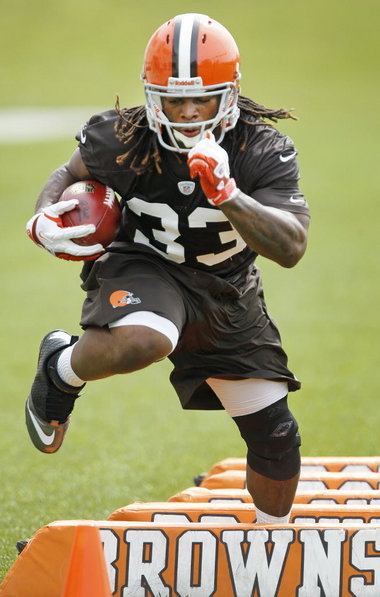
An ordinary running back.
So how do things look at the running back position? The Bills drafted Willis McGahee knowing he would miss his entire rookie season, while Bo Jackson chose to play baseball instead of playing with the Buccaneers. Ki-Jana Carter and Larry Stegent suffered season-ending injuries in the pre-season of their rookie years, making them inapplicable for our purposes, assuming Richardson stays healthy. What about the other 38 running backs who were the first at their position selected in the draft since the merger?
Over 40% of those highest drafted running backs led their class [1]Note that this only includes drafted running backs. in rushing yards as a rookie, while exactly half gained at least 75% as many rushing yards as the the most productive rookie running back. That may not be particularly impressive in the abstract, but represents a much better track record than we saw at the wide receiver position. On the other hand, recent history has not been particularly great: in the past 10 years, arguably every top rookie running back outside of Adrian Peterson disappointed, as even Moreno failed to meet the expectations of many.
Richardson is the favorite to be the most productive rookie running back, although “the field” appears to be a more enticing proposition. But Cleveland drafted Richardson for what he can do for the next five or ten years, which will ultimately be much more significant than how he performs in 2012. Even if the highest drafted running back is unlikely to lead his draft class in rushing yards as a rookie, is he more likely (than the field) to lead his draft class in career rushing yards?
The table below shows the career rushing yards gained by the top drafted running back in each of the last 42 drafts, along with how he performed relative to the best runner (as measured by total rushing yards) selected in the same draft:
| Year | Running Back | Team | Pick | College | Rush Yds | % of Leader | Top Career |
|---|---|---|---|---|---|---|---|
| 2011 | Mark Ingram | NOR | 28 | Alabama | 474 | 0.53 | DeMarco Murray |
| 2010 | C.J. Spiller | BUF | 9 | Clemson | 844 | 0.48 | Ryan Mathews |
| 2009 | Knowshon Moreno | DEN | 12 | Georgia | 1905 | 0.63 | LeSean McCoy |
| 2008 | Darren McFadden | OAK | 4 | Arkansas | 2627 | 0.47 | Chris Johnson |
| 2007 | Adrian Peterson | MIN | 7 | Oklahoma | 6752 | 1.00 | Adrian Peterson |
| 2006 | Reggie Bush | NOR | 2 | USC | 3176 | 0.46 | Maurice Jones-Drew |
| 2005 | Ronnie Brown | MIA | 2 | Auburn | 4951 | 0.65 | Frank Gore |
| 2004 | Steven Jackson | STL | 24 | Oregon St. | 9093 | 1.00 | Steven Jackson |
| 2003 | Willis McGahee | BUF | 23 | Miami (FL) | 7366 | 1.00 | Willis McGahee |
| 2002 | William Green | CLE | 16 | Boston Col. | 2109 | 0.21 | Clinton Portis |
| 2001 | LaDainian Tomlinson | SDG | 5 | TCU | 13684 | 1.00 | LaDainian Tomlinson |
| 2000 | Jamal Lewis | BAL | 5 | Tennessee | 10607 | 1.00 | Jamal Lewis |
| 1999 | Edgerrin James | IND | 4 | Miami (FL) | 12246 | 1.00 | Edgerrin James |
| 1998 | Curtis Enis | CHI | 5 | Penn St. | 1497 | 0.13 | Fred Taylor |
| 1997 | Warrick Dunn | TAM | 12 | Florida St. | 10967 | 0.98 | Corey Dillon |
| 1996 | Lawrence Phillips | STL | 6 | Nebraska | 1453 | 0.14 | Eddie George |
| 1995 | Ki-Jana Carter | CIN | 1 | Penn St. | 1144 | 0.08 | Curtis Martin |
| 1994 | Marshall Faulk | IND | 2 | San Diego St. | 12279 | 1.00 | Marshall Faulk |
| 1993 | Garrison Hearst | PHO | 3 | Georgia | 7966 | 0.58 | Jerome Bettis |
| 1992 | Tommy Vardell | CLE | 9 | Stanford | 1427 | 0.36 | Edgar Bennett |
| 1991 | Leonard Russell | NWE | 14 | Arizona St. | 3973 | 0.37 | Ricky Watters |
| 1990 | Blair Thomas | NYJ | 2 | Penn St. | 2236 | 0.12 | Emmitt Smith |
| 1989 | Barry Sanders | DET | 3 | Oklahoma St. | 15269 | 1.00 | Barry Sanders |
| 1988 | Gaston Green | RAM | 14 | UCLA | 2136 | 0.18 | Thurman Thomas |
| 1987 | Alonzo Highsmith | HOU | 3 | Miami (FL) | 1195 | 0.24 | Christian Okoye |
| 1986 | Bo Jackson | TAM | 1 | Auburn | 2782 | 0.45 | Neal Anderson |
| 1985 | George Adams | NYG | 19 | Kentucky | 886 | 0.11 | Herschel Walker |
| 1984 | Greg Bell | BUF | 26 | Notre Dame | 4959 | 0.60 | Earnest Byner |
| 1983 | Eric Dickerson | RAM | 2 | SMU | 13259 | 1.00 | Eric Dickerson |
| 1982 | Darrin Nelson | MIN | 7 | Stanford | 4442 | 0.36 | Marcus Allen |
| 1981 | George Rogers | NOR | 1 | South Carolina | 7176 | 0.89 | Freeman McNeil |
| 1980 | Billy Sims | DET | 1 | Oklahoma | 5106 | 0.95 | Joe Cribbs |
| 1979 | Ottis Anderson | STL | 8 | Miami (FL) | 10273 | 1.00 | Ottis Anderson |
| 1978 | Earl Campbell | HOU | 1 | Texas | 9407 | 1.00 | Earl Campbell |
| 1977 | Ricky Bell | TAM | 1 | USC | 3063 | 0.24 | Tony Dorsett |
| 1976 | Chuck Muncie | NOR | 3 | California | 6702 | 0.91 | Mike Pruitt |
| 1975 | Walter Payton | CHI | 4 | Jackson St. | 16726 | 1.00 | Walter Payton |
| 1974 | Bo Matthews | SDG | 2 | Colorado | 1566 | 0.24 | Mark van Eeghen |
| 1973 | Otis Armstrong | DEN | 9 | Purdue | 4453 | 0.75 | Chuck Foreman |
| 1972 | Franco Harris | PIT | 13 | Penn St. | 12120 | 1.00 | Franco Harris |
| 1971 | John Riggins | NYJ | 6 | Kansas | 11352 | 1.00 | John Riggins |
| 1970 | Larry Stegent | STL | 8 | Texas A&M | 0 | 0.00 | Jim Otis |
The results are actually a little less impressive here. Whereas the top drafted rookie wide receiver generally took some time to develop, the situation looks different at running back. One-third of the highest-drafted running backs finished with the most career rushing yards in their class, only slighter higher than the results we saw with wide receivers. The results look to be better across the board than they were at wide receiver, but perhaps the bigger takeaway is that the top drafted rookie runner performed slightly better as a rookie relative to his peers than he did over the course of his career. More on this tomorrow.
To highlight the issue, let’s turn this into a poll:
[poll id=”5″]
The sample sizes are not large enough to draft any significant conclusions to answer the above question. But I think it’s an interesting intellectual exercise. What do you think?
Previous “Random Perspective On” Articles:
AFC East: Buffalo Bills, Miami Dolphins, New England Patriots, New York Jets
AFC North: Baltimore Ravens, Cincinnati Bengals, Cleveland Browns, Pittsburgh Steelers
AFC South: Houston Texans, Indianapolis Colts, Jacksonville Jaguars, Tennessee Titans
AFC West: Denver Broncos, Kansas City Chiefs, Oakland Raiders, San Diego Chargers
NFC East: Dallas Cowboys, New York Giants, Philadelphia Eagles, Washington Redskins
NFC North: Chicago Bears, Detroit Lions, Minnesota Vikings, Atlanta Falcons
NFC South: Atlanta Falcons, Carolina Panthers, New Orleans Saints, Tampa Bay Buccaneers
NFC West: Arizona Cardinals, San Francisco 49ers, Seattle Seahawks, St. Louis Rams
References
| ↑1 | Note that this only includes drafted running backs. |
|---|