≡ Menu

Playoff Picture: Who needs what in week 17

With week 16 in the books, it’s time to take a look at the playoff picture. In the AFC, it’s simple: we know the six teams that will be in the post-season. In the NFC, there are two spots still remaining and five teams trying to claim them. In both conferences, there will be battles for byes in week 17.

AFC

The 12-3 Houston Texans are suddenly in a freefall, and could drop from the presumptive number one seed to having to win in the first round of the playoffs. If Houston loses in Indianapolis, the Texans are vulnerable to being caught by either Denver (home against Kansas City) or New England (home against Miami), or both. There’s likely no middle ground, since the Broncos and Patriots are big favorites, meaning it’s the #1 seed or no bye for Houston. Still, Houston is likely to get the top seed in the AFC. After all, the Colts did just struggle mightily to handle the worst team in the NFL.

Denver can secure a bye by beating Kansas City or having the Dolphins beat the Patriots, and would earn home field advantage throughout the playoffs with a win and a Colts victory. The likely result for Denver is the #2 seed

The Patriots are third in the pecking order with four losses. They could drop to the #4 seed with a loss and a Ravens victory over Cincinnati, but that doesn’t mean much: a home game against Indianapolis won’t scare New England and might even be an easier matchup than facing A.J. Green and Geno Atkins. The real drama is whether Denver or Houston falls, giving New England a chance for a bye or even home field. While the Patriots could end up being slotted from 1 to 4 in the AFC, expect each of the top three seeds to take care of business, and New England to finish as the #3 seed.

Pagano will likely see his old friends in two weeks

Pagano as defensive coordinator of the Ravens.

Because the Browns defeated the Bengals, the Ravens hold the tiebreaker over Cincinnati. Both teams split with Pittsburgh, and would split with each other if Cincinnati defeats Baltimore on Sunday, but Baltimore’s sweep of Cleveland would give them the division even if they lose to Cincinnati in week 17. Baltimore has little to play for in Cincinnati; the irony is that if Baltimore defeats the Bengals and the Patriots lose, the two teams would face off again in the first round of the playoffs in Baltimore. Still, the likely scenario is Baltimore staying at the 4 seed and hosting the Colts in the first round of the playoffs.

The Colts are the feel good story of the year, and Chuck Pagano comes back to coach the team this weekend. It’s actually a meaningless game for Andrew Luck and the Colts on Sunday, as they can’t improve their playoff positioning. In fact, they can only hurt it: a victory over Houston in week 17 means, assuming the Patriots defeat the Bengals in the first round of the playoffs, that the Colts would face the Broncos instead of the Texans in the second round. In any event, we know that the Colts are the 5 seed and unless the Patriots lose and the Ravens win, will travel to their old stomping grounds in Baltimore in the first round of the playoffs. Expect that to be a very emotional game and for the Ravens crowd to give a warm #Chuckstrong welcome to their former defensive coordinator.

NFC

Matt Ryan and the Falcons have clinched the #1 seed in the NFC. For all the bashing Atlanta seems to take, they might end up winning three more games than any other team in the conference. However, the most likely opponent in the first round of the playoffs is Seattle, which would be a fascinating contrast in styles. The Falcons will face the winner of the 4/5 game or the 6 seed, but since the 6 seed will likely play in San Francisco, and the Seahawks look much better than either the Redskins or the Cowboys, my money is on Seattle-Atlanta in round two.

Brett Favre is honestly surprised the Packers haven't secured a bye yet.

Brett Favre is honestly surprised the Packers haven't secured a bye yet.

Green Bay is the frontrunner to win the #2 seed and secure the other bye in the conference. The NFC East winner is out, so the #2 seed comes down to either the Packers or the NFC West winner. Green Bay gets the #2 spot with a win, or with losses by both the Seahawks and 49ers. I wouldn’t count on that. Winning in Minnesota is not going to be easy — Adrian Peterson will be chasing Eric Dickerson’s rushing record and the Vikings are in a “win and you’re in” scenario themselves — but I’d still make Aaron Rodgers and the Packers the favorites. If the Packers lose in Minnesota, their punishment is a first round visit from the Vikings.

San Francisco can still finish as the #2, #3, or #5 seeds. The 49ers get a bye if the Packers lose and the 49ers win, but more likely, San Francisco defeats Arizona and ends up as the #3 seed in the NFC. The 49ers could also get the #3 seed with a loss if the Seahawks lose at home against the Rams, but good luck with that. If San Francisco loses at home to Arizona, the 49ers will likely get what they deserve — the fifth seed and a trip to either Washington or Dallas in the first round of the playoffs.

The NFC East will be decided in Washington on Sunday. If the Redskins win, which would be my prediction, Washington will win the division at 10-6. The ‘Skins have another out, as they could get the 6 seed even if they lose to the Cowboys. At 9-7, Washington would have the tiebreaker over Minnesota based on head-to-head record, so if the Vikings and Bears lose to Green Bay and Detroit, Washington is in the playoffs. Assuming the Redskins make the post-season, Luck would be joined by fellow rookies Robert Griffin III and Russell Wilson in the playoffs, an NFL first.

TO taught Sherman what to do when you arrive at the Cowboys 50-yard line.

TO taught Sherman what to do when you arrive at the Cowboys 50-yard line.

Meanwhile, the Cowboys face your basic ‘win and you’re in’ scenario. At 8-8 they can’t make the playoffs, so it’s just a question of whether they can defeat the Redskins and claim the NFC East. The other interesting thing to keep an eye on: Tony Romo is only 315 yards away from hitting the 5,000-yard mark, although he trails both Drew Brees and Matthew Stafford in the race for the passing crown.

By defeating San Francisco on Sunday night, the Seahawks clinched the #5 seed in the NFC. While the Bears and Vikings could get to 10 wins, Seattle defeated both teams, so Seattle’s fate is secure as no worse than the 5th seed and is rewarded with a trip to either Washington or Dallas in the first round of the playoffs.

That leaves just the sixth seed up for grabs. If the Vikings defeat the Packers, they’d get the #6 seed and likely travel to Lambeau Field in the first round of the playoffs. No word on whether Brett Favre would be in attendance. Minnesota has the tiebreaker over the Bears because Green Bay swept Chicago, while in this scenario, the Vikes would end up 4-2 in the division. Chicago therefore needs Minnesota to lose and to win in Detroit to get the #6 seed. If both teams lose, the Redskins then would slot into the 6 seed even if they lose.

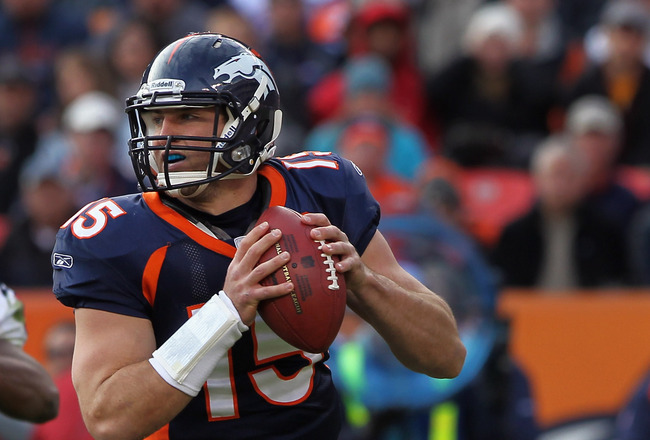
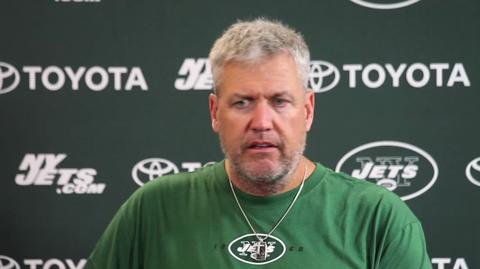
You might notice we’re missing a certain team from New York. Well, the Jets have struggled this season, and the Mark Sanchez/Tim Tebow/Greg McElroy circus has only gotten more depressing. Oh wait, there’s another team in New York, right? Well, the Giants can’t win the division, but could get a wildcard berth. They would need the other teams they’d be battling for the final spot — Chicago, Minnesota, and Dallas — to lose to Detroit, Green Bay, and Washington, in addition to taking care of business against the Eagles. The longshot there would be the Lions defeating Chicago, but otherwise, it’s not a completely far-fetched scenario.
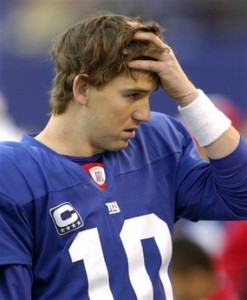
{ 10 comments }

Rankings the kickers, from Tucker to Crosby

Mack Brown knows kicker.

Mack Brown knows kickers.

In the summer of 2009, I wrote a three-part series analyzing every kicker of the last half-century (here are the links to Part I, Part II, Part III). What I did there was analyzed field goal attempts by distance, and then credited a kicker for how many field goals he made over the expected number of successful field goals from each distance.

For example, field goal kickers this year have made 15 of 23 attempts from exactly 50 yards. [1]There is some bias in the data in that only the best distance kickers attempts long field goals, but dealing with that is best left for another day. If we assume that 50-yard kicks are successful 65% of the time, then a made 50-yarder will be worth +0.35 field goals and a missed 50-yarder will be worth -0.65 field goals.

To smooth the data, I used kicks from 2005 to 2011, and I also grouped field goals into four-yard increments. In the off-season, I plan to incorporate stadium, temperature, and other weather effects, but for now, I’ve ignored the (often large) role such elements can play.

The table below shows how many field goals over expectation each kicker made through week 15. I also included a column for extra points, and the final column shows how many points over average each kicker provided, giving them 3 points for each field goal and one point for each extra point over average:

RkNameTmFG MFG AFG %EXP FG MadeFG Ov AVGXP MXP AXP Ov AvgPoints Ov Avg
1Justin TuckerBAL252792.6%20.74.337370.213.1
2Sebastian JanikowskiOAK293290.6%24.74.322220.112.9
3Blair WalshMIN293290.6%25.13.930300.211.8
4Shaun SuishamPIT262796.3%22.43.630300.210.8
5Phil DawsonCLE262796.3%22.53.528280.210.6
6Kai ForbathWAS1515100%11.53.52627-0.89.6
7Dan BaileyDAL272993.1%24332320.29.3
8Jason HansonDET283287.5%25.12.934340.28.8
9Connor BarthTAM232882.1%20.52.537370.27.7
10Greg ZuerleinSTL212972.4%18.72.321210.17.1
11Jay FeelyARI212487.5%18.82.223230.16.8
12Josh ScobeeJAX222491.7%19.62.41516-0.96.2
13Matt BryantATL313686.1%29.31.738380.25.4
14Rian LindellBUF202195.2%18.31.734340.25.2
15Nick NovakSDG151788.2%13.61.427270.24.2
16Alex HeneryPHI252889.3%23.51.52223-0.93.7
17Dan CarpenterMIA222781.5%21.20.826260.12.6
18Ryan SuccopKAN252986.2%24.20.816160.12.4
19Nate KaedingSDG77100%6.20.86602.4
20Josh BrownCIN66100%5.30.75502.2
21Robbie GouldCHI212584%20.50.533330.21.8
22Steven HauschkaSEA222588%20.91.13840-1.81.4
23Mike NugentCIN192382.6%18.60.435350.21.3
24Olindo MareCHI22100%1.80.21100.5
25Graham GanoCAR55100%4.60.41314-0.90.3
26Garrett HartleyNOR151883.3%15.1-0.148480.30.1
27Lawrence TynesNYG333984.6%33.1-0.138380.2-0.2
28Stephen GostkowskiNWE263281.3%26.2-0.260600.3-0.3
29Shayne GrahamHOU263281.3%26.2-0.244440.2-0.5
30Adam VinatieriIND243177.4%24.2-0.231310.2-0.5
31Matt PraterDEN232979.3%23.8-0.846460.3-2.2
32Nick FolkNYJ172277.3%17.8-0.828280.2-2.3
33Rob BironasTEN243080%24.9-0.929290.2-2.4
34Justin MedlockCAR71070%8.3-1.323230.1-3.9
35Billy CundiffWAS71258.3%9.3-2.317170.1-6.7
36David AkersSFO253571.4%28.2-3.240400.2-9.5
37Mason CrosbyGNB172958.6%21.3-4.339390.2-12.8

So Justin Tucker and Sebastian Janikowski have been the most valuable kickers this year — no surprise there, although Tucker is far from a household name. The worst two kickers won’t shock anyone who has watched much of the Packers or 49ers this year, as David Akers and especially Mason Crosby have been constant sources of frustration for their fans.

I’ll note that I am counting blocked field goals just like a regular miss. When I previewed the list to my brother, he was surprised to see Folk ranking 32nd, since he only missed five field goals. Well, two of them were blocked; if you removed those (and blamed them on the line instead of a low trajectory), he would be 17th (although in this one, I am only removing blocks for Folk). I’d also note that two of his other 3 misses hit the uprights, so I’m not surprised to see my brother (or any Jets fan) surprised to see Folk 32nd.

What if we look at expected field goals over average by distance?

RkNameTm19to2223to2627to3031to3435to3839to4243to4647to5051to5455to5859to6263to66FG Ov Avg
1Justin TuckerBAL00.10.10.10.401.60.11.40.6004.3
2Sebastian JanikowskiOAK0.10.10.20.40.40.60.30.70.81.2-0.3-0.24.3
3Blair WalshMIN00.1-0.80.10.70-0.71.12.31.2003.9
4Shaun SuishamPIT0.100.20.40.30.80.81.1-0.10003.6
6Kai ForbathWAS00.100.2001.12.200003.5
5Phil DawsonCLE00.1-0.80.40.410.30.71.40003.5
7Dan BaileyDAL0.10.10.10.50.40.80.50.7-0.20003
8Jason HansonDET000.10.50.10.61.4-0.20.40002.9
9Connor BarthTAM000.10.1-0.60.20.51.40.40.3002.5
12Josh ScobeeJAX0.10.100.30.40.80.11.10-0.4002.4
10Greg ZuerleinSTL000.10.2-1.70.40.81.40.8-0.10.7-0.32.3
11Jay FeelyARI000.20.2-0.3-0.80.31.50.500.702.2
13Matt BryantATL-0.900.20.3-0.31-0.4-0.30.91.2001.7
14Rian LindellBUF0000.5-0.51.200.400001.7
16Alex HeneryPHI0.10.10-0.70.51.20.10.70-0.4001.5
15Nick NovakSDG0.10.100.300.20.50.7-0.1-0.4001.4
22Steven HauschkaSEA0.10.10.10.50.30.40.3-0.3-0.10-0.301.1
17Dan CarpenterMIA000.10.40.11.40.8-1.9-0.20000.8
19Nate KaedingSDG00.10000.40.3000000.8
18Ryan SuccopKAN00-0.9-0.30.3-0.80.80.70.90000.8
20Josh BrownCIN00.100.200000.50000.7
21Robbie GouldCHI0.10.10-0.70.3-0.21.1-0.90.90000.5
25Graham GanoCAR00.100.200.20000000.4
23Mike NugentCIN0.10.10.10.10.4-0.2-0.5-0.200.6000.4
24Olindo MareCHI0000.2000000000.2
26Garrett HartleyNOR0.10.100.2-0.70.20-0.30.4000-0.1
27Lawrence TynesNYG00.2-0.70.3-0.10.4-0.21.1-1.1000-0.1
28Stephen GostkowskiNWE00.10.10.4-0.5-2.21.1-0.20.9000-0.2
30Adam VinatieriIND0.10.100.1-2.30.40.81.2-0.2-0.400-0.2
29Shayne GrahamHOU0.100.20.40.41-0.2-1.6-0.6000-0.2
31Matt PraterDEN0.10.10.1-0.20.10-0.6-1.31.4-0.400-0.8
32Nick FolkNYJ0.1-0.900.3-0.60.2-0.600.8000-0.8
33Rob BironasTEN00.10.10.30.8-0.4-1.5-0.30.5-0.400-0.9
34Justin MedlockCAR0000.30-0.8-0.2-0.60000-1.3
35Billy CundiffWAS000-1.80.4-0.40.300-0.4-0.30-2.3
36David AkersSFO000.3-0.60.7-1.8-0.9-0.3-1.1-0.400.8-3.2
37Mason CrosbyGNB00.10.1-0.7-0.7-0.2-1.51.2-1.7-0.800-4.3

Greg Zuerlein — or Greg the Leg, Young GZ, or Legatron, if you prefer — has cooled off since his hot start. He’s hit 3 of the successful field goals from 56+ yards this season, but all three came in September. Mason Crosby comes out as the worst kicker, and some have defended him because he’s mostly missed long field goals. While that’s somewhat true, this metric adjusts for distance, so he’s struggling even when you consider the difficulty of the kick.

Crosby is 1 for 8 when attempting field goals from 50+ yards, but the average kicker would have been successful on 4.2 field goals. He’s also missed from 32, 38, 42, 43, and 44 yards, and comes out as the worst kicker in the 43-to-46 range. David Akers tied an NFL record with a 63-yarder this year, but otherwise, he’s had a rough season. He’s missed six field goals from inside of 43 yards.

References

References
1 There is some bias in the data in that only the best distance kickers attempts long field goals, but dealing with that is best left for another day.
{ 2 comments }

Week 15 Power Rankings

With only two weeks left in the regular season, it’s time to change the format of my projected standings. At this point, we might as well just predict each of the remaining 32 games. So here goes:

WeekDayVisitorHomeTimeWinner
16SatAtlanta FalconsDetroit Lions8:30 PMAtlanta Falcons
16SunOakland RaidersCarolina Panthers1:00 PMCarolina Panthers
16SunNew Orleans SaintsDallas Cowboys1:00 PMDallas Cowboys
16SunTennessee TitansGreen Bay Packers1:00 PMGreen Bay Packers
16SunMinnesota VikingsHouston Texans1:00 PMHouston Texans
16SunNew England PatriotsJacksonville Jaguars1:00 PMNew England Patriots
16SunIndianapolis ColtsKansas City Chiefs1:00 PMIndianapolis Colts
16SunBuffalo BillsMiami Dolphins1:00 PMMiami Dolphins
16SunWashington RedskinsPhiladelphia Eagles1:00 PMWashington Redskins
16SunCincinnati BengalsPittsburgh Steelers1:00 PMPittsburgh Steelers
16SunSan Diego ChargersNew York Jets1:00 PMNew York Jets
16SunSt. Louis RamsTampa Bay Buccaneers1:00 PMTampa Bay Buccaneers
16SunCleveland BrownsDenver Broncos4:05 PMDenver Broncos
16SunNew York GiantsBaltimore Ravens4:25 PMNew York Giants
16SunChicago BearsArizona Cardinals4:25 PMChicago Bears
16SunSan Francisco 49ersSeattle Seahawks8:20 PMSeattle Seahawks
17SunTampa Bay BuccaneersAtlanta Falcons1:00 PMTampa Bay Buccaneers
17SunNew York JetsBuffalo Bills1:00 PMBuffalo Bills
17SunBaltimore RavensCincinnati Bengals1:00 PMCincinnati Bengals
17SunHouston TexansIndianapolis Colts1:00 PMHouston Texans
17SunChicago BearsDetroit Lions1:00 PMChicago Bears
17SunGreen Bay PackersMinnesota Vikings1:00 PMGreen Bay Packers
17SunCarolina PanthersNew Orleans Saints1:00 PMCarolina Panthers
17SunMiami DolphinsNew England Patriots1:00 PMNew England Patriots
17SunPhiladelphia EaglesNew York Giants1:00 PMNew York Giants
17SunJacksonville JaguarsTennessee Titans1:00 PMTennessee Titans
17SunCleveland BrownsPittsburgh Steelers1:00 PMPittsburgh Steelers
17SunDallas CowboysWashington Redskins1:00 PMDallas Cowboys
17SunKansas City ChiefsDenver Broncos4:15 PMDenver Broncos
17SunOakland RaidersSan Diego Chargers4:15 PMSan Diego Chargers
17SunSt. Louis RamsSeattle Seahawks4:15 PMSeattle Seahawks
17SunArizona CardinalsSan Francisco 49ers4:15 PMSan Francisco 49ers

I’m short on time this week, so let’s move on to the weekly Power Rankings.

[As always, the number of wins I’m projecting each team to finish the season with is in column 3. The fourth column – PWIN – shows how many wins I projected last week, and the difference column represents how many wins I added or subtracted this week. The “RSOS” column stands for the remaining SOS for the team, based on the number of projected wins I’m giving to each of their opponents. The “RHG” column stands for remaining home games.]

TeamRecWinsPrvWinDiffRemSOSRemHGComment
Houston Texans12-2141310.5631One game away from clinching the #1 seed in the AFC. That's huge -- they won't need to beat both Denver and New England to get to their first Super Bowl.
Atlanta Falcons12-2131300.3751A statement win for the Falcons? Unfortunately for Atlanta, regular season games have little upside for them.
Denver Broncos11-3131300.2192I'm still projecting the Broncos to win 13 games. More interestingly, will Peyton Manning become the first player since Ken Anderson to win MVP and Comeback Player of the Year in the same season?
New England Patriots10-41213-10.2811Tom Brady leads the league in ANY/A; if it holds, he will win the ANY/A crown for the third time in his last five full seasons.
Green Bay Packers10-4121110.4381One of the underreported stories of the year: Aaron Rodgers is having a bad year by his lofty standards; he ranks 15th in NY/A after ranking 1st last year.
San Francisco 49ers10-3-111.510.510.51Most non-topical 49ers comment ever: I am really excited to see what LaMichael James does in the playoffs.
Seattle Seahawks9-5111100.5632The 49ers comeback may end up hurting the Seahawks more than the Patriots. Three road games is a tall order for what may be the best team in the NFC.
Chicago Bears8-6101000.2810Last year the Bears started 7-3, but Jay Cutler got hurt and Chicago finished 8-8. This year Chicago started 7-1 but now needs help to make the playoffs.
Indianapolis Colts9-5101000.51For the 2011 Colts, week 16 was when the worst team in the league won at home against an AFC South playoff team. Andrew Luck needs to make sure the same result doesn't happen in 2012.
New York Giants8-6101000.4061The Ravens started 9-2, the Giants started 6-2. This game has morphed from a potential SB preview to a 'which team can sink the fastest' battle.
Dallas Cowboys8-610910.4691Did you know that Tony Romo is on pace to throw for around 4900 yards this year and leads the NFL in 4th quarter comebacks?
Baltimore Ravens9-5910-10.5941That offense without Cam Cameron looked an awful lot like that offense with Joe Flacco from the last five years.
Pittsburgh Steelers7-79900.4382Ben Roethlisberger started the season white hot -- the Steelers need him to finish that way if 2012 won't be considered a lost year.
Washington Redskins8-69900.4381Will Robert Griffin III play this weekend? Washington can probably beat the Eagles without him, but I don't love the idea of Kirk Cousins going up against the Cowboys in week 17.
Cincinnati Bengals8-69810.5631This team has the feel of an 8-8 team, and if they don't want to end up that way, they're going to have to beat one of the big brothers of the AFC North.
Tampa Bay Buccaneers6-88710.6091Tampa Bay is 2-7 in one-score games, arguably the worst such record in the league.
Minnesota Vikings8-68710.8131Adrian Peterson is more likely to break Eric Dickerson's record than the Vikings are to make the playoffs.
New York Jets6-878-10.3751The Mark Sanchez era is over, for now. It's only six games too late, and now the Jets won't be able to really find out what they have in either Tim Tebow or Greg McElroy.
Miami Dolphins6-87700.5631Not a terrible inaugural season for Joe Philbin, especially after how things looked after Hard Knocks.
Carolina Panthers5-97610.3131Cam Newton and the Panthers just keep winning.
St. Louis Rams6-7-16.57.5-10.5940Sam Bradford did not have a great season, but he showed enough improvement considering the lack of weapons around him to give Rams fans hope.
San Diego Chargers5-967-10.3441Norv Turner can't save his job with wins over the Jets and Raiders, right? Right?!
New Orleans Saints6-86600.5311Drew Brees still leads the league in both passing touchdowns and interceptions. For the second year in a row.
Buffalo Bills5-96600.4381An embarrassing performance against Seattle; Canadians aren't going to become Bills fans anytime soon.
Tennessee Titans5-96510.4381Did Titans fans enjoy that win over the Jets? They couldn't have, right?
Cleveland Browns5-956-10.6880While it seems like the Browns have made some progress this year, will they be rebuilding in 2013?
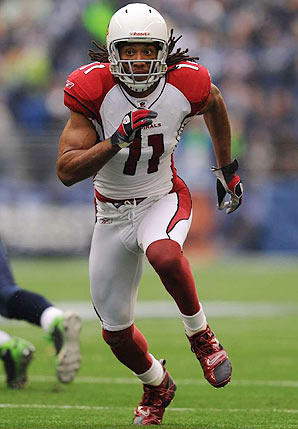
Arizona Cardinals5-95410.6721I like what Aaron Schatz said on twitter: They should put Larry Fitzgerald in the Pro Bowl just so he can play with a real quarterback at least once this year
Detroit Lions4-1045-10.7192Calvin Johnson is going to break Jerry Rice's record, but fans should take the achievement with a grain of salt considering the record number of Lions pass attempts.
Philadelphia Eagles4-1045-10.5941Even Andy Reid has to know he only has two more games left with the Eagles, right?
Oakland Raiders4-104400.4060Will we see more of Terrelle Pryor this week?
Jacksonville Jaguars2-1223-10.5631Jaguars should have the #2 pick locked up, and hope for a "slip" by the Chiefs in the next two weeks.
Kansas City Chiefs2-1223-10.7191A miserable season in Kansas City is about to come to an end.
{ 3 comments }

Looking back: The most surprising games of the year

Five weeks ago, I looked at the most surprising results of the season. It’s time to update that post now that most of the season is in the books.

First, we need to rank the teams. The table below shows each team’s current Simple Rating System rating through week 15. As a reminder, the SRS is simply the sum of a team’s margin of victory and strength of schedule.

RkTeamGMOVSOSSRS
1New England Patriots1413.4-0.213.3
2San Francisco 49ers149.91.711.7
3Seattle Seahawks149.81.210.9
4Denver Broncos1410.1-0.79.4
5Atlanta Falcons148-17
6New York Giants144.91.76.6
7Chicago Bears145.40.86.2
8Houston Texans148.1-26.1
9Green Bay Packers143.71.65.3
10Washington Redskins142.213.2
11Baltimore Ravens142.9-0.82.1
12New Orleans Saints140.71.11.8
13Cincinnati Bengals144.4-2.81.7
14Minnesota Vikings140.80.51.3
15Dallas Cowboys14-0.81.70.9
16Carolina Panthers14-1.62.10.5
17Tampa Bay Buccaneers140.4-0.20.2
18Pittsburgh Steelers141.2-1.9-0.7
19St. Louis Rams14-4.33-1.3
20Miami Dolphins14-1.1-1-2.1
21San Diego Chargers14-0.9-1.5-2.4
22Detroit Lions14-3.10.6-2.5
23Arizona Cardinals14-5.62.5-3.1
24New York Jets14-4.60.8-3.8
25Cleveland Browns14-2.6-2.2-4.7
26Indianapolis Colts14-3.5-2.3-5.8
27Buffalo Bills14-6.9-0.1-6.9
28Philadelphia Eagles14-8.71-7.7
29Tennessee Titans14-7.9-0.7-8.7
30Oakland Raiders14-10.4-1.3-11.7
31Jacksonville Jaguars14-11.7-1.5-13.2
32Kansas City Chiefs14-12.3-1.3-13.6

Eli does not like being surprised.

Half the time, Eli does not like being surprised.

Now that we have each team’s SRS score, it’s easy to come up with a projected game score. For example, since Miami has an SRS of -2.1 and Tennessee has an SRS of -8.7, this means the Dolphins are 6.5 points (rounding error) better than the Titans. Therefore, if Tennessee played at Miami, we would expect Miami to win by 9.5 points.

Well, Tennessee did travel to Miami, but the Titans won the game 37-3. Ouch. Instead of a 9.5-point win, the Dolphins suffered a 34-point loss. Therefore, this game was shocking to the tune of -43.5 points from the standpoint of the Dolphins. That makes it the most surprising game of the year.

Such a method is obviously going to be slanted towards blowouts. What if we wanted to just know which results were the most shocking? If you sort the table below by EXP_MOV — that’s the expected score — and type in “Loss” in the search box, you can see the biggest upsets.

According to the SRS, there were two huge upsets this year that only look more surprising in retrospect. The Patriots should have beaten the Cardinals by 19.4 points in Foxboro, but somehow lost in the final seconds. Meanwhile, the Saints at home against the Chiefs projected as an 18.4-point New Orleans win; it ended up being a Kansas City overtime victory.
[continue reading…]

{ 4 comments }

NYT Fifth Down: Post-week 15

A double post at the New York Times this week.

Did you know that Alex Smith is seven attempts away from qualifying for eligibility for certain rate-based statistics? If Jim Harbaugh wants to game the system — and this is Harbaugh — he could ptobably that Smith breaks the completion percentage record, set by Drew Brees in 2011.

I also looked at how the playoff field will be very familiar this year:

With two weeks remaining in the N.F.L. regular season, seven teams have clinched a playoff berth and several more can clinch this weekend. Chances are, two weeks from now, the teams in the playoffs will look pretty familiar to N.F.L. fans.

In the A.F.C. in 2011, the Patriots, the Ravens, the Texans and the Broncos won the East, North, South and West Divisions. New England, Houston and Denver have already clinched their divisions in 2012, and even the free-falling Ravens are still the favorites to win the A.F.C. North. That would give the conference four repeat division winners, a first since the league moved to the four-division format in 2002.

Last year, the Pittsburgh Steelers and Cincinnati Bengals were the two wild-card teams. Well, those two teams are currently battling for a wild-card spot, and it would be a surprise if both teams are left out of the playoffs. That would leave one spot in the A.F.C., which is most likely going to go to the Indianapolis Colts. The Colts did not make the playoffs in 2011 — in fact, the team had the worst record in the league — but they did make the playoffs every year from 2002 to 2010.

From 2009 to 2011, half of the conference — the Ravens (6), Jets (6), Patriots (5), Steelers (4), Colts (4), Broncos (2), Texans (2), and Bengals (2) — played in 31 of the A.F.C.’s 33 playoff games, and barring the miraculous (the 6-8 Dolphins are technically still alive), that won’t change this year. The last time a Tom Brady-led team didn’t make the playoffs was in 2002; the last time Peyton Manning’s team missed out on the postseason was in 2001. In the A.F.C., some things never change.

The N.F.C. features only slightly more turnover. Green Bay is going to the playoffs for the fourth straight season while Atlanta will be there for the fourth time in the five-year Matt Ryan/Mike Smith“>Mike Smith era. San Francisco has a good chance of securing a first-round bye for the second year in a row. That leaves just three remaining spots.

Seattle, winner of a playoff game just two years ago, is likely to be back in the postseason as well. The Giants, winners of two of the last five Super Bowls, will make the playoffs if they win their final two games. Chicago and Dallas are no strangers to the playoffs, and one might make it again this year. The real “surprise” teams in the N.F.C. are Minnesota — which did go to the N.F.C. championship game three years ago — and Washington. Andrew Luck and Robert Griffin III were the first two picks in the draft and may power their teams to the playoffs this year. When it comes to the 2012 season, that qualifies as unpredictable.

Your weekly updates on Adrian Peterson and Calvin Johnson

At this point, it’s getting impossible to write a statistical column without talking about Adrian Peterson“>Adrian Peterson. The Vikings gained just 322 yards against the Rams on Sunday, but Adrian Peterson“>Adrian Peterson ran for 212, accounting for 66 percent of the Minnesota offense. It was the fourth time this season — and in the last two months — that Peterson has rushed for at least 8 yards per carry on 15-plus carries; since 1960, only Barry Sanders (5) and Peterson have accomplished such a feat in a season.

In one of the most incredible stats of this or any year, Peterson has rushed for 1,313 yards in his last eight games, the most by a player in an eight-game stretch since at least 1960. From 1960 to 2011, only four men rushed for 1,200 yards in that span. In 1977, Walter Payton rushed for 1,221 yards over an eight-game stretch; three years later, Earl Campbell rushed for 1,245 yards in half a season. In 2005, Kansas City’s Larry Johnson gained 1,244 rushing yards in the last eight games of the year. Before Peterson, Eric Dickerson held the record for rushing yards in an eight-game stretch; Dickerson rushed for 1,292 yards in the last five games of the ’84 season and the first three games of 1985.

For more on Peterson and Calvin Johnson, along with some interesting week 15 stats, check the full article here.

{ 0 comments }

Checkdowns: Biggest failed comebacks

Brady joins Marino on the failed comebacks list

Brady joins Marino on the failed comebacks list.

[UPDATE: There was an error earlier in this post. I believe it is fixed now.]

On Sunday Night, the Patriots trailed 31-3 halfway through the third quarter. But that’s when Tom Brady got hot, and New England tied the game with 6:43 left in the 4th quarter. At that moment, many fans probably had visions of the Oilers-Bills playoff game, where Buffalo came back from a 32-point deficit to win.

And while there are a lot of famous comebacks, the failed comeback is much less memorable. But in fact, this was the 4th time a team trailed by 28 points in the game only to tie or take the lead in the 4th quarter… but ultimately lose.

The table below shows all games prior to 2012 where a team trailed by at least 21 points, was trailing entering the 4th quarter, came back to tie or take the lead in the 4th quarter, but then still lost. The table is listed from the perspective of the eventual winner and shows the final points for and points allowed in the game, along with the biggest lead and the largest fourth-quarter deficit the winning team faced despite the large early lead.

YearDateBoxscoreTmOppPFPABgLdDef
199409/25/1994BoxscoreMINMIA3835280
194409/24/1944BoxscoreGNBCHI4228280
200710/21/2007BoxscoreTENHOU383625-1
200412/12/2004BoxscoreSFOARI3128250
198012/07/1980BoxscoreCINBAL343325-2
198710/25/1987BoxscoreGNBDET343324-2
198101/02/1982BoxscoreSDGMIA413824-7
199609/22/1996BoxscoreNWEJAX2825220
201012/13/2010BoxscoreBALHOU3428210
200910/11/2009BoxscoreARIHOU2821210
200901/10/2010BoxscoreARIGNB5145210
200809/14/2008BoxscoreGNBDET482521-1
200612/17/2006BoxscoreCHITAM3431210
200410/10/2004BoxscoreMINHOU3428210
200311/30/2003BoxscoreNWEIND3834210
199912/12/1999BoxscoreKANMIN3128210
199812/06/1998BoxscoreSFOCAR3128210
199511/19/1995BoxscoreDENSDG3027210
199309/12/1993BoxscoreNORATL3431210
199301/03/1994BoxscorePHISFO3734210
199111/17/1991BoxscoreNYJNWE2821210
199010/07/1990BoxscoreCINRAM3431210
198909/10/1989BoxscoreNWENYJ272421-3
198611/20/1986BoxscoreRAISDG3731210
198301/08/1984BoxscoreWASSFO2421210
198011/23/1980BoxscoreNYJHOU3128210
197909/09/1979BoxscoreWASDET2724210
197511/30/1975BoxscoreWASMIN313021-6
196011/06/1960BoxscoreBALGNB3824210
194910/23/1949BoxscoreNYGCHI3528210
194511/04/1945BoxscoreWASCRD2421210

Note that this excludes games this game between Green Bay and Pittsburgh from 1951, where the Packers held a 28-point lead and won, but actually trailed entering the 4th quarter.

{ 1 comment }

Adjusting team sack rates in the NFL for SOS

I’ve got sacks on the mind today. A few hours ago, I looked at the single-season sack records by various players in both the 3-4 and 4-3. Today I also want to look at things from the team perspective. In 2012, which team is the best at getting to the quarterback? You might think that’s as simple as looking at a list of defensive statistics and sorting by sacks, but I’d like to take a more nuanced approach.

There are two factors that heavily impact a team’s sack rate: the opponents they face and the number of passing plays they defend. Using sack rate instead of sacks helps to solve the latter issue, but we still need an opponent adjustment even if we use sack rate. It’s a bit tricky doing it correctly, because you need to iterate the results just like you do with the SRS. What I mean by that is the sack rate of the Denver defense will need to be adjusted for the sack rate of the Kansas City, Oakland, and San Diego offenses (among other teams), and those will need to be adjusted for the Denver defense (and all the other defenses those teams faced).

Once you properly iterate the results, what are the results? The table below shows the top defenses this year at getting to the quarterback, although note that these numbers exclude the games from week 15. The table shows how many pass attempts each team has faced, the number of actual sacks they have recorded and their actual sack rate; the next column shows the SOS adjustment to the sack rate, with a positive number indicating a difficult strength of schedule (i.e., they’ve faced teams that are difficult to sack). The last two columns show the SOS-adjusted sack rates and total sacks.

RkTeamATTACT SKSK RTSOSADJ SK RTADJ SK
1DEN506397.7%0.9%8.6%43.3
2CIN542437.9%0.5%8.4%45.7
3ARI426348%-0.5%7.4%31.7
4DAL429296.8%0.3%7.1%30.4
5CAR483306.2%0.9%7.1%34.2
6KAN389246.2%0.9%7.1%27.5
7STL489398%-1.2%6.8%33.1
8PHI467286%0.8%6.8%31.6
9HOU533376.9%-0.2%6.7%35.9
10MIA532377%-0.2%6.7%35.7
11GNB524356.7%-0.1%6.6%34.6
12BAL506305.9%0.6%6.6%33.3
13CLE531346.4%0.2%6.6%34.8
14NYG464316.7%-0.1%6.5%30.4
15SFO478326.7%-0.4%6.3%30.3
16PIT434266%0.3%6.3%27.4
17ATL463286%0.3%6.3%29.2
18BUF484316.4%-0.2%6.2%30.2
19CHI498336.6%-0.5%6.1%30.6
20SDG508254.9%1%5.9%30
21TEN481275.6%0.3%5.9%28.3
22SEA475326.7%-1.1%5.7%27
23NWE511285.5%-0.1%5.3%27.3
24NOR496255%0.2%5.3%26.1
25MIN515316%-0.8%5.2%27
26DET490306.1%-1.1%5%24.4
27WAS539234.3%0.7%4.9%26.6
28TAM541244.4%0.5%4.9%26.5
29NYJ446224.9%-0.1%4.8%21.5
30IND470245.1%-0.4%4.7%22.3
31OAK465173.7%0.7%4.3%20.1
32JAX464143%0%3%14

[continue reading…]

{ 3 comments }

Monster

J.J. Swatt.

Houston’s J.J. Watt sacked Andrew Luck three times on Sunday, bringing his season sack total to 19.5. Entering 2012, Bruce Smith was the single-season record holder for sacks by a defensive lineman in a 3-4 scheme with 19 in 1990. The sack has only been an official statistic since 1982, but since the 3-4 only entered the NFL in the mid-’70s, we can be pretty sure that Watt is now the all-time record holder.

The tables below show the single-season leaders by various defensive players in 3-4 and 4-3 schemes from 1982 to 2011.

Let’s start with a look at the most sacks by a 3-4 defensive end:

YearTeamNamePosSacks
1990BUFBruce Smith3-4 DE19
1983SFOFred Dean3-4 DE17.5
1984PHIGreg Brown3-4 DE16
1983MIADoug Betters3-4 DE16
1983SEAJacob Green3-4 DE16
1992NORWayne Martin3-4 DE15.5
1986RAISean Jones3-4 DE15.5
1985NYGLeonard Marshall3-4 DE15.5
1993KANNeil Smith3-4 DE15
1986SDGLee Williams3-4 DE15
1986BUFBruce Smith3-4 DE15
1984KANArt Still3-4 DE14.5
1984SEAJeff Bryant3-4 DE14.5
1983GNBEzra Johnson3-4 DE14.5
1997BUFBruce Smith3-4 DE14
1993BUFBruce Smith3-4 DE14
1992BUFBruce Smith3-4 DE14
1989SDGLee Williams3-4 DE14
1984MIADoug Betters3-4 DE14
1984CLEReggie Camp3-4 DE14
1983PITKeith Willis3-4 DE14

As you can imagine, 3-4 defensive linemen don’t rack up many sacks. Bill Pickel, a nose tackle for the Raiders in the ’80s, recorded 12.5 sacks in both ’84 and ’85, making him the only 3-4 tackle to record more than 12 sacks in a season. Karl Mecklenburg, with 13 sacks for the Broncos in ’85, remains the only inside linebacker in a 3-4 with more than a dozen sacks.

Of course, 3-4 outside linebackers get all the glory in that scheme. San Francisco’s Aldon Smith has 19.5 sacks so far in 2012 with two games remaining, but here were the leaders prior to 2012:

YearTeamNamePosSacks
1986NYGLawrence Taylor3-4 OLB20.5
2008DALDeMarcus Ware3-4 OLB20
1990KANDerrick Thomas3-4 OLB20
2011DALDeMarcus Ware3-4 OLB19.5
1989GNBTim Harris3-4 OLB19.5
1984NWEAndre Tippett3-4 OLB18.5
2008MIAJoey Porter3-4 OLB17.5
1995BUFBryce Paup3-4 OLB17.5
2009DENElvis Dumervil3-4 OLB17
2006SDGShawne Merriman3-4 OLB17
1992SFOTim Harris3-4 OLB17
1991NORPat Swilling3-4 OLB17
1989NORPat Swilling3-4 OLB16.5
1989RAMKevin Greene3-4 OLB16.5
1988RAMKevin Greene3-4 OLB16.5
1985NWEAndre Tippett3-4 OLB16.5
2008PITJames Harrison3-4 OLB16
1992DENSimon Fletcher3-4 OLB16
1990SFOCharles Haley3-4 OLB16
2010DALDeMarcus Ware3-4 OLB15.5
1988NYGLawrence Taylor3-4 OLB15.5
1998CARKevin Greene3-4 OLB15
1989NYGLawrence Taylor3-4 OLB15
1984PITMike Merriweather3-4 OLB15

What about 4-3 defensive ends?

YearTeamNamePosSacks
2001NYGMichael Strahan4-3 DE22.5
2011MINJared Allen4-3 DE22
1984NYJMark Gastineau4-3 DE22
1989MINChris Doleman4-3 DE21
1987PHIReggie White4-3 DE21
1992PHIClyde Simmons4-3 DE19
1983NYJMark Gastineau4-3 DE19
2003NYGMichael Strahan4-3 DE18.5
2002MIAJason Taylor4-3 DE18.5
1986WASDexter Manley4-3 DE18.5
2011PHIJason Babin4-3 DE18
1988PHIReggie White4-3 DE18
1984CHIRichard Dent4-3 DE17.5
1999STLKevin Carter4-3 DE17
1992SDGLeslie O'Neal4-3 DE17
1985CHIRichard Dent4-3 DE17
2011NYGJason Pierre-Paul4-3 DE16.5
2008ATLJohn Abraham4-3 DE16.5
2000MIATrace Armstrong4-3 DE16.5
1999ARISimeon Rice4-3 DE16.5
1998SEAMichael Sinclair4-3 DE16.5
2005OAKDerrick Burgess4-3 DE16
2004INDDwight Freeney4-3 DE16
1998GNBReggie White4-3 DE16
1983STLCurtis Greer4-3 DE16

And 4-3 defensive tackles:

YearTeamNamePosSacks
1989MINKeith Millard4-3 DT18
1986PHIReggie White4-3 DT18
2000NORLa'Roi Glover4-3 DT17
2000TAMWarren Sapp4-3 DT16.5
1997MINJohn Randle4-3 DT15.5
1997SFODana Stubblefield4-3 DT15
1992SEACortez Kennedy4-3 DT14

4-3 outside linebackers rarely rack up huge sack numbers. In fact, Denver’s Von Miller, who has 16 sacks this year, is already the record holder in the official sack era. Derrick Thomas (14.5 sacks in 1992, 13 in 1996) in Kansas City, Washington’s Ken Harvey (13.5 in ’94) and Cleveland’s Jamir Miller (13 in ’01) are the only other 4-3 outside linebackers with more than twelve sacks in a season since 1982. (Of course, Thomas also had a 20-sack season a 3-4 outside linebacker.) Charlie Clemons, with 13.5 sacks in 2001, is the record holder among 4-3 middle linebackers.

{ 2 comments }

Trivia of the Day – Sunday, December 16th

Manning finds the last empty spot on his trophy case.

What do you give to the man who already has everything? How about a Comeback Player of the Year Award?

Right now, the choice for AP Comeback Player of the Year is a two-horse race between Peyton Manning and Adrian Peterson. If Manning wins the award, it will put him in pretty rare territory: he’d be just the fourth player to, over the course of a career, be named by the Associated Press as the Most Valuable Player of the Year, Comeback Player of the Year, and Super Bowl MVP. Can you name the first three?

Below is one hint for each of the three players who have won all three awards.

Trivia hint for Player 1 Show


Click 'Show' for the Answer for Player 1 Show

Trivia hint for Player 2 Show


Click 'Show' for the Answer for Player 2 Show

Trivia hint for Player 3 Show


Click 'Show' for the Answer for Player 3 Show

{ 5 comments }

From the Colorado School of Mines to the NFL

Unless you follow Division II football, you probably aren’t familiar with the name Bob Stitt. He’s the head coach at the Colorado School of Mines, and here is what Bruce Feldman wrote about him in the summer of 2011 in connection with the One-Back Clinic, an annual meeting of a few of the sharpest minds in college football:

Stitt is the 45-year-old head coach at Colorado School of Mines, a Division II school just down the road from the Coors facility in Golden, Co. Stitt is a regular to the one-back clinic and has become pals with [Dana] Holgorsen and the rest of the core crowd. His teams win big despite dealing with high academic requirements… Stitt’s topic is the pistol offense and back-shoulder throws. As you’ll find out, Stitt is a huge believer in the back-shoulder throw. He talks about it the way Jared talks about Subway. “If this stuff works with our guys, it’ll probably work with the guys you have,” he says. “We’re an engineering school, and we only have one major, engineering. Our average ACT score in math is 29.” That line draws the biggest “Oooh!” of the day. . . .

The tricky part of Stitt’s tact — as is the case with many of the things discussed here — is that it’s hard to say just how well these things could be replicated someplace else. “I love coming to this because it reinforces a lot of what we do, ” one coach says. “Sometimes you might get one or two things you can try out from a technique or a practice point.” It’s also pretty good for networking because you never know what position might open a few months from now.

That was only a year and a half ago, but Stitt’s fame has grown considerably since then. He’s become famous in some circles for the Fly Sweep, a play brought to the national state when Holgorsen repeatedly used the Fly Sweep in the Orange Bowl eleven months ago. So what is the Fly Sweep?

On most plays, West Virginia has Geno Smith in shotgun in a fairly standard shotgun spread look. On the Fly Sweep, the Mountaineers would motion a wide receiver/running back, usually Tavon Austin, before the snap, and have him accelerate as he approached the quarterback. When well-executed, the snap would arrive in Smith’s hands for just a fraction of a second before he would pitch the ball forward to Austin, who would be arriving between the center and the quarterback just a second after the ball was snapped. Already in motion and with the ball in his hands, Austin would then be able to use his considerable speed and quickness to get in space and rack up yards against an unprepared defense.

Well, in the Orange Bowl, it was executed perfectly. For four touchdowns. Take a look:

http://www.youtube.com/watch?v=1Gu62DFo9-w

One of the benefits of the play is that it is low risk: if the quarterback/sweep exchange is mishandled, it’s simply an incomplete pass because the quarterback is technically throwing the ball forwards. So why the post today? Well, last week, the Stitt Sweep (my post, I get to pick the name) entered the NFL. I’m not sure if Jay Gruden picked up the play from his time in the Arena Football League or the World Football League — or maybe from just watching last year’s Orange Bowl — but there’s no doubt where the inspiration came from the Bengals first touchdown of the game against the Cowboys. You can see Andy Dalton’s touchdown “pass” to Andrew Hawkins at the 40-second mark of this video.

{ 1 comment }

Checkdowns: Elo-Ratings for NFL teams

So we're going to pretend all my losses were by 1 point?

So we're going to pretend all my losses were by 1 point?

Just a quick Friday night checkdown post. By now, you’re very familiar with the Simple Rating System. I used the SRS to create college football ratings every week this season and used the SRS to grade NFL teams earlier this year. Pro-Football-Reference.com calculates SRS ratings every week and they are always available on their Standings page.

The first S in SRS stands for Simple because the SRS is simply the sum of two variables: a team’s average margin of victory (or points differential) and a team’s strength of schedule.

But what if we only care about wins and losses? Even in that case, we still care about strength of schedule. The BCS mandates that the computer systems used to provide the official BCS ratings ignore margin of victory. Essentially, that’s what I’m doing here. To provide Elo-style ratings for NFL teams, I made each win a one-point win, each loss a one-point loss, and each tie worth 0 points. Therefore, a team’s MOV perfectly matches its record, leaving just the SOS to shuffle the deck.

Is this useful for anything? No. That’s why it’s a Friday night checkdown.

RkTeamGMOVSOSSRSRecord
1Houston Texans130.6920.0110.70411-2-0
2New England Patriots130.5380.1160.65410-3-0
3San Francisco 49ers130.4620.0810.5439-3-1
4Green Bay Packers130.3850.1070.4929-4-0
5Atlanta Falcons130.692-0.2730.4211-2-0
6Denver Broncos130.538-0.1660.37310-3-0
7Chicago Bears130.2310.1210.3528-5-0
8Seattle Seahawks130.2310.1140.3458-5-0
9Indianapolis Colts130.385-0.0530.3329-4-0
10Baltimore Ravens130.385-0.1350.2499-4-0
11New York Giants130.231-0.040.1918-5-0
12St. Louis Rams1300.1750.1756-6-1
13Minnesota Vikings130.0770.0670.1447-6-0
14New York Jets13-0.0770.1720.0956-7-0
15Washington Redskins130.077-0.0030.0747-6-0
16Dallas Cowboys130.077-0.0120.0657-6-0
17Cincinnati Bengals140.143-0.203-0.068-6-0
18Pittsburgh Steelers130.077-0.138-0.0617-6-0
19Miami Dolphins13-0.2310.126-0.1055-8-0
20Buffalo Bills13-0.2310.067-0.1645-8-0
21Arizona Cardinals13-0.3850.203-0.1814-9-0
22Detroit Lions13-0.3850.188-0.1974-9-0
23Tampa Bay Buccaneers13-0.077-0.162-0.2396-7-0
24Tennessee Titans13-0.3850.134-0.254-9-0
25New Orleans Saints13-0.231-0.035-0.2665-8-0
26Cleveland Browns13-0.231-0.125-0.3565-8-0
27Carolina Panthers13-0.3850.014-0.3714-9-0
28San Diego Chargers13-0.231-0.165-0.3965-8-0
29Philadelphia Eagles14-0.429-0.048-0.4764-10-0
30Jacksonville Jaguars13-0.6920.141-0.5512-11-0
31Oakland Raiders13-0.538-0.112-0.6513-10-0
32Kansas City Chiefs13-0.692-0.148-0.842-11-0
{ 2 comments }

What to do on 4th-and-7 in No Man’s Land

You went to Harvard, help me out on this

You went to Harvard, help me out on this.

Twice in close games in the last month, an NFL team has arrived at a three-way junction with seemingly no desirable path. In each case, the team faced a 4th and 7 from so-called ‘no man’s land.’

On November 25th, trailing the Atlanta Falcons 24-23, the Buccaneers had the ball on 4th and 7 from the Atlanta 38-yard line with just over three minutes remaining. Greg Schiano had all his timeouts left but faced a very difficult decision.

On Sunday, with 12 minutes remaining and a 12-7 lead, Chan Gailey’s Bills faced a 4th-and-7 from the St. Louis 34-yard-line. It’s worth noting — in part because it was notable to Gailey — that minutes earlier, Buffalo scored a touchdown but Shawn Powell botched the extra point, preventing Buffalo from going up 13-7. I suppose we could dwell on the fact that up 5 with 20 minutes left in the game after scoring a touchdown is an obvious scenario that calls for going for two, but let’s not do that in this post.

In Tampa Bay, Schiano attempted a 56-yard field goal. In Buffalo, with rain but wind at his back, the Bills sent on the field goal unit but then changed their mind and chose to punt, with the botched snap from minutes earlier apparently being a factor in the decision.

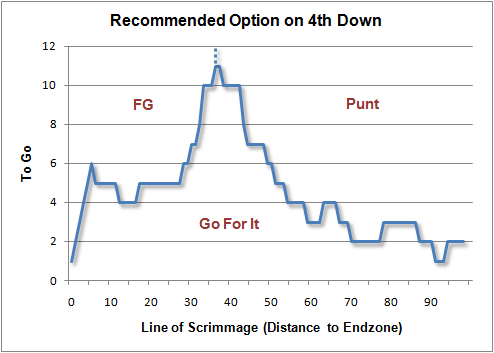
Who was right? Who was wrong? If you think this post is just a bunch of words I needed to type to show off a really cool graphic, you’re right. Take a look at this chart Brian Burke made to tell you what to do on 4th down generally:

At the 35-yard-line facing 4th and 7 is not a desirable situation, but Burke does say you should go for it. If you are a few yards closer to the end zone and it’s 4th and 8, then kicking is the advised course of action, while punting is best reserved for more dire circumstances.

What do teams actually do? This year, 15 times a team has faced a 4th-and-7 from between the 34- and the 38-yard lines. Nine times the team chose to kick the field goal, with teams hitting on 5 of those 9; Nick Folk missed from 52 but made from 54, Josh Brown hit from 52, Matt Prater from 53, Robbie Gould from 54, and Sebastian Janikowski from 55, while Dan Bailey and Janikowski missed from 54. The 9th example was in Tampa Bay, where Connor Barth missed from 56 yards out.

As you might expect if you have watched an NFL game before, coaches who chose not to kick the field goal did not entirely embrace the idea of going for it. Twice the Bills sent Shawn Powell out to punt (net of 29 and 24 yards), twice a team punted the ball out of the end zone (Pat McAfee, Dave Zastudil), and Andy Lee pinned the Rams on their four-yard-line with a 33-yard punt.

There was one coach who chose to go for it. It was Marvin Lewis, that beacon of wisdom in a cavernous field of conservative coaches. In the first quarter, trailing 3-0 to the Chiefs, first Lewis called a fake punt and when the drive stalled on the Kansas City 36, he chose to go for it. Andy Dalton scrambled for 11 yards, the Bengals would score a touchdown three plays later, and Cincinnati would go on to win the game, 28-6.

So what is the right call in the NFL’s version of the Bermuda triangle? The first answer is “it depends.” All these league average stats and theories have caveats which are easy to ignore in obvious situations. In close situations, like this one, all those caveats apply. Is it windy or raining? Are you in a dome? How good is your quarterback? What’s the score? How much time is left? And on and on.

Here are my thoughts for the two examples in this post.

  • Schiano made the wrong call, but probably not for the reason you’re thinking. I’d say Barth had something resembling a 50/50 shot of converting that field goal, but what is the upside if he does? You now have a one-point lead against the Falcons with 3:30 to go and they have the ball. That’s not exactly a desirable scenario. According to Burke, the league average team has a 48% chance of winning if they have 1st and down on their own 22 with 3:30 left and trailing by one point. But this was not a situation involving league average teams. Matt Ryan has led the NFL in 4th quarter comebacks and game-winning drives in two of the last three years. He ranks 10th in ANY/A and 3rd in completion percentage, which might actually matter when your only real goal is gaining 10 yards every four plays. To make matters worse, despite an incredible run defense, Tampa Bay ranks 32nd in both passing yards allowedand net yards per attempt allowed.

    If there were six minutes left, maybe this is a different story, but I think there was too little time left to give up the ball like that. You’ve got Josh Freeman — who ranks 4th in ANY/A — going against a mediocre Falcons pass defense. I’d go for it in that situation, because your best path to victory is to gain 7-10 yards and then bleed the clock before kicking the game-winning field goal. I’ll also add this: to the extent that you want to bank on your opponent’s conservatism, punting is not as bad of an option as you might think. If you can down the punt inside the 10, and feel confident that Atlanta would run it three times, then you’re in pretty good. If successful, you would get the ball back with about 3 minutes left (remember, Tampa Bay had all three timeouts) and basically place yourself in that positive situation the Falcons would have been in if the Bucs hit the field goal, except Tampa would have been about 25 yards closer. Of course, I have no idea how much you can count on your opponent being conservative: that would depend on the opponent.
  • While the clock was the most important variable in the Tampa game, it wasn’t a huge factor in Buffalo. The Bills led by 5 points with 12 minutes to go. In this case, the Bills were at the 34, not the 38, which tilts towards the field goal and away from the punt. On the other hand, there were weather issues at play. In a rare twist, Burke’s calculator essentially has all three options as even, with the Bills having a 77-78% win probability regardless of whether they chose to punt, kick, or go for it. The Bills have a slightly below average passing offense and the Rams a slightly above average passing defense, but neither factor is particular strong. This is one of the closest calls I can think of, as I see good arguments for all three options. The Bills punted and pinned the Rams inside the five, so Chan Gailey won’t face too much criticism.

    But while extending a lead from 5 to 8 points doesn’t sound like much, it actually has a significant impact. Down by 8, you need to do a bunch of things well and then convert a two-point conversion and then win in overtime, and those two events only happen 25% of the time. Down by 5 you just need to do a bunch of things well. The weather is an important factor here — Rian Lindell said the wind was at his back, which maybe makes the weather a nonfactor even if it was raining, cold, and windy. In field goals from the 33-, 34-, or 35-yard line since 2009, NFL kickers have been successful 62% of the time. Again, the conditions are a huge variable here, but I think I would have trusted my kicker in this case.
{ 2 comments }

Week 14 Power Rankings

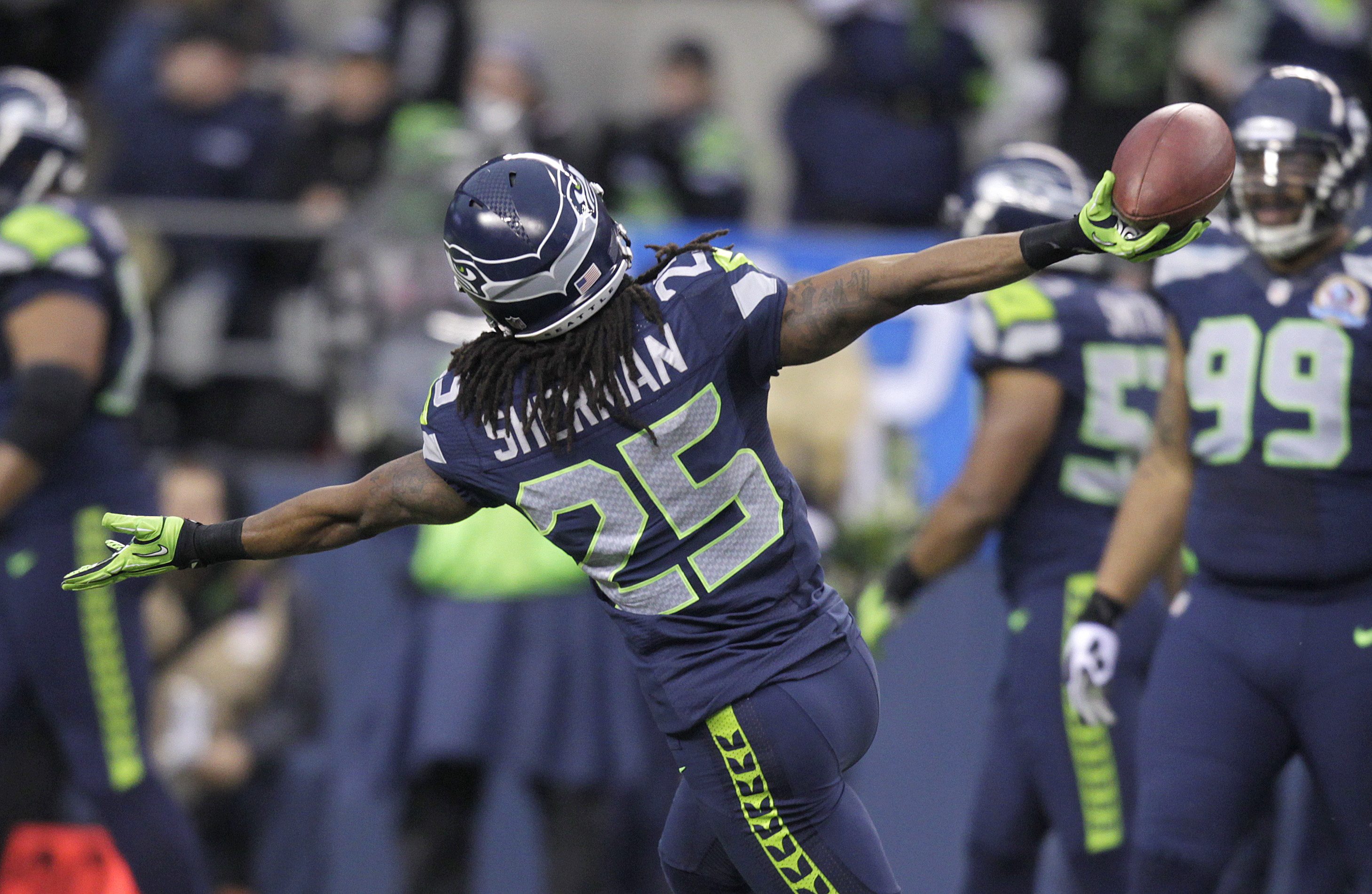
Richard Sherman exhibits the proper form for 'You Mad Bro?' in sign language.

It’s time to take Seattle seriously. On Sunday, the Seahawks had a “name your score” game, the type of matchup college football powerhouses regularly use to beef up their statistics. The Seahawks defense took over the game, posting the 10th highest fantasy performance ever, but the offense wasn’t too shabby, either. Seattle rushed for 284 yards and 4 touchdowns, and Russell Wilson completed 7 of 13 passes for 148 yards.

Brian Burke now has the Seahawks 4th in his power rankings. Aaron Schatz has Seattle second overall, and even had them first before the Patriots blew out the Texans on Monday Night. Seattle is third according to the SRS, too. Seattle is better on offense than you think: the Seahawks rank 8th in ANY/A and 11th in NY/A and 4th in rushing yards and 5th in rushing first downs. Seattle is 15th in points scored and 14th in PFR’s Expected Points Added, but they’ve done all this despite facing a pretty difficult schedule filled with good defenses.

Defensively, they’re in the top 10 in rushing yards allowed, rushing first downs allowed, rushing touchdowns allowed and EPA. The Seahawks are 4th in NY/A and 2nd in ANY/A allowed, while ranking 7th in turnovers forced, 3rd in yards allowed and 2nd in points allowed.

They’re really good and really balanced. Are they a Super Bowl contender? Absolutely. So what about that 8-5 7-6 record according to Packers fans? Well, Seattle lost by 4 in Arizona, by 6 in St. Louis, by 7 in San Francisco, by 4 in Detroit, and by 3 in Miami. They were leading in the 4th quarter in every game except the 49ers loss (trailed by 4 late in the game) and the Rams loss (intercepted in Rams territory in the final minutes). They’ve lost some close games in the 4th quarter and dominated most of their other opponents. They’re one of the best teams in the NFL. Obviously they’re even better at home, but if New England defeats San Francisco this week, the entire landscape of the NFC playoffs will change.

If the 49ers lose in Foxboro, the Seahawks control their own destiny for the division title since they host the 49ers in week 16. And if the Packers lose one of their final three games, the Seahawks would control their own destiny for the 2 seed, which would mean a bye and a home playoff game — or possibly two, if Matt Ryan and the Falcons lose like everyone expects. Essentially, Seattle fans can dream about this scenario:

— New England wins at home against San Francisco (the Patriots are 5-point favorites)
— Green Bay loses in Chicago (or in Minnesota or at home against the Titans)
— Seattle wins in Toronto, which would be their last road game of the year if…
— Seattle beats San Francisco and St. Louis at home and…
— The Falcons lose to the Giants or 49ers or whichever team they face in the second round of the playoffs

There are a lot of “ifs” and “ands” but they’re in as good a position as I can ever remember an 8-5 team being. Of course, even as the 2 seed they would likely have to beat Green Bay and then either New York or San Francisco to get to the Super Bowl, so I wouldn’t book tickets to New Orleans just yet.

[As always, the number of wins I’m projecting each team to finish the season with is in column 3. The fourth column – PWIN – shows how many wins I projected last week, and the difference column represents how many wins I added or subtracted this week. The “RSOS” column stands for the remaining SOS for the team, based on the number of projected wins I’m giving to each of their opponents. The “RHG” column stands for remaining home games.]

TeamRecWinsPrvWinDiffRemSOSRemHGComment
Atlanta Falcons11-21314-10.4582According to Advanced NFL Stats, the Panthers had a 62% chance of winning against Atlanta.
Houston Texans11-2131300.5632That's your classic 'burn the tape' game. Houston still controls their own destiny for the #1 seed.
Denver Broncos10-3131300.3962Guess what? I still think the Broncos win 13 games this year.
New England Patriots10-3131210.4272But so will the Patriots. We could have three 13-3 teams in the AFC and no one else with more than ten wins.
Green Bay Packers9-4111100.4581Aaron Rodgers leads the league in sacks for the second time in four years.
Seattle Seahawks8-5111010.5002Russell Wilson will get some Rookie of the Year votes if the Seahawks get 11 wins.
San Francisco 49ers9-3-110.511.5-10.5831Aldon Smith is a monster. He's got Michael Strahan's "record" in sight. But at New England and at Seattle are brutal tasks.
Baltimore Ravens9-41011-10.6462When the Ravens were 9-2, I wrote "I still don't believe in this team, because they aren't going to have amazing special teams or amazing 4th and 29 conversions every week."
Chicago Bears8-51011-10.4171The Bears took care of business early in the year, giving themselves some margin for error later on. Finishing against Arizona and Detroit gives them a safety net
Indianapolis Colts9-4101000.6041If it didn't look like they were going to play Baltimore, I'd say picking against the Colts will be the easiest call of the playoffs.
New York Giants8-510910.5831There are no easy games left, but I'm not ready to bet against the Giants.
Pittsburgh Steelers7-6910-10.4792This team suffers so many inexplicable losses, Mike Tomlin has to bear some of the blame.
Dallas Cowboys7-69810.5002Huge game for the Cowboys to beat the Bengals. Wait, if they won, it couldn't have been a huge game, right?
Washington Redskins7-69810.4171NFC East race is going to be fascinating. Robert Griffin III and Kirk Cousins combined for the comeback win to keep Washington alive.
Cincinnati Bengals7-689-10.5001Just when I start to get on their bandwagon, the Bengals did the unthinkable and blew a lead against the Cowboys.
New York Jets6-78710.3751The Jets proved that they can beat the worst teams in the league. The Titans are right on that border, so Monday Night will be interesting.
St. Louis Rams6-6-17.57.500.5211Incredible job by Jeff Fisher this year. Rams can make the playoffs if they run the table.
Tampa Bay Buccaneers6-778-10.5521I did not see that coming; blowing a big lead, at home, against Nick Foles, means this team is farther away than I thought.
Miami Dolphins5-87700.4582Miami gets to host in-state rival Jacksonville and division rival Buffalo the next two weeks. Unfortunately, it's another meaningless december for the Dolphins.
Minnesota Vikings7-67610.6561I thought the Vikings were done, but Adrian Peterson took over against the Bears.
San Diego Chargers5-87610.3752Keep Norv!
New Orleans Saints5-867-10.4582Drew Brees leads the league in both passing touchdowns and interceptions.
Buffalo Bills5-867-10.5422One loss away from clinching their 7th consecutive losing season. They get to expand their internationl reach in Toronto this weekend.
Carolina Panthers4-96510.3541That's the type of team Carolina could be. I don't think Ron Rivera can save his job, but his team was well-prepared against Atlanta.
Cleveland Browns5-86510.6461Cleveland won by 23 points. That's kind of a big deal, since the new Browns have only won by so many points once before.
Tennessee Titans4-956-10.4582Titans did a great job against Andrew Luck, but could not come away with the win. Next up? Mark Sanchez.
Detroit Lions4-95500.5632Only interesting thing over the next three weeks is whether Calvin Johnson can break Jerry Rice's record.
Philadelphia Eagles4-95410.5632Keep Andy!
Arizona Cardinals4-945-10.5312From 4-0 to 4-12.
Oakland Raiders3-104400.3331This was going to be a one step backwards type of season with a new regime; the question is will they ever take two steps forward?
Jacksonville Jaguars2-113300.5211Fought valiantly for a bad team that's been killed by injuries and lacks talent just about everywhere. Of course, their opponent was the Jets.
Kansas City Chiefs2-113300.5631Chiefs-Raiders this weekend with the #1 pick on the line.
{ 2 comments }

You’re probably hearing a lot right now about how Matt Schaub is not a primetime player — literally. Schaub and the Texans struggled in embarassing losses on Sunday Night Football to the Packers earlier in the season and on Monday Night Football two days ago to the Patriots. Schaub posted terrible numbers in a defensively-driven 13-6 win over the Jay Cutler/Jason Campbell Bears.

For his career, Schaub is 2-5 (0.286 winning percentage) in night games and 41-31 (0.569) in day games. Among the 24 quarterbacks studied (more on that below), that drop in winning percentage is the largest such decline. You might think this is due to facing better defenses in night games, but that’s not really the case.

Schaub has averaged 7.8 Adjusted Yards per Attempt during day games and 6.0 AY/A during night games; that difference of 1.8 AY/A is the second largest among the twenty-four quarterbacks.

So yes, there is no debate: Schaub has been noticeably worse during night games in his career.

The table below shows all quarterbacks who have started a game this season and that have started at least five night games in their career. The data consist of all games throughout their career in which they were the starter. To make it a little easier to read, I’ve shaded the day and night categories differently:

QBD_W/LD_WIN%D_Y/AD_AY/AN_W/LN_WIN%N_Y/AN_AY/AY/A_DIFFAY/A_DIFFWin%_Diff
Jason Campbell28-310.4756.936.653-90.255.754.77-1.18-1.88-0.225
Matt Schaub41-310.5697.937.792-50.2866.946-0.99-1.79-0.284
Jay Cutler37-280.5697.36.8413-140.4817.16.08-0.2-0.76-0.088
Joe Flacco46-210.6877.116.912-70.6326.646.19-0.47-0.71-0.055
Ben Roethlisberger67-270.7137.947.7929-140.6747.857.14-0.09-0.65-0.038
Matt Ryan47-190.7127.197.037-50.5836.636.4-0.56-0.63-0.129
Carson Palmer48-580.4537.256.745-100.3336.556.27-0.7-0.47-0.119
Matt Cassel25-290.4636.596.114-50.4446.355.65-0.24-0.46-0.019
Matt Hasselbeck75-720.516.886.4210-60.6256.96.220.02-0.20.115
Aaron Rodgers40-200.6678.218.6814-70.66788.49-0.21-0.190
Alex Smith31-320.4926.616.078-50.6156.325.91-0.29-0.160.123
Sam Bradford13-200.3976.215.791-40.26.335.710.12-0.08-0.197
Michael Vick43-380.536.976.5515-80.6527.066.520.09-0.030.122
Mark Sanchez29-200.5926.645.828-90.4716.425.83-0.220.01-0.121
Tony Romo35-270.5657.77.6720-120.6258.177.740.470.070.06
Eli Manning61-390.617.136.5424-190.5586.966.68-0.170.14-0.052
Matthew Stafford16-210.4326.876.511-50.1677.476.90.60.39-0.266
Peyton Manning120-620.6597.587.3940-180.697.77.790.120.40.03
Tom Brady112-300.7897.397.4938-140.7317.557.90.160.41-0.058
Byron Leftwich21-240.4676.5163-30.56.656.470.140.470.033
Philip Rivers51-350.5937.87.5320-100.6678.18.130.30.60.074
Drew Brees79-620.567.397.1823-110.6767.77.840.310.660.116
Charlie Batch16-270.3726.725.789-30.757.738.221.012.440.378
Chad Henne12-170.4146.35.172-30.48.057.811.752.64-0.014

[continue reading…]

{ 3 comments }

I’ve noted a few times this year that Calvin Johnson, in his pursuit of Jerry Rice’s single-season receiving record, has quite an advantage on his side. The Lions have attempted more passes through 13 games of any team ever, and seem likely to break the pass attempts record.

Obviously it’s easier to gain more receiving yards when your team is throwing the ball nearly every play. That’s why when I came up with my Greatest WR Ever series, I looked at receiver performance per pass attempt.

I don’t have time for a nuanced analysis of wide receiver, but let’s just look at a simple statistic: receiving yards per team pass attempt. That’s what the table below shows, along with each player’s rank in receiving yards (the far left column). Brandon Marshall has 1,342 receiving yards while the Bears have only attempted 444 passes this year (including sacks). That means he’s averaging more than three yards per team pass attempt, which is incredible. Of course, it also speaks to the lack of other weapons in Chicago.

Ryds RkPlayerTmRecRydsTDTMATTYds/AttY/A Rk
2Brandon MarshallCHI101134294443.021
7Vincent JacksonTAM56114584422.592
4Andre JohnsonHOU82120934712.573
1Calvin JohnsonDET96154656182.54
6A.J. GreenCIN791151104782.415
5Demaryius ThomasDEN74119785032.386
12Steve SmithCAR6099924252.357
9Wes WelkerNWE95111645192.158
3Reggie WayneIND94122045692.149
8Roddy WhiteATL77114055352.1310
11Victor CruzNYG76100494792.111
14Brian HartlineMIA6292514422.0912
28Michael CrabtreeSFO6676153831.9913
13Julio JonesATL6399775351.8614
22Dwayne BoweKAN5980134361.8415
10Dez BryantDAL75102895671.8116
45Sidney RiceSEA4565873651.817
26Steve JohnsonBUF6177654321.818
24Davone BessMIA6177814421.7619
19Anquan BoldinBAL5882844821.7220
35Jeremy KerleyNYJ5272824351.6721
31Mike WilliamsTAM4673674421.6722
20Cecil ShortsJAX4382475001.6523
39Greg OlsenCAR5469154251.6324
25Randall CobbGNB7177774841.6125
15Marques ColstonNOR6588985591.5926
42Percy HarvinMIN6267734291.5827
23Eric DeckerDEN6479085031.5728
29Torrey SmithBAL4375374821.5629
18Tony GonzalezATL8183175351.5530
16Jason WittenDAL9288015671.5531
27Malcom FloydSDG5477555031.5432
17Lance MooreNOR5384845591.5233
32Josh GordonCLE4273254871.534
21Miles AustinDAL5581955671.4435
30Rob GronkowskiNWE53748105191.4436
34Mike WallacePIT5972885091.4337
47Hakeem NicksNYG5065234791.3638
44Jordy NelsonGNB4665864841.3639
59Brandon LaFellCAR3457744251.3640
72Golden TateSEA3749273651.3541
40Heath MillerPIT6167975091.3342
52Jermaine GreshamCIN5563654781.3343
70Vernon DavisSFO3850653831.3244
53Owen DanielsHOU5262264711.3245
49Nate WashingtonTEN3964844991.346
33Brandon MyersOAK7072845611.347
38DeSean JacksonPHI4570025411.2948
36Jimmy GrahamNOR6471085591.2749
58Chris GivensSTL3658434641.2650
{ 13 comments }

NYT Fifth Down: Post-week 14

This week at the New York Times, I take a look at how three defensive stars from the 2011 Draft have dominated the league and helped make their teams Super Bowl contenders.

The 2011 N.F.L. draft class was initially talked up for its star potential at quarterback: Cam Newton (the first overall pick), Jake Locker (8), Blaine Gabbert (10), Christian Ponder (12), Andy Dalton (35) and Colin Kaepernick (36).

Twenty months later, the  most dominant players have been guys named Smith, Miller and Watt. Those three are the front-runners for the defensive player of the year award:

Aldon Smith San Francisco took Smith, a Missouri linebacker, with the seventh pick in the 2011 draft. As a rookie, he was a role player who participated in fewer than half of his team’s snaps but recorded 14 sacks as the team’s designated pass rusher. This year, Smith is a full-time player and continues to be a dominant force. After sacking Miami’s Ryan Tannehill twice on Sunday, he has 19.5 sacks, the most of any player through 13 team games since the sack became an official statistic.

Smith has recorded more sacks in his first two seasons than Reggie White, Derrick Thomas or anyone else who has entered the league since 1982, the year the N.F.L. began officially tracking the statistic. Against the Bears on “Monday Night Football,” Smith recorded five and a half sacks against Jason Campbell, the most by a player in a game since 2007. He is within reach of Michael Strahan’s single-season record of 22.5, set in 2001. But as good as Smith has been, he is arguably just the third-best defensive player from his draft class.

Von Miller The Denver Broncos selected Texas A&M’s Miller with the second overall pick. He had an eye-opening rookie season that was somewhat overshadowed by Tebow Time, but he helped transform the Bronco defense and rightfully earned defensive rookie of the year honors. In 2011, Pro Football Focus rated Miller as the second-best defensive player in the league, and ranked him as the top linebacker against the run and the best pass-rushing 4-3 outside linebacker.

He has only gotten better in 2012. Miller has recorded a sack in each of the team’s last six games, all wins, and now has 16. More impressively, according to Pro Football Focus, Miller’s 16 sacks and 45 quarterback hurries are more than triple the numbers produced by the second-best 4-3 outside linebacker. He ranks as the best pass-rushing linebacker and the best run-stopping linebacker in the N.F.L., and neither race is particularly close. Miller is arguably the best all-around linebacker in the league and perhaps one of the three or four best pass rushers in the N.F.L., too. But Miller still isn’t the most highly regarded member of the 2011 draft.

J.J. Watt The presumptive favorite for the defensive player of the year award remains Houston’s Watt. With an 11-2 record, the Texans are tied for the best record in the N.F.L., and Watt, drafted out of Wisconsin at No. 11,  is a huge reason for that. According to Football Outsiders, entering Week 14, Watt led the league with 41 “Defeats” (a turnover, a tackle for loss or a play that prevents a third- or fourth-down conversion); the next-closest player was Miller with 33. According to an e-mail conversation Monday with Aaron Schatz  of Football Outsiders, who has been tracking the metric since 1996, only linebackers Ray Lewis (45) and Derrick Brooks (42) have recorded more “Defeats” in a full season, both doing so in 1999.

Watt’s production is remarkable for any player, let alone a 3-4 defensive end. Generally, defensive ends in a 3-4 scheme are not expected to fill up a stat sheet; they are supposed to absorb blockers to enable the linebackers behind them to achieve the glory. But Watt has recorded 16.5 sacks this season and became the first player to officially record 15 sacks and 15 passes defended in the same season. Pro Football Focus ranked Watt just ahead of Miller, and says he’s more than twice as valuable as the next best 3-4 defensive end in football, the Jets’ Muhammad Wilkerson.

Looking for a darkhorse? To identify the  man who probably should win the underrated player of the year award — watch a Bengals game. Defensive tackle Geno Atkins was taken in the same draft as Ndamukong Suh but has delivered  more production with a fraction of the hype. Atkins was at it again on Sunday against the Cowboys, delivering a sack and two other tackles behind the line of scrimmage, to go with two additional hits and six hurries against Tony Romo.

You can read the full article here, which notes that Calvin Johnson and Adrian Peterson are both chasing the 2,000-yard mark and highlights one really, really sad bit of Lions trivia.

{ 1 comment }

Checkdowns: My very first football article

Because I am an enormous narcissist, I wondered if I could find the very first article I ever wrote. And I did. While I doubt anyone visiting the site today wants to read an article by a first-time writer from the summer of 2002, if you do, here is my article discussing the fantasy relevance of a defense when ranking running backs. Here is the intro:

Being the most important position in fantasy football, running backs are analyzed and examined from just about every angle. Most fantasy footballers can tell you who slumped in the 2nd half, who had a great ypc, and who had a ton of “fluky” TDs last year that won’t likely happen again. One factor a lot of owners look into is the defense of a RB. Logic dictates that the RBs on good defenses are like gold mines: see Eddie George the past few years, Jamal Lewis and A-Train when their teams Ds had breakout seasons, and the original superstar of modern fantasy football, Emmitt Smith. 4 straight years as the number 1 RB, and his team’s D was in the top 5 all 4 years. Teams with great Ds are notorious for pounding the ball late in game, running a lot early in games(so as to not throw interceptions, and win the battle of field position and win it with your defense), and basically pad your RBs stats. While some put more weight than others on the importance of a strong D(some view it as very important, others as a deciding factor between 2 backs they rate similarly), it appears the correct weight to put on a defense when evaluating a RB is 0. Zilch. Nothing. Meaningless. Let’s take a look at last year:

RBYardsDPADPYADRYATDsYearDTR
Holmes15552313278200121
Martin15131252810200115
S. Davis1432133205200112
Green1387515169200112
Faulk138271031220017
Alexander131818231514200119
Dillon131514141110200113
Williams12452720146200120
Tomlinson123616191910200118
Hearst120691894200112
Avg1359141416915


Yards is the rushing yards, DPA is the POINTS ALLOWED RANK by that RBs defense, DPYA and DRYA are the rank that RBs team fared in Passing and Rushing yards allowed respectively, and TDs are rushing TDs for that RB. DTR is the average of the 3 defensive categories. The top 2 RBs last year were on teams with defenses who were in the bottom 5 of the league against the run. Using “common theory’, one would figure that teams that can’t stop the run, can’t control the clock, get behind early, and have to pass more. Those who backed off on Holmes and Martin due to their poor Ds(and Stephen Davis included) missed out. On average, the top 10 rushers in the league had well, average defenses. Middle of the pack in terms of points allowed, rushing yards allowed and passing yards allowed. Is this a one year trend?

I think it was Doug Drinen who once said if you don’t look at something you wrote five years ago and cringe, then you aren’t improving as a writer. For ten years old, this article seems to hold up okay although it could certainly use some editing. Fortunately, the conclusion is cringe-inducing enough for me to be convinced that I have improved from my first piece to my last.

{ 0 comments }

Best Games by Fantasy Defenses

Richard Sherman exhibits the proper form for 'You Mad Bro?' in sign language.

Bill Barnwell wrote yesterday about the dominant fantasy performance by the Seahawks defense against Arizona on Sunday. The Seahawks scored two touchdowns, forced 8 turnovers, recorded three sacks, and pitched a shutout. That made me wonder: which defense produced the best fantasy in NFL history?

I used Footballguys.com’s scoring system in the Footballguys Players Championship to calculate every performance by a fantasy D/ST since 1940. Here it is:

    Team Defense/Special Teams

  • 1 point – Every sack
  • 2 points – Every team takeaway (interception or fumble recovery)
  • 6 points – Every TD (via interception return, fumble return, punt or kickoff return, blocked FG return, missed FG return, blocked punt return)
  • 5 points – Every safety
  • 12 points – Every shutout
  • 8 points – Allowing between 1- 6 points
  • 5 points – Allowing between 7 – 10 points

Because I decided to use the official scoring designation for every play and chose not to rewatch every game in NFL history, there is one error that will come up in every few hundred games. Occasionally, an offense will score a touchdown on its own fumble recovery and that goes down in the gamebooks as a fumble recovery just like a defensive touchdown. So, be warned, these are unofficial fantasy scores.

As it turns out, Seattle’s game against Arizona comes in tied for 10th place. Incredibly, the best performance by a fantasy defense — a whopping 52 points — came in a Steelers-Browns game but wasn’t delivered by Pittsburgh. The came in the 1989 season opener, and after losing 41-10 the following week, Pittsburgh rebounded to finish 9-7 and make the playoffs. In 1950, the New York Giants also scored 52 fantasy points against the Steelers. New York scored 18 points in that game — 2 safeties, two fumble return touchdowns — and forced 9 turnovers and 7 sacks. The table below lists the best performances by a fantasy defense:
[continue reading…]

{ 5 comments }

Larry Fitzgerald, innocent bystander

In the preseason, I wrote a post showing what percentage of each receiver’s receiving yards came from each of their quarterbacks. Using that same methodology, here’s an updated look at the quarterbacks responsible for Larry Fitzgerald’s career numbers entering week 14. The second receiving yards column (and second games column) shows the percentage of Fitzgerald’s receiving yards came (and games) that came from that quarterback: [1]Note: To determine quarterback games, I gave each quarterback credit for his number of pass attempts in each game divided by the team’s total number of attempts in the game.

QBRec YdsRec YdGGYd/G
Kurt Warner457244%53.539%85.5
John Skelton125812%15.611%80.6
Josh McCown121512%19.715%61.6
Kevin Kolb100810%12.99%78.4
Matt Leinart99810%14.110%70.6
Derek Anderson6096%9.57%64.2
Max Hall1521%2.12%71.7
Shaun King1121%1.81%61.4
Richard Bartel991%1.11%90.3
Tim Rattay871%0.91%97.1
Ryan Lindley621%2.72%22.7
John Navarre611%1.61%38.7

Fitzgerald ran away when he heard who his quarterback was going to be.

On Sunday, the Cardinals went into Seattle and played the type of game that leads people to wonder if a college football team could beat the worst NFL team. Coming into the game, Larry Fitzgerald had recorded a reception in 129 consecutive games, the second longest streak in football behind Tony Gonzalez. Against the Seahawks, Fitzgerald was kept off the stat sheet until seven minutes remained, and, when trailing 51-0, Ryan Lindley completed a two-yard pass to Fitzgerald to keep the streak alive. Fitzgerald, perhaps the best wide receiver of his era, has now recorded one catch in three of his last four games.

In 13 games this season, Fitzgerald has just 652 yards, an average of 50.1 yards per game. Entering week 14, Fitzgerald ranked 40th in receiving yards, and we can safely assume he is no longer ranked in the top forty.

How rare is it for an elite receiver to have such a miserable season at the age of 29? First we need to define what ‘elite’ means without asking ESPN. I came up with a quick and dirty system where I gave a receiver credit for his receiving yards over the Nth ranked receiver, where N represents the number of teams in the league in that season. For example, in 2011 Calvin Johnson receives credit for 794 yards, since he gained 1,681 yards and the 32nd receiver gained 887 yards. If you gained fewer yards than the Nth best receiver, you get zero yards for that season. The table below shows the career leaders using this formula (excluding 2012), and the column on the right pro-rates the data for non-16-game seasons.
[continue reading…]

References

References
1 Note: To determine quarterback games, I gave each quarterback credit for his number of pass attempts in each game divided by the team’s total number of attempts in the game.
{ 7 comments }

Checkdowns: Some Bo Jackson stats

The Bills get to know Bo.

Tonight ESPN aired You Don’t Know Bo, another excellent documentary in its 30 for 30 series. It’s often said that Bo Jackson’s greatness can’t be captured by statistics. While that’s undoubtedly true, there are still some ways to use Jackson’s numbers to give a glimpse into the type of player he was. A few years ago, Jason Lisk talked about Bo in this podcast and noted that Bo had the longest rush in the NFL in three of the four seasons he played. Jackson and O.J. Simpson remain the only two players to record the league’s longest rush in three different NFL seasons.

There are other ways to capture what Bo did in his brief career. Because he was busy being a baseball player, Bo missed the first third of the season each year. If we look at the data starting in week 7, from 1988 to 1990, Bo compares pretty favorably to the elite running backs of his day. Over that span he ranked third in rushing yards while averaging over five yards per carry:

Rank Player From To Tm G Att Yds Y/A TD
1 Eric Dickerson* 1988 1990 CLT 30 606 2536 4.18 19
2 Thurman Thomas* 1988 1990 BUF 30 519 2221 4.28 16
3 Bo Jackson 1988 1990 RAI 30 423 2143 5.07 11
4 James Brooks 1988 1990 CIN 30 383 2082 5.44 16
5 John Stephens 1988 1990 NWE 31 523 1989 3.80 10
6 Herschel Walker 1988 1990 TOT 30 494 1985 4.02 13
7 Barry Sanders* 1989 1990 DET 20 370 1968 5.32 19
8 Neal Anderson 1988 1990 CHI 29 455 1951 4.29 14
9 Roger Craig 1988 1990 SFO 27 445 1874 4.21 12
10 Earnest Byner 1988 1990 TOT 31 438 1697 3.87 14

[continue reading…]

{ 9 comments }

Week 15 College Football SRS Ratings

I didn’t publish my college football SRS ratings last week, but with the conclusion of yesterday’s Army-Navy game, the college football regular season is over. But before we turn our attention to the Bowls, here is a look at the final regular season SRS ratings.

RkTeamConfConf RkGMOVSOSSRSREC
1OregonP1211223.741.465.111-1
2AlabamaSEC11322.841.364.112-1
3Texas A&MSEC21218.242.460.610-2
4Kansas StB1211216.543.259.711-1
5FloridaSEC31213.144.457.511-1
6Notre DameIND--1214.742.857.512-0
7GeorgiaSEC41315.841.557.311-2
8OklahomaB1221213.543.757.310-2
9StanfordP122131045.455.411-2
10South CarolinaSEC51212.541.954.410-2
11LSUSEC61211.442.854.110-2
12Oregon StP123129.64453.69-3
13Oklahoma StB1231211.142.553.67-5
14Southern CalP124127.944.552.47-5
15Florida StACC11319.332.65211-2
16Ohio StateB1011213.738.351.912-0
17BaylorB124125.145.9517-5
18TexasB125126.144.550.68-4
19WisconsinB102139.940.750.68-5
20ClemsonACC21215.135.550.610-2
21Arizona StP125129.241.350.57-5
22UCLAP126137.942.650.59-4
23Utah StWAC11217.732.149.810-2
24MichiganB10312940.349.28-4
25Fresno StMWC1121633.249.29-3
26Brigham YoungIND--1211.736.147.87-5
27ArizonaP127122.444.6477-5
28NebraskaB104137.339.546.910-3
29Texas TechB126124.442.246.67-5
30TCUB127124.941.446.47-5
31Penn StateB105128.737.546.28-4
32San José StWAC21212.733.446.110-2
33VanderbiltSEC7129.336.645.98-4
34West VirginiaB128122.343.545.87-5
35Boise StMWC21213.831.845.710-2
36Northern IllinoisMAC11318.52745.512-1
37NorthwesternB106127.637.4459-3
38Iowa StB129120.844.144.96-6
39MississippiSEC8121.243.744.96-6
40Mississippi StSEC912638.344.38-4
41Michigan StB10712341.344.36-6
42WashingtonP128120.543.644.17-5
43CincinnatiBgE11212.331.243.59-3
44MissouriSEC1012-3.346.743.45-7
45Louisiana TechWAC31211.831.343.19-3
46Central FloridaCUS11311.431.542.99-4
47San Diego StMWC3129.832.642.49-3
48North CarolinaACC3121131.342.48-4
49UtahP1291204241.95-7
50SyracuseBgE2123.53841.57-5
51TulsaCUS2139.33241.310-3
52Arkansas StSun1129.731.441.19-3
53Miami FLACC4121.639.340.97-5
54TennesseeSEC1112-0.440.740.45-7
55PittsburghBgE3126.333.840.16-6
56LouisvilleBgE4127.132.94010-2
57Georgia TechACC5132.936.939.86-7
58RutgersBgE5128.131.639.79-3
59Louisiana-MonroeSun2127.232.239.48-4
60Louisiana-LafayetteSun3127.33239.38-4
61Kent StMAC21310.129.239.311-2
62PurdueB10812038.438.36-6
63ArkansasSEC1212-5.944.138.24-8
64North Carolina StACC6123.234.537.77-5
65CaliforniaP121012-9.146.437.33-9
66Virginia TechACC7120.836.437.26-6
67Ball StMAC3124.931.836.79-3
68IowaB10912-440.536.54-8
69ToledoMAC4125.530.936.49-3
70SMUCUS312234.1366-6
71MinnesotaB101012-2.737.534.86-6
72NevadaMWC4123.331.234.47-5
73Western KentuckySun4122.731.3347-5
74NavyIND--122.731.233.98-4
75AuburnSEC1312-9.643.333.63-9
76DukeACC812-336.233.36-6
77Bowling GreenMAC5127.625.533.18-4
78IndianaB101112-4.337.3334-8
79Middle Tennessee StSun5120.531.832.28-4
80TroySun612-0.332.3325-7
81East CarolinaCUS4121.430.531.98-4
82Washington StP121112-11.843.531.73-9
83VirginiaACC912-6.137.331.24-8
84KansasB121012-16.147.131.11-11
85South FloridaBgE612-737.9313-9
86KentuckySEC1412-12.443.3312-10
87RiceCUS5120.230.630.76-6
88ConnecticutBgE712-2.532.830.35-7
89Ohio U.MAC6125.224.729.98-4
90Air ForceMWC5120.429.429.86-6
91MarylandACC1012-6.435.929.44-8
92TempleBgE811-6.735.528.84-7
93Boston CollegeACC1112-9.438.228.82-10
94HoustonCUS612-3.53228.55-7
95MarshallCUS712-2.430.327.95-7
96Texas St-San MarcosWAC412-431.927.94-8
97WyomingMWC612-6.834.427.64-8
98Western MichiganMAC712-1.829.227.44-8
99Colorado StMWC712-8.635.526.94-8
100UTEPCUS812-7.834.426.63-9
101Florida Int'lSun712-6.833.326.53-9
102Florida AtlanticSun812-8.735.126.43-9
103North TexasSun912-6.332.726.44-8
104New MexicoMWC813-4.830.525.64-9
105Wake ForestACC1212-11.537.125.65-7
106Central MichiganMAC812-3.528.625.16-6
107IllinoisB101212-14.739.324.62-10
108BuffaloMAC912-731.124.14-8
109MemphisCUS912-629.923.94-8
110Texas-San AntonioWAC5122.62123.58-4
111Alabama-BirminghamCUS1012-8.63223.43-9
112UNLVMWC913-10.633.823.22-11
113Miami OHMAC1012-9.832.322.54-8
114ColoradoP121212-22.944.621.81-11
115Hawai`iMWC1012-12.333.921.63-9
116ArmyIND--12-11.633.121.52-10
117South AlabamaSun1013-10.830.519.62-11
118AkronMAC1112-1029.419.41-11
119Eastern MichiganMAC1212-14.63419.42-10
120TulaneCUS1112-15.533.818.32-10
121Southern MissCUS1212-17.834.216.40-12
122IdahoWAC612-21.636.715.11-11
123New Mexico StWAC712-18.532.513.91-11
124MassachusettsMAC1312-22.332.19.91-11

I’ve also updated the NCAA Games page, which displays every game in major college football this season.

The table below lists the Bowl matchups along with some SRS data squeezed in: the last four columns show the SRS rating of the favorite and the underdog, along with the difference between the two ratings (i.e., a projected point spread) and the average of the two ratings (essentially a ranking of how good the game is).
[continue reading…]

{ 7 comments }

Checkdowns: Most Game Winning Drives in First 12 games

Scott Kacsmar, friend of Football Perspective and the leading writer on quarterback comebacks, noted that Andrew Luck has 5 game-winning drives in his first 12 games. Where does that rank historically?

To be clear, game-winning drives are not an official statistic, and while Kacsmar has gone through thousands of games to record data on the subject, we can’t confirm that the below list in 100% complete. With that disclaimer out of the way, the table below displays all quarterbacks with at least 3 game-winning drives in their first 12 NFL games:

Tim Tebow led a game-winning drive in half of his first twelve starts.

If we look just at quarterbacks in their first 12 starts, well, a different name vaults to the top of the list. Tim Tebow launched a phenomenon known as Tebow-mania last year, thanks to his dramatic comebacks seemingly every week last November and December.

Luck’s career trajectory looks to be on a much better path than Tebow, Jay Schroeder or John Skelton, but hey, I don’t make the trivia, I just present it.

The table below shows how many game-winning drives were led by quarterbacks in their first 12 starts. Thanks to Scott Kacsmar and Pro-Football-Reference.com for the data.
[continue reading…]

{ 6 comments }

Every hand in the Jets passing game is to blame

Not Don Coryell.

It’s a special edition of Saturday rant day at Football Perspective.

I’m no Mark Sanchez apologist. But that doesn’t mean he’s the only one to blame for the Jets’ passing game struggles.

The Supporting Cast

Jeremy Kerley, Dustin Keller, Chaz Schilens, Stephen Hill, and Jeff Cumberland are the team’s leading receivers. Clyde Gates has started two games at wide receiver. Kerley would be a great #3 receiver, but he’s the Jets #1. Schillens and Gates are best left as fifth receivers, while Stephen Hill is incredibly raw and has struggled most of the year. Keller would be a good tight end on a good passing offense, but is overmatched as the team’s #2 target. I don’t think anyone would disagree that the Jets’ receivers (including stone-hands Shonn Greene) rank in the bottom five of the league.

Mike Tannenbaum

Tannenbaum has come under heavy criticism from Jets fans of late. While I think much of that is probably unfair, there are several areas to point the finger at Tannenbaum — starting with drafting Sanchez in the first place. The Jets general manager listens to eternal optimist Ryan too much when it comes to personnel decisions, which led the Jets to start Wayne Hunter at right tackle last year and enter the pre-season with him, somehow, still entrenched at the spot. The Vlad Ducasse pick has been a bust, leaving Matt Slauson to cover at left guard (you know, when he’s not being rotated out of the game). Trades for Braylon Edwards and Santonio Holmes yielded immediate dividends, but have only added to the disruption in the locker room without helping the 2012 version of the team. Sanchez is playing with one of the worst supporting casts in the league, so the man who picks the talent certainly bears some of the blame.

Rex Ryan

There are very few head coaches who are excellent on both sides of the ball, but Rex Ryan is one of the most specialized head coaches in the NFL. He’s a defensive mastermind — no doubt about that — but he’s as helpless on offense as he is strong on defense. He vowed this year to get more involved in the offense, which should start sending red flags to begin with since 2012 is his fourth season as head coach of the team. To the extent that he has been more hands on in 2012, the results aren’t any better.

Perhaps Ryan is the mirror image of a Gary Kubiak, who took awhile to find the right man to run the other half of his team. But from the standpoint of developing a quarterback, Ryan may even be counterproductive. The red light-yellow light-green light system he gave Sanchez in his rookie season was Ryan’s first attempt to right the ship and a sign of what the coach expects out of the quarterback position. The bottom line is Ryan is focused on playing good defense and running the ball, and as long as his quarterback doesn’t mess up, he thinks his team will win. That’s not the ideal environment for a young quarterback to blossom in, and we learned exactly what Rex thinks about his quarterback when this off-season he chose to hire as his offensive coordinator…

Tony Sparano (hat tip, Brian Schottenheimer)
[continue reading…]

{ 3 comments }

So you're telling me they were 1-15 last year?

An old friend of mine was always mildly irked at the praise thrown at Bill Parcells for turning around moribund franchises. In reality, making a team with a terrible record respectable isn’t all that challenging. Where Parcells added value was in making his good teams great, not in making terrible teams mediocre.

In 1992, one year B.P., the New England Patriots were 2-14, in part thanks to a 1-5 record in one-score games. Throw in some regression to the mean and the first pick in every round of the ’93 draft, and going 5-11 in 1993 wasn’t so much of an accomplishment as it was pre-ordained.

In 1996, one year B.P., the Jets went 1-15. New York was a horrific 0-7 in one-score games. Throw in the #1 pick in every round, and they were an attractive target. Parcells did do a masterful job cleaning up the mess left by Rich Kotite, but getting them to 9-7 looked very impressive in large part thanks to the poor fortunes of the team the prior year.

The Big Tuna again went after the low-hanging fruit again when he took over as the Executive Vice President of Football Operations in Miami (it is here my old friend would get particularly annoyed, noting that Parcells found a way to have his cake and eat it too. If the Dolphins succeeded, Parcells would have “done it again.” Had they failed, well, he wasn’t the coach.) He took over a 1-15 team that was bad but not 1-15 bad; they had faced one of the harder schedules in the league and gone 1-6 in close games. Enter Jake Long, Chad Pennington, and the Wildcat, and the Dolphins went 11-5. Parcells did it again!

In any event, that’s just background. The 2013 Panthers are the real topic today — and they are the lowest hanging fruit any potential coach has seen in decades. Consider:

  • The Panthers are currently 3-9, and little is expected of them going forward. They are now just 9-19 in the Cam Newton era.
  • Despite that, Carolina ranks 4th in Brian Burke’s Advanced NFL Stats efficiency ratings. Now maybe they aren’t the 4th best team in the league, but Brian’s system is purely predictive and minimizes events that shape our views but are unlikely to impact future records. I have no doubt that they’re closer to the 4th best team in the league than the 4th worst, which is where they are by record.
  • Football Outsiders ranks Carolina 18th — which, by the way, still means they’re much better than their record — but even that is misleading. Schatz ranks Carolina 32nd in special teams — a unit that Burke ignores — but instead has them 15th in offensive DVOA and 14th in defensive DVOA. That means excluding special teams the Panthers are above average, and special teams performance is notoriously fickle.
  • So why are the Panthers 3-9? Carolina is currently 0-7 in one-score games.

There’s an even simpler way to show how the Panthers are massively underachieving this year. Net yards per attempt isn’t the only stat in the world, but it’s one of the most important indicators of an offense’s effectiveness. Net yards per attempt is just as important on defense; NY/A differential, the difference between how many net yards you gain per offensive attempt and how many you allow per defensive attempt, is a simple shorthand to highlight the best in the league. Here are the results through 13 weeks (i.e., not counting last night’s game):
[continue reading…]

{ 11 comments }

Running back success rate

Grading running backs can be tricky; rushing yards tell much of the story but remain a function of opportunity (itself an indicator of talent). Yards per carry sounds nice but often is more misleading than revealing. Last year at Smartfootball.com I analyzed team rushing games using rush success rate, and I will do the same today. Success rate has been around for awhile – The Hidden Game of Football wrote about it in the late ’80s and Football Outsiders has been tracking it for close to a decade. Everyone has their own unique definition, it seems; here is mine.

C.J. Spiller is a success.

  • I started with every play from scrimmage where a running back was credited with a carry. I then removed all instances of 3rd or 4th down carries where the back needed to gain more than 5 yards for a first down, since the primary goal in these situations usually isn’t to get the first down. However, on the rare occasions where a running back did convert for the first down, those plays were kept in the data set. This has only happened 20 times this season.
  • On 3rd and 4th down, a success is a rush that gains a first down (or touchdown). A failure is every carry that does not result in a first down.
  • On 2nd down, a success is achieved when the player gains at least 50% of the yards needed for the first down. This means that 2nd-and-8 runs are failures unless they pick up 4 yards; on 2nd-and-7, the running back must also gain at least 4 yards. A rush for one yard on 2nd-and-3 is a failure, and so on.
  • On 1st down, a running back is credited with a successful carry if he gains at least 40% of the yards needed; therefore, four yards are required on 1st-and-10 before the running back is given credit. On 1st and goal from the 5, a two-yard gain would be considered a success.

The league average success rate by these rules is 49.8%. The table below lists all running backs with at least 50 carries, along with their number of rushes (which excludes the excluded carries), number of successful runs, and their success rate. The table is sorted by the far right column, which shows how many successes over 50% of their runs the player had. In the event of a tie, the player with more carries was ranked higher.
[continue reading…]

{ 19 comments }

Week 13 Power Rankings

Unlike Alex Smith, Colin Kaepernick's team won't kiss its sister.

We’re 75% of the way through the regular season. We know the Patriots, Broncos, and Texans are elite teams in the AFC, the Ravens and Colts aren’t as good as their gaudy records, and the Bengals and Steelers will consistently be inconsistent. In the NFC, the Giants remain the benchmark for consistent inconsistency. But if December plays out as another Groundhog’s Day for Daniel Snyder and Jerry Jones, the NFC East will again go to New York. The Falcons are going to grab the #1 seed and the NFC North will likely come down to the winner of the Green Bay-Chicago matchup in week 15. The last wildcard is up for grabs — the first is reserved for the NFC North runner-up — but unfortunately the likely prize is just a road game against one of the last two Super Bowl champions.

So let’s take a moment and look at how the 49ers tie against the Rams could impact playoff seeding. In retrospect, that tie was no better than a loss for San Francisco. As an initial matter, the team is battling Seattle for the NFC West crown. San Francisco plays in Seattle in week 16; if the Seahawks win, they have a legitimate shot at the division. Right now they’re 1.5 games behind the 49ers, and the rest of the Seahawks schedule (ARI, @BUF, STL) is manageable; meanwhile, San Francisco also has to go to New England. If the Seahawks run the table and the Patriots beat the 49ers, the Seahawks win the NFC West.

Had the 49ers defeated the Rams, even losing to Seattle and New England in the last two weeks wouldn’t cost them the division. That’s because Seattle already lost in Arizona, St. Louis, and San Francisco, so the 49ers would have won the tiebreaker. A win would have been helpful, while that tie against the Rams comes out as no more helpful than a loss — in either case, San Francisco would have 10 wins to Seattle’s 11. Since they would have had the tiebreaker, the difference between a win and a tie was much larger than the difference between a tie and a loss (which was essentially nothing).

But perhaps the more important race is against the Packers for the #2 seed. San Francisco is unlikely to lose to both Seattle and New England while the Seahawks run the table, so I think 49ers fans are more concerned about securing that bye. Right now, the 49ers are just a half-game ahead of Green Bay. Since the 49ers defeated the Packers, they would have held the tiebreaker if the two teams finished with the same record. Therefore, just like in the case of the Seahawks, “salvaging” a tie against the Rams will end up having been meaningless.

With that, perhaps it is time to turn our attention to the bottom of the list. We can skip from the top to the bottom after this short break

The Jets, the Eagles, Rex Ryan, the Chargers, Tim Tebow, Andy Reid, Mark Sanchez, Norv Turner

Now that that’s covered, the race for the #1 draft pick is on. Jason Lisk did a nice job handicapping the race, placing the Chiefs in the pole position but giving both the Raiders and Jaguars a better than 20% chance of the top pick. Football Outsiders sees things slightly different, giving both Kansas City and Jacksonville a two-in-five chance of shouting “We’re #1″… in April.

TeamRecWinsPrvWinDiffRemSOSRemHGComment
Atlanta Falcons11-1141310.422214-2 but with a Matt Ryan-sized monkey on their backs.
Houston Texans11-1131300.5942The game of the regular season takes place in New England on Monday Night.
Denver Broncos9-3131300.3592From 2-3 to 13-3? The Broncos will be streaking towards the playoffs and Peyton Manning is the favorite to earn his 5th MVP award
New England Patriots9-3121200.5393A win in Houston gives the Patriots a chance for the 1 seed; a loss means they may have to beat Pittsburgh and win in Denver and Houston to get to New Orleans.
San Francisco 49ers8-3-111.512.5-10.5312Hey, at least they didn't tie the Rams!
Green Bay Packers8-4111100.4382At 2-3, who would have guessed that Green Bay could still end up with a first round bye? They're only a half-game behind San Francisco.
Baltimore Ravens9-3111100.6092Stage 1 of regression to the mean happened last week.
Chicago Bears8-4111100.4221That was a tough loss to Seattle, but the Bears still control their own destiny in the NFC North with one game left against each rival.
Indianapolis Colts8-4101000.5472The difference between the 5 and 6 seed in the AFC is enormous, because it's a tall order asking Andrew Luck to win at Denver/NE/Houston.
Pittsburgh Steelers7-510910.4383Ben Roethlisberger may be back this weekend; the Steelers still have enormous upside but rarely flash it.
Seattle Seahawks7-510910.4843Russell Wilson is climbing up the Rookie of the Year charts. He doesn't have to do as much as Luck or Robert Griffin III but he's been excellent.
New York Giants7-5910-10.5632After week 8, I had them at 11 wins. Early in the season I had them at 9. The lesson: don't get confused by what happens to the Giants in the middle of the year.
Cincinnati Bengals7-59810.5162Starting to come around on the Bengals, although that may just be because the bar known as the rest of the conference keeps falling.
Tampa Bay Buccaneers6-689-10.5082Close losses against the Falcons and Broncosshow how far the team has come but are likely season killers.
Dallas Cowboys6-68800.5312It's December - can Tony Romo rewrite history?
Washington Redskins6-68800.4382Own the tiebreaker over the Giants and a much easier schedule.
St. Louis Rams5-6-17.56.510.4841Being able to go toe-to-toe with the 49ers should be a huge confidence booster for a young team.
New Orleans Saints5-778-10.4692Playing out the string in a disappointing season. Saints should consider giving some younger players playing time.
Miami Dolphins5-77700.5232Losing a close game to the Patriots doesn't drop your win total.
New York Jets5-77610.3441Anything between 5-9 and 9-7 is possible. But I doubt Mark Sanchez, Tim Tebow, or Greg McElroy quarterback the next Jets team that makes the playoffs.
Buffalo Bills5-77610.4923Another below-average but not terrible year for the Bills. At least they have a great running game.
Minnesota Vikings6-667-10.6642Percy Harvin out for the year is the final nail in the coffin for the Vikings' playoff hopes.
Tennessee Titans4-86600.4842Figuring out how to turn Jake Locker into the quarterback of the future should be the only goal for the rest of the year.
San Diego Chargers4-86600.4062This team started 2-0 but hasn't beaten anyone but the Chiefs since then.
Detroit Lions4-856-10.6412Calvin Johnson's pursuit of Jerry Rice is the only drama left in Lions land.
Carolina Panthers3-956-10.4842It's hard to reconcile this team with their record. Cam Newton still leads the league in yards per attempt.
Arizona Cardinals4-856-10.5862Kevin Kolb looks like Joe Montana compared to Ryan Lindley. The Cardinals were 0-15 on third down against the Jets.
Cleveland Browns4-85410.5312Cleveland is 3-2 in their last five games, which would inspire more confidence if this wasn't a lost season under a dead-end regime.
Oakland Raiders3-945-10.4222A good candidate to steal the #1 pick from KC and Jacksonville due to their weak SOS.
Philadelphia Eagles3-94400.5312Will the Eagles be able to win one last game under Andy Reid? At this point, I'm not counting on anything.
Jacksonville Jaguars2-103300.5002Best case scenario is Chad Henne plays well enough to convince the team to move on from Blaine Gabbert but not so well as to convince them in Henne himself.
Kansas City Chiefs2-103210.5001A tragic week in Kansas City. Thoughts and prayers go out to those impacted by the horrific events.

{ 5 comments }

Game Scripts, Part III – 2012 results

Last week, I introduced the concept of Game Scripts in Part I and Part II of this series. The short explanation is that a team’s Game Script score is simply the average score during each second of every game. Today, we’re going to look at some data from the 2012 season, although I have not yet included the data from this past weekend (week 13).

Let’s start with a look at the game scripts for each team this season.

TeamGScript
Patriots118.3
Texans114.8
49ers114.8
Bengals113.9
Bears113.8
Falcons113.6
Chargers113.3
Giants112.8
Buccaneers112.5
Ravens112.3
Redskins112.1
Packers112.1
Seahawks111.7
Steelers111.4
Vikings110.8
Broncos110.5
Saints110.2
Dolphins11-0.1
Colts11-1
Panthers11-1.6
Bills11-1.9
Cardinals11-2
Rams11-2
Browns11-2.1
Lions11-2.2
Cowboys11-3.4
Titans11-4
Jets11-4
Jaguars11-4
Eagles11-5.1
Raiders11-7.4
Chiefs11-7.6

There aren’t too many surprises on there. The Patriots are 8-3 (in this data set) with a record-setting offense; they have had a number of blowout victories and their three losses came by a combined four points. The Texans and 49ers also have impressive Game Script scores, and many would consider those three the three best teams in the league. Cincinnati might be a little surprising up at the top, but the Bengals were 10th in points differential through eleven games and third in points differential in the first half. Remember, the Game Script score is designed to be descriptive, not predictive; it’s not saying that Cincinnati is the 4th best team, it’s simply revealing the fact that the Bengals have, on average, led by 3.9 points in each second of every game they’ve played this year. That’s mostly because Cincinnati has been a great first half team.
[continue reading…]

{ 7 comments }

NYT Fifth Down: Post-week 13

This week at the New York Times, I blush when discussing Andrew Luck, praise the great Calvin Johnson as he tries to surpass Jerry Rice (but with a caveat), and take a look at some other random stats (including some absurd numbers from Adrian Peterson). Trivia: Brandon Marshall has gained over 1,000 yards on both the Bears and Broncos in seasons in which Jay Cutler was his primary quarterback both seasons. Can you name the only two other wide receivers to gain 1,000 yards with multiple teams but the same passer?

It’s not supposed to be this easy.

Sure, Steve Young and Aaron Rodgers followed Joe Montana and Brett Favre and excelled, but the fact that those examples are so memorable shows that they are the exception to the rule.

You’re not supposed to be able to replace a Hall of Fame quarterback with another star. In Indianapolis, the Colts got a taste of what life is often like for a team in the first year after a franchise quarterback’s exit: Curtis Painter, Dan Orlovsky and Kerry Collins earned every bit of their combined 2-14 record in 2011. But after the Colts bottomed out, Indianapolis’s fortunes changed dramatically. With the first pick in the 2012 draft, the team selected Stanford’s Andrew Luck, and the Colts appear set to be an annual contender for the next decade. Again.

Luck ranks fourth in passing yards this season, and he has shouldered the load for a Colts team that is below average in rushing, stopping the run and stopping the pass. Luck ranks “only” 19th in Adjusted Net Yards per Attempt and 14th in Net Yards per Attempt, unimpressive numbers only outside of the context of a rookie quarterback playing for what was the worst team in the N.F.L. a year ago. Luck passes the eye test and at least one advanced metric (before last night’s game, Luck ranked 6th in ESPN’s Total QBR), but part of what’s impressive about him is that even when he isn’t playing well, he remains capable of carrying his team to victory. Luck struggled for much of the game against Detroit on Sunday but still managed to pull out a most improbable victory.

In the first 56 minutes of the game, Luck was 17 for 39 for 279 yards with three interceptions. His team trailed the Lions, 33-21, with under three minutes remaining. At that point, Advanced NFL Stats calculated Indianapolis’s odds of winning at 2 percent.

But Luck led them on two scoring drives, and the Colts became just the seventh team to win a game despite trailing by 12 or more points with so little time remaining since 2000. Two of the other instances involved Peyton Manning with the Colts. In 2003, Manning led the Colts on a marvelous comeback against the Buccaneers on “Monday Night Football.” Six years later, Indianapolis trailed New England, 34-21, with 2:30 remaining. A Colts touchdown was followed by three Patriots plays that gained 8 yards, setting up Bill Belichick’s infamous 4th-and-2 decision.

It will be a long time before Luck could be considered anywhere near Manning’s class in terms of body of work, but his performance against the Lions is now alongside many of Manning’s memories in the annals of great Colts moments. Luck’s game-winning touchdown to Donnie Avery was just the 13th game-winning touchdown pass in the final seconds of a game since 2000.

Statistically, Andrew Luck may not be having the best year, but he has played an enormous part in the Colts’ magical run. At 8-4, the Colts are almost certainly going to make the playoffs; if they do, they will join the 2008 Miami Dolphins and 1982 Patriots on the list of N.F.L. teams to make the playoffs a year after going 2-14 or worse.

Luck will also set a couple of rookie records. With the game-winning drive he led against the Lions, he tied Ben Roethlisberger and Vince Young for the most fourth-quarter game-winning drives (five) by a rookie quarterback. By defeating Detroit and earning his eighth win, he broke a tie with Sam Bradford and now has the most wins among rookie quarterbacks selected first over all since 1950. Luck’s next victory will give him nine wins this season, tying him with Chris Chandler for the franchise record for wins by a rookie quarterback.

Calvin Johnson and the Lions’ Passing Game

Calvin Johnson led the league with 1,681 receiving yards last season and was named a first-team All-Pro by The Associated Press for the first time in his career. His encore performance may be even better.

He has gained a mind-boggling 1,428 receiving yards this season, joining Elroy Hirsch (1,495 yards in 1951) on the short list of N.F.L. players to top the 1,400-yard mark in a team’s first 12 games (in the A.F.L., Charley Hennigan and Lance Alworth each reached that mark once as well).

You can read the full post (and the answer to the trivia question) here.

{ 1 comment }

My college football playoff system

We need a playoff system to see more games between great teams like Alabama and LSU.

If Friday (or sometimes Thursday) is rant day at Football Perspective, then perhaps the first Tuesday in December can be fantasy day. Since everyone else does it, allow me to describe to you my preferred college playoff system.

  • A modified 8-team playoff that’s actually a 10-team playoff with a four-team “play-in” round. A playoff system should not undermine the regular season, and my system places significant emphasis on success in the regular season: the most-accomplished teams get to clear the lowest hurdles due to byes, home-field, and weaker opponents.
  • Notre Dame and the conference champions from the SEC, B12, P12, B10, and ACC earn automatic berths to the playoffs but only if they finish in the top 14.
  • A selection committee (or a BCS-style ranking system) is used to select the remaining teams. There is a limit of 4 teams per conference. The “play-in” round and the first round of the playoffs are held at the higher seed’s location the week after the conference championship games (i.e., next weekend).

Therefore, Alabama (#2 in the BCS), Kansas State (#5), Stanford (#6), and Florida State (#12) would be guaranteed spots by virtue of being conference champions. Notre Dame (#1) is also guaranteed a slot.

That leaves five at-large selections:

— Florida (#3)
— Oregon (#4)
— two of Georgia (#7), LSU (#8), Texas A&M (#9), and South Carolina (#10)
— Oklahoma (#11)

Basically the only teams that could complain about this system are the leftover SEC teams, but I’m okay with that since they would be considered the 5th and 6th best teams from their conference. I suppose 12-1 MAC Champion Northern Illinois might be bothered, but they lost to Iowa and had a cupcake schedule. Had Nebraska defeated Wisconsin, or had Ohio State been eligible, Oklahoma or a 4th SEC team would have been left out.

For purposes of this post, I will say Georgia and A&M would be the committee’s picks.

Here’s how the playoff system would work. The three highest-ranked conference champions (Alabama, K-State, Stanford) get byes along with the next three highest-ranked teams — Notre Dame, Florida, and Oregon. The other four teams play at the site of the higher ranked team [1]I would have the committee involved in this step of the process as well and instruct them to avoid rematches if possible. This year it is not an issue. this Saturday (December 8th). So we would have:

Play-in round

#13 Florida State @ #7 Georgia
#11 Oklahoma @ #9 Texas A&M

— Had UGA beaten Alabama, the Bulldogs would have earned a bye followed by a home playoff game. By losing, they have to play a play-in game and then win a road playoff game. So the SEC Championship was a critical game — and there’s a good chance the committee would have simply selected LSU instead because of the loss.
— Had Florida State beaten Florida, they would have had likely received a bye and possibly a home playoff game. Now they have to win two road games. Of course, the ACC Championship Game, which no one cared about on Saturday night, would have been significantly more relevant.
— Ditto the Big 10 Championship Game, well, at least for the first half. Meanwhile, Oklahoma would have known they would have needed to run the table to get in after losing to Notre Dame. Instead of the season essentially being meaningless, think how much more exciting the Sooners last-second wins over West Virginia and Oklahoma State would have been?
— And of course, think how much more exciting the rest of the season for A&M and Johnny Manziel would have been if they had a chance to make the playoffs?

First round of the playoffs:

The three conference winners and the top-seeded at large receive home playoff games, which would be played on Saturday, December 15th:

#1 Notre Dame hosts the worst remaining seed (either FSU or the A&M/Oklahoma winner)
#2 Alabama hosts the 2nd worst seed remaining (Georgia or the A&M/Oklahoma winner).
#5 Kansas State hosts the 3rd worst seed remaining (Florida)
#6 Stanford hosts the 4th worst seed remaining (Oregon)

[Note: If you want to have the committee switch the bottom two games so that Stanford does not “have to beat Oregon again” I am fine with that. KSU-Oregon and Stanford-Florida are just as acceptable to me, and I am willing to do the same to avoid a UGA or A&M rematch with Alabama if events unfolded that way.]

Notre Dame and Alabama had the best two regular seasons, and look at their rewards: they get a bye, they get a home game, and they play a team coming off a play-in game.

KSU and Stanford both won their conferences, so they are rewarded with byes and home playoff games. Florida State won their conference but their lackluster regular season did not merit the same reward. Wisconsin won the Big 10 and got nothing. So the regular season remains vitally important. Oregon and Florida had great regular seasons, and thanks to a second bite at the apple (which is instead only reserved for Alabama this year), their seasons weren’t meaningless after one loss. And the lowest two seeds played their win into the playoff.

This playoff format makes the regular season much more meaningful for many more teams, while only slightly taking away from the value of certain games (admittedly, the Kansas State and Oregon upsets on November 17th would have been less meaningful in this format; I’m okay with that — the perfect should not be the enemy of the good.)

The Final Four

We now break until the first weekend of January. At this point, we have four very deserving teams. They would play in a four-team playoff, rotated among the bowl sites, as currently envisioned. We might see Notre Dame and Oregon in the Rose Bowl and Alabama and Kansas State in the Sugar Bowl. Or perhaps A&M and Oregon in the Cotton Bowl and Florida and Notre Dame in the Orange Bowl. Who knows. The good news is that unless there are 11 deserving teams, everyone gets a shot (and even if all 5 autobids finish in the top 14, 4 non-conference champs are still eligible; no worthy undefeated team should get left out in this system).

References

References
1 I would have the committee involved in this step of the process as well and instruct them to avoid rematches if possible. This year it is not an issue.
{ 14 comments }

Scott Kacsmar has been keeping track of 4th quarter comebacks and game-winning drives for some time. As a technical matter, Greg McElroy earned both a 4th quarter comeback and led a game-winning drive in his first game ever yesterday. How rare is that?

The table below shows all the quarterbacks to lead 4th quarter comebacks and game-winning drives. Some of these, like Brian St. Pierre’scomeback win” — and to a large extent, McElroy’s 4QC/GWD — are far from laudable. Still, here is the list:

YearNameTmOppWeekFinal Score
2012Greg McElroyNYJARI137-6
2005Ryan FitzpatrickSTLHOU1233-27
2004Brian St. PierrePITBUF1729-24
2001A.J. FeeleyPHITAM1717-13
1998Ryan LeafSDGBUF116-14
1997Jim DruckenmillerSFOSTL215-12
1987Mike KelleySDGCIN310-9
1987Brian McClureBUFNYG56-3
1985Dieter BrockRAMDEN120-16
1985Bernie KosarCLENWE524-20
1985Steve YoungTAMDET1219-16
1981Turk SchonertCINSEA127-21
1977Jerry GolsteynNYGWAS120-17
1974Clint LongleyDALWAS1224-23
1971Archie ManningNORRAM124-20
1961Sam EtcheverrySTLNYG121-10
1961Warren RabbBUFHOU522-12
1960Bob WatersSFOBAL930-22
{ 1 comment }
Next Posts Previous Posts