≡ Menu

NYT Fifth Down: Post-week 10

This week at the New York Times I looked at several interesting statistical developments in both the 2012 season and in week 10.

Even in today’s pass-happy N.F.L., it pays to have one of the best running backs. In one of the bigger surprises of the season, the best of the best is Minnesota’s Adrian Peterson.

He’s a four-time Pro Bowler and a two-time first-team All-Pro selection, but few expected a big year out of Peterson. That’s because last year, on Christmas Eve, Peterson tore the anterior cruciate ligament and medial collateral ligament in his left knee against the Redskins. Such a brutal injury often permanently robs a player of his elite ability; the rule of thumb tells us that it’s not until the second full season after the injury that the player regains his old form, if he ever does.

An injury so late in the 2011 season had most people figuring his 2012 season would be a lost year. Instead, Peterson leads the league in rushing with 1,128 yards and is on pace for a remarkable 1,804. Peterson is the first player since 2009 to rush for 1,100 yards in his team’s first 10 games, and he’s showing no signs of slowing. He has rushed for 629 yards in his last four games, including an impressive 171 rushing yards in a victory over the Lions on Sunday.

Peterson is also averaging 5.75 yards per rush the season, the most among players with at least 100 carries. He joins Jim Brown, Walter Payton, Barry Sanders and Chris Johnson as players with 1,100 or more rushing yards and such a high yards-per-carry average after his team’s first ten games.

Minnesota’s passing game ranks 26th in Adjusted Net Yards per Attempt and last in the league in yards per completion, a sign of an offense that doesn’t stretch the field through the air. But despite a passing attack that doesn’t scare any defense, thanks to Peterson, Minnesota is 6-4 and a potential playoff team.

The Return of Megatron

For most of the season, N.F.L. fans wondered what was wrong with Calvin Johnson. It wasn’t until the final minutes of Detroit’s loss to the Vikings on Sunday that Matthew Stafford and Johnson connected on a touchdown pass this season (Johnson did catch a touchdown pass from Shaun Hill earlier this year). Well, after a 207-yard game against Minnesota, Johnson is again leading the league in receiving yards. With 974 yards in nine games, Johnson is actually ahead of last year’s pace, when he gained a league-high 1,681 yards. The big difference: in 2011, he caught 16 touchdown passes, but he has only two in 2012.

Continued Dominance in New England

When it comes to the Patriots, mind-boggling offensive numbers are the norm. That means we occasionally ignore just how impressively the New England machine is operating. The Patriots lead the league in points scored, yards gained and first downs. Since 1990, only the 1993 49ers, the 1997 Broncos, the 2001 Rams and the 2007 Patriots have finished first in each metric.

The Patriots are averaging 33.2 points per game, 3.1 points more than the second-place Broncos. At 430.3 yards per game, the Patriots far outpace the rest of the league; Detroit (406.1) is the only other team averaging more than 400 yards per game.

But where New England really stands out is the 259 first downs it has gained. Last year, New Orleans set the N.F.L. record for first downs in a season with 416; the 2011 Patriots also broke the old record (held by the 2003 Kansas City Chiefs) with 399. This year’s team is on pace for an incredible 460 first downs. And the Patriots are on pace to crush the record in a surprising way: New England leads the N.F.L. in rushing first downs with 92, and Stevan Ridley leads all running backs with 54 rushing first downs.

You can read the full article here.
{ 1 comment }

Creating a NFL draft value chart, Part I

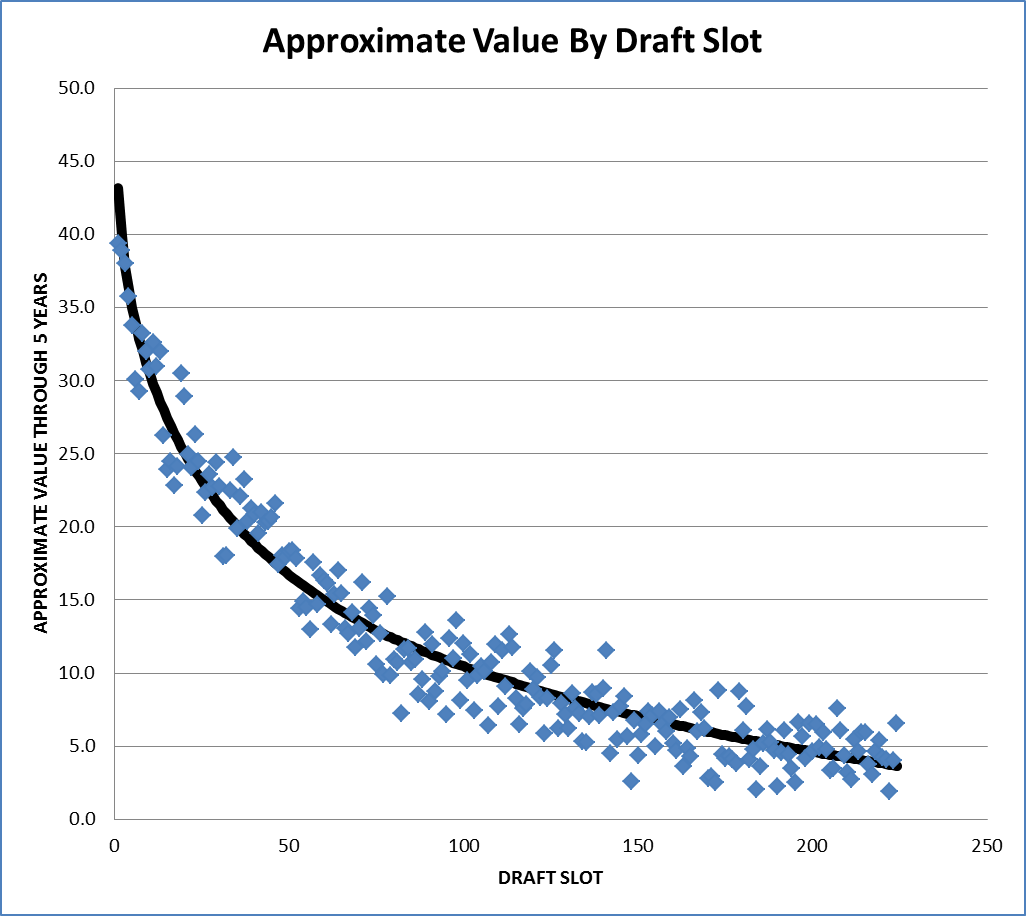
Nearly five years ago, I came out with my own draft value chart to replace the “Jimmy Johnson” draft chart commonly cited by draftniks. What I did then was assign the career approximate value grade to each slot for each player drafted over a 30-year period, smoothed the data, and came up with a chart that actually represented career production.

The chart was due for an update in any event, but I’m going to make a key change. Using each player’s career AV makes sense on some level, as the drafting team gets the chance to have a player for his entire career. But the real value in the draft –especially now thanks to the new collective bargaining agreement — is the ability to get a player for cheap on his rookie contract, which expires after (at most) five years. The Jets got a great deal with Darrelle Revis early in his career, but now that he’s the highest paid cornerback in the NFL, much of his value (even pre-injury) is gone.

There’s also another consideration. Of the 100 top-ten draft picks between 1998 and 2007, only 48 players [1]counting Eli Manning and Philip Rivers as staying with the teams that drafted them were still on the same team entering their sixth season. From the perspective of the head coach, things look even bleaker. In only eleven instances were the head coach and the top-ten pick still on the same team after five years (i.e., in year six): Chris McAlister and Jamal Lewis with Brian Bilick in Baltimore, Donovan McNabb with Andy Reid in Philadelphia, Richard Seymour with Bill Belichick in New England, Julius Peppers and Jordan Gross with John Fox in Carolina, Carson Palmer with Marvin Lewis in Cincinnati, Eli Manning with Tom Coughlin in New York, A.J. Hawk with Mike McCarty in Green Bay, Mario Williams with Gary Kubiak in Houston, and Levi Brown with Ken Whisenhunt in Arizona.

If you’re a head coach — or a general manager — I’m not sure it makes sense to project any more than five years down the line. Therefore, I’m going to construct my draft value chart based on the amount of Approximate Value provided by that player in his first five years after being drafted. [2]Note: I am giving the player credit for all of the AV he earned, regardless of whether or not it was accumulated with the team that selected him. Using PFR’s AV as my guide, I graded each player drafted from 1980 to 2007 and counted how much AV they accumulated in each of their first five years. Below is a chart plotting the data along with a smoothed line:


[continue reading…]

References

References
1 counting Eli Manning and Philip Rivers as staying with the teams that drafted them
2 Note: I am giving the player credit for all of the AV he earned, regardless of whether or not it was accumulated with the team that selected him.
{ 11 comments }

Why trust this guy?

Falcons head coach Mike Smith made a couple of interesting decisions in the 4th quarter of Atlanta’s loss to the Saints on Sunday. And by interesting, I mean conservative. The first strategic blunder came when his team scored a touchdown with 13 minutes remaining, to cut the lead to 28-23 pending the point after. Smith’s absurd reasoning doesn’t merit discussion, and according to Bill Barnwell and the footballcommentary folks, Atlanta should have gone for it if they had just a 23% chance of converting.

Jason Lisk highlighted what was likely in Smith’s head: we don’t know who is going to kick the next field goal. Sure, if it’s the Falcons, then you want to go for two, but if it would be New Orleans (the team about to gain possession) then we’re in a 7-point game situation, so the extra point is the conservative right play.

But here’s the easy shorthand: if the downside to missing the two-point conversion is limited to you needing a two-point conversion later to even things up, then going for it is usually the correct call.

What is the advantage to being down 3 vs. being down 4? Well a field goal ties the game, and even if the opponent kicks a field goal, a touchdown will win it for you.

What is the disadvantage to being down 5 vs. being down 4? Well, a field goal is meaningless in either case (or, if it’s not meaningless, one field goal still leaves you one field goal away from taking the lead). The big disadvantage is that if New Orleans scores, the Falcons would have been down 8 as opposed to being down 7. But in coach-speak, being down 8 is one-possession game just like being down 7 is! That’s obviously not true, but in this case, the downside to going for 2 is essentially cut in half, because you get a second bite at the apple.

In other words, 50% of the time that you ‘go for two’ following a touchdown when trailing by 11, you will be down by 3 and glad you were aggressive; 25% of the time you go for 2 you will have some short-term discomfort, but this will be alleviated when you convert the next touchdown (which you need anyway if you don’t go for two). Only 25% of the time will this move blow up in your face. This is exactly the same logic that dictates that a team, down by 14, should go for two after scoring the first touchdown.

Considering Atlanta’s odds of converting the two-point attempt had to be greater than 50/50, considering that’s roughly the league average, Atlanta’s offense is great, and New Orleans’ defense is terrible, that makes going for two the obvious correct call.

Of course, Smith also made an ugly mistake when he kicked a field goal from the Saints’ two-yard-line when trailing by 4 points with nine minutes left. Had he gone for 2 earlier, I could at least understand the logic of kicking the field goal, even if I wouldn’t do it. But down by 4, he passed up a 50/50 chance to take a three-point lead to cut the lead to 1? Even if he missed, the Saints would have been backed up near the own goal, and a three-and-out would have likely put the Falcons a first down or two away from getting that precious field goal.

{ 2 comments }

Gary Kubiak.

Gary Kubiak doesn’t have a personality like a Ryan or a Harbaugh. He hasn’t been profiled to death like Andy Reid or Norv Turner. He doesn’t have the rings of Mike Tomlin or Bill Belichick. If not for the simple fact that he’s been in Houston forever, I’m not sure if most NFL fans could even name the head coach of the Texans. But his coaching career has been a fascinating one that leaves me with more questions than answers.

In January 2011, I wrote that Kubiak and Jack Del Rio were given incredibly long leashes in the AFC South. From 1970 to 2010, only four head coaches had (a) finished with a .500 or worse record in four out of five seasons with the same team, (b) finished with a .500 or worse record in the fifth season, and (c) were retained to coach for a sixth season. The four head coaches — Marvin Lewis, Dan Reeves, Bart Starr, and John McKay — all had extenuating circumstances for their failures, which differentiated them from Del Rio and Kubiak, who were about to become the fifth and sixth such coaches.

Things have changed dramatically in 22 months. The Jaguars have changed owners, head coaches, and quarterbacks, and likely will have a new general manager soon, too. Meanwhile, the Texans still have the same four men — Bob McNair, Rick Smith, Kubiak and Matt Schaub — in the four most prominent roles in the organization. Houston’s one big move, hiring Wade Phillips as defensive coordinator, has worked perfectly. Phillips has turned a dreadful Houston defense into one of the best units in the league.

The outlook is so promising in Houston that it’s easy to forget where things stood less than two years ago. Following a loss to the Tim Tebow-led Broncos — this was the year before Tebow-mania took the NFL by storm — most of the football world assumed the firing of Kubiak was a fait accompli. John McClain, a veteran writer in Houston for over 30 years, tweeted: “After the way the Texans blew Denver game leading 17-0 at halftime and 23-10 in the 4th quarter, I’ll be stunned if the staff isn’t fired.” McLain was so disgusted that he added, “I’ll say it again: The Texans have the worst pass defense in the history of football at any level since the beginning of time.”
[continue reading…]

{ 19 comments }

Week 11 College Football SRS Ratings

Johnny Football, with his shirt on (for now).

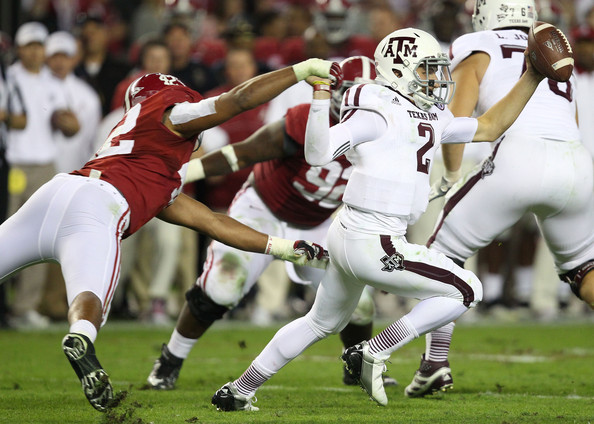
For the second straight season, the game of the year took place in Tuscaloosa. A week after Alabama eeked out a victory over LSU, and 53 weeks after Alabama loss to LSU in last year’s “Game of the Century”, Johnny Manziel produced one of the performances of the season in leading Texas A&M to an incredible upset victory. I have been a believer in the Aggies — they ranked 4th in my SRS ratings last week and remain there this week — but make no mistake, this was still an incredible upset. For a true freshman, on the road, against a Nick Saban defense, to go 24/31 for 253 yards and 2 TDs and to run 18 times for 92 yards is outstanding.

For now, the upset means we’re likely headed towards an SEC-free national championship game. This will anger some in the South, so I’ll take this time to remind you that the SEC’s record this year against the other BCS conferences is an incredibly dominant 4-5. Yes, the SEC has a losing record against the other top conferences in college football in 2011.

The bottom of the SEC has struggled considerably both in and out of conference — Auburn lost to Clemson, Vanderbilt to Northwestern, Kentucky to Louisville (and also to Western Kentucky), Ole Miss to Texas, and Arkansas to Rutgers (and also Louisiana-Lafayette). The positive side of the ledger isn’t all that impressive, unfortunately. Sure, Tennessee beat N.C. State, which would be impressive if not for the fact that the Wolfpack are 68th in the SRS. Yes, LSU beat Washington at home, but it’s LSU against the 8th best team in the Pac-12. Missouri over Arizona State and Alabama over Michigan are basically the two nonconference games the SEC can hang its hat on.

If Oregon wins out, they seem assured of getting one of the two golden tickets to Miami. Who will get the other? Obviously an undefeated Kansas State or Notre Dame would take one of the other spots. For now, K-State is ahead in the polls and the BCS standings, and gets the benefit of playing a streaking Texas team after the Fighting Irish have hung up their cleats for the year. According to the BCS Guru, Notre Dame is the clear third wheel.

But what if both Kansas State and Notre Dame lose? At that point, a one-loss SEC Champ — presumably Alabama — likely rises to number two. To that end, Alabama’s biggest friend right now is Lane Kiffin, who could knock off both Oregon and Notre Dame if USC wins out, setting up a Kansas State-Alabama title game.

And with that, a look college football’s SRS ratings after 11 weeks:
[continue reading…]

{ 6 comments }

A guide to Saturday’s games

The game of the day is in Tuscaloosa, as the #4 team in the SRS tries to ruin the perfect season of the best team in the country. Here’s a look at the weekly results for Alabama and Texas A&M, sorted from highest to lowest SRS score:

DateTeamPFOppPAH/RW/LDiffMOVSOSSRS
09-15-2012Alabama52Arkansas0RoadWin5239.542.782.2
09-01-2012Alabama41Michigan14Arlington TXWin2725.551.877.3
09-29-2012Texas A&M58Arkansas10HomeWin4834.542.777.2
10-13-2012Alabama42Missouri10RoadWin3229.547.376.8
09-15-2012Texas A&M48SMU3RoadWin453638.674.6
10-27-2012Alabama38Mississippi St7HomeWin312647.773.7
11-03-2012Texas A&M38Mississippi St13RoadWin252647.773.7
10-20-2012Alabama44Tennessee13RoadWin312944.773.7
10-27-2012Texas A&M63Auburn21RoadWin4234.537.672.1
09-08-2012Alabama35Western Kentucky0HomeWin352839.867.8
11-03-2012Alabama21LSU17RoadWin4757.164.1
09-29-2012Alabama33Mississippi14HomeWin191647.163.1
09-22-2012Alabama40Florida Atlantic7HomeWin332729.456.4
09-08-2012Texas A&M17Florida20HomeLoss-3-761.854.8
10-13-2012Texas A&M59Louisiana Tech57Shreveport LAWin2747.554.5
10-06-2012Texas A&M30Mississippi27RoadWin3747.154.1
09-22-2012Texas A&M70South Carolina St14HomeWin5638.514.553
10-20-2012Texas A&M19LSU24HomeLoss-5-857.149.1

Both teams blew out Arkansas in September and then embarrassed Mississippi State the last two weeks. Both Alabama and Texas A&M played their worst games of the year against LSU. The Aggies are a 13.5-point underdog, and it seems absurd to think that college football’s version of what it would look like if the Eagles and Chargers could have a baby could upend the mighty Crimson Tide, but it’s November. That generally means expect the unexpected.

Louisville @ Syracuse

The Cardinals look to keep their dream season alive in what looks to be an easy matchup on paper. Louisville is 9-0 and Syracuse is 4-5, so this should be a gimme, right? Except in Vegas, the line is just Syracuse -1.5. Many college football fans are calling this the oddest line of the week, but fans of the SRS would disagree. The SRS is predictive and doesn’t care about your record; it is intended to tell us how well teams will play in the future, and as a result, often mirrors the point spread in a game. Well, the SRS says Louisville should be favored by just 2.4 points despite the much more impressive record. You can view every college football game score here, which helps explain why Syracuse isn’t the pushover you might expect them to be. Syracuse has lost just one home game this season, a 42-41 game against Northwestern that ended in controversial fashion. Against the other cream of the conference, the Orange lost on the road by 8 against Rutgers and 11 against Cincinnati.

Meanwhile, Louisville beat Cincinnati at home by 3, and defeated North Carolina two months ago, but otherwise, doesn’t have any impressive wins on its resume. And it was only three weeks ago that Louisville was trailing in the final two minutes, at home, to South Florida. The Cardinals have played just three road games this season, against teams that are a combined 6-22. I think Vegas has this line appropriately placed; it’s close to a toss-up game, although I’d obviously favor the Cardinals.
[continue reading…]

{ 1 comment }

Ranking NFL quarterbacks by how much ‘it’ they have

Yep, that's it.

2) Tom Brady, New England Patriots. Until further notice, nobody has more ‘it’ than Tom Brady, who has been overflowing with ‘it’ since his first year as a starter. He’s the only active quarterback with three Super Bowl rings. However, since he has lost two Super Bowls to Eli Manning, I guess Manning has more “it.” So…

1) Eli Manning, New York Giants. If to be the man you have to beat the man, well, Eli Manning is now the man. Nobody has ‘it’ in the 4th quarter quite like Eli, which is when ‘it’ becomes really important.

3) Peyton Manning, Denver Broncos. If ‘it’ was Tapenade, Manning would be first on the list.

4) Ben Roethlisberger, Pittsburgh Steelers. With two Super Bowl rings, Roethlisberger arguably has more ‘it’ than Manning, but to be fair, Peyton Manning does hold the record for the most 4th quarter comebacks.

5) Drew Brees, New Orleans Saints. Despite gaudy numbers, Brees kind of doesn’t have that much ‘it’, in my opinion. But I’m not sure who else could go ahead of him.

6) Aaron Rodgers, Green Bay Packers. The last of the quarterbacks with rings, as Rodgers has one of the worst records in history when it comes to 4th quarter comebacks.

7) Tim Tebow, New York Jets. Without question, in possession of more ‘it’ than any quarterback without a Super Bowl ring, and maybe even more than some of the ones who do.

8) Alex Smith, San Francisco 49ers. This dude is loaded with ‘it’ and grit and teammates that hit. He went about 20 games without throwing an interception and he nearly completed more than 100% of his passes a couple of weeks ago.

9) Joe Flacco, Baltimore Ravens. If ‘it’ is Ray Lewis, Haloti Ngata, Ray Rice, Lardarius Webb, and Ed Reed, then Joe Flacco has had ‘it’ in spades for years. Let’s not forget he outplayed Mr. It in the AFC Championship Game last year, a particularly notable feat since both quarterbacks were playing against identical defenses.

10) Robert Griffin III, Washington Redskins. It doesn’t matter that his team loses, he has ‘it’ until the first game he struggles in 2013.
[continue reading…]

{ 8 comments }

Week 9 Power Rankings

Things were happier in Jets world three months ago.

Maybe it was the election, the great weekend of college football, or the fact that I had no cable and barely watched the NFL this weekend, but power rankings this week don’t generate any buzz for me. I only was able to see the two night games this week, which worked out well, as I didn’t miss the rare opportunity to see the Cowboys or Eagles implode on a national stage.

I’ve already said my piece about the Falcons; with their remaining schedule, we should expect 5 or 6 more wins more than 50% of the time. Right now, the odds of them landing on “5” and “6” are almost identical, but that assumes independence; since they might bench players (or suffer injuries), 13 wins still feels like the best projection for them.

Advanced NFL Stats continues to love the Panthers; after their victory over the Redskins, perhaps they’re going to have a second-half surge? The most head-scratching result from Football Outsiders is probably their sixth-place ranking of the Seahawks, just in time for the Jets to visit. If that game doesn’t start the Tim Tebow era, I don’t know what will.

One thing Burke, Schatz, and the SRS Standings agree on is that the Chiefs are the 32nd best team. Sorry, Jason, but even he agrees.

[As always, the number of wins I’m projecting each team to finish the season with is in column 3. The fourth column – PWIN – shows how many wins I projected last week, and the difference column represents how many wins I added or subtracted this week. The “RSOS” column stands for the remaining SOS for the team, based on the number of projected wins I’m giving to each of their opponents. The “RHG” column stands for remaining home games.]

TeamRecWinsPrvWinDiffRemSOSRemHGComment
Atlanta Falcons8-0131300.4454There are nits to pick, but an 8-0 start positions them well to quiet the doubters.
Houston Texans7-1131210.5083Great matchup with the Bears this week, but Houston is going to get the #1 seed either way.
San Francisco 49ers6-2121200.5164At this point, San Francisco seems very likely to get the 2 seed. Will be interesting to see how Harbaugh treats the end of the season.
Chicago Bears7-1121110.5634Dominant defense but they have a brutal remaining schedule. If they lose to the Packers, they may drop from a bye to the 5 seed.
Denver Broncos5-3121110.3594As a matter of principle, projecting a team to finish 7-1 is never advised. But this seems to be a good place to make an exception.
New England Patriots5-3111100.5315Can Aqib Talib make a difference on this defense?
Green Bay Packers6-3111100.5003Streaking Packers head into the bye week on a four-game winning streak.
Pittsburgh Steelers5-3111010.4065I have been a big Ben Roethlisberger fan all season, and will continue to get burned by believing in this team.
New York Giants6-31011-10.5273Even with a difficult schedule, the typical Giants second-half collapse shouldn't cost them much in a watered down NFC East.
Baltimore Ravens6-2101000.5394Nobody wins uglier than the Ravens.
Seattle Seahawks5-49810.5094Russell Wilson on the road in a playoff game is not going to be pretty, especially when it's at Lambeau or Soldier Field.
Indianapolis Colts5-39810.4923They are looking at a first round game in Foxboro or Mile High. Think there will be some storylines there?
Miami Dolphins4-49900.5085The Dolphins have been burned with some ugly fourth quarter performances; they've lost two games in overtime and were tied late in the 4th quarter against the Colts.
Dallas Cowboys3-58800.4065Even with an easy schedule, the Cowboys have a lot of ground to make up to win the division or beat the Seahawks out for a playoff berth.
Minnesota Vikings5-478-10.6433Sell. Sell. SELL!
San Diego Chargers4-47700.5004Wins over the Chiefs should be treated like FCS victories.
Detroit Lions4-47700.6415The remaining schedule is brutal; the Lions are streaking, but they dug themselves an enormous hole.
Tampa Bay Buccaneers4-47700.5474Can they be the team to end the Falcons perfect season?
New Orleans Saints3-57610.5864They'll need a miracle to make the playoffs, but ruining the Falcons perfect season is a decent consolation prize.
Philadelphia Eagles3-567-10.4454They are the worst team in the NFC, previously unthinkable under Andy Reid.
Washington Redskins3-667-10.4644The breakout team of 2013.
Arizona Cardinals4-567-10.5803Did you know the Arizona Cardinals are 11-7 in their last 18 games?
Cincinnati Bengals3-567-10.4774Is Marvin Lewis ever going to be on a hot seat?
Oakland Raiders3-567-10.4304Nobody racks up meaningless numbers like Carson Palmer.
New York Jets3-56600.4303Will Tim Tebow play this week? If not, maybe the Jets can give Greg McElroy some playing time.
St. Louis Rams3-56600.5083The second half of the season may tell us a lot about the future of Sam Bradford.
Tennessee Titans3-66600.5003An embarrassing performance against the Bears.
Buffalo Bills3-56600.4925This has to be the last 8 games of the Chan Gailey era, right?
Carolina Panthers2-66510.4774With an easy schedule, they should build some momentum for next year.
Jacksonville Jaguars1-74400.5164Can Blaine Gabbert show over the next 8 weeks that he deserves to be the quarterback of the future?
Cleveland Browns2-74400.5093Gritty performances against Baltimore but two losses in the standings.
Kansas City Chiefs1-734-10.5164May be headed for the worst season in franchise history.
{ 1 comment }

Quarterback performance on third and fourth downs

So far this season, teams have converted on 37.2% of all pass plays on third or fourth downs. Looking at success rates on these downs helps to identify which quarterbacks are keeping drives alive for their teams and coming through in the most important situations. For example, Peyton Manning leads the league with an impressive 52.6% rate. How impressive is that?

The table below lists the conversion rates for quarterbacks on passing plays (excluding scrambles) on third and fourth downs; the table is sorted by the far right column, which shows how many third downs over average each quarterback converted. This is calculated by subtracting from the number of actual conversions the number of expected conversions (which is 37.2% multiplied by the number of third down plays):

RankQuarterbackPlaysConvRate3DCovOvAvg
1Peyton Manning784152.6%12
2Ben Roethlisberger974647.4%9.9
3Matt Ryan793949.4%9.6
4Drew Brees1044745.2%8.3
5Andrew Luck994444.4%7.1
6Matthew Stafford1024544.1%7
7Tom Brady863844.2%6
8Matt Schaub723244.4%5.2
9Matt Hasselbeck783443.6%5
10Matt Cassel713143.7%4.6
11Ryan Fitzpatrick803442.5%4.2
12Tony Romo913841.8%4.1
13Michael Vick953941.1%3.6
14Aaron Rodgers943739.4%2
15Jay Cutler843339.3%1.7
16Christian Ponder943537.2%0
17Philip Rivers843035.7%-1.3
18Ryan Tannehill782734.6%-2
19Eli Manning893134.8%-2.1
20Alex Smith612032.8%-2.7
21Josh Freeman802733.8%-2.8
22Kevin Kolb682232.4%-3.3
23Sam Bradford872933.3%-3.4
24Mark Sanchez963233.3%-3.7
25Russell Wilson832732.5%-3.9
26Brandon Weeden1113733.3%-4.3
27John Skelton591627.1%-6
28Robert Griffin III782329.5%-6
29Carson Palmer922830.4%-6.3
30Cam Newton681927.9%-6.3
31Joe Flacco782126.9%-8
32Blaine Gabbert842226.2%-9.3
33Andy Dalton771620.8%-12.7

[continue reading…]

{ 3 comments }

NYT Fifth Down: Post-week 9

Are the Bears the best team in the NFL? This week at the New York Times, I profiled the incredible season the Bears are having. If you feel like every few years the Bears come out of nowhere with an incredible defense and a questionable offense, you’re right.

The 2012 Bears stand as the next in a long line of Bears teams that wildly exceeded expectations thanks to a great defense. Chicago ranks second in points allowed and rushing yards allowed, and fifth in net yards per pass allowed. Chicago leads the league in turnovers forced and red zone defense. But this year’s defense is doing things no other Bears defense — or any other N.F.L. defense, for that matter — has ever done.

Chicago has returned seven interceptions for touchdowns in eight games. Before this season, no other team had more than five pick-sixes after eight games, and the Bears are only one interception return for a touchdown away from tying the single-season record, held by the ’98 Seahawks (in the A.F.L. in 1961, the San Diego Chargers returned nine interceptions for touchdowns). But Chicago’s defense hasn’t just been a big-play defense. The Bears have allowed only 10 touchdowns this year, and five of them came in garbage time. Matthew Stafford threw a touchdown with the Lions down by 13 with 36 seconds left, and four other touchdowns came in the second halves of Chicago victories with the Bears already leading by 20-plus points. That means the Bears’ defense has allowed only five meaningful touchdowns while scoring seven of their own. Incredible.

Against the Colts, Chicago forced Andrew Luck into three interceptions and allowed just 7 meaningful points. Against the Rams, Chicago scored 7 points and allowed 6. In Dallas, Charles Tillman and Lance Briggs scored on interceptions, while the defense limited the Cowboys to just 10 meaningful points and intercepted five Tony Romo passes. In Jacksonville, Tillman and Briggs became the first teammates to score on interception returns in consecutive weeks, and the Bears limited Jacksonville to 3 points.

Against Detroit, the Bears forced six fumbles (recovering three) and held the Lions’ high-flying passing attack to a last-second touchdown; half of Detroit’s 12 drives ended in three-and-outs. Against the Panthers, Chicago’s defense was forced to overcome a Bears offense that gained just 61 yards in the first three quarters and held the ball for only 23 minutes 22 seconds in the game; still, Tim Jennings’s defensive touchdown in the fourth quarter proved to be the play of the game.

Chicago’s performances in the first half of the season were apparently just a warm-up act for Week 9 against Tennessee. On Sunday, on the first play from scrimmage, Charles Tillman forced a fumble, giving the Bears the ball in Titans territory. The Bears forced Tennessee to go three-and-out on each of its next two possessions, with the second stalled drive leading to a punt that was blocked and returned for a touchdown. Later in the first quarter, Hester returned a punt to the Titans’ 8-yard-line, setting up a one-play scoring drive. On the Titans’ next drive, Urlacher intercepted Matt Hasselbeck and returned it for a touchdown. On Tennessee’s next play from scrimmage, Tillman stripped Chris Johnson of the ball, giving Chicago possession at the Titans’ 16. Three plays later, Cutler found Brandon Marshall for a 13-yard score. After the first quarter, the Titans had eight drives, and the four that ended in three-and-outs and punts were the good ones.

Tillman ended the day with four forced fumbles; while not an official statistic, Tillman continues to force fumbles at an unprecedented rate for a cornerback. Unofficially, he now holds the modern record for most forced fumbles in a game, and with seven this season, he could easily exceed the record of 10 forced fumbles by Osi Umenyiora (2010) and Dwayne Harper (1993). If not for the monster season J.J. Watt is having for Houston, Tillman would be a leading candidate for defensive player of the year.

Check out the full article for some historical comparisons and some insight from Aaron Schatz.

{ 1 comment }

Sunday morning, I noted that the Falcons had a 2.4% chance of going undefeated and that the team most likely give them their first loss was the Dallas Cowboys. After Atlanta’s victory on Sunday night, they halfway to perfection. This is the first time in franchise history the Falcons have started off 8-0, although star tight end Tony Gonzalez once played on a 9-0 team and Matt Ryan went 8-0 in 2007 at Boston College. After the victory over the Cowboys, what is the current probability that Atlanta goes 16-0?

First, we need to calculate SRS standings. Neil gave us his Weighted SRS Ratings earlier today, but the table below shows the vanilla SRS ratings:

RkTeamGMOVSOSSRS
1San Francisco 49ers810.81.111.8
2Chicago Bears814.5-2.811.7
3New England Patriots812.3-1.510.7
4Houston Texans811.8-2.19.6
5Denver Broncos87.51.69.1
6New York Giants97.318.4
7Atlanta Falcons89.6-2.37.4
8Green Bay Packers95.41.67
9Seattle Seahawks92.13.25.3
10Tampa Bay Buccaneers85.1-1.83.3
11Dallas Cowboys8-3.15.72.6
12Pittsburgh Steelers84.1-2.12.1
13Miami Dolphins83.4-2.31
14Detroit Lions81.3-0.50.7
15Baltimore Ravens82.9-2.20.7
16Carolina Panthers8-3.94.50.6
17Washington Redskins9-2.11.2-0.9
18Minnesota Vikings90.4-1.3-0.9
19Arizona Cardinals9-3.62.1-1.5
20New Orleans Saints8-1.4-0.3-1.7
21San Diego Chargers83.5-5.3-1.8
22New York Jets8-4.82.6-2.1
23St. Louis Rams8-6.94.3-2.6
24Philadelphia Eagles8-6.31.1-5.2
25Cincinnati Bengals8-3.6-1.9-5.5
26Indianapolis Colts8-4.8-1.9-6.6
27Cleveland Browns9-5-2.6-7.6
28Oakland Raiders8-7.3-0.7-7.9
29Buffalo Bills8-7.8-0.8-8.5
30Jacksonville Jaguars8-12.81-11.7
31Tennessee Titans9-14.31.9-12.4
32Kansas City Chiefs8-13.4-1.3-14.7

[continue reading…]

{ 3 comments }

Like everything else, the rules disappear when Ogden is involved.

The game is won in the trenches, I know.

As we hit the halfway mark of the season, some teams are already thinking about next year, and in particular, the 2013 draft. If I was in charge of a bad team, and specifically, a bad passing team, I would try to avoid spending a lot of money or a high first round pick on a left tackle. This philosophy is more guideline than rule — if there is a can’t miss prospect there and/or you are underwhelmed with the other top prospects, then draft the tackle — but spending a high pick on an offensive lineman would be my move of last resort.

Let’s pretend for a few minutes that a top-five pick on a left tackle is going to give you Jake Long or Joe Thomas or Jonathan Ogden, and not Jason Smith or Levi Brown or Robert Gallery or Mike Williams. Now, why is having a star left tackle so valuable? The traditional theory goes that since the left tackle is response for protecting the quarterback’s blind side, he’s the most important member of your offensive line. The other corollary is that most star pass rushers play on the defense’s right side (and the offense’s left), amplifying the value of the left tackle.

When it comes to the running game, the left tackle is no more valuable than the right tackle, or (in some systems) any other members of the offensive line, for that matter. To make this a more straightforward analysis, let’s just stick to the passing game, even though obviously most elite left tackles are also very good at run blocking, which of course adds value.

On most passing plays, offensive linemen are basically the equivalent of fences, designed to prevent the opposition from getting to the quarterback. How useful is a fence that’s totally impenetrable on the left side but has a human-sized hole on the right? This isn’t just a snarky comment; an offensive line is often only as valuable as its weakest link. Which defense will get to the quarterback first: one facing five average linemen or one facing three average linemen, an All-Pro left tackle and the worst starting right tackle in the league? If you were a defensive coordinator, which group would you rather scheme against? To me, it’s a pretty simple question: you want to attack your opponent’s weakness, and an offensive line, like a fence or a chain, is only as strong as its weakest link.

Let’s put it another way. In what circumstances does an All-Pro left tackle add value over say, the 25th best starting left tackle in the league? I think those circumstances are basically limited to those plays where:

The All-Pro left tackle does his job, and the other four, five or six blockers do their job, and the quarterback makes the right read and an accurate throw, and the receiver makes the catch, and on this particularly play, the player(s) that was (were) blocked by the All-Pro left tackle would have gotten to the quarterback in time to prevent him from throwing and completing said pass had he (they) been blocked by a replacement-level tackle.

If you think there are a lot of ‘ands’ in that sentence, you’re right. If the other lineman don’t do their job, the star left tackle is meaningless. If the quarterback can’t make the right read or is inaccurate, the left tackle that blocks DeMarcus Ware doesn’t help his team (other than an incomplete pass being better than a sack or a rushed throw that turns into an interception). If the receiver drops the ball, the left tackle doesn’t provide any value. And if we’re talking about a player where the left tackle didn’t do anything that a replacement level linemen wouldn’t have done, then our star tackle has added no value, either.
[continue reading…]

{ 10 comments }

There were close calls in Baton Rouge and in South Bend, but all six undefeated teams escaped week 10 without a blemish. Ohio State is now the first team to win 10 games in 2012, although the Buckeyes are not eligible to participate in postseason play. Louisville ran its record to 9-0 yesterday, with winnable games against Syracuse and Connecticut before a season-defining finale in Piscataway on November 29th.

However, the eyes of the country are now focused on Notre Dame, Kansas State, Oregon, and Alabama. Last weekend, I said there was only a 10% chance that Oregon, Kansas State, and Notre Dame would finish the season undefeated. That was with 13 games left for those teams to win; now those odds are close to 17%. Kansas State has the easiest remaining path, although all three of its remaining opponents have realistic chances of pulling an upset. Oregon has a relatively easy game against Cal this week while Notre Dame shouldn’t have any problem with Boston College.

Alabama has another tough challenge this week in Texas A&M, although it is hard to imagine college football’s most inconsistent team of the last two years winning a close match-up against the country’s most consistent and brutal opponent. If Alabama can defeat the Aggies this weekend, a perfect regular season is all but assured, with the Crimson Tide’s final two games coming against Western Carolina (SRS of 11.6) and Auburn (37.6). The Iron Bowl this year should be more coronation than battle, which leaves just Texas A&M and Georgia — the likely opponent in the SEC Championship Game — as the two remaining hurdles for Alabama to clear.

Here are the week 10 SRS ratings: [continue reading…]

{ 2 comments }

In this post by Neil, he provided a formula to predict each team’s likelihood of winning a game based on the Vegas point spread. With the help of the SRS, we can come up with a projected point spread for each game, and therefore figure out which team is most likely to give the Falcons their first loss.

The table below shows the SRS rating for Atlanta and each of their remaining opponents, along with the projected point spread in the game (based on the difference between the two SRS scores and home field) and the concomitant projected win probability. Note that in the Dallas game, the projected line is Atlanta -8.6, which would yield a 73.2% win probability; since the actual line is Atlanta -4, for the purposes of that game, I will be using the real line and not the projected one.

WkOppATL SRSOPP SRSProj LineWin Prob
9Dallas Cowboys7.51.9-461.3%
10@New Orleans Saints7.5-3.3-7.871.3%
11Arizona Cardinals7.5-0.6-11.178.8%
12@Tampa Bay Buccaneers7.53.1-1.454%
13New Orleans Saints7.5-3.3-13.884%
14@Carolina Panthers7.5-1-5.565.4%
15New York Giants7.510-0.551.4%
16@Detroit Lions7.5-0.5-564.1%
17Tampa Bay Buccaneers7.53.1-7.470.3%

As you can see, the Falcons are projected to be a favorite in every remaining game, with the Giants game looming as the most difficult challenge. The probability of Atlanta winning each of their remaining 9 games is only 2.4%.

But figuring out which team is most likely to be the first to defeat the Falcons is a trickier question. The Cowboys are the obvious pick, in part because they’re up first and in part because they’re one of the most challenging remaining opponents for the Falcons. What are the odds that the Giants become the first team to knock off the Falcons, like they did to the Patriots in ’07 and the Broncos in ’98? For that to happen, the Giants would need to beat Atlanta (51.4%) plus the Falcons would need to beat Dallas, Arizona, Tampa Bay, Carolina, and New Orleans twice before their game with New York. The probability of Atlanta winning all of those games is just 10.2%, so there is only a 1-in-20 chance that New York performs its giant-killer act again.

To calculate the odds of the opponent in each week being “the team” to knock off the Falcons, we simply have to perform the same math. Therefore, the table below shows the likelihood of Atlanta first losing (in each week) to each team:

WkOpponentProb
9Dallas Cowboys38.7%
10New Orleans Saints17.6%
12Tampa Bay Buccaneers15.9%
11Arizona Cardinals9.3%
14Carolina Panthers5.4%
15New York Giants5%
13New Orleans Saints3%
16-0Undefeated2.4%
16Detroit Lions1.9%
17Tampa Bay Buccaneers1%

Even though they’re not favored to win the game, since we can’t pick “the field”, the Cowboys are the team most likely to ruin the Falcons’ perfect season. As of today, New Orleans is next with a 20.6% chance thanks to two bites at the apple; meanwhile, the Falcons are more likely to go undefeated than they are to go 14-0 only to have the Lions ruin perfection.

{ 2 comments }

Trivia of the Day – Saturday, November 3rd

.

Philip Rivers not pictured.

On Sunday, Eli Manning and Ben Roethlisberger will meet for the first time since Manning picked up his second Super Bowl ring. The game will be the 9th such matchup between two teams whose starting quarterbacks have each won multiple Super Bowls as starters.

This is the third straight year where we have such a game on the heels of a 25-year drought. In each of the last two seasons, the Steelers and Patriots have played, with Roethlisberger and Tom Brady starting both games. But prior to 2010, the last NFL matchup between two starting quarterbacks with multiple rings was in 1985, featuring the San Francisco 49ers (Joe Montana) and the Los Angeles Raiders (Jim Plunkett).

But today’s trivia question wants to know: which two quarterbacks starred in the first NFL game between two quarterbacks with multiple Super Bowl rings?

Trivia hint 1 Show


Trivia hint 2 Show


Trivia hint 3 Show


Click 'Show' for the Answer Show

Hat tip to The Jerk from the Footballguys message boards for pointing this out to me.

{ 1 comment }

November 3rd has been circled on the calendars of college football fans for nearly a year. Unfortunately, the two biggest games of the day — Alabama/LSU and Oregon/USC — will compete for the eyeballs of the nation. The Ducks and Trojans kick off at 7PM on the East Coast, with the Crimson Tide stealing our attention one hour later. Making matters worse, the #3 team in the country will be playing in the 8PM time slot, too, as Kansas State hosts Oklahoma State. So with a lot of interesting games this weekend, I thought I’d take a look at my thoughts on each game involving an eligible, undefeated team on Saturday in relation to two key metrics: the SRS ratings and the Vegas lines. I’ll also make heavy use of the Game Scores page, which lists every game from this season for all FBS teams.

Temple at Louisville, 12PM (all times Eastern)

Louisville SRS: 43.7
Temple SRS: 31.5
Projected SRS line: Louisville -15.2
Actual line: Louisville -16.5

Temple had been respectable early this year (minus an ugly home loss to Maryland) but has been miserable the last two weeks, likely driving this line up. The Owls were up 10-0 at halftime being being routed 35-10 by Rutgers at home two weeks ago, and then last week lost by 30 at a terrible Pittsburgh team. Louisville is not great, but they should be able to handle Temple with ease. No thoughts on the point spread, though, which seems right to me.

Pittsburgh at Notre Dame, 3:30PM

Notre Dame SRS: 63.1
Pittsburgh SRS: 37.5
Projected SRS line: Notre Dame -28.6
Actual line: Notre Dame -16.5

Why is this line the same as Louisville-Temple? The only explanations I can think of are: (1) Pittsburgh just played its best game of the week (SRS score of 57.0) in a win over Temple and (2) Notre Dame hasn’t earned the public’s trust just yet. But with the exception of a squeaker over Purdue in week two, the Fighting Irish have been very good each week. They beat Michigan State by 17 (SRS score of 67.5), Michigan by 7 (58.2), Miami by 38 (73.0), Stanford by 7 (60.8), BYU by 3 (51) and Oklahoma by 17 (82.9). Maybe some of those scores are a little inflated — the Hurricanes have several drops and an injured quarterback, the Stanford game was in overtime, the Oklahoma game was closer than the score — but that’s picking nits, in my opinion. This is a ridiculously good defense playing a Pittsburgh team that scored 20 points in its last road game, which was at Buffalo. The Panthers were horrrrrrrrible with probably more Rs than that the first two weeks of the season, losing to FCS Youngstown State and Cincinnati by a combined 38 points. But even if we threw those games out, the SRS would still say the Fighting Irish should be favored by at least three touchdowns.

The pick: Notre Dame -16.5

[continue reading…]

{ 1 comment }

Week 8 Power Rankings

I’d like to extend my best wishes to everyone dealing with the fallout from Sandy. I’m in my fourth location in five nights, and have lost power in my building for two days, but consider myself one of the lucky ones. This has been a tragedy for many out there, and thoughts and prayers go out to those who have been harmed.

But that won’t stop me from publishing the week 8 power rankings. This week it’s time to vault Atlanta to the top of the heap. I don’t love the Falcons, but it’s hard to see them not winning 13 games this year. So why don’t I love them?

The MVP of the first half of the season?

  • According to Football Outsiders’ drive stats, Atlanta ranks 8th in yards per drive, 3rd in points per drive (partially because they rank 3rd in starting field position per drive and 5th in fumble rate per drive), and 4th in drive success rate. That’s great; defensively, they’re 11th in yards per drive, 6th in points per drive, and 11th in drive success rate allowed. That’s less impressive but still pretty good. As far as “net” categories go, they are 6th in net yards per drive, 2nd in net points per drive, and 4th in net drive success rate. In other words, they look like an elite team, perhaps the best in the league. Except…
  • In Football Outsiders’ Rankings, the Falcons are just 8th. Aaron Schatz sums up why: “First, close wins: four by a touchdown or less. Second, its schedule so far ranks 29th in the NFL. Third, the Falcons have recovered 75 percent of fumbles.” If you ignore SOS — which the drive stats do — Atlanta looks like an elite team. Factor in the fumble luck, and it makes sense why FO does not view the Falcons as a top-five team.
  • Brian Burke now has Atlanta as his fifth ranked team; he doesn’t think Atlanta’s schedule has been all that easy. That’s because Denver is his #1 team and his system loves the Panthers and doesn’t think the Raiders are that bad.
  • According to the Simple Rating System, the Falcons are just the 7th best team, behind the Texans, Patriots, and Broncos in the AFC and San Francisco, New York, Chicago in the NFC.

Atlanta is a very good team, but probably not the best team in the league. My guess is on a neutral site, they’d be an underdog to at least five teams in the NFL, if not more.

TeamRecWinsPrvWinDiffRemSOSRemHGComment
Atlanta Falcons7-0131210.4445With 9 games left and a pretty easy schedule, the Falcons should hit the 13-win mark.
Houston Texans6-1121200.4794Mario Williams comes back to Houston this week. Spoiler: It's not going to be a happy homecoming.
San Francisco 49ers6-2121200.5004Better than the Falcons but 2 games behind them in the loss column and a tougher remaining schedule makes the #1 seed a longshot.
Chicago Bears6-1111100.5494Didn't win over any doubters against the Panthers, but with the streaking Packers, Chicago will 'survive and advance' for as long as they can.
Denver Broncos4-3111100.3824At 3-3, I thought they would go 8-2 the rest of the way. That might have been conservative.
New England Patriots5-3111010.5165Hey, the Patriots are back. New England gets 4 division games in the second half, along with the Jaguars and Colts.
Green Bay Packers5-3111010.5084No reason not to expect a 6-2 finish for this team. Four games left with Detroit and Minnesota don't look so challenging right now.
New York Giants6-2111010.5554The schedule is starting to look easier (Bal, Phi, Cin) and the team keeps banking wins.
Baltimore Ravens5-2101000.5144Baltimore's season will depend on what they do in their 2 games against the Steelers. Two warm-up games with the Browns and Raiders before round one.
Pittsburgh Steelers4-310910.4515Head to New Jersey to face the Giants in one of the games of the week. I can't seem to quit the Steelers bandwagon, and have them back at 10 wins -- for now.
Miami Dolphins4-39900.5005I really like this team. Three weeks ago I had them at 8 wins (pats back), and now 9 may be conservative.
Seattle Seahawks4-489-10.5085Could not afford to lose to the Lions last week. The 49ers, Packers and Bears are going to make the playoffs, so Seattle must finish ahead of the Vikings, Cowboys, Cardinals and Redskins. They'd be looking a lot better at 5-3.
Minnesota Vikings5-38800.6023The toughest remaining schedule in the NFL means there is no margin for error now for the Vikings.
Dallas Cowboys3-48800.4725Heartbreaking loss to the Giants but there's still a very good chance the Cowboys make the playoffs and face the Giants in the first round.
Indianapolis Colts4-38710.4934A wildcard darkhorse? I don't think the Colts are very good -- they're just 29th according to Football Outsiders -- but a win over Miami this weekend puts them in the driver's seat.
Philadelphia Eagles3-478-10.4584I can't think of anything positive to say about the Eagles right now.
San Diego Chargers3-478-10.4655I can't think of anything positive to say about the Chargers right now.
Washington Redskins3-578-10.4695I have to drop Washington in the rankings after last weekend's games. Fortunately, their receivers are comfortable with that.
Arizona Cardinals4-47700.5783Did you know the Arizona Cardinals are 11-6 in their last 17 games? Oh, and the Cardinals have one of the toughest remaining schedules in the NFL.
Cincinnati Bengals3-47700.5215With losses to Baltimore, Miami and Pittsburgh on the books, the Bengals are not in good tiebreaker shape. The next two games are against Denver and New York; if they don't win at least one, the season is effectively over.
Detroit Lions3-47610.5905You know, the NFC is really good, but really only have 5 very good teams. That means even at 3-4 in the NFC, Detroit could make the playoffs, although they have the 2nd toughest remaining schedule.
Tampa Bay Buccaneers3-47610.5214The same comment applies to Tampa Bay, who can get fat off of games with Oakland, San Diego and Carolina the next three weeks.
Oakland Raiders3-47610.4245Dominating the Chiefs means they're not as bad as the Chiefs. I think.
New York Jets3-567-10.4303[Comment Redacted.]
New Orleans Saints2-567-10.5765A difficult schedule and a terrible defense mean I'm ready to revise my predictions down to 6 wins for the Saints for the first time this season.
St. Louis Rams3-567-10.5163I don't want to overreact to one game, but man was that ugly.
Tennessee Titans3-567-10.5084A tough loss to the Colts, but this time wasn't going anywhere, anyway.
Buffalo Bills3-46600.5075With upcoming games in Houston and Foxboro, the Bills can turn their season around. Or officially turn the clock to 2013.
Carolina Panthers1-65500.4794One more loss and I have to drop them more, but for now, they stay at 5 wins.
Kansas City Chiefs1-645-10.4864When the Bills killed the Chiefs in week 2, I thought "man, the Chiefs might be really bad this year." Nostradamus, look out.
Jacksonville Jaguars1-64400.4935The Jaguars put up a fight against the Packers, but lack the talent to compete with most teams.
Cleveland Browns2-64400.5234The win over the Chargers says a lot more about San Diego than it does Cleveland.
{ 4 comments }

NYT Fifth Down: Post-week 8

My post for the New York Times this week takes a look at the triumvirate of Mike Tannenbaum, Rex Ryan, and Mark Sanchez.

Rex Ryan was hired by Mike Tannenbaum on Jan. 19, 2009. Three months later, they traded up in the 2009 N.F.L. draft to acquire Mark Sanchez. Since that moment, the three of them — the general manager, the head coach and the franchise quarterback — have had their fates intertwined. When the Jets made the A.F.C. championship game in their first season together, they far exceeded expectations, reaching that level far sooner than expected.

In the following off-season, Tannenbaum became the toast of the N.F.L. as he acquired four veterans – Santonio Holmes, LaDainian Tomlinson, Jason Taylor, and Antonio Cromartie — to help put the Jets over the proverbial hump. In August, it was Ryan’s turn to steal the spotlight, as he became a national sensation and the coach everyone wanted to play for following his appearance on HBO’s “Hard Knocks.” During the season, it was Sanchez’s time to shine, as he led the Jets on game-winning drives in the fourth quarter or overtime in six different games, the highest number in the league. The Jets won 11 games and went back to the A.F.C. championship game, but again, were stuck at the Super Bowl’s doorstep.

That was the high-water mark of the Tannenbaum-Ryan-Sanchez era. The Jets regressed to 8-8 last season and with a 3-5 record in 2012, appear to be continuing in a downward spiral. With Tannenbaum, Ryan, and Sanchez forever linked, the question the Jets will have to answer at the end of the season is whether all — or any — of them are the right men to take the Jets back to the Super Bowl.

The Quarterback

Statistically, Sanchez has been a disappointment his entire career with the Jets. On the field, he has struggled with reading defenses and throwing accurate passes, and as a result, he is ranked below the league average in completion percentage and yards per attempt in each of his four seasons in the N.F.L. Only 18 quarterbacks in N.F.L. history have ranked below league average in those categories while playing for the same team in three consecutive years. Perhaps surprisingly, all but three — Joe Ferguson, Mark Malone, and an aging Marc Bulger — returned to the same team for a fourth season.

Of the remaining 15, one was Phil Simms, who tore his knee in the 1982 preseason, ending his streak of mediocre play. It wasn’t until he turned 30 that Simms had his first statistically solid season in 1985. David Woodley returned to Miami but lost his job to Dan Marino. Kyle Boller went back to Baltimore, but Steve McNair was acquired to replace him. Sanchez and Matt Cassel each received a fourth year in 2012 to prove themselves.

That leaves 10 quarterbacks who had three straight years of below average play in both yards per attempt and completion percentage, and were brought back by their team and remained as starters. Five quarterbacks — Donovan McNabb, Tobin Rote, Jim Hart, John Elway, and Drew Bledsoe — responded with above-average seasons in their fourth year in at least one of the two categories.

The other five? All again finished below average in the two categories for a fourth straight season. Mike Phipps in Cleveland, Rick Mirer in Seattle, Trent Dilfer in Tampa Bay and Joey Harrington in Detroit were the first four; the fifth was Eli Manning. I excluded Manning’s rookie season because he did not have enough pass attempts to qualify, but technically, he finished below average in both completion percentage and yards per attempt in each of the first five seasons of his career.

Sanchez currently ranks 33rd in completion percentage and 31st in yards per attempt, so absent Peyton Manning wearing his jersey for the rest of the year, Sanchez is going to finish below average for the fourth straight season in both categories. In Kansas City, Matt Cassel may match his streak, although his days with the Chiefs are numbered.

Can the Jets justify starting Sanchez in Year 5? If previous examples are considered, it’s doubtful. Mike Phipps, like Sanchez, was a top-five pick a franchise gambled on. In fact, Cleveland traded the future Hall of Fame wide receiver Paul Warfield to Miami to acquire Phipps, so the Browns were very hesitant to admit their mistake. In his fifth year, Phipps entered the season as the starter but an injury in the season opener against the Jets allowed Brian Sipe to take the job. Mirer was also a top-five pick, but after his fourth year, the Seahawks traded him to the Bears. Somehow, they were able to package him with a fourth-round pick for Chicago’s first-round selection. Tampa Bay, a team that was able to win despite its poor quarterback play because of a great defense, kept Dilfer as the starter in his fifth year, although an injury paved the way for the team to move on. Detroit traded Harrington after his fourth season to Miami for a late round pick. And while Manning’s individual statistics were not impressive, he had already won a Super Bowl with the Giants, ending any questions about his job security.

If the Jets go into the 2013 season with Sanchez as the starter, they will essentially be giving him as long a leash as any quarterback in N.F.L. history has ever had. There are obviously other considerations with Sanchez. He will cost the Jets salary cap over $17 million if they release him before the start of the 2014 season. As it stands, the Jets will pay him nearly $13 million in 2013. But it’s the extreme exception to the rule for a quarterback to have four consecutive years of mediocre play be given the starting job in his fifth year on a silver platter. When a highly drafted quarterback struggles so consistently and fails to develop, there are usually severe ramifications. And they extend far beyond the quarterback.

For a look at the coach and the general manager, you can read the full article here.

{ 2 comments }

The Jacksonville Jaguars faced an uphill battle on Sunday: they were 15-point underdogs against the Packers in Lambeau Field. Trailing 14-6 in the final seconds of the first half, Blaine Gabbert threw a one-yard touchdown pass to tackle Guy Whimper. At that point, Mike Mularkey decided to go for two in an attempt to tie the game before the teams went into the locker room. The two-point conversion attempt failed, and Jacksonville ultimately lost, 24-15. So, did Mularkey make the right call?

In a lot of ways, this is similar to the decision Chan Gailey faced against the Titans in week seven. Essentially, Mularkey would need to calculate:

— (A) Jacksonville’s win probability in a 14-12 game
— (B) Jacksonville’s win probability in a 14-13 game; and
— (C) Jacksonville’s win probability in a 14-14 game

If we assume a 50% conversion rate on the 2-point attempt — more on this in a minute — then the question is a simple one. We just need to determine whether the difference between (A) and (B) is greater than or less than the difference between (B) and (C). Green Bay was set to receive the ball at the start of the second half, so according to Brian Burke, the values for (A), (B), and (C) are and 41%, 45%, and 48%.

I also looked at all games since 2000 where the team was set to kick to start the second half and was tied, trailing by 1, or trailing by 2 at halftime. In 275 tie games, the team kicking off to start the second half won 52% of the time. There were 70 instances where the team was trailing by 1, but they won just 39% of the time. And in 32 situations where a team was trailing by 2, the trailing team won 41% of the time. The sample sizes here are not large, and the set is of course biased; teams kicking off at halftime obviously had the ball in the first half, so if they trailed at halftime, that’s a signal that they were the inferior team.

So Burke’s model tells us that it’s a very close call; a small sample of results indicates a strong preference for being in a tie game. We can also look at Football Commentary, which theorizes that a team needs only a 36% chance to convert to make going for 2 the right call. So as you can see, the results are a somewhat over the map here.

My thoughts? It’s very close. It’s similar to the Gailey decision, but the uncertainty is magnified here with 30 minutes remaining instead of fifteen. There are a lot of ways for the game to unfold that make me think the difference between (A) and (B) is pretty close to the difference between (B) and (C). Still, my gut does tell me that — assuming a 50% conversion rate — it probably *is* better to go for two, but it’s certainly not obvious or a slam dunk. If I was a Packers fan, I would have preferred to see the Jaguars kick the extra point.

That said, understanding the resulting win probabilities is just one part of the equation. Let’s look at some of the others.
[continue reading…]

{ 4 comments }

For years, I was an unabashed Philip Rivers supporter. I had no preexisting affinity for the Chargers or Rivers, but in all the metrics I care about, Rivers was always one of the best. In 2008, 2009, and 2010, Philip Rivers led the league in yards per attempt. He finished first in ANY/A in ’08 and second in ’09 and ’10; he finished second in NY/A in ’08 and then first in NY/A in 2009 and 2010. Simply put, going into the 2011 season, no quarterback had been better over the last three years.

Rank Player Tm Gms Cmp Att Cmp% Yds TD Int Rate Sk Y/A SkYds AY/A ANY/A Y/G
1 Philip Rivers SDG 48 986 1505 65.5% 12973 92 33 103.8 88 8.62 545 8.86 8.02 270.3
2 Tom Brady NWE 33 702 1068 65.7% 8374 64 17 102.9 41 7.84 261 8.32 7.78 253.8
3 Drew Brees NOR 47 1224 1807 67.7% 14077 101 50 98.1 58 7.79 412 7.66 7.20 299.5
4 Aaron Rodgers GNB 47 1003 1552 64.6% 12394 86 31 99.4 115 7.99 730 8.20 7.19 263.7
5 Tony Romo DAL 35 771 1213 63.6% 9536 63 30 94.8 61 7.86 360 7.79 7.13 272.5
6 Matt Schaub HTX 43 1012 1537 65.8% 12183 68 37 94.7 80 7.93 524 7.73 7.02 283.3
7 Peyton Manning CLT 48 1214 1805 67.3% 13202 93 45 95.4 40 7.31 251 7.22 6.93 275.0
8 Kurt Warner CRD 31 740 1111 66.6% 8336 56 28 95.2 50 7.50 354 7.38 6.75 268.9
9 Ben Roethlisberger PIT 43 858 1364 62.9% 10829 60 32 92.5 128 7.94 852 7.76 6.53 251.8
10 Eli Manning NYG 48 945 1527 61.9% 11261 79 49 88.3 73 7.37 507 6.97 6.33 234.6
11 Donovan McNabb TOT 43 887 1486 59.7% 10846 59 36 85.4 95 7.30 684 7.00 6.15 252.2
12 Matt Ryan ATL 46 885 1456 60.8% 10061 66 34 86.9 59 6.91 354 6.77 6.27 218.7
13 Kyle Orton TOT 43 901 1504 59.9% 10427 59 33 84.8 90 6.93 562 6.73 6.00 237.0
14 Joe Flacco RAV 48 878 1416 62.0% 10206 60 34 87.9 108 7.21 788 6.97 5.96 212.6
15 Brett Favre TOT 45 923 1411 65.4% 10183 66 48 88.1 86 7.22 599 6.62 5.84 226.3
16 Jay Cutler TOT 47 981 1603 61.2% 11466 75 60 82.9 98 7.15 625 6.40 5.67 244.0
17 Matt Cassel TOT 45 860 1459 58.9% 9733 64 34 83.9 115 6.67 644 6.50 5.62 211.6
18 David Garrard JAX 46 885 1417 62.5% 9951 53 38 84.7 117 7.02 777 6.56 5.56 216.3
19 Jason Campbell TOT 44 836 1342 62.3% 9250 46 29 85.1 114 6.89 759 6.61 5.57 205.6
20 Carson Palmer CIN 36 719 1181 60.9% 7795 50 37 81.4 63 6.60 481 6.04 5.34 216.5
21 Ryan Fitzpatrick TOT 33 603 1040 58.0% 6327 40 34 74.9 83 6.08 465 5.38 4.57 175.8
22 Matt Hasselbeck SEA 35 668 1141 58.5% 7246 34 44 71.2 80 6.35 503 5.21 4.46 207.0

[continue reading…]

{ 14 comments }

Neil once pointed out, that you can approximate a team’s odds of winning a game by using the point spread and the following formula:

p(W) = 1 – (1-NORMDIST(0.5,SPREAD,13.86,TRUE))+0.5*(NORMDIST(0.5,SPREAD,13.86,TRUE)-NORMDIST(-0.5,SPREAD,13.86,TRUE))

For college football games, there is research by Wayne Winston and Jeff Sagarin that the standard deviation in the above formula should be 16 instead of 13.86. One of the nice things about the SRS is that it comes very close to approximating the point spread in each game. If we give 3 points to the home team, we can then approximate each team’s likelihood of winning in their remaining games.

For example, here is a look at Oregon’s remaining schedule and their likelihood of winning each game. Note that for now, I am assuming that the Ducks host the Trojans in the Pac-12 Championship Game:

TmOppLocSRS TmSRS OppProj SpreadWin Prob
OregonSouthern CalRoad65.953.9-8.971.2%
OregonCaliforniaRoad65.942.3-20.690.1%
OregonStanfordHome65.953.8-1582.6%
OregonOregon StRoad65.955.2-7.768.4%
OregonSouthern CalHome65.953.9-14.982.5%
Total29.9%

Winning five games in a row isn’t easy, even for a team as good as Oregon. With four difficult games left, the odds of them going 5-0 are just 29.9%. Things are much more favorable for Kansas State:

TmOppLocSRS TmSRS OppProj SpreadWin Prob
Kansas StOklahoma StHome66.352.5-16.985.4%
Kansas StTCURoad66.346.2-17.185.7%
Kansas StBaylorRoad66.346-17.486.1%
Kansas StTexasHome66.352.1-17.285.9%
Total54.1%

The Big 12 has some good teams, but Kansas State appears to be an elite one. My gut tells me the SRS is underrating the likelihood of one of those teams pulling off an upset, but there’s no doubt that Kansas State would be a double-digit favorite against each of those teams right now. Of course, one thing the SRS ignores in all of these instances is the possibility of a key injury affecting any team.

Notre Dame has a history of dropping games to bad teams, but I don’t think there’s much of a chance the Fighting Irish lose any of their next three games. That means the USC game should have national title implications:

TmOppLocSRS TmSRS OppProj SpreadWin Prob
Notre DamePittsburghHome63.137.2-28.996.5%
Notre DameBoston CollegeRoad63.131.1-29.196.5%
Notre DameWake ForestHome63.127.9-38.399.2%
Notre DameSouthern CalRoad63.153.9-6.265.1%
Total60.1%

There is only a 10% chance (29.9% * 54.1% * 60.1%) that Oregon, Kansas State and Notre Dame all finish the season undefeated, at least according to the assumptions in this post. If you want to look at how all three teams got here, you can check all the NCAA game scores here.

{ 7 comments }

Week 9 SRS Ratings: When Will Oregon Stop Scoring?

Oregon’s offense is ridiculous, and its defense and special teams aren’t far behind. Entering this weekend, Oregon had outscored opponents 234-46 … in the first half. Prior to their game against Colorado, Bill Connelly ranked Oregon as the third best defense in college football. Against the horrible Buffaloes, the Ducks didn’t disappoint.

Oregon jumped out to a 28-0 lead after the first quarter, and led 56-0 by halftime. Backup quarterback Bryan Bennett led the team with three touchdowns in the 70-14 rout. De’Anthony Thomas rushed for 97 yards on five carries and scored on a 73-yard punt return. Kenjon Barner had 9 carries for 104 yards and 2 touchdowns, and if not for the one-yard score, would have averaged 12.9 yards per carry; he also caught a 48-yard pass.

For the Ducks, this was a going-through-the-motions victory against a very overmatched opponent. Soon, though, we’ll find out a little more about the Ducks. On Saturday, they go to Los Angeles to face a talented but inconsistent USC team. And while California isn’t a serious threat, the Ducks close with games against Stanford and Oregon State, who may at least be able to slow down the mighty Ducks offense. For now, though, Oregon looks like the one hope to make for an exciting BCS National Championship Game.

We can assume Alabama will take one spot, with Oregon, Kansas State and Notre Dame battling for the other golden ticket. The odds of another all-SEC title game dropped with the Florida loss to Georgia. That’s because the Bulldogs now have the inside track on winning the SEC East, with a head-to-head victory over Florida. South Carolina beat Georgia, but UGA will essentially win the division due to luck of the draw. South Carolina drew Arkansas and LSU in Baton Rouge from the SEC West this year, while Georgia gets to play Ole Miss and Auburn — their final two conference opponents. Assuming the Bulldogs can take care of business against Ole Miss next week, their ticket to Atlanta should be secure. Considering Florida could have boosted their SOS against Florida State — and also faced and defeated LSU — replacing Florida with Georgia as the SEC East champion lowers the odds of that division sending a team to Miami.

Without further ado, below are the week 9 SRS ratings. As always, thanks to Dr. Peter R. Wolfe for publishing his game results.
[continue reading…]

{ 3 comments }

Wins with quarterbacks drafted by that team

Good stat today by ESPN’s Adam Schefter, who notes that Kansas City has gone 25 years without winning a game with a quarterback drafted by the Chiefs. This Todd Blackledge-led victory over the Chargers in 1987 was the last time a quarterback drafted by the Chiefs won a game in red and gold.

That’s remarkable, but as always, we need context. The table below looks at all team wins from 1988 to 2012 and shows how many games were won by a quarterback drafted by that team. Note: For purposes of this post, I’m considering John Elway, Jim Everett, Kelly Stouffer, Eli Manning, and Philip Rivers as having been drafted by the Broncos, Rams, Seahawks, Giants, and Chargers, respectively. Additionally, quarterbacks drafted before 1988 count, but only their wins starting in 1988 count for purposes of the table below. The last two columns show, for each, the quarterback with the most wins among those quarterbacks drafted and not drafted by that team.

TmWinsWbDQBPercMWbDQBMWbnDQB
NWE22521294.2%Tom Brady (128)Doug Flutie (7)
IND21318185.0%Peyton Manning (141)Jim Harbaugh (20)
PIT23719883.5%Ben Roethlisberger (83)Tommy Maddox (15)
NYG21717781.6%Eli Manning (74)Kerry Collins (35)
PHI22515970.7%Donovan McNabb (92)Michael Vick (18)
DEN22115570.1%John Elway (102)Jake Plummer (39)
TAM17311767.6%Trent Dilfer (38)Brad Johnson (26)
CIN15610466.7%Carson Palmer (46)Jeff Blake (25)
BUF20312662.1%Jim Kelly (91)Drew Bledsoe (23)
SDG19111861.8%Philip Rivers (66)Stan Humphries (47)
ATL18411361.4%Matt Ryan (49)Chris Chandler (34)
MIA20411857.8%Dan Marino (99)Jay Fiedler (36)
WAS18010457.8%Mark Rypien (45)Brad Johnson (17)
DAL20411556.4%Troy Aikman (94)Tony Romo (50)
NYJ1799955.3%Chad Pennington (32)Vinny Testaverde (35)
TEN21611955.1%Steve McNair (76)Warren Moon (51)
CLE1276853.5%Bernie Kosar (29)Derek Anderson (16)
DET1508053.3%Rodney Peete (21)Scott Mitchell (27)
MIN21410850.5%Daunte Culpepper (38)Warren Moon (21)
JAX1397050.4%David Garrard (39)Mark Brunell (63)
BAL1457350.3%Joe Flacco (49)Steve McNair (15)
ARI1497147.7%Jake Plummer (30)Kurt Warner (27)
CHI1968844.9%Jim Harbaugh (35)Jay Cutler (29)
STL1626540.1%Jim Everett (38)Marc Bulger (41)
SFO2298336.2%Alex Smith (37)Steve Young (89)
HOU712433.8%David Carr (22)Matt Schaub (38)
GNB2316929.9%Aaron Rodgers (45)Brett Favre (160)
CAR1263225.4%Kerry Collins (22)Jake Delhomme (53)
SEA1863619.4%Rick Mirer (20)Matt Hasselbeck (69)
OAK1772011.3%Steve Beuerlein (8)Rich Gannon (45)
NOR19921.00%Danny Wuerffel (2)Drew Brees (64)
KAN20200.00%--Trent Green (48)

As bad as the Chiefs record has been, the Saints record isn’t any better. In fact, since Archie Manning’s last game for the Saints, New Orleans has only drafted two quarterbacks – Dave Wilson and Danny Wuerffel – who have started and won a game for the team. JaMarcus Russell couldn’t even break the Raiders list, ending his career with seven wins. Two other interesting notes. Tony Romo is the only undrafted quarterback in the league currently starting. And of the 32 starting quarterbacks, three of them — Michael Vick, Matt Schaub, and Matt Ryan — were drafted by the Falcons.

{ 7 comments }

New page added to Football Perspective: NCAA Games

At the top of every page there are gray tabs that will take you to the different pages at Football Perspective. I’ve added a new one: NCAA Games. That page will show you the results for every individual game involving any of the 124 FBS teams this year. The page will be updated along with the SRS standings each week. If you’ve got any tips or suggestions, you can leave them here.

{ 0 comments }

Trivia of the Day – Saturday, October 27th

Last week, I noted that Calvin Johnson was trying to become just the third player since 1970 to lead the NFL in receiving yards in consecutive seasons. The rushing crown is much more likely to go to the same player; in fact, ten rushing champions since 1973 also led the league in rushing yards in the prior season.

Maurice Jones-Drew led the league in rushing in 2011, but isn’t going to repeat in 2012. Who was the last player to win the rushing crown in consecutive years?

Trivia hint 1 Show


Trivia hint 2 Show


Trivia hint 3 Show


Click 'Show' for the Answer Show

{ 0 comments }

Cam Newton is having an interesting year

I don’t care about any of the nonsense with Cam Newton. Instead, take a look at his 2011 and 2012 stat lines:

                                                                                            
Year   GS  QBrec Cmp Att Cmp%  Yds TD TD% Int Int% Y/A  AY/A Y/C  Yd/G Sk Yds NY/A ANY/A Sk% Rsh Yds TD  YPC Y/G  C/G
2011   16 6-10-0 310 517 60.0 4051 21 4.1  17  3.3 7.8  7.2 13.1 253.2 35 260  6.9   6.2 6.3 126 706 14  5.6 44.1 7.9
2012    6  1-5-0 101 173 58.4 1387  5 2.9   6  3.5 8.0  7.0 13.7 231.2 15 102  6.8   5.9 8.0  46 273  3  5.9 45.5 7.7

His Y/A is actually higher this year (although his sack rate is a little worse), and his rushing yards per game and yards per carry are both slightly up. Obviously the biggest change is that Newton simply isn’t scoring very much — he’s on pace for just 21 touchdowns after scoring 35 last year. But touchdowns are more volatile than metrics like yards per attempt, and tend to rebound quickly when paired with a strong yards per attempt average. Compared to league average, Newton’s only slightly worse in NY/A and ANY/A than he was last year, and he’s still above-average in both statistics. Statistically, he looks fine.

But the eye test certainly says Newton is struggling. And some stats back that up, too. Newton ranks 25th in Total QBR, although he only ranked 17th in that metric a year ago. Perhaps more importantly, the Carolina offense has plummeted to 29th in points per drive so far in 2012 (while ranking 17th and 19th in drive success rate), after ranking 6th in points per drive (and 6th in yards and 5th in DSR) in 2011. So the offense has been quite a bit worse, and significantly worse when it comes to scoring. That sort of matches what the “eye test” tells me.

But as Aaron Schatz pointed out to me, there are some odd splits going on with Newton. Take a look at how Newton’s performed on pass attempts on 1st downs this year:
[continue reading…]

{ 2 comments }

Have you taken a look at a passing leaderboard lately? Here’s the PFR passing leaderboard sorted by ANY/A; as always, all columns are sortable.

RkQBTmGCmpAttCmp%YdsTDTD%IntInt%Y/AAY/AY/CSkYdsNY/AANY/ASk%
1Peyton ManningDEN615422767.81808146.241.888.411.710637.47.84.2
2Josh FreemanTAM610418755.61538115.952.78.28.214.89657.57.54.6
3Eli ManningNYG716926563.82109124.572.687.712.55407.77.41.9
4Robert Griffin IIIWAS713318970.4160173.731.68.58.512151067.37.47.4
5Drew BreesNOR616627360.82097186.672.67.77.812.612867.17.24.2
6Ben RoethlisbergerPIT6155235661765114.731.37.57.911.413726.87.25.2
7Tom BradyNWE718628565.32104124.231.17.47.811.314966.77.14.7
8Aaron RodgersGNB718326269.81979197.341.57.68.310.8261426.47.19
9Matt SchaubHOU714022263.11650104.541.87.47.511.88596.973.5
10Jake LockerTEN46710663.278143.821.97.47.311.731676.92.8
11Matt RyanATL616023667.81756145.962.57.47.511131076.66.75.2
12Carson PalmerOAK614824161.4173272.941.77.2711.712936.56.34.7
13Alex SmithSFO712719066.8142794.752.67.57.311.2181006.46.28.7
14Joe FlaccoBAL715025259.5183793.662.47.36.912.2181106.46.16.7
15Andy DaltonCIN715624364.21831135.3104.17.56.811.7171026.75.96.5
16Cam NewtonCAR610117358.4138752.963.58713.7151026.85.98
17Tony RomoDAL615022167.9163683.694.17.46.310.99596.95.83.9
18Ryan FitzpatrickBUF7133218611435156.994.16.66.110.88446.25.73.5
19Christian PonderMIN71522276714929462.66.66.29.816685.95.56.6
20Sam BradfordSTL713121959.8159273.262.77.36.712.2211316.15.58.8
21Ryan TannehillMIA611819859.6145442637.36.412.3121096.45.55.7
22Matthew StaffordDET616426462.1175451.962.36.6610.7128665.44.3
23Michael VickPHI613623158.9163283.583.57.16.21217906.25.46.9
24Andrew LuckIND613425053.6167472.872.86.7612.516995.95.36
25Mark SanchezNYJ711621853.2145394.173.26.7612.514775.95.36
26Jay CutlerCHI610618756.7135984.373.77.36.412.81912165.39.2
27Russell WilsonSEA710417559.4123084.67476.111.8149765.27.4
28Brandon WeedenCLE715427256.6178393.3103.76.65.611.611696.15.13.9
29Philip RiversSDG613920966.51492104.894.37.16.210.7181186.15.17.9
30Kevin KolbARI610918359.6116984.431.66.46.510.7271594.84.912.9
31Matt HasselbeckTEN59615661.593153.242.665.59.710745.24.76
32Blaine GabbertJAX68815855.790663.831.95.75.610.3151054.64.58.7
33Matt CasselKAN510317658.5115052.895.16.54.811.213745.74.16.9

[continue reading…]

{ 1 comment }

Week 7 Power Rankings

The Big 10 used to have good athletes.

At 6-1, Houston is sitting pretty atop the AFC. They have to be the Super Bowl favorite right now, as they’re the most likely team in either conference to wrap up the 1 seed and they won’t have to go through two very good teams to get to New Orleans. In addition, they’re also really, really good.

Things are muddy in the NFC, and we get another NFC East showdown this week between the Giants and Cowboys. A New York win would open up a three-game lead over Dallas, but that would make things way too smooth in New York. The Atlanta Falcons already have a four-game lead in the NFC South, but it won’t take much for them to slip and miss out on a bye. The Packers, Bears and Vikings all look like playoff teams; Chicago might be the favorite to win the division right now, but these teams still play each other 5 more times. The NFC West looks like a competitive division but one that everyone assumes the 49ers will win. A Cardinals upset this weekend would send ripple effects throughout the conference. We’re in for a treat, as that’s the Monday Night game this week, and I expect the Cardinals to play well despite the three-game losing streak.

[As always, the number of wins I’m projecting each team to finish the season with is in column 3. The fourth column – PWIN – shows how many wins I projected last week, and the difference column represents how many wins I added or subtracted this week. The “RSOS” column stands for the remaining SOS for the team, based on the number of projected wins I’m giving to each of their opponents. The “RHG” column stands for remaining home games.]

TeamRecWinsPrvWinDiffRemSOSRemHGComment
Houston Texans6-1121200.4584The Texans the clear best team in the AFC; projecting only 12 wins includes a potential loss when they rest starters.
Atlanta Falcons6-0121200.4385Atlanta hasn't had a difficult schedule to date, but the schedule isn't that challenging the rest of the way, either.
San Francisco 49ers5-2121110.5144I keep going back and forth on the 49ers, from 11 to 12 to 11 and now back to 12 wins. But no matter how you say it, they're elite.
Chicago Bears5-1111100.5255A good win against the Lions, but I'm not ready to project a 7-3 finish. Two games with Minnesota, and games left against SF, Hou and GB make 12 wins an uphill battle.
Denver Broncos3-3111100.3945Good news: the Broncos didn't lose a close game after a crazy 4th quarter rally last week. Denver has by far the easiest remaining schedule in the league.
New England Patriots4-3101000.5075The Patriots made Mark Sanchez look good last week. Two games against Miami and a rematch with the Jets doesn't look so easy anymore, not to mention the games still against Houston and San Francisco.
Baltimore Ravens5-2101000.5004I dropped the Ravens a win last week despite the fact that they had just defeated Dallas; can they go 5-4 against a mediocre schedule the rest of the way? Probably.
Green Bay Packers4-3101000.4655The Packers are back, but I'm not sure if I'm ready to call them 7-2 the rest of the way good.
New York Giants5-210910.5494Giants got a big win against the Redskins, and look like the class of the division. We'll see if Dallas can change that.
Pittsburgh Steelers3-39900.4636Pittsburgh took care of business against Cincinnati, but I think we'll see a couple more Raiders-like slip-ups the rest of the way.
Miami Dolphins3-39900.4885Miami is the 4th or 5th best team in the AFC according to nearly every advanced stats metric out there.
Seattle Seahawks4-39900.5075Can't get too disappointed with a loss in San Francisco on a short week, but a loss in Detroit this weekend will be damaging.
Minnesota Vikings5-28800.5694The Vikings face Green Bay and Chicago twice along with Houston in their last six games; they must take care of business against Tampa Bay this weekend.
Philadelphia Eagles3-38800.4945Last week did not feel right without an Eagles meltdown.
San Diego Chargers3-38800.4385Last week did not feel right without a Chargers meltdown.
Dallas Cowboys3-38800.5066Cowboys could flip the script by sweeping the Giants this year and stealing the division. Game of the season for the Cowboys, and 98% of the nation will get to watch (sorry
Washington Redskins3-48800.4865Redskins went on the road against an elite team and nearly won; they don't drop a game for that.
Arizona Cardinals4-378-10.5974Did you know the Arizona Cardinals are 11-5 in their last 16 games? Oh, and the Cardinals have the toughest remaining schedule in the NFL.
New York Jets3-478-10.4654A great effort against the Patriots, but I'm not ready to say this team has turned things around. I don't expect them to beat Miami.
Cincinnati Bengals3-47700.5215Just think: three weeks ago, the Bengals were 3-1 with two home games sandwiched around a trip to Cleveland.
New Orleans Saints2-47700.5635With a difficult schedule in front of them, I'm not ready to put New Orleans even at 8-8 despite the fact that they're playing like a playoff team.
St. Louis Rams3-47700.5354A loss against the Packers isn't going to drop many teams.
Indianapolis Colts3-37610.4884A win at home against Cleveland is essentially holding serve, but I think they can go 4-6 against a workable schedule.
Tennessee Titans3-47610.4935I'm pretty sure this team is still garbage - they've been outscored by 89 points - and I don't expect them to beat Indianapolis this weekend.
Buffalo Bills3-467-10.5145Buffalo is really bad.
Detroit Lions2-46600.5636A loss in Chicago doesn't change my outlook on Detroit: a mediocre team with a brutal schedule.
Tampa Bay Buccaneers2-46600.5254A tough home loss to the Saints but I don't think Tampa Bay is that far from being a good team. A 95-yard pass helps, but Josh Freeman is 2nd in the NFL in ANY/A, NY/A and Y/A.
Oakland Raiders2-46510.4255How is Darren McFadden healthy but terrible? An easy schedule should make Oakland a 6-win team.
Carolina Panthers1-556-10.5134I don't really know when the bleeding will end, but in Chicago this weekend doesn't seem like the answer to that question.
Kansas City Chiefs1-55500.4635Romeo Crennel didn't go for it once on 4th down last week, and he probably won't this week, either.
Jacksonville Jaguars1-545-10.5065Things are not good in Jacksonville, as a loss to the Raiders was combined with injuries to Maurice Jones-Drew and Blaine Gabbert.
Cleveland Browns1-64400.5145Pat Shurmur hates winning.
{ 2 comments }

NYT Fifth Down: Post-week 7

A couple of weeks ago, I wrote the differing rookie seasons of Andrew Luck and Robert Griffin III. The numbers still hold — Griffin dominating in all traditional stats, while Luck throwing more passes downfield than any other quarterback — so I sat down with ESPN’s Jeff Bennett to figure out why Luck ranks ahead of Griffin in ESPN’s QBR.

After seven weeks, Robert Griffin III of the Redskins has exceeded even the most optimistic expectations. He leads the N.F.L. with a 70.4 completion percentage, and could become the first rookie to lead the league in that category since Parker Hall with the Rams in 1939.

Griffin also ranks first in yards per attempt with an 8.5 average, and could become the first rookie since another Ram, Bob Waterfield in 1945, to lead the N.F.L. in that statistic. Only two rookies in professional football history have ever led the league in both completion percentage and yards per attempt. The first was another Redskin, Sammy Baugh, in 1937; the last was Greg Cook, in the American Football League in 1969 (his career was ruined by a shoulder injury that year).

Griffin’s statistical domination of the record book has been astounding. And that’s before we get to the fact that he has 468 rushing yards and 6 touchdowns in seven games, putting Cam Newton’s rookie rushing records in both categories (706 and 14) in jeopardy.

Griffin will always be compared to the man selected one spot before him in the 2012 draft, Andrew Luck. And on the surface, there’s no comparison. Luck ranks 32nd in completion percentage (53.6) and 25th in yards per attempt (6.7). Whereas Griffin ranks third in traditional passer rating (101.8) behind Aaron Rodgers and Peyton Manning, Luck is tied with Brandon Weeden (72.3) and ahead of only Matt Cassel for last place.

But traditional statistics don’t always tell the full story, especially when we’re dealing with a sample size that’s smaller than half a season. Those watching Luck have usually come away thinking that he’s the next great quarterback, despite the raw numbers. Fortunately, there’s a way to fill in the rather large gap between perception and statistical production. One of those tools is ESPN’s Total QBR, which ranks Luck as the sixth-best quarterback in the N.F.L. this season. That’s even ahead of Griffin, who is eighth in QBR.

Jeff Bennett of ESPN Stats & Information, in a telephone interview, was able to help explain why Luck was not only the best rookie quarterback this season, but also perhaps the most underrated quarterback in the N.F.L.

Difficulty of Throws

It’s a gross generalization, but Luck plays in a vertical offense while Griffin plays in a horizontal one. Griffin ranks first in completion percentage while Luck ranks 32nd, but that has as much to do with the throws they’re asked to make as each quarterback’s accuracy. Luck‘s average pass attempt has traveled 10.2 yards past the line of scrimmage, the longest average pass distance in the league (this was before “Monday Night Football”; Jay Cutler was second at 9.9 entering the game). Griffin averages 7.9 yards downfield per pass attempt, slightly below the league average of 8.2.

And Luck’s long average pass distance isn’t simply a product of throwing lots of incomplete passes down the field. His average pass distance on completions is 8.6 yards past the line of scrimmage, also highest in the N.F.L. (Cutler was fourth at 8.3 entering Monday night). Griffin’s completions come an average of 5.8 yards from the line of scrimmage, well below the league average of 6.5.

Those numbers agree with Brian Burke’s data at Advanced NFL Stats, which show that Griffin has thrown only 14 percent of his passes 15-plus yards past the line of scrimmage, the lowest rate in the league. Luck has thrown only 11 percent of his passes at or behind the line of scrimmage, while Griffin is in an offense that has let him throw 44 passes at or behind the line, accounting for 23 percent of his attempts. Coach Mike Shanahan and his offensive coordinator, Kyle Shanahan, deserve credit for molding an offense that fits Griffin’s strengths. Unfortunately for Luck, nothing is being made easy for him in Indianapolis.

Yards After the Catch

Casting Luck as a downfield thrower is true, but only half the story. Unlike many rookie quarterbacks, whether through design or lack of talent, Luck rarely has a running back as a checkdown option. According to Footballguys.com, Colts running backs have been targeted on just 7 percent of all Indianapolis passes, the lowest mark in the league. Conversely, Colts receivers have been targeted on 72 percent of Indianapolis attempts, the highest mark in the N.F.L.

In the same vein, much of Griffin’s production has come via yards after the catch. On average, passers in 2012 have gained 56 percent of their yards through the air and 44 percent on yards after the catch by their receivers. For Griffin, 51.4 percent of his yards have come via his receivers after the catch, the fifth-highest mark in the league. Luck, in large part because of his downfield passing, has gained 68.9 percent of his yards through the air, the highest percentage in the league, and therefore has been helped the least in terms of yards after the catch.

However, simply putting the stats in this context does not mean that Luck has been a better passer than Griffin; rather, it is to simply close the extraordinary gap created by traditional statistics. Griffin’s completion percentage and yards per attempt average are still more impressive even after adjusting for the difficulty of his throws. If we looked simply at their passing numbers, even ESPN’s Total QBR would rank Griffin ahead of Luck, by a score of 68.7 to 60.7. And while you know there is more to being a quarterback than just passing, you might be surprised to learn that looking at those things actually vaults Luck ahead of Griffin.

You can read the rest of the article here.

{ 1 comment }

In Buffalo’s loss to Tennessee on Sunday, Chan Gailey faced an interesting decision. Buffalo trailed 28-27 in the final seconds of the third quarter when Ryan Fitzpatrick hit Steve Johnson for a 27-yard touchdown. Now up 33-28, Gailey chose to kick the extra point, and ultimately saw his team lose, 35-34.

Why did Gailey choose to go for 1? Bill Barnwell has his theory:

[The next mistake was] Gailey’s decision to kick an extra point on a touchdown at the end of the third quarter, which created the margin of victory. By going for one with seconds left in the third and a five-point lead (pending the extra point), Gailey paid tribute to the long-standing rule that teams shouldn’t go for two and try to create a seven-point lead before the fourth quarter. It’s an absurd rule, of course, that breaks down when you ask anybody to explain at any length why it makes sense. The two-point conversion chart at footballcommentary.com suggests that the Bills should have tried to tack a two-pointer onto their 33-28 lead if their chances of converting were better than 24 percent. Because the clock hadn’t ticked for 10 additional seconds and bumped the decision into the fourth quarter, though, the Bills kicked and ended up losing by one.

When I read that, my reaction was “yep, that sounds about right.” Up 5 with just over 15 minutes left, it seems like the “stats-geek” move is to go for two while the “conservative old school train of thought” says it’s “too early” to go for two. Of course, if that’s all there was to the story, you wouldn’t be reading this post right now. Take it away, Jason Lisk:

When I look at the game winning probabilities at Advanced NFL Stats, though, Gailey’s decision was different [than Mike Tomlin’s]. It pains me to say that conventional wisdom is right here, but it is. With 15 minutes left, being up 5 is more costly than up 7 is beneficial with all the permutations. There are enough possessions that you can get beat by two field goals gained, or not extend the lead with another field goal.

When is it too late to go for one point in either of these situations, though? As it turns out, the answer is roughly between the 6 and 7 minute mark of the fourth quarter. That’s when possessions become more limited and you must try to tie, or make it where a touchdown doesn’t beat you.

A little surprised, I went over to Advanced NFL Stats and entered the numbers into Brian Burke’s Win Probability Calculator. Up 5, at the start of the 4th quarter, with the opponent having 1st and 10 at the 22 yard line, yields a 72% win probability to the leading team. Up 6 translates to a 77% win probability and up 7 increases it to 80%. That’s what Lisk meant when he said that difference between being up 5 and up 6 — 5% — is greater than the difference between being up 6 and up 7 — 3%.

Nerd Fight! Brian is a good friend of the site and one of the smartest minds out there, but he’d be the first to tell you that his Win Probability model is not perfect. So the question we have to ask is, is this a situation where his Win Probability Model breaks down?

Let’s not forget what Barnwell noted: according to footballcommentary.com, going for 2 is the obvious call here. And let’s used my tried-and-true method for making any football decision. If you were a Titans fan, now trailing by 5 at the end of the 3rd quarter, would you have been happy to see Buffalo’s kicking team run onto the field, or would you have wished that instead they went for it? My gut tells me — and let’s stipulate that the Bills would have had a 50% chance of converting the 2-point attempt — that as a hypothetical Titans fan, I’d want Buffalo to kick the extra point. Being down 7 sounds really bad, while the difference between 5 and 6 seems pretty negligible to my Nashville gut.
[continue reading…]

{ 11 comments }
Next Posts Previous Posts