≡ Menu

Last year at this time, I looked at which teams were spreading it around the most in their passing offenses. And this time last year, the Indianapolis Colts had the most diverse passing offense in the NFL. This season, that honor …. again belongs to the Colts.

T.Y. Hilton is the team’s leading receiver and has “only” 22% of the team’s receiving yards; Eric Ebron and and Zach Pascal are next on the team and neither has more than 13% of the team’s receiving yards. Indianapolis is the only team in the NFL where its top three leaders in receiving yards have less than half of the team’s receiving yards. The table below shows the Colts receivers; the final column is the square of the percentage of team’s receiving yards, which is how we calculate the concentration index. [continue reading…]

{ 0 comments }

Podcast Talk, Brothers Edition

Can you spot the HOF QB?

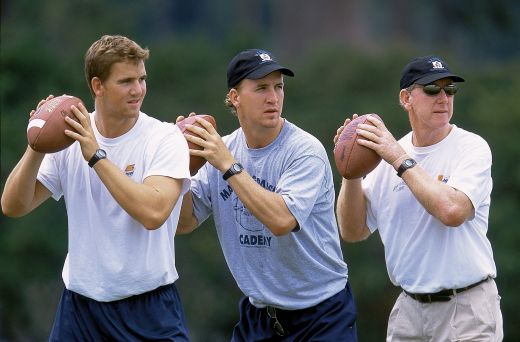
Many of you know that my brother, Jamie Stuart, is a sportscaster for News 12. Well, he has his own podcast, and I was invited on to speak about football and analytics. I wasn’t given any of the questions in advance (so much for nepotism helping out), but wound up speaking about Eli Manning, Adam Gase, and analytics. My favorite part is at the end, where I put together an idea I never quite verbalized before: one of the goals of analytics is to help quantify what we see on TV, not tell us that the eye test is wrong. I suspect that in 30 years, the gap between what “the numbers say” and what the eye test says will shrink.

You can listen here.

As always, please leave your thoughts in the comments.

{ 0 comments }

Matthew Stafford is Throwing It Down The Field Again

In 2016, Matthew Stafford averaged just 5.8 air yards per attempt on completed passes.

In 2017, Stafford averaged 6.0 air yards per attempt on completions.

In 2018, the Lions franchise quarterback averaged an anemic 4.8 AYpAoCP.

But this season, through six weeks, Stafford leads the NFL in AYpAoCP, posting a whopping 8.1 average.

There are 23 quarterbacks who threw at least 100 passes last season and, as of today, have thrown at least 100 passes so far this season. This includes Joe Flacco (Baltimore in 2018, Denver in 2019), Case Keenum (Denver, Washington), and Josh Rosen (Arizona, Miami). The graph below shows the Air Yards per Attempt on Completed Passes for all 23 quarterbacks in both 2018 (X-Axis) and 2019 (Y-Axis). The NFL logo represents the quarterback on his 2019 team. Jameis Winston, unsurprisingly, stands out here: he ranks second in this metric in both seasons. Also unsurprising is Derek Carr ranking very low in both years. But Stafford (and Dak Prescott) stand out as big movers: [continue reading…]

{ 0 comments }

The Rams just traded a 2020 first round pick, a 2021 first round pick, and a 2021 fourth round pick for Jaguars All-Pro cornerback Jalen Ramsey.

A few weeks ago, the Steelers traded a 2020 first round pick, a 2020 fifth round pick, and a 2021 sixth round pick to the Dolphins for Minkah Fitzpatrick and a 2020 fourth round pick, and a 2021 seventh round pick. In addition, the Texans traded for Laremy Tunsil and Kenny Stills, along with a 2020 fourth round pick and 2021 sixth round pick from Miami for a 2020 first round pick, a 2021 first round pick, a 2021 second round pick, and Johnson Bademosi and Julie’n Davenport.

This came after an offseason where the Browns traded with the Giants for Odell Beckham and sent back to New York Jabrill Peppers, a 2019 1st round pick (#17, used on Dexter Lawrence) and 2019 third round pick (#95, Oshane Ximines).

That was the second blockbuster trade for a wide receiver in less than six months, after the Cowboys sent a 2019 1st round pick (which turned out to be the 27th pick and was used on Johnathan Abram) to the Raiders for WR Amari Cooper.

And, of course, the Cooper trade followed the blockbuster Khalil Mack trade, where Chicago tradeda  2019 first round pick (which turned out to be #24 and used on Josh Jacobs), a 2019 sixth round pick, a 2020 first round pick, and a 2020 third round pick to the Raiders for Mack, a 2020 second round pick, and a 2020 conditional fifth round pick.

It is the Mack trade that appeared to open the floodgates: Mack was the runner-up for the 2018 AP Defensive Player of the Year award, and was the star of a Bears defense that was the best in the NFL.  Similarly, the Cowboys trade for Cooper was widely (and rightly) panned at the time, but Cooper put on a dominant performance: in 10 games with Dallas, including the playoffs, he gained 838 receiving yards and 6 touchdowns.

The problem with the Mack and Cooper trades, however, wasn’t the player acquired but the cost.  In addition to significant draft capital, Chicago had to hand Mack an enormous contract, and the Cowboys are paying Cooper over $13M this year and will soon have to sign Cooper to a large deal, too.  Mack had played 4 years in Oakland, and Cooper 3, meaning their years on cheap, cost-controlled contracts were in Oakland.

The Browns/OBJ trade was a bit different: Cleveland will pay Beckham a little over $15M per year, but (1) there is no signing bonus, and therefore Cleveland can cut him at any time, and (2) he’s coming at a bit of a discount relative to his true value, since the Giants ate his signing bonus.   It’s not a cheap contract by any means, but I suspect Cleveland will be happier with his contract than Dallas will be with whatever they hand Cooper.

The Tunsil and Fitzpatrick trades felt crazy at the time, and that’s how this Rams/Ramsey one does, too.  Yes, Ramsey is young — he turns 25 years old next week — but he’s going to cost a lot of money.  Los Angeles handed out a record-breaking contract to its running back, its quarterback, and its defensive tackle, and L.A. will have to do the same with Ramsey, too.   If Ramsey was a free agent, and the Rams signed him to the richest contract in cornerback history, there are some who would criticize that move.  To give up two first round draft picks for the honor to do that is extremely risky. [continue reading…]

{ 0 comments }

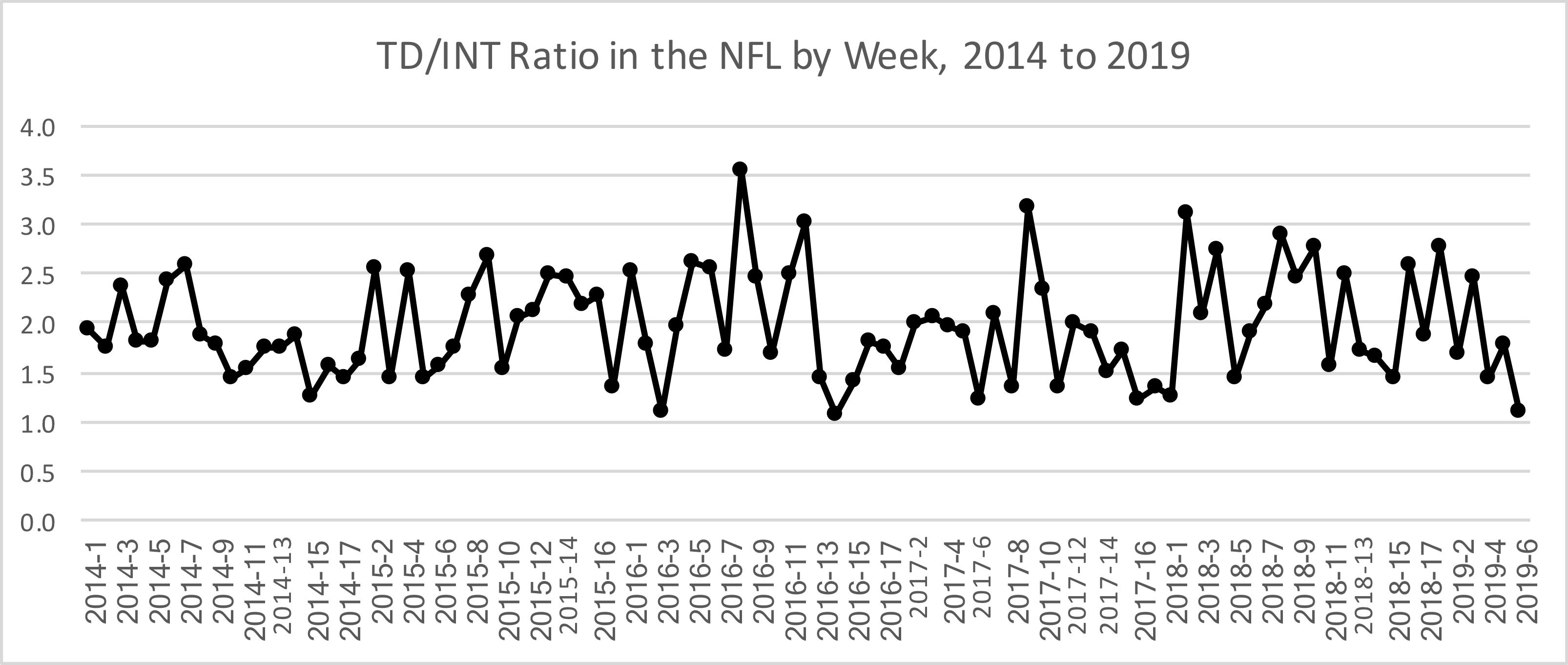
This was another rough week for passers, at least by 2019 standards. The most remarkable stat was the TD/INT ratio, which was just 35/32 in week six. The graph below shows the TD/INT ratio for each week since the start of the 2014 season; other than week 14 of 2016 (38 TDs, 36 INTs), this was the worst week of this period:

And if you weren’t watching the Falcons/Cardinals game, you probably thought week 6 was really ugly. Outside of that game, NFL teams threw for just 28 touchdowns across 26 teams, but the story of the week was in Arizona. Because once again, Matt Ryan in a losing effort is becoming a thing. Since the start of the 2018 season, Ryan has lost while averaging over 12.0 ANY/A and throwing for over 350 yards, lost while averaging over 11.0 ANY/A and throwing for over 400 yards, and now lost while averaging over 11.0 ANY/A and throwing for over 350 yards. Since the start of the 2018 season, there have been just 17 times when a quarterback has hit the 11.00 ANY/A and 350-yard thresholds; Ryan is 0-3 in these games, while the rest of the NFL is 14-0.

The reason Ryan lost, of course, was his defense, but some (much?) of the credit must go to Kyler Murray and the Cardinals, too (and some of the rest of the blame should go on the missed extra point at the end of the game). The number one overall pick had the best game of his young career on Sunday, and finished with the third best passing performance of the week. The full week 6 passing stats are below: [continue reading…]

{ 0 comments }

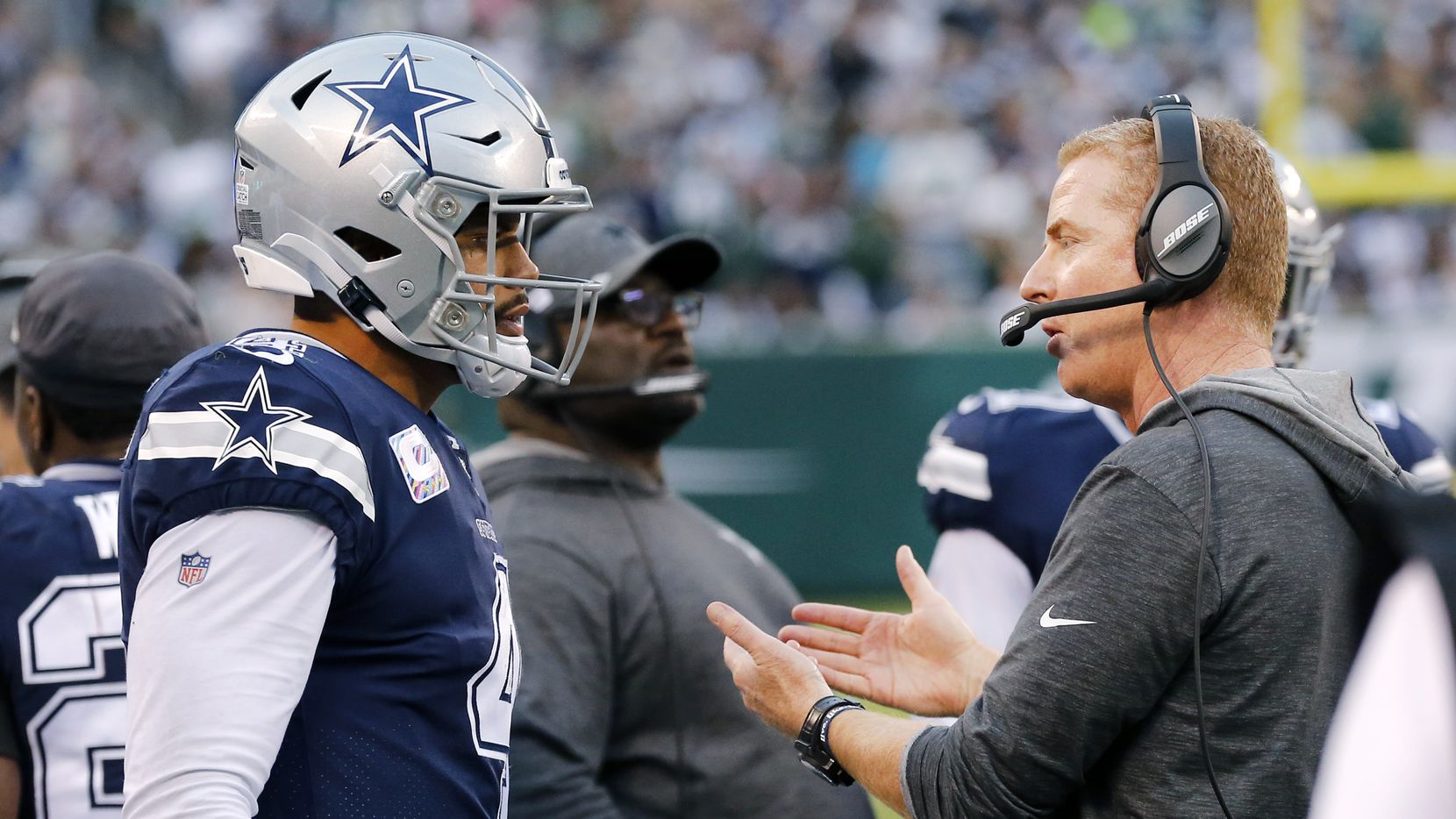
Jason Garrett Cost Dallas A Chance To Win The Game

I’m telling you, Dak, Tom Landry never went for 2.

In week 6, the Cowboys traveled to MetLife Stadium to face the Jets in what looked to be an easy win for Dallas. It was not: Sam Darnold injected some much needed offense into a lifeless Jets team, highlighted by a 92-yard touchdown pass to Robby Anderson. New York played well, but Dallas did have a chance to steal a come-from-behind victory. To do that, however, it would have required Jason Garrett to maximize his team’s win probability with thoughtful end-game strategy. Instead, Garrett made two key blunders in the 4th quarter of Sunday’s game, lowering the Cowboys chances of completing a comeback.

Seven years ago, I wrote that when trailing by 15 points midway through the fourth quarter, a team that scores a touchdown should go for two. Midway through the fourth quarter, Dallas trailed the Jets by 12 points — which, math experts may quickly realize, is a 15-point lead minus one field goal. Therefore, the same logic applies, and you’ll see why in a moment.

Ezekiel Elliott rushed for a touchdown with 6:36 remaining, and this is when the Cowboys should have gone for two. And this is not Monday morning quarterbacking: I tweeted as such in real time. Instead, Dallas sent out the kicker and cut the lead to 5 points. The Jets responded with a field goal, which highlighted the problem.

That made it a 8-point game, which is why it was a mistake to not go for two earlier. Just like when you score a touchdown down by 15, you want to go for two to make it either a 7-point game or a 9-point game. When trailing by 15, you need to score two touchdowns and convert a two-point conversion. If you convert the two-point conversion, it doesn’t matter whether you go for two after the first touchdown or the second touchdown (although, of course, only if you go for it the first time can you try to win the game with a 2-point attempt after the second touchdown). If you miss the two point conversion attempt, however, it makes a very big difference.

Dallas was ignorant of the situation: by going for 1, the Cowboys did not know that they would go on to fail on their two-point conversion attempt. Here’s what actually happened: after the Jets kicked a field goal, Dallas took over with 3:23 remaining, and casually drove down the field, scoring with 47 seconds left. The Cowboys then missed the 2-point conversion play, effectively ending the game (more on this in a minute). [continue reading…]

{ 2 comments }

When Does ANY/A Get It Wrong? By Adam Steele

Adam Steele is back for another guest post. You can view all of Adam’s posts here. As always, we thank him for contributing.


When Does ANY/A Get It Wrong?

In Chase’s review of week one passing stats, I commented that the league’s passing efficiency was inflated by ANY/A in comparison to expected points added (EPA). Today’s post takes a deeper dive into the discrepancy between ANY/A and EPA and which quarterbacks look better in each metric.

While ANY/A is a good metric for quick and dirty analysis, it ignores a number of important variables for accurately measuring a quarterback’s passing efficiency. These variables include: first downs, failed completions, air yard / YAC splits, dropped passes, fumbles, the context of interceptions, and garbage time adjustments. My metric of choice to solve these issues is ESPN’s model of expected points (the primary component of Total QBR). I prefer ESPN’s version in particular because it attempts to isolate the quarterback’s share of credit for every play; the EPA numbers found at Pro Football Reference and Advanced Football Analytics hold the quarterback fully responsible for his team’s pass plays, which, in my opinion, is not much better than just using ANY/A.

In order to compare EPA to ANY/A, I divided pass EPA by dropbacks then converted EPA/A into an index stat using the same formula for ANY/A+. For those not familiar, index stats are scaled so a score of 100 is average and 15 points represents one standard deviation above or below that average. EPA data goes back to 2006 which gives us 439 qualifying seasons to compare. As you would suspect, these two variables are closely correlated (R^2 of 0.74) in the aggregate, but there will be many individual outliers. In the graph below, the X-Axis shows the ANY/A+ for each quarterback, while the Y-Axis shows the EPA/Attempt+ for that quarterback. [continue reading…]

{ 0 comments }

Longest Active Streaks Without A Sack

Jacoby Brissett has a reputation as a guy who will take a lot of sacks. In fact, prior to 2019, he stood out as one of the most extreme examples of a quarterback who would rather take a sack than throw an interception. But among all starting quarterbacks in the NFL, it’s Brissett who has the longest active streak of pass attempts without a sack.

Earlier in the week, we looked at quarterbacks who had gone the longest without throwing an interception. Per reader Eric Drew’s suggestion, today we will look at the active streaks for all quarterbacks (through week 5, so excluding the Giants/Patriots TNF game) in terms of pass attempts without taking a sack. As you can see, Brissett has gone 85 pass attempts without a sack. During this stretch, he’s thrown two interceptions, while Deshaun Watson has the longest active streak of pass plays without a sack or an interception: [continue reading…]

{ 0 comments }

Previously:

The Seahawks beat the Rams in week 5 by the smallest of margins, 30-29. Quarterback Russell Wilson was incredible, averaging 14.25 ANY/A against Los Angles on 24 dropbacks. Wilson also had 5 scrambles for 28 yards, two kneel downs, and one designed carry for six yards. The Seahawks also had 35 designed runs for players other than Wilson that picked up 135 yards.

That is, to put it bluntly, not the correct ratio. Giving Wilson 30 plays and running the ball 35 times with someone else is pretty silly, but it’s doubly bad in a close game where Wilson is playing like a Hall of Fame quarterback in his prime. Seattle trailed entering the 4th quarter, and while Wilson’s 8 carries make the stats a bit misleading, consider the following:

Seattle with 43 rush attempts on 67 plays, a 64% run ratio. That’s the second-highest run ratio of any game in the last 5 years where a team trailed entering the 4th quarter, behind a super run-heavy game by the Colts in the snow in Buffalo in 2017. Seattle finished with a negative Game Script and ran more than they passed — by a lot — in a game where Wilson was outstanding!

By way of reference, consider how the Colts had a super run-heavy game in week 5. Jacoby Brissett had 29 dropbacks and 6 runs (2 scrambles, 2 kneels, 2 designed runs), while Indianapolis runners besides Brissett had 39 rushes for 171 yards! That is a really run-heavy game, but keep in mind two things: Indianapolis had a slightly positive Game Script of +1.8, and Brissett wasn’t all that good, averaging 3.66 ANY/A! The Colts had the second most run-heavy game of the week, and were still less run-heavy than Seattle despite the better Game Script, the better rushing attack, and the much, much, much worse passing attack.

The full week 5 Game Scripts, below: [continue reading…]

{ 0 comments }

Longest Active Streaks Without An Interception

Some fun with play by play data this morning. As you know, Patrick Mahomes, Russell Wilson, and Marcus Mariota are the only starting quarterbacks that have not thrown an interception so far this year. Going back to the 2019 regular season and playoffs, Mahomes has now gone 274 passes without throwing an interception, Wilson 201 passes, and Mariota 191 passes. The table below shows how long each quarterback in the NFL has gone without throwing an interception, as of week 5, 2019. I’ve also shown how many sacks that quarterback has taken during this streak, and their sack rate. [continue reading…]

{ 0 comments }

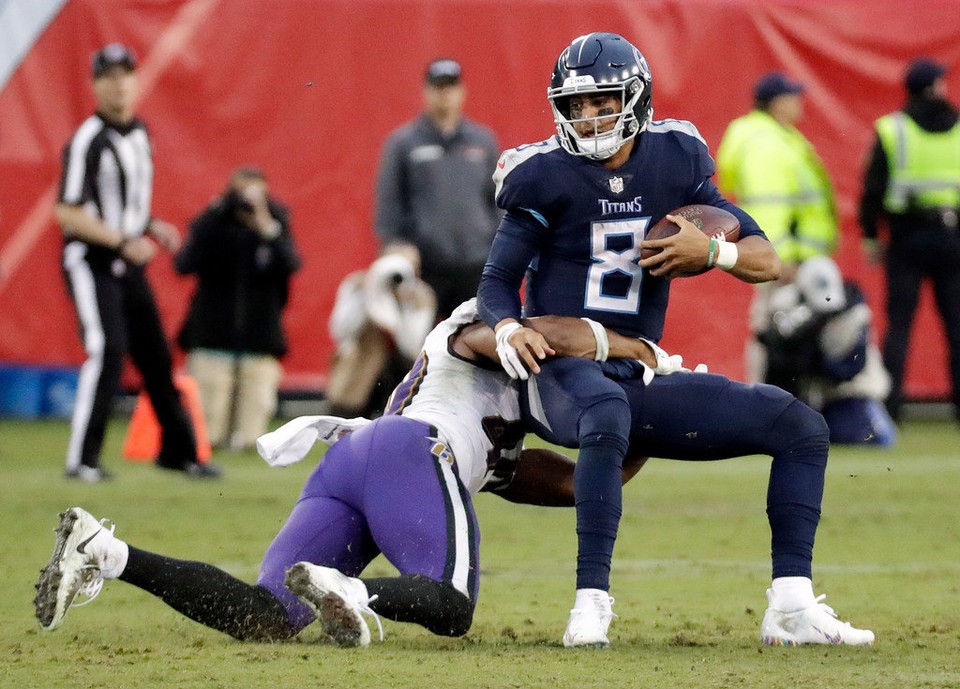
Marcus Mariota Needs To Throw More Interceptions

Mariota sacks and the leaves changing, a fall tradition like no other.

Last December, I wrote that Marcus Mariota needs to throw more incomplete passes. At the time, Mariota had thrown just 71 incomplete passes all season, while also taking 35 sacks. That’s nearly a 2:1 ratio of incomplete passes to sacks! Over the rest of the season, he threw 32 incomplete passes and only took 7 sacks, and the Titans went 4-0.

Mariota is a frustrating quarterback to analyze because he seems so afraid of making mistakes. Last year, that manifested itself by taking a sack rather than throwing an incomplete pass. This year, Mariota is taking sacks and not throwing interceptions. Dating back to last season, Mariota has now thrown 191 straight passes without throwing an interception. But during that time, he’s taken 26 sacks, a 12% sack rate.

This season, the Titans have taken a sack on 13.5% of pass plays, the second-worst rate behind the hapless Jets (who have been playing a third string quarterback). Meanwhile, Tennessee is one of just three teams (Seattle, Kansas City) that has yet to throw an interception. Tennessee has picked up a 1st down on just 28.2% of passing plays this season (46 passing first downs, 141 pass attempts, 22 sacks), which ranks 27th so far in 2019. Avoiding interceptions is great, but that should be the product of good quarterback play and not the primary goal.

Along with the Jets, the Titans are the only team this season to punt on over half of their drives. Tennessee is the only team this year without a turnover, while all other teams have at least four. But the objective of an offense is to score, and Tennessee is joined by the Redskins and the three stepsisters of the AFC East in the bottom five of the NFL in percentage of drives that end in a score.

I don’t know if Mariota is ever going to take the leap and become a top quarterback, and the evidence so far suggests he won’t. But I do know that if he is going to take that leap, it’s going to be because he starts leading touchdown drives, and not because he doesn’t make mistakes.

{ 18 comments }

Week 5 (2019) Passing Stats: Deshaun Watson Stars

Houston Texans quarterback Deshaun Watson is pretty darn good when he isn’t being sacked. On Sunday against the Falcons, for just the second time in his career, Watson played a game without being sacked. And now both times, he has thrown 5 TDs in those games. He also has a 3-sack, 5 TD game, meaning he’s played more games where he’s thrown 5 TDs than he’s avoided any sacks.

Against Atlanta, the Texans punted on their opening drive. After that, Houston scored on its other 8 drives in the game, discarding end of half/game drives. And most of those drives were touchdowns, with all of them covering at least 59 yards. Houston went 10/13 on third down conversions, averaged nearly 9 yards per play, and looked dominant against an overmatched Falcons pass defense.

Watson stood out as by far the best passer of week 5, overshadowing strong performances from Russell Wilson and Teddy Bridgewater. On the other side of things, Luke Falk and Baker Mayfield turned in two of the sorriest performances you’ll witness this season. Both finished with negative ANY/A, and the Jets and Browns combined for only 11 passing first downs.

The full week 5 passing numbers below:

RkQuarterbackTmOppResultAttYdsTDIntSkYdsANY/AVALUE
1Deshaun WatsonHOUATLW 53-3233426500015.94323
2Russell WilsonSEALARW 30-2923268401614.25194
3Teddy BridgewaterNORTAMW 31-2434314410010.26140
4Kirk CousinsMINNYGW 28-10273062032710.63134
5Gardner MinshewJAXCARL 27-3444374202168.65115
6Jared GoffLARSEAL 29-304939511007.5568
7Andy DaltonCINARIL 23-263826220107.7462
8Dak PrescottDALGNBL 24-3444463233227.3657
9Kyler MurrayARICINW 26-233225300157.5245
10Tom BradyNWEWASW 33-742348314367.1144
11Patrick MahomesKANINDL 13-1939321104337.1643
12Matt RyanATLHOUL 32-5346330312146.935
13Derek CarrOAKCHIW 24-213222900007.1632
14Jimmy GaroppoloSFOCLEW 31-329181202106.8120
15Carson WentzPHINYJW 31-62918910186.716
16Odell BeckhamCLESFOL 3-3112000002014
17Devlin HodgesPITBALL 23-2696800007.5613
18Taysom HillNORTAMW 31-2411800001812
19Mason RudolphPITBALL 23-2620131101116.6711
20Alvin KamaraNORTAMW 31-241130000137
21Jameis WinstonTAMNORL 24-3127204206466-5
22Garrett GilbertCLESFOL 3-311000000-6
22Christian McCaffreyCARJAXW 34-271000000-6
22Jarrett StidhamNWEWASW 33-71000000-6
25Aaron RodgersGNBDALW 34-2434238002235.97-7
26Joe FlaccoDENLACW 20-1320182113235.83-8
27Marcus MariotaTENBUFL 7-1422183005335.56-16
28Josh AllenBUFTENW 14-732219214155.53-23
29Kyle AllenCARJAXW 34-2730181103215.45-23
30Jaylen SamuelsPITBALL 23-26240100-20.5-53
31Chase DanielCHIOAKL 21-2430231224374.24-65
32Jacoby BrissettINDKANW 19-132915101003.66-73
33Daniel JonesNYGMINL 10-2838182114352.9-137
34Colt McCoyWASNWEL 7-3327119016440.91-173
35Philip RiversLACDENL 13-204821102002.52-175
36Lamar JacksonBALPITW 26-2328161135220.73-179
37Baker MayfieldCLESFOL 3-312210002442-1.23-192
38Luke FalkNYJPHIL 6-312612002952-0.63-237
Total99173954324805816.160

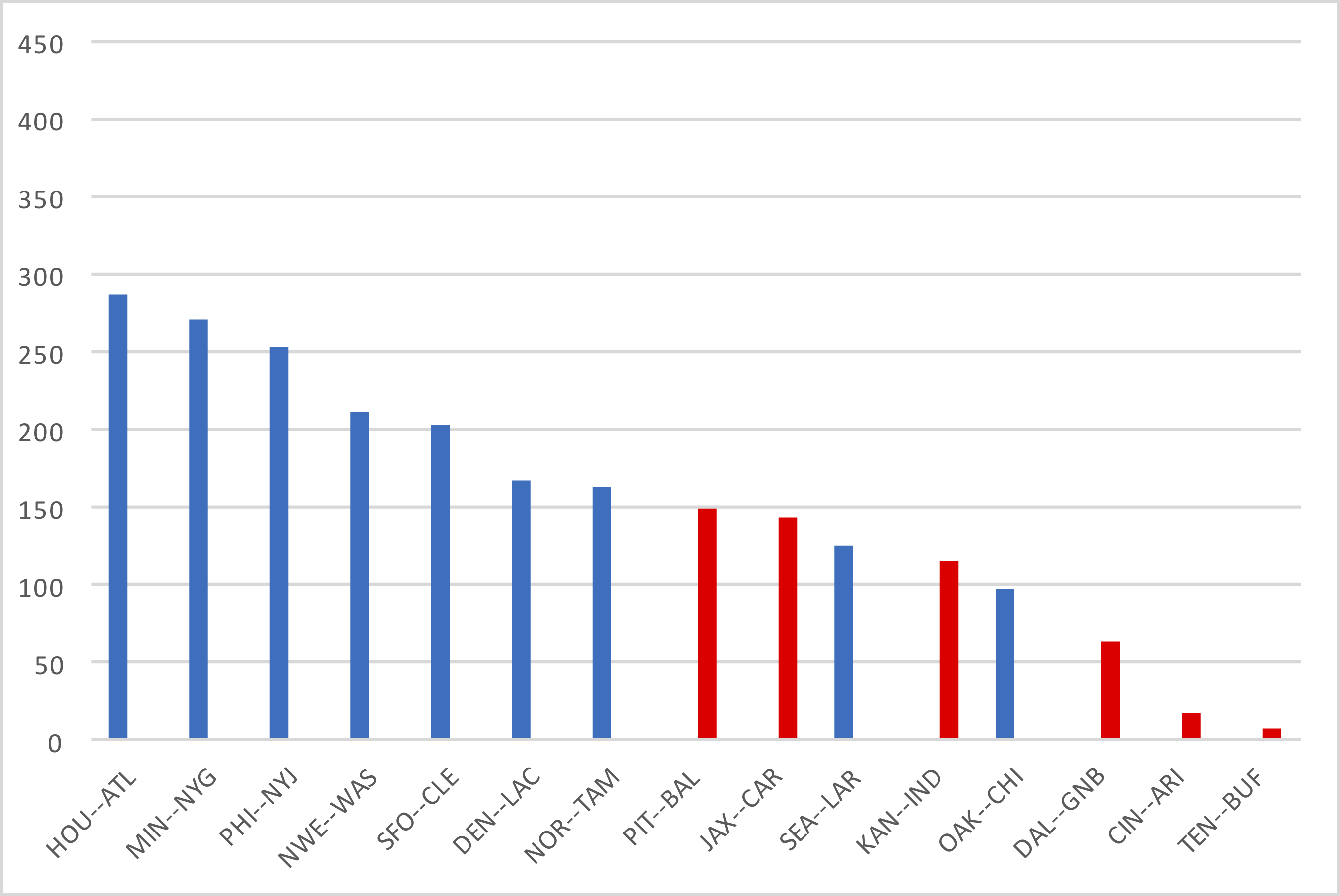
As usual, the teams that won the passing battle won the game. But there were three notable outliers in week 5: the Steelers pass defense was great, but Pittsburgh still lost in overtime to Baltimore. Jacksonville won the passing battle against Carolina, but didn’t have Christian McCaffrey. And the Colts had a run-heavy and very efficient offense against the Chiefs, shutting down Kansas City enough times to steal the win.

What stands out to you?

{ 0 comments }

The Jets Offense Is Averaging 3.16 Yards per Play

That’s it.  That’s the article. The Jets are averaging 3.16 yards per play this year, which is embarrassing beyond belief.

Throug  Since 1970, the Jets are just the 8th team to average under 3.2 yards per play of offense through four games, and the first since 1978.

The graph below shows the yards per play gained by each NFL offense since 1970. As you can see, the Jets stick out on the bottom right.  The X-Axis shows teams by year, and the Y-Axis shows the yards per play gained by that offense. [continue reading…]

{ 0 comments }

Washington Redskins, Trailing 16 Game History

The Washington Redskins are 0-4, and are 15-point underdogs at home today against the Patriots. It is the largest spread the Redskins have ever faced in a home game, topping a 13-point margin against the 1995 Cowboys. A loss today means Washington will have lost 11 of its last 12 games, as the Redskins finished 2018 with a 1-6 mark in the team’s final 7 games once Alex Smith went down.

It certainly feels like a low point in franchise history. And over a long enough time horizon, that’s certainly true: since 1993, Washington has the fourth worst record in the NFL, below even the Cardinals.

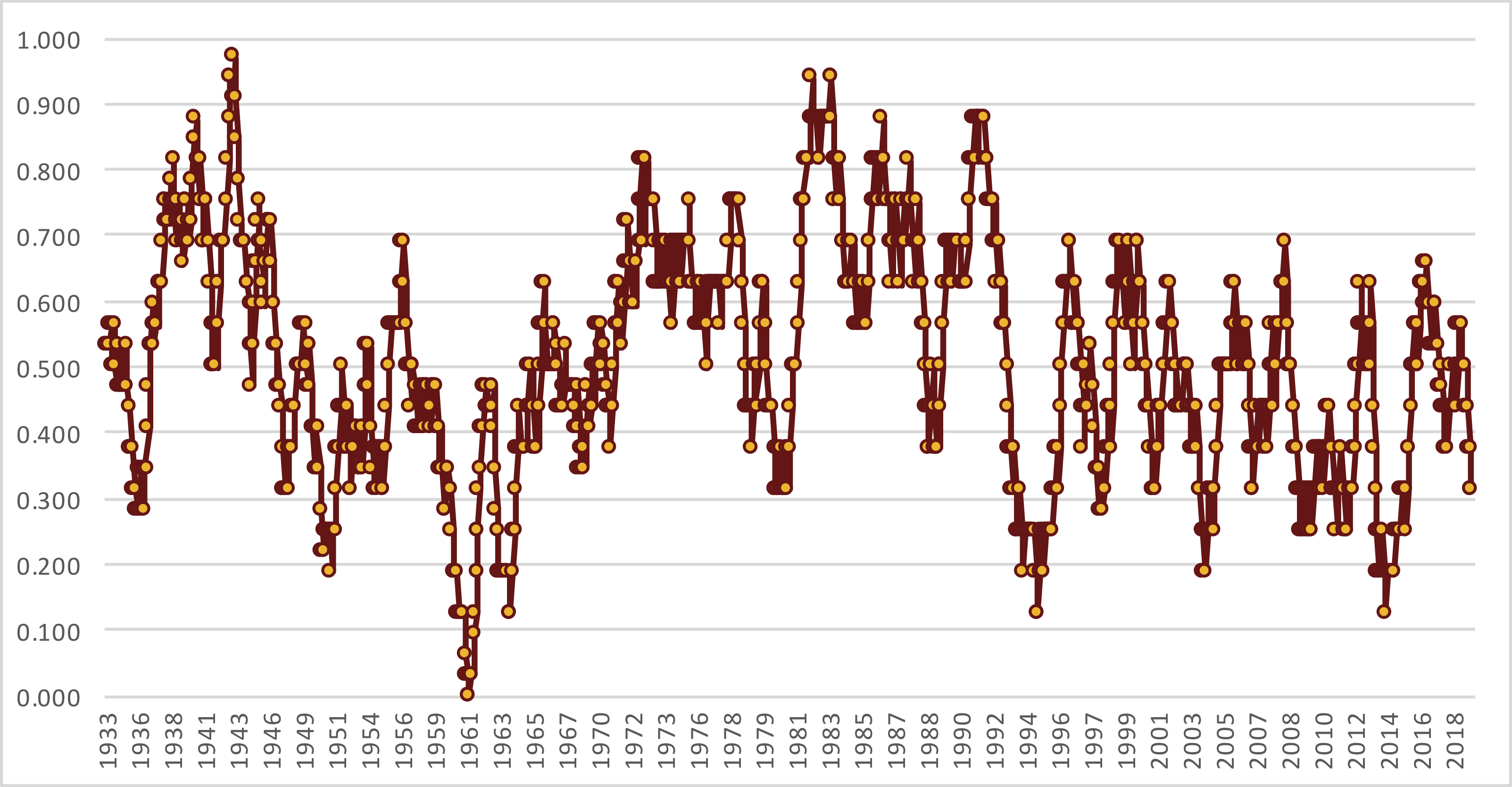
The graph below shows the team’s trailing 16-game winning percentage over each 16-game period in franchise history.

Less than a year ago, Washington had a 9-7 record over its previous 16 games. But that was with Smith, and with a head coach who apparently didn’t want the team’s first round quarterback, the team seems as directionless now as it has in years. But take note, Redskins fans: it could be worse. As you can see from the graph above, Washington lost 16 straight games from ’60 to ’61, and went 22 straight games during this stretch without a win.

{ 0 comments }

The Patriots And The Point Spread Under Tom Brady

Tomorrow, the Patriots will be 15-point favorites to win on the road in Washington. This is the third time in four weeks that New England is favored to win by more than two touchdowns. The Patriots had been favored in 69 consecutive games until the 2018 AFC Championship Game, but the Patriots have quickly resumed their usual role as favorites.

The graph below shows the point spread in every Patriots game since 2001. The games are colored based on whether it was a regular season game, a playoff game, or a game without Tom Brady. [continue reading…]

{ 0 comments }

Can this man go 12 more games without an interception?

Russell Wilson, Marcus Mariota, and Patrick Mahomes have yet to throw an interception this season. Wilson has now started five games, with Mariota and Mahomes set to start their fifth games of the season on Sunday. Of the three, Mariota seems the least likely to put together any sort of long streak here. While the Titans quarterback is famous for his ability to take a sack at the first sign of trouble, he entered the 2019 season with a career 2.6% interception rate. More importantly (and related to that fact), most interceptions are thrown when trailing, and Mariota plays on the worst of these three teams. On the other hand, he has now gone 6 straight games without an interception and 169 passes without an interception, while taking 21 sacks during that period. Presumably, Mariota will at some point soon throw an interception while in catch-up mode, but you never know: against the Jaguars in week 4, Tennessee took over down 13 points with 3:23 remaining, and were so aggressive that they… got to the Jaguars 37-yard line with 2 seconds remainin.

Since the start of the 2015 season, 62% of all interceptions have come when a team was behind on the scoreboard, 14% in tie games, and the remaining 24% by the team in the lead. The easiest way to avoid throwing interceptions is to take a sack; the second-easiest way is to play with the lead. You might have noticed that since the Saints have become good again, Drew Brees has stopped throwing interceptions.

Wilson, of course, is therefore in a very good position. He takes a lot of sacks and often plays with the lead, which should help to minimize his chances of throwing an interception. He’s also one of the most accurate passers in the NFL, which helps quite a lot, too. Wilson is completing 73.1% of his passes so far in 2019, and he has a career interception rate under 2.0%. Can he go the next 11 games without throwing an interception? It’s been done before, but only once: Tom Brady, during the last 11 games of the 2010 season, is the only quarterback to go 11 straight games without throwing an interception (minimum 10 pass attempts in each game). The next time he took the field, he threw an interception on the first drive of the Patriots playoff game against the Jets, which New England lost. If Brady wasn’t so clutch, that would have looked like he choked in a playoff game. [continue reading…]

{ 0 comments }

Previously:

If you drop back to pass 70 times, it doesn’t matter what the score is: that’s a very pass-heavy game! The Rams had one of the most pass-heavy games of the season on Sunday in a 55-40 loss to Tampa Bay. Los Angeles finished with 70 pass plays versus just 11 runs, an 86.4% pass ratio rarely see in the NFL.

Someone asked: should we hand the ball to Gurley?

And it wasn’t all game script. Los Angeles had 7 passes and 1 run (a Cooper Kupp handoff, no less) on the team’s first offensive drive of the game. And on the Rams second drive, with the score only 7-0, Los Angeles had 7 passes and no runs.  The Rams seemed to overcorrect on their third drive by running on the first two plays of their third drive, but two Malcolm Brown runs led to a 3rd-and-4 and a Jared Goff interception.  This means Todd Gurley didn’t get his first carry of the game until the team’s 18th play from scrimmage and fourth drive of the game.

Aaron Rodgers and the Packers also had a very pass-heavy game plan in week four.  This was a perfectly even game: it was a back-and-forth contest where Green Bay finished with a -0.1 Game Script.  Running back Aaron Jones rushed 13 times for only 21 yards, while Rodgers had 53 pass attempts, 1 sack, and 5 scrambles (with zero designed runs).  That means the Packers called 59 pass plays and just 15 rushes, although Game Scripts data currently considers scrambles as rushing plays.  That’s remarkably pass-heavy for an even game.

Finally, Joe Flacco and the Broncos stood out as pass-happy, too.  Denver lost, but led the most of the game and finished with a +4.9 Game Script. Flacco played pretty well, taking no sacks and throwing for 15 first downs and 303 yards on 38 attempts.  Perhaps this was a response to my article about how Denver was over-the-top run-heavy in week 3?

The full week 4 Game Script data below: [continue reading…]

{ 0 comments }

There were 14 NFL teams back in 1962, and the starting quarterbacks for 11 of them averaged more yards per pass attempt than the starting quarterbacks for those same teams did in 2018. We learned that in Part I of this series.  Today, in Part II, we will look at the evolution of passing efficiency in the NFL since 1940.

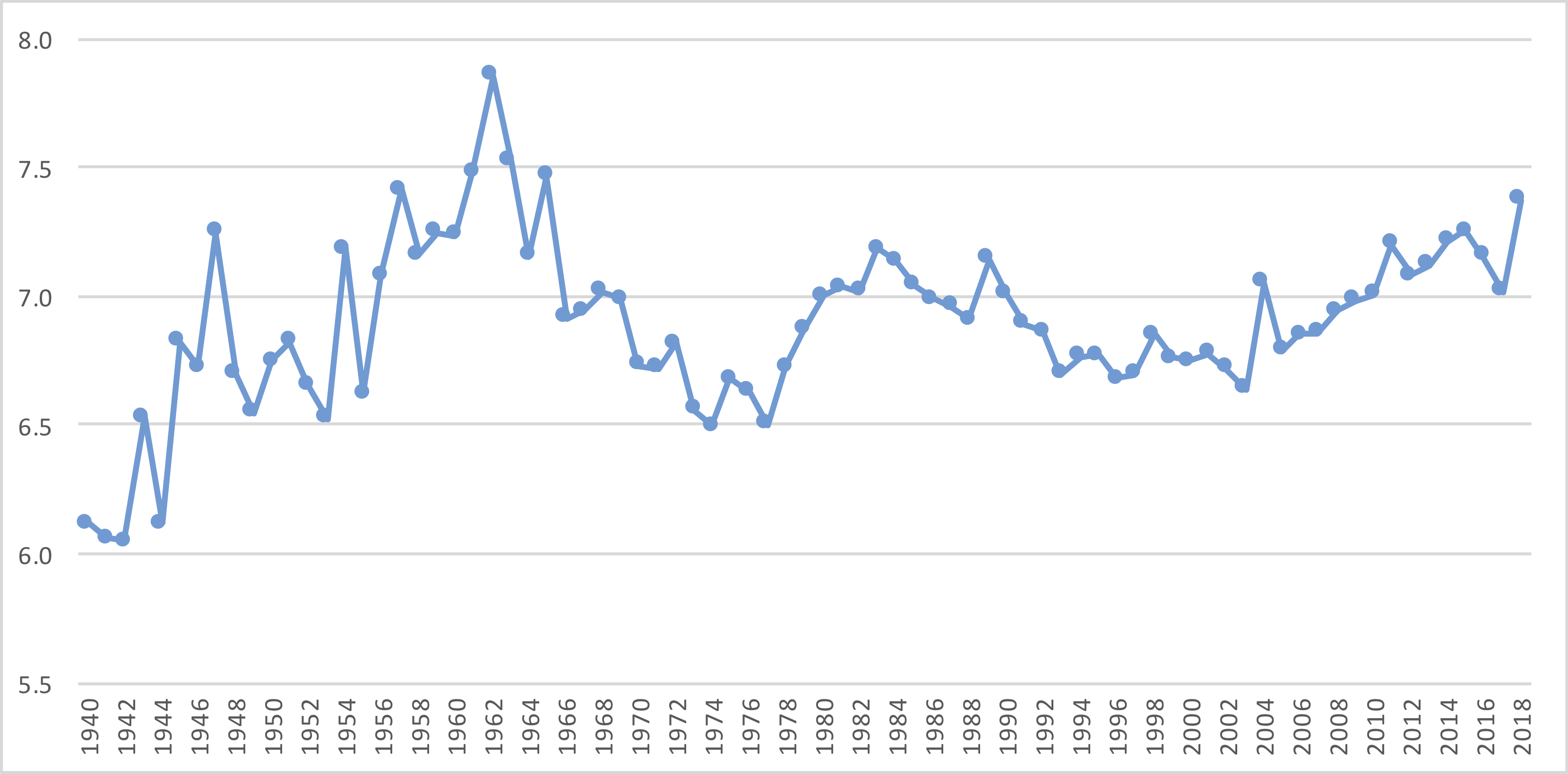
In 1962, the league as a whole averaged 7.9 yards per pass attempt.  That’s a remarkable figure.  So remarkable that it remains the record and is unlikely to be broken anytime soon.  The graph below shows the NFL yards per attempt average in each season from 1940 to 2018.

It doesn’t take a long examination to see that the 1962 season is a significant outlier.  So what caused this?  It helps to begin by breaking down yards per attempt into two components: Completions per Attempt and Yards per Completion; the product of these two statistics is, of course, yards per attempt.

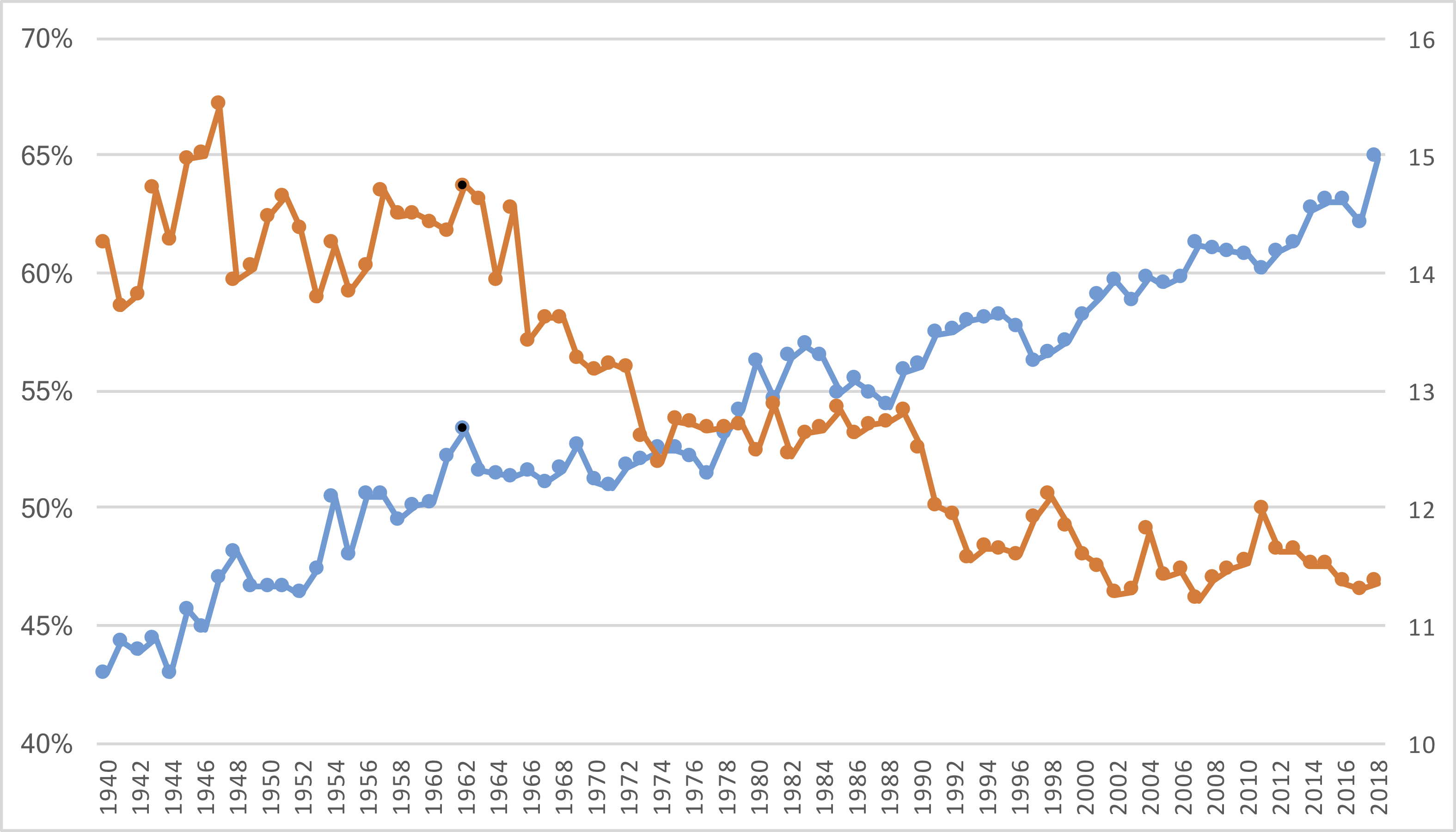
Over the last 80 years, completion percentages have been rising. This is well known, but less discussed is that the average gain on those completed passes — the statistic known as yards per completion — has been steadily falling.   The graph below shows the NFL average completion percentage in blue and marked against the Left Y-Axis, and NFL  yards per completion average in orange marked against the Right Y-Axis, for each year from 1940 to 2018.  The graph forms a jagged X: yards per completion starts up and to the left and ends down and to the right, with completion percentage beginning in the lower left quadrant and ending on the upper right quadrant.

To make it easier for you to see, I shaded the 1962 season in black dots on both lines.  There was a large jump in completion percentage in 1962 — in fact, ’62 set the new record for completion percentage in a season at 53%, and that mark wasn’t broken until 1979!  On the other hand, this wasn’t shocking for the era: after all, 1961 also set a new record for completion percentage.  The 53% rate was notably high and a bit of an outlier, but part of a (still) growing trend towards higher completion percentages year over year.

On the other hand, the 1962 season also represented a reversal of the trend in terms of yards per completion.  Teams gained 14.74 yards per completed pass, the 4th-highest since 1940 both at the time and since.  And the three higher seasons all had come well over a decade earlier, so this was a true change in the tides.  Not only were teams completing more passes than ever, but they were doing so at a rate similar to what happened prior to 1950.

Of course, simple math tells us that if you have an extraordinarily high (for that era) completion percentage combined with an extraordinarily high yards per completion average, that you will wind up with a record-setting yards per attempt average.  And that’s exactly what happened.  The early 1960s were somewhat of an inflection point in this regard: the top three yards per attempt seasons in NFL history were in 1961, 1962, and 1963!  And the 4th-best mark came in 1965.

In the early part of the ’60s, while the AFL was earning a reputation for being a pass-happy league, the NFL was quietly enjoying its most pass efficient seasons in history.  And to be clear, all data in this post is NFL-only.  But even among this era of rising completion percentages and still-high YPC averages, the ’62 season stands alone.  If 1962 didn’t exist, we’d talk about how 1961 and 1963 were remarkably high yards/attempt seasons, but 1962 easily eclipses both of those marks.

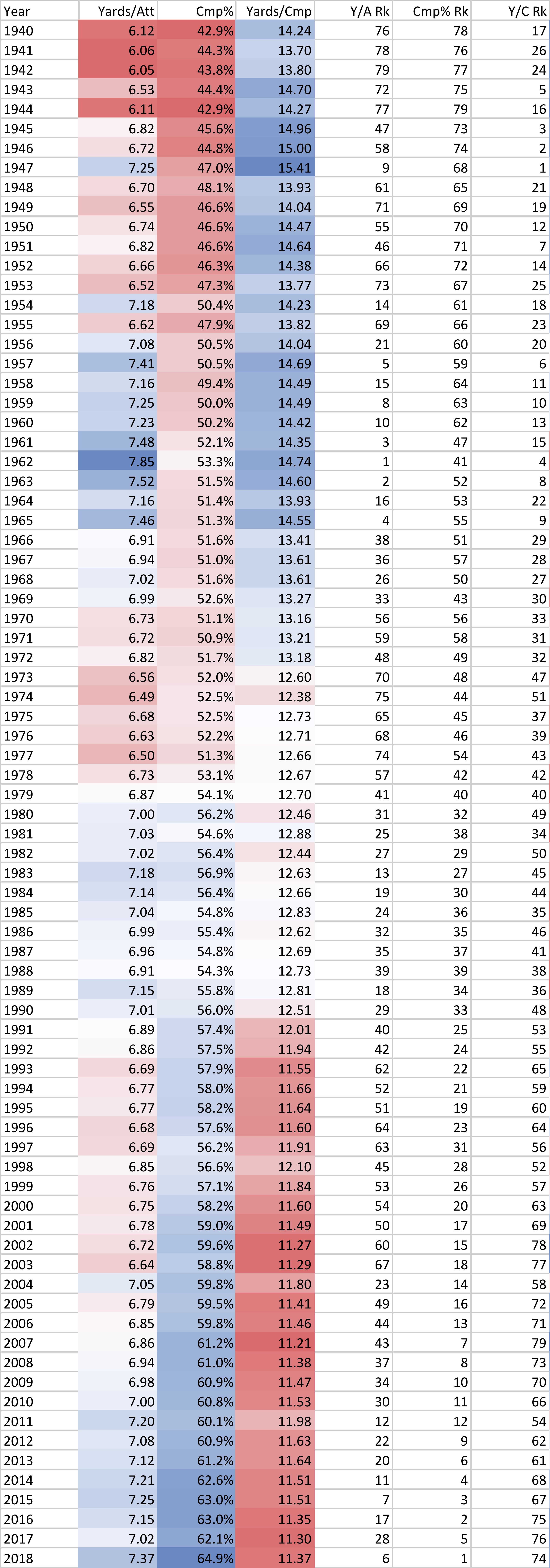
Finally, here is the data from every year since 1940, presented in table form.

So what caused all of this? Stay tuned for Part III.

{ 0 comments }

Week 4 (2019) Passing Stats: NFL Offenses Struggle

It was a rough week for a lot of passers in week 4: there were just 39 touchdown passes by the 30 teams, and the league averaged only 5.82 ANY/A. There were a pair of 16-10 victories (NE/BUF, CAR/HOU) where all quarterbacks played poorly, a 16-6 victory that was pretty ugly (CHI/MIN), and a 12-10 matchup on Sunday Night (NO/DAL) that was equally hard to watch.

NFL teams have gotten very conservative in the passing game, and I’d suggest that they are far too conservative. Kirk Cousins did not throw an interception, but that’s because he showed no sign of aggressiveness. Take a look at his passing chart, and keep in mind that this does not show the six times he took a sack: [continue reading…]

{ 0 comments }

Frank Gore Is Remarkable

In 1977, the Kansas City Chiefs went 2-10. This was during one of the worst passing seasons in NFL history, the season that encouraged the 1978 rules changes. Quarterback Mike Livingston went 1-10 as the starter and he was about as bad as his record. Kansas City brought him back as the team’s starter in 1978, but changed coaches, bringing in Marv Levy. The future Bills coach inherited a terrible team in Kansas City that was particularly inexperienced on defense: all three starters on the defensive line were rookies, as was one of the linebackers; two other starters were ’77 draft picks, and another two starters were 24-year old players drafted in 1976.  That’s 8 of 11 starters on defense that were 24 or younger, to go with a a bad passing attack centered around Livingston, and WRs Henry Marshall and Larry Dorsey.

So what did Levy do?  He decided to install the Wing-T offense, centered around three halfbacks, a tight end, and Marshall at split end.  Kansas City had Tony Reed as the starting halfback, Arnold Morgando as the fullback, and Ted McKnight as the Wingback as part of a ball-controlled offense designed to keep the young defense (and weak passing game) off the field. But on October 1st, 1978, it was veteran backup Macarthur Lane — with the emphasis on veteran — that powered the offense.  Lane rushed 17 times for 144 yards in a game where Livingston and backup Tony Adams combined to complete 9 of 21 passes for just 83 yards.

So why is this noteworthy today? Well, on October 1st, Lane was 36 years and 199 days old. Playing in that Wing-T offense, he became the oldest player to ever rush for 100 yards in a game. And yesterday, Frank Gore nearly matched him. The ageless Gore rushed 17 times for 109 yards in a Bills loss to the Patriots. He wasn’t aided by a Wing-T offense, but the 36 year, 138-day old back did his best to keep the Bills alive on a day where the passing attack was a disaster (averaging 1.22 ANY/A).

And historians, take note: Gore will be 36 years and over 200 days old for the Bills four games in December, making him eligible to set the new record for the oldest player to rush for 100 yards in a game. [continue reading…]

{ 0 comments }

Murray has been sacked 16 times in 3 games.

Arizona rookie Kyler Murray has some pretty strong counting stats so far this year: he’s averaging 276 passing yards per game, which would lead him to breaking the mark for passing yards by a rookie if he keeps this up for 16 games. He “only” has three interceptions, and he is completing a whopping 28 passes per game: only Drew Brees (5x), Peyton Manning (2x), and Ben Roethlisberger (2018) have ever done that in a season while playing in at least 8 games.

But Murray’s efficiency numbers have been, well, bad. He’s averaging just 4.42 ANY/A this year, thanks to an awful sack rate (10.5%) and a poor yards per completion average (9.9). But we don’t need an advanced stat like ANY/A to see Murray’s struggles: the most basic of stats will suffice.

Murray has thrown for only 37 first downs so far this year, despite having 153 passing plays (pass attempts plus sacks). That is an ugly 24.2% rate, while the league average is 32.6%. First down rate is one of the most basic stats to measure passing success, but it’s much better than completion percentage and is a handy way to quickly and easily check in on quarterback performance. The table below shows the passing stats for quarterbacks prior to today: [continue reading…]

{ 0 comments }

Interceptions By Win Probability, Part 2

Mayfield is having a tough start to the year, but don’t point to his interception against Tennessee as a reason why.

Last year, I wrote about how not all interceptions are created equally, and that there is a large diversity in the impact of interceptions.

There have been a lot of meaningless interceptions this season already. Baker Mayfield threw an interception down by 23 points with 3 minutes remaining at the Cleveland 20. That interception dropped the Browns chances of winning from zero to zero. Trailing by 42 points, Josh Rosen opened the 4th quarter of the opening game loss to the Ravens by throwing a meaningless interception. The next week, Miami’s Ryan Fitzpatrick threw two 4th quarter interceptions in a blowout loss to the Patriots: yeah, maybe all Dolphins interceptions are meaningless, but these three were *really* meaningless. And the most meaningless (is that a thing?) one yet? Rosen threw an interception on the final play of that Patriots game, too. [continue reading…]

{ 0 comments }

Mike Leach has been at the front of the passing revolution in football circles for three decades.  He worked with Hal Mumme at Iowa Wesleyan in 1989, and that’s where the two began creating the Air Raid offense. Together they moved on to Valdosta State in Georgia, and then up to major college football when they moved to Kentucky in 1997.   There, Leach mentored a future number one overall draft pick; two years later, he moved to Oklahoma and helped the Sooners win a national title before embarking on a decade-long stint in Lubbock as head coach of the Texas Tech Red Raiders.  And since 2012, Leach has been the head coach at Washington State.

The table below shows all of Leach’s starting quarterbacks during his time in major college football: [continue reading…]

{ 0 comments }

Previously:

New England is at it again, rolling through the NFL in dominant fashion.  For the third time in three games, the Patriots had a Game Script of over +14.0.  The Patriots have outscored teams by 53 points at halftime and 73 points through three quarters; both are the best marks in the league.  Here’s your money stat of the week: New England opponents have run 169 plays this year, and 120 of them (71%) have come with the Patriots leading by more than two touchdowns.

From a Game Scripts perspective, the most interesting thing about week 3 might have been that Tom Brady was still really pass-happy. The Patriots joined the rare 10/15/20/45 club: leading by at least 10, 15, and 20 points after the 1st, 2nd, and 3rd quarters, respectively, and throwing 45+ times in the game.  The last time it happened was so unusual I wrote about it in this column then, too.

The other team that was really pass-heavy was Philip Rivers and the Chargers.  In a game where Los Angeles had a +2.4 Game Script, you’d expect a pretty average pass ratio.  Instead, L.A. passed on 74% of plays, the most of all 32 teams in week 3.  It is unusual that the team with the highest pass ratio in a week had a positive Game Script, but it’s hard to fault a team like the Chargers for passing a lot. Also worth noting: the two Chargers running backs, Austin Ekeler and Justin Jackson, caught 11 of 11 targets for 51 yards (and 3 first downs), which … well, I’m not quite sure what to think about that. [continue reading…]

{ 0 comments }

Coaching Tips: Don’t Miss Out On A Free Pass Play

In 2012, the New Orleans Saints led the Cowboys, 31-24, with 2:46 remaining and Dallas holding just two timeouts. Drew Brees completed a pass to Jimmy Graham for the first down, and the Saints looked to be in great shape.

New Orleans still had to run another play before the 2 minute warning, however, and with 2:04 remaining, the Saints ran Mark Ingram off left tackle.  He lost a yard and the two minute warning stopped the clock.  New Orleans ran again on second down, and the Cowboys called their second timeout.  On third and long, Brees completed a pass short of the sticks, and the Cowboys called their final timeout.  After a punt, the Cowboys took over with 1:29 remaining and no timeouts, and needing 64 yards for a touchdown.  That was all Tony Romo, always known for his great 4th quarter passing numbers, needed to tie the game: with 21 seconds remaining, he threw a game-tying touchdown pass, and the two teams went to overtime.

Why am I bringing that up today?  Because the Saints should have passed the ball with 2:04 remaining!  When you are that close to the two minute warning, coaches should view that as a free opportunity to pass the ball and pick up a first down.  This happened again on Sunday in an even more egregious situation.  The Ravens scored a touchdown with 2:01 remaining to cut the lead to 33-28.  Baltimore then brilliantly chose to do a drop kick onside kick; the Chiefs correctly responded with a fair catch, but that meant no time went off the clock.

So now Kansas City had the ball, with 2:01 remaining, and Baltimore down to just one timeout.  The Chiefs, I remind you, have Patrick Mahomes. There was no downside to passing here other than an interception, and well, that’s not something Mahomes is very likely to do. This is an obvious passing situation, and I said so immediately when the situation arose:

Alas, the Chiefs chose to run the ball twice, and then were forced to pass on 3rd and 9 (which, of course, Mahomes converted because well, he’s Mahomes). But that outcome doesn’t change the bad process.
[continue reading…]

{ 0 comments }

Week 3 (2019) Passing Stats: Kyler Murray Hits Rock Bottom

If you took a quick glance at the passing stats from week 3, you might not notice how bad number one overall pick Kyler Murray performed against the Panthers. You’d see that he threw for only 173 yards with 2 TDs and 2 INTs, and might think that it was a typical underwhelming performance by a rookie quarterback.

What you might not have noticed was that Murray had 43 pass attempts and also was sacked a whopping 8 times, losing 46 yards. He also only passed for 9 first downs, a pitiful number given his 51 passing plays (17.6%). Murray threw for just 127 net passing yards against Carolina, a shockingly-low 2.49 net yards per attempt average. In fact, no passer had averaged under 2.50 NY/A in a game with 40+ attempts since 2003.

Murray finished week 3 with a 1.51 ANY/A average, the second-worst performance in week 3 by any starting quarterback. The worst? Well, that honor belongs to Jets third string QB Luke Falk, who was basically useless against the Patriots. Falk had 27 passing plays on Sunday: 20 of them produced negative EPA, meaning they were a negative play, 3 were slightly positive plays (i.e., a 5-yard pass on 1st-and-10), and 4 picked up first downs. New York scored 14 points courtesy of a special teams touchdown and a defensive touchdown.

On the positive side of things, the top three passing stat lines belonged to Patrick Mahomes, Deshaun Watson, and Kyle Allen. The full week 3 passing stats below: [continue reading…]

{ 0 comments }

Advanced Stats Pages Now On Pro-Football-Reference.com

You may have noticed that PFR has been making some additions to their fantastic website, including by adding some advanced statistics pages. For example, regular readers may recall Adam’s post this offseason about Nick Mullens and how much he benefited from yards after the catch.

In the cases of Beathard and Mullens, it’s no coincidence that both played for the same team. Kyle Shanahan’s scheme was able to exploit defenses and create gaping holes in the zone for his receivers to pick up huge chunks of yardage. This created long gains that boosted the stat sheet for his quarterbacks but only required simple throws that nearly every professional passer could make.

Well, now you can check for yourself at PFR: this page shows advanced passing stats from 2018; as it turns out, Mullens averaged 6.9 yards of “YAC” — yards after the catch — on his completions last season, the highest rate in the NFL.  And while they didn’t throw enough passes to qualify, 49ers quarterbacks C.J. Beathard (7.1 YAC/C) and Jimmy Garoppolo (6.9) also had crazy-high YAC numbers.

This season? With Garoppolo back as the San Francisco starter, his receivers are averaging an NFL-best 9.8 yards after the catch.  This page is a great resource, and also can help you uncover some surprises. For example, I expected the marriage between head coach Bruce Arians and quarterback Jameis Winston to lead to a lot of big plays down the field. Winston averaged 8.5 air yards per attempt last season, 2nd-highest in the NFL behind his Bucs teammate Ryan Fitzpatrick. But Winston also ranked last in yards gained after the catch per completion, at 3.7, a residue of Tampa Bay’s downfield style.

Arians was known for constructive a similar offense, but so far this year, Winston is one of five passers averaging over 9 yards of YAC per completion. Is that sustainable over 16 games? We have no way of knowing, but it will be interesting to monitor. And thanks to PFR’s new advanced stats pages, we can.

For fun, I graphed the passers in 2018 and 2019 by their YAC per completion, with 2018 data on the X-Axis and 2019 data on the Y-Axis. Jimmy G and Pat Mahomes are in the upper right, with high YAC numbers in both ’18 and ’19. But Winston is on the upper left, with high YAC in ’19 but low YAC in ’18. [continue reading…]

{ 0 comments }

Luke Falk, who came on in relief for the Jets in week 2.

The Jets started Sam Darnold in week 1 at quarterback, but due to mono, New York was forced to start Trevor Siemian in week two. But in Siemian’s first start, he injured his ankle and was lost for the season. Now, the Jets turn to Luke Falk today to be the team’s third starting quarterback in just three weeks.

How rare is that? Excluding the 1987 season which featured replacement players during week three, the Jets will be just the 6th team since 1950 to start three different quarterbacks in the team’s opening three games.

In 2016, as the Browns embarked on an 0-16 season, Cleveland started Robert Griffin in week 1, Josh McCown in week 2, and Cody Kessler in week 3.  Both changes were the result of injury, with Griffin suffering a broken bone in his shoulder and McCown breaking his collarbone.

In 2008, the soon to be 2-14 Chiefs went with Brodie Croyle at quarterback to open the season, Damon Huard, and finally Tyler Thigpen in week 3. Croyle suffered a shoulder injury in week one, while Huard had a neck/head injury in week two, leading to Thigpen’s promotion to starting quarterback.

In 1997, the Jaguars had a rough start to the year beginning in the preseason. Starting quarterback Mark Brunell suffered a knee injury during the preseason which sidelined him for a few weeks. As a result, Rob Johnson wound up starting week 1, but suffered a high ankle sprain that caused him to miss the following week. Steve Matthews would start for the team in week 2, and following a week 3 bye, Brunell returned as the starter in week 4. Jacksonville won all three games and went 11-5 that season.

In 1988, Bernie Kosar started for the Browns in week 1, but injured his elbow and was replaced by Gary Danielson. In week 2, Danielson started but played poorly in the last game of his NFL career; he was replaced by Mike Pagel, who would start in week 3. Cleveland would finish the season 10-6, with Kosar starting nine games.

Finally, in 1976, the Rams started three different quarterbacks. Starter James Harris injured his thumb in the preseason, leading Ron Jaworski to open the season as the starter. But Jaws was injured in week 1, leading Pat Haden to start in week 2 for Los Angeles. By the third game, Harris was back, and the Rams would finish the year 10-3-1.

And that’s it. The Jets are now the 6th team to have to start three different quarterbacks to open the season, and none of the first five teams had to start four different quarterbacks in its first four games.

{ 0 comments }

Largest Point Spreads in Franchise History

Did you know: Detroit, Tampa Bay, and Cleveland have never been 14-point favorites in any game since 1978? In December 1995, facing the expansion Jaguars quarterbacked by backup Steve Beuerlein, the Lions were 13-point favorites.  That is the largest points spread the team has had since ’78, and the playoff-bound Lions won 44-0.

In 2005, in a game against the Katrina Saints with backup Todd Bouman, the Bucs were 13-point favorites. This was the last game of the regular season, and the host Bucs scored a late defensive touchdown to cover, 27-13.  Tampa Bay would finish the year 11-5.

And finally, we have the Browns.  In 1995, against those same expansion Jaguars, the old Browns were 13.5 point favorites coming off of a bye.  But for the first time, a Bill Belichick-led favorite was shocked by a Tom Coughlin-led underdog, as the Jaguars won 23-15.  From a points spread perspective, this was actually a bigger upset than the 2007 Super Bowl!  The largest points spread for the new Browns came in the final game of the 2007 season, where Cleveland beat San Francisco 20-7 as 11.5-point favorites.

The table below shows the largest points spread for each team in a game since 1978. [continue reading…]

{ 0 comments }

Luke Falk, the Patriots, and Scott Zolak

Luke Falk, who came on in relief for the Jets in week 2.

On Sunday, the Jets will be a sacrificial lamb for the enjoyment of 70,000 fans in Foxboro. New York is a 23-point underdog to the Patriots, making this one of the largest point spreads in NFL history.  The Jets have lost 12 straight regular season games in Gilette Stadium to the Tom Brady Patriots, with the last victory coming back in 2006 (during this span, the Jets beat New England once without Brady, in ’08, and also in the 2010 playoffs). 

Remarkably, New York was an underdog of over 2 TDs in each of the team’s last three games in New England, and a 3-TD underdog against the ’07 Patriots. And yet it is Sunday’s matchup that brings the largest points spread in Jets history. The table below shows the points spread in each Jets game in Foxboro during Brady’s time with the team prior to 2019 (as for 2001, that is not included; the Jets game in Foxboro that year was the origin story for Brady).

 
Vegas Vegas Vegas Vegas
Tm Year Date Opp Week G# Day Result Spread vs. Line Over/Under OU Result
NYJ 2018 2018-12-30 @ NWE 17 16 Sun L 3-38 14.5 not covered 46.5 under
NYJ 2017 2017-12-31 @ NWE 17 16 Sun L 6-26 17.0 not covered 43.5 under
NYJ 2016 2016-12-24 @ NWE 16 15 Sat L 3-41 17.0 not covered 45.0 under
NYJ 2015 2015-10-25 @ NWE 7 6 Sun L 23-30 7.5 covered 47.5 over
NYJ 2014 2014-10-16 @ NWE 7 7 Thu L 25-27 9.5 covered 44.5 over
NYJ 2013 2013-09-12 @ NWE 2 2 Thu L 10-13 11.5 covered 43.0 under
NYJ 2012 2012-10-21 @ NWE 7 7 Sun L 26-29 10.5 covered 47.0 over
NYJ 2011 2011-10-09 @ NWE 5 5 Sun L 21-30 7.5 not covered 50.0 over
NYJ 2010 2011-01-16 @ NWE 19 18 Sun W 28-21 9.5 covered 45.0 over
NYJ 2010 2010-12-06 @ NWE 13 12 Mon L 3-45 4.0 not covered 44.5 over
NYJ 2009 2009-11-22 @ NWE 11 10 Sun L 14-31 11.0 not covered 45.0 push
NYJ 2007 2007-12-16 @ NWE 15 14 Sun L 10-20 20.5 covered 41.0 under
NYJ 2006 2007-01-07 @ NWE 18 17 Sun L 16-37 9.0 not covered 38.5 over
NYJ 2006 2006-11-12 @ NWE 10 9 Sun W 17-14 10.5 covered 38.0 under
NYJ 2005 2005-12-04 @ NWE 13 12 Sun L 3-16 7.5 not covered 42.5 under
NYJ 2004 2004-10-24 @ NWE 7 6 Sun L 7-13 6.0 push 43.5 under
NYJ 2003 2003-09-21 @ NWE 3 3 Sun L 16-23 6.0 not covered 38.0 over
NYJ 2002 2002-12-22 @ NWE 16 15 Sun W 30-17 3.5 covered 41.0 over

But the most shocking thing to me isn’t that the Jets are heavy underdogs, but that the over/under for the game is just 43 points! This means that Vegas is setting the Over/Under on the Jets points total at 10 points, and the Patriots total at 33 points. I mean, I know the Jets are down to third-string quarterback Luke Falk, but a 10-point total for one team is really, really low.

Since 1978, there have only been 45 times where a team, based on the Vegas point spread and over/under, was projected to score under 11 points. The Jets against the Patriots will be the 46th, but New England has not always been on the positive side of things. Before there were Patriots fans, the team once traveled to Arrowhead Stadium in 1992 to face the mighty Chiefs.  Kansas City, with Neil Smith, Derrick Thomas, and Dale Carter, had a pretty good defense in those days, but the real issue was the Patriots offense.  Quarterbacked by Scott Zolak, the 2-11 Patriots had been shut out in back to back games entering the trip to Kansas City and had gained a total of 199 yards of offense.

So on December 13th, 1992, on a cold and rainy day, the Chiefs were favored to win by 16.5 points, and the over/under was 33 points. That means New England was expected to score only 8.25 points, with Kansas City projected to score 24.75 points. Kansas City ultimately won, 27-20, with the Patriots scoring touchdowns once on defense and once after a turnover gaave the team the ball at the 8-yard line.

[continue reading…]

{ 0 comments }
Next Posts Previous Posts