≡ Menu

In this series, I will be looking at the history of coaches, quarterbacks, rushers, and receivers for all 32 franchises. For coaches and quarterbacks, I will be looking at how much their franchise’s career records (regular season only) would change if we removed the games with that person. For rushers and receivers, I will note how many times that player was the team’s leading rusher/receiver over the course of their time with that franchise (regular plus postseason).

Previous Teams:

AFC East: Dolphins, Bills, Jets, and Patriots
NFC East: Cowboys, Eagles, Giants, and Redskins
AFC North: Steelers, Browns, Ravens, and Bengals
NFC North: Packers, Vikings, Bears, and Lions
AFC South: Jaguars, Colts, Texans, and Titans
NFC South: Panthers, Falcons, Saints, and Buccaneers

[continue reading…]

{ 0 comments }

It has long been established that, on average, winning teams rush for more yards than losing teams. That’s because, among other reasons, the winning team usually has the lead late in the game, causing the winning team to run more frequently and the losing team to run less frequently. Rushing attempts (and therefore, yards) are highly correlated with winning, which is one of the reasons I first started calculating Game Scripts data.

As a result, teams tend to average more rushing yards in victories than defeats. And I’m not breaking any news here when I say that this tenet holds up at the individual player level, too. From 1950 to 2018, there were 69 players who (i) rushed for at least 2,500 yards in games their teams won and also (ii) rushed for at least 2,500 yards in games their teams lost.

And 67 of those players averaged more rushing yards per game in wins than in losses. That, of course, is what you would expect. Earnest Byner is the most extreme player in this regard: in games his team won, Byner averaged 52.2 rushing yards per game; in games his team lost, Byner averaged 25.7 rushing yards per game. And it’s not just the Byners of the world: Hall of Famers with different styles and from different eras — Marshall Faulk (86.0 rushing yards per game in wins, 52.0 in losses), Earl Campbell (107.4, 63.4), O.J. Simpson (112.0, 69.3) and Thurman Thomas (77.6, 44.5) to name a few — have large splits in rushing averages in wins and losses.

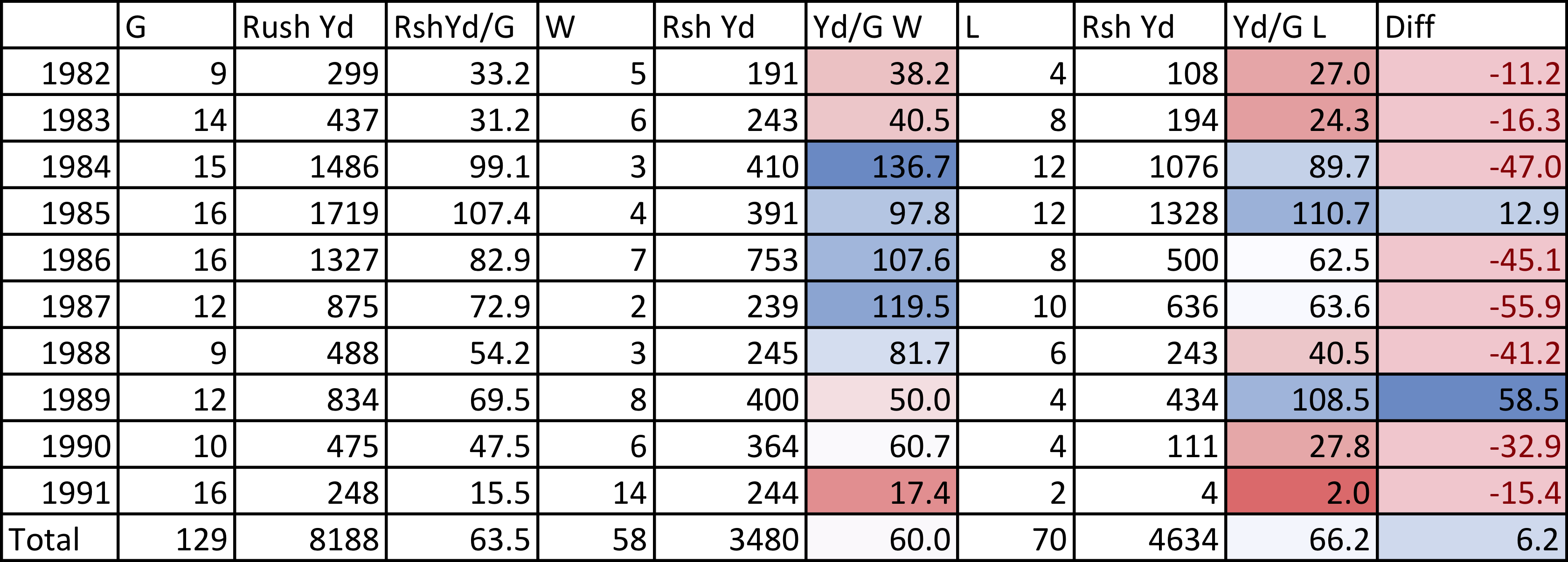
But today’s post is about Byner’s teammate on the ’91 Redskins, Gerald Riggs. He is one of just two players (Don Perkins, 56.2, 59.8) in this group who averaged fewer rushing yards per game in wins (60.0) than in losses (66.2). That should be shocking to you as a reader, given that the average running back will have about 40% more rushing yards in wins than losses. So does this mean Riggs actually was a better running back when his team lost the game?

The short answer is, no. Riggs, like every other running back, rushed for more yards when his team won than when his team lost, all else being equal. It’s that last part, though, that is the tricky part.

Riggs had two dominant rushing seasons where he averaged 99 and 107 rushing yards per game: 1984 and 1985. In those two seasons, his Falcons went just 7-24 in the games he played.

Riggs had four strong seasons where he averaged between 50 and 90 rushing yards per game: 1986 to 1989. In those four years, his teams went 20-28-1 in games he played (and I will be ignoring the one tie game for the rest of this article).

Riggs also had four years — two at the beginning of his career and two at the end — where he was a backup and averaged under 50 rushing yards per game. In those four seasons (’82, ’83, ’90, and ’91) his teams went 31-18. Notably, this includes his time on the ’91 Redskins — who went 14-2 and for whom Riggs played every game — when he averaged a career low 15.5 rushing yards per game and retired after the season (after scoring a pair of touchdowns in the Super Bowl, no less).

Regular readers of this site and those familiar with Simpson’s Paradox can surely see what’s coming. During his stud running back days, Riggs played on bad teams that produced just 12% of his career wins but 34% of his career losses. During his days as a solid starter, Riggs played on teams that produced 34% of his career wins and 40% of his career losses. And during his days as a backup, Riggs played on good teams that produced 53% of his career wins and just 26% of his career losses. His time as the third-string running back behind Byner and Ricky Ervins on one of the best teams of all time produced 24% of his career wins but just 3% of his career losses.

So when we look at his career, of course Riggs rushed for more yards in losses than in wins: broadly speaking, he was a reserve in a lot of the games his team won and the center of the offense in many of the games his teams lost.

In 1984, Riggs rushed for 99 yards per game on a 3-12 Falcons team in the games he played. In Atlanta’s three wins, he rushed for 137 yards per game; in the 12 losses, he averaged 90 rushing yards per game. That’s perfectly normal, rushing for significantly more yards per game in wins than losses.

In 1991, Riggs rushed for 16 yards per game on maybe the best team of all time. In wins, he rushed for 17 yards per game, and in losses, he rushed for 2 yards per game. That’s perfectly normal, too: rushing for significantly more yards per game in wins than losses.

But here’s the catch: what if we remove the ’84 and ’91 seasons from Riggs’ career entirely? By removing two years where Riggs rushed for significantly more yards per game in wins than in losses, what happens to his career average? Well, it would mean Riggs would have rushed for 69 yards per game in wins and … 63 yards per game in losses. This, of course, is the heart of Simpson’s Paradox: because of the different sizes of the groups, the results are reversed when we combine the data. It’s counter-intuitive, because Riggs looks better for his career in wins than in losses only after we remove two years where he did much worse in wins than in losses!

The table below shows Riggs’s career stats by season, and his per-season rushing statistics in wins and losses. The final right column shows how many more rushing yards per game Riggs averaged in losses than in wins each year. As you can see, while this number is a positive 6.2 for his career, in all but two seasons, this number was negative, meaning Riggs averaged more rushing yards per game in wins than losses:

This is what Simpson’s Paradox is all about, and this may be my new favorite example: the 1991 season really deflates his career averages, but it hits his “wins” statistics 8x as powerfully as his “losses” statistics.

And there’s even an easy story to tell about his 1989 season, which looks like a big outlier. After all, Riggs averaged a mediocre 50 rushing yards per game in wins and a superstar-producing 108.5 yards per game in wins. So what happened? In week 2, Riggs rushed for a whopping 211 yards in a win against the Eagles…. except it wasn’t a win; the Redskins led 20-0 early and 37-28 with less than three minutes left in the game, but the Eagles scored two last-minute touchdowns to steal the game and turn this into a great rushing effort in a loss (in part because of Riggs’ game-changing fumble). Had this been a win, Riggs would have averaged 69.0 rushing yards in wins that season, and 71.0 rushing yards per game in losses. And that is only because Riggs lost playing time as the season went along: he was a part-time player by December, when Washington went 4-0 but Riggs averaged only 41 rushing yards per game.

The general rule is that all players average more rushing yards in wins than in losses. And when that’s not true, well, it probably still is true: you just need to figure out how Simpson’s Paradox is mucking up your data.

{ 0 comments }

Let’s begin with a brain teaser. Suppose you want to do 7 unique things in 7 days, by doing exactly one per day. How many different combinations are there? Consider that on day 1, you can do any of 7 things: A, B, C, D, E, F, or G. Let’s say you pick C. On day 2, you can then do any of 6 things: A, B, D, E, F, or G. Let’s say you pick A. On day 3, you can do any of 5 things: B, D, E, F, or G. And so on.

As a result, the amount of options you have is 7 x 6 x 5 x 4 x 3 x 2 x 1, which equals 5,040. For those who remember their school days, this can be represented as 7! (you can refresh yourself on Factorials here).

Now, let’s say introduce some constraints. Let’s say you can’t do C on the day before or after doing B (that would eliminate 1/3 of your 5,040 combinations). Or that you can’t do F on any day but day 7 (that would eliminate 6/7 of your 5,040 combinations). But, of course, there is some overlap there, so figuring out how many combinations that leaves you with is a bit tricky. And you can keep introducing constraints, but at some point, there would be too many constraints to satisfy all of them.

So here’s the big question: is there a way to model this in Microsoft Excel so that you can see the results with each constraint? That answer is yes: I created a series of formulas in Excel to do just this, although I will admit that it is pretty ugly. Still, since I created it, and it took quite a bit of work, I wanted to share it with you today.

This came out of a real life example, which was a desire to create a workout schedule. I won’t bore you with the details of each workout, but my goal was to create a 7-day training split, where I would do the following on each of the 7 days: [continue reading…]

{ 0 comments }

In this series, I will be looking at the history of coaches, quarterbacks, rushers, and receivers for all 32 franchises. For coaches and quarterbacks, I will be looking at how much their franchise’s career records (regular season only) would change if we removed the games with that person. For rushers and receivers, I will note how many times that player was the team’s leading rusher/receiver over the course of their time with that franchise (regular plus postseason).

Previous Teams:

AFC East: Dolphins, Bills, Jets, and Patriots
NFC East: Cowboys, Eagles, Giants, and Redskins
AFC North: Steelers, Browns, Ravens, and Bengals
NFC North: Packers, Vikings, Bears, and Lions
AFC South: Jaguars, Colts, Texans, and Titans
NFC South: Panthers, Falcons, Saints

The Tampa Bay Bucs have only had two coaches with a winning record in franchise history. Jon Gruden won the team’s lone Super Bowl, of course, but otherwise he isn’t too interesting to analyze: he went 57-55 as the team’s head coach.

That leaves Tony Dungy, clearly the best regular season coach in the history of the franchise. Under Dungy, Tampa Bay won 56% of their games; without him, the Bucs have won just 36% of their games. During his 6 seasons, the Bucs were tied for the 9th-best record in the league; in the previous six years, Tampa Bay won just one out of every three games, making them one of the league’s worst teams. But with Dungy, the more interesting question is did he do his best work here or with the Colts? Dungy had a better record in Indianapolis and coached there longer, but he certainly had a tougher task considering what he inherited at both spots. By this analysis, it’s almost perfectly even: Dungy improved the Colts’ all-time winning percentage by 3.0%, and he improved Tampa Bay’s mark by 2.9%. Dungy is the only coach to improve two teams by such a large amount; Don Shula is the only other head coach to improve two teams by at least two percent, and for him, the Colts were also his other team (Andy Reid ranks third by this metric; he improved the Eagles by 2.1% and the Chiefs by 1.8% so far). How bad have the Bucs coaches been? Dirk Koetter ranks as the third-best both by this metric and overall winning percentage, two facts I can’t wrap my head around. [continue reading…]

{ 0 comments }

All Time NFC West Teams, by Bryan Frye

Friend of the program Bryan Frye is back for another guest series. As regular readers know, Bryan operates his own fantastic site, http://www.thegridfe.com. You can view all of Bryan’s guest posts here, and follow him on twitter @LaverneusDingle.


This is post seven in an eight part series, so you know how this goes by now. I copy and paste some rules about the article to follow, then I write that article. Here are the rules:

  1. I write everything before my painkiller prescription runs out,
  2. I write it completely off the top of my head and don’t do any research,
  3. I don’t have to proofread this when I finish it, and
  4. Chase doesn’t edit my nonsense out of the article (so my inane asides and non sequiturs are our shared burden now). [1]Roster construction is as follows: 1 QB, 2 RB, 3 WR, 2 TE, 2 T, 2 G, 1 C, 2 DE, 2 DT, 2 OLB, 2 MLB/ILB, 3 CB, 2 S, 1 K, 1 P, 1 HC
  5. I maintain modern division designations. If a player played for the Seahawks when the team was in the AFC West, I am counting him in the NFC West. I have neither the time nor the inclination to make this 100% perfect.

Here’s the article about the NFC West.

Offense

Quarterback – Joe Montana

Sure, Steve Young was more efficient. Kurt Warner and Norm Van Brocklin led record setting offenses. But Montana was Montana, and that’s all I really have to say about that.

Running Backs – Marshall Faulk and Eric Dickerson [continue reading…]

References

References
1 Roster construction is as follows: 1 QB, 2 RB, 3 WR, 2 TE, 2 T, 2 G, 1 C, 2 DE, 2 DT, 2 OLB, 2 MLB/ILB, 3 CB, 2 S, 1 K, 1 P, 1 HC
{ 0 comments }

In this series, I will be looking at the history of coaches, quarterbacks, rushers, and receivers for all 32 franchises. For coaches and quarterbacks, I will be looking at how much their franchise’s career records (regular season only) would change if we removed the games with that person. For rushers and receivers, I will note how many times that player was the team’s leading rusher/receiver over the course of their time with that franchise (regular plus postseason).

Previous Teams:

AFC East: Dolphins, Bills, Jets, and Patriots
NFC East: Cowboys, Eagles, Giants, and Redskins
AFC North: Steelers, Browns, Ravens, and Bengals
NFC North: Packers, Vikings, Bears, and Lions
AFC South: Jaguars, Colts, Texans
NFC South: Panthers, Falcons, Saints

The Tennessee Titans history is really the history of the franchise owned by Bud Adams.  The son of an oil magnate, Adams was part of the foolish club with Lamar Hunt and the other key founding member of the AFL.  Adams named his Houston expansion team the Oilers, of course, and the team resided there until moving to Tennessee in 1997.  The man who guided the team from Houston to Tennessee was Jeff Fisher, who is still arguably the best coach in franchise history. In games coached by anyone but Fisher, the franchise has a 0.458 winning percentage, but including Fisher’s 0.542 mark in 142 games, and the Oilers/Titans franchise has a 0.482 record. Bum Phillips (whose ’78 and ’79 teams lost back-to-back AFC Championship Games to the eventual champion Steelers) and Jack Pardee (who guided the ’90s Run-N’-Shoot teams) are the only other coaches to finish at least 10 games over .500, while the franchise has had a number of coaches (Hugh Campbell, Ed Biles, Ken Whisenhunt, and Bill Peterson) who really struggled. [continue reading…]

{ 0 comments }

Footballguys.com – Why Subscribe?

Regular readers know that I got my start writing at Footballguys.com. If you are a hardcore fantasy football enthusiast, daily fantasy sports player, or just a casual fantasy football player you probably know by now that Footballguys is the single best source for fantasy football information. For those with limited time to devote to fantasy football research, you’ll find that the tools available at Footballguys will make life much, much easier for you to win your league(s). And the experts know that the projections and tools available at FBG is top notch. Either way, I think fantasy football players will find FBG to be a great value at any of the pricepoints currently offered ($39.95 for the Season Long Pro subscription, $49.95 for the Daily Fantasy Pro subscription or $69.95 for the All-Pro that includes both).

I don’t make any money if people sign up for Footballguys and I don’t have any promo code: I hope my readers subscribe because I think a lot of you play fantasy and a subscription is a really good deal. Here are a few reasons why: [continue reading…]

{ 0 comments }

In this series, I will be looking at the history of coaches, quarterbacks, rushers, and receivers for all 32 franchises. For coaches and quarterbacks, I will be looking at how much their franchise’s career records (regular season only) would change if we removed the games with that person. For rushers and receivers, I will note how many times that player was the team’s leading rusher/receiver over the course of their time with that franchise (regular plus postseason).

Previous Teams:

AFC East: Dolphins, Bills, Jets, and Patriots
NFC East: Cowboys, Eagles, Giants, and Redskins
AFC North: Steelers, Browns, Ravens, and Bengals
NFC North: Packers, Vikings, Bears, and Lions
AFC South: Jaguars, Colts, and Texans
NFC South: Panthers, Falcons

Without Sean Payton, the New Orleans Saints were one of the worst franchises in NFL history. The ‘Aints won just 40% of their games prior to Payton’s arrival in 2006; under his reign, New Orleans has a 0.615 winning percentage. Overall, the franchise now has 45% winning rate, which means “games under Payton” — despite representing just 24% of all Saints games — has increased the team’s overall winning percentage by 5%. That makes him one of just five head coaches to be responsible for a 5% increase in his team’s winning percentage, along with four inner circle Hall of Famers: Don Shula in Miami, Bill Belichick in New England, Paul Brown in Cleveland, and George Halas in Chicago. Payton and Jim Mora are the only two coaches in New Orleans history with a winning record. The table below shows each coach in Saints history. At the bottom you will see Mike Ditka, Hank Stram, and Bum Phillips, who won 63%, 62%, and 61% respectively of their games with Chicago, Kansas City, and Houston, before struggling as head coach of the Saints. [continue reading…]

{ 0 comments }

In this series, I will be looking at the history of coaches, quarterbacks, rushers, and receivers for all 32 franchises. For coaches and quarterbacks, I will be looking at how much their franchise’s career records (regular season only) would change if we removed the games with that person. For rushers and receivers, I will note how many times that player was the team’s leading rusher/receiver over the course of their time with that franchise (regular plus postseason).

Previous Teams:

AFC East: Dolphins, Bills, Jets, and Patriots
NFC East: Cowboys, Eagles, Giants, and Redskins
AFC North: Steelers, Browns, Ravens, and Bengals
NFC North: Packers, Vikings, Bears, and Lions
AFC South: Jaguars, Colts
NFC South: Panthers, Falcons

The Texans have only had three real head coaches in team history. Bill O’Brien has been Houston’s coach for the last five years, and has a 42-38 record. Gary Kubiak was the team’s longest-tenured coach and he went 61-64; he was fired with three games left in the 2013 season, and Wade Phillips replaced him and went 0-3 down the stretch. But the first coach in team history was Dom Capers, and he went 18-46 in four years. The Texans are 30 games under .500 for team’s history, and nearly all of that was due to the Capers era. He has dropped the team’s winning percentage by 5.0%, the largest amount of any coach in NFL history. Of course, he happened to coach the expansion version of the league’s newest franchise, so we can cut him a bit of slack. [continue reading…]

{ 0 comments }

In this series, I will be looking at the history of coaches, quarterbacks, rushers, and receivers for all 32 franchises. For coaches and quarterbacks, I will be looking at how much their franchise’s career records (regular season only) would change if we removed the games with that person. For rushers and receivers, I will note how many times that player was the team’s leading rusher/receiver over the course of their time with that franchise (regular plus postseason).

Previous Teams:

AFC East: Dolphins, Bills, Jets, and Patriots
NFC East: Cowboys, Eagles, Giants, and Redskins
AFC North: Steelers, Browns, Ravens, and Bengals
NFC North: Packers, Vikings, Bears, and Lions
AFC South: Jaguars, Colts
NFC South: Panthers

We have entered the Marion Campbell portion of the series. One of Football Perspective’s best guest profiles was on Marion Campbell, owner of some of the worst coaching records in history. He’s the only coach to win no more than 25% of his games over a 65+ game stretch with one team, and one of just four coaches (David Shula in Cincinnati, Dom Capers with the expansion Texans, and Gus Bradley with the Jaguars) to win less than 30% of his games with one franchise over at least 60 games. The most successful coach in Falcons history is, without question but still weird to say, Mike Smith. Atlanta as a franchise has won 44.2% of its games, but remove the Smith games, and that number drops by 2.34% to just 41.9%. And don’t feel too bad for the team’s first coach, Norb Hecker, who took over the expansion Falcons and went just 4-26-1. He wound up with eight NFL titles: one with the Rams in 1951 as a rookie safety, three with the Lombardi Packers, and then four with the 49ers in the ’80s. The table below shows every head coach in Falcons history: [continue reading…]

{ 0 comments }

All Time NFC East Teams, by Bryan Frye

Friend of the program Bryan Frye is back for another guest series. As regular readers know, Bryan operates his own fantastic site, http://www.thegridfe.com. You can view all of Bryan’s guest posts here, and follow him on twitter @LaverneusDingle.


As you know by now, I’m making all-time division teams while Chase is off on his honeymoon. I’ll spare you a verbose introduction and just lay out the rules:

  1. I write everything before my painkiller prescription runs out,
  2. I write it completely off the top of my head and don’t do any research,
  3. I don’t have to proofread this when I finish it, and
  4. Chase doesn’t edit my nonsense out of the article (so my inane asides and non sequiturs are our shared burden now). [1]Roster construction is as follows: 1 QB, 2 RB, 3 WR, 2 TE, 2 T, 2 G, 1 C, 2 DE, 2 DT, 2 OLB, 2 MLB/ILB, 3 CB, 2 S, 1 K, 1 P, 1 HC
  5. I maintain modern division designations. If a player played for the Seahawks when the team was in the AFC West, I am counting him in the NFC West. I have neither the time nor the inclination to make this 100% perfect.

Without further ado, here’s the NFC East.

Offense

Captain America

Quarterback – Roger Staubach

Sammy Baugh was a better player, but it’s hard to find a better pure quarterback than Captain America himself. Baugh (along with Troy Aikman, Drew Brees, and Kurt Warner) is the most accurate pure passer I have witnessed. But Staubach was in a league of his own as a leader. Not many guys come into a locker room as a rookie with instant credibility because of their military service. Even more impressive is that he backed it up with his play on the field and his actions off the field. [continue reading…]

References

References
1 Roster construction is as follows: 1 QB, 2 RB, 3 WR, 2 TE, 2 T, 2 G, 1 C, 2 DE, 2 DT, 2 OLB, 2 MLB/ILB, 3 CB, 2 S, 1 K, 1 P, 1 HC
{ 0 comments }

In this series, I will be looking at the history of coaches, quarterbacks, rushers, and receivers for all 32 franchises. For coaches and quarterbacks, I will be looking at how much their franchise’s career records (regular season only) would change if we removed the games with that person. For rushers and receivers, I will note how many times that player was the team’s leading rusher/receiver over the course of their time with that franchise (regular plus postseason).

Previous Teams:

AFC East: Dolphins, Bills, Jets, and Patriots
NFC East: Cowboys, Eagles, Giants, and Redskins
AFC North: Steelers, Browns, Ravens, and Bengals
NFC North: Packers, Vikings, Bears, and Lions
AFC South: Jaguars
NFC South: Panthers

The Colts have been blessed with two Hall of Fame coaches, but oddly, one could argue that neither Tony Dungy nor Don Shula did their best work with the Colts. Both made their names in Florida: Shula as the long-time coach of the Dolphins, and Dungy as the man who turned around Tampa Bay. Still, these two have left a strong mark on Colts history: without Dungy, the Colts would have a losing record; overall, the team is 516-459-7. There’s another shared history between Dungy and Shula: immediate Super Bowl success after they left. When Dungy left Tampa Bay, the Bucs won the championship in the team’s first season without him. When Shula left for Miami, the Colts under Don McCafferty won the team’s first Super Bowl. But as much success as the franchise has had under these two coaches, it’s probably fair to say that the better way to understand this franchise is by examining their quarterbacks. But before we get to that, a moment to stop and pause for Weeb Ewbank, who was one of the two best coaches in Jets history and remains the only coach since World War II to win NFL titles as head coach of two different franchises. Ewbank did it in iconic style, beating the Colts in Super Bowl III as head coach of the New York Jets, and leading the Colts to a title against the New York Giants in The Greatest Game Ever Played. [continue reading…]

{ 0 comments }

Marginal Air Yards: 2019 Update by Adam Steele

Adam Steele is back for another guest post. You can view all of Adam’s posts here. As always, we thank him for contributing.


It’s been a few years since I updated my Marginal Air Yards metric, so that’s what today’s post will do. I decided to make this a purely style based statistic rather than trying to combine style with efficiency. As such, here is the updated formula:

mAir = (completed air yards / completions – league average) * completions

Said simply, Marginal Air Yards represents the total depth of a passer’s completions compared to league average. A quarterback who averages 7.0 AirY/C on 300 completions in a league that averages 6.5 AirY/C will be credited with +150 mAir (i.e., 0.5 x 150). [continue reading…]

{ 1 comment }

In this series, I will be looking at the history of coaches, quarterbacks, rushers, and receivers for all 32 franchises. For coaches and quarterbacks, I will be looking at how much their franchise’s career records (regular season only) would change if we removed the games with that person. For rushers and receivers, I will note how many times that player was the team’s leading rusher/receiver over the course of their time with that franchise (regular plus postseason).

Previous Teams:

AFC East: Dolphins, Bills, Jets, and Patriots
NFC East: Cowboys, Eagles, Giants, and Redskins
AFC North: Steelers, Browns, Ravens, and Bengals
NFC North: Packers, Vikings, Bears, and Lions
AFC South: Jaguars

The Panthers, like the Jaguars, entered the NFL in 1995. They have been almost exactly .500 through 24 seasons, and have had only four coaches. One of them, Ron Rivera, is 15 games above .500; two of them were right around .500, and George Seifert — the first, and the only member of was 16 games below .500. An interesting note: all four were defensive coordinators before becoming head coaches, meaning Carolina’s never had a head coach with an offensive background. [continue reading…]

{ 0 comments }

In this series, I will be looking at the history of coaches, quarterbacks, rushers, and receivers for all 32 franchises. For coaches and quarterbacks, I will be looking at how much their franchise’s career records (regular season only) would change if we removed the games with that person. For rushers and receivers, I will note how many times that player was the team’s leading rusher/receiver over the course of their time with that franchise (regular plus postseason).

Previous Teams:

AFC East: Dolphins, Bills, Jets, and Patriots
NFC East: Cowboys, Eagles, Giants, and Redskins
AFC North: Steelers, Browns, Ravens, and Bengals
NFC North: Packers, Vikings, Bears, and Lions

The Jacksonville Jaguars have not been a good franchise overall, but the team has really not been good when Tom Coughlin hasn’t been around. The initial coach of the Jaguars following a stint at Boston College, Coughlin guided Jacksonville to a 68-60 record. Without Coughlin, Jacksonville has won less than 40% of the team’s games! On the other hand, maybe you just want to blame Gus Bradley for things. When he hasn’t been the head coach, Jacksonville has won nearly 50% of its games. Bradley’s -4.2% mark is the second worst in NFL history, which is of course biased by the fact that the Jaguars haven’t been around very long. It’s also only the second-worst in this division (you can probably guess who has the lowest mark). [continue reading…]

{ 0 comments }

All Time NFC North Teams, by Bryan Frye

If you’ve been following along, you know I am giving Chase a little break while he is honeymooning. I wrote this while recovering from surgery and in the middle of a series on each division’s all-time team.

In case you’re not privy to the rules and regulations of the game, these are the stipulations Chase conceded to for my series:

  1. I write everything before my painkiller prescription runs out,
  2. I write it completely off the top of my head and don’t do any research,
  3. I don’t have to proofread this when I finish it, and
  4. Chase doesn’t edit my nonsense out of the article (because let’s keep it organic, man). [1]Roster construction is as follows: 1 QB, 2 RB, 3 WR, 2 TE, 2 T, 2 G, 1 C, 2 DE, 2 DT, 2 OLB, 2 MLB/ILB, 3 CB, 2 S, 1 K, 1 P, 1 HC
  5. I maintain modern division designations. If a player played for the Seahawks when the team was in the AFC West, I am counting him in the NFC West. I have neither the time nor the inclination to make this 100% perfect.

These rules are to keep me from having to do much work and to increase the chances that I write something stupid, which amuses me. I can’t wait to look back on this series when I am more coherent and realize how supremely I have played myself.

Without further ado, here’s the NFC North. [continue reading…]

References

References
1 Roster construction is as follows: 1 QB, 2 RB, 3 WR, 2 TE, 2 T, 2 G, 1 C, 2 DE, 2 DT, 2 OLB, 2 MLB/ILB, 3 CB, 2 S, 1 K, 1 P, 1 HC
{ 0 comments }

In this series, I will be looking at the history of coaches, quarterbacks, rushers, and receivers for all 32 franchises. For coaches and quarterbacks, I will be looking at how much their franchise’s career records (regular season only) would change if we removed the games with that person. For rushers and receivers, I will note how many times that player was the team’s leading rusher/receiver over the course of their time with that franchise (regular plus postseason).

Previous Teams:

AFC East: Dolphins, Bills, Jets, and Patriots
NFC East: Cowboys, Eagles, Giants, and Redskins
AFC North: Steelers, Browns, Ravens, and Bengals
NFC North: Packers, Vikings, Bears

The Detroit Lions began as the Portsmouth Spartans before the Great Depression led to a sale and a five hour move north out of Ohio. Depressing is also a good way to describe much of the Lions history, too. The best coach in Detroit football history is… ??? Well, that’s probably a question most modern fans can’t answer. Potsy Clark won a title with the team in Portsmouth, while Buddy Parker helped guide the team to two titles in the ’50s, with George Wilson being the head coach for a third championship in ’57. And asking who the worst coach in Lions history isn’t an easy one, either: four men finished their tenures at 20 games below .500. The table below shows the full list, and you can see how each man changed the team’s all-time record: [continue reading…]

{ 0 comments }

In this series, I will be looking at the history of coaches, quarterbacks, rushers, and receivers for all 32 franchises. For coaches and quarterbacks, I will be looking at how much their franchise’s career records (regular season only) would change if we removed the games with that person. For rushers and receivers, I will note how many times that player was the team’s leading rusher/receiver over the course of their time with that franchise (regular plus postseason).

Previous Teams:

AFC East: Dolphins, Bills, Jets, and Patriots
NFC East: Cowboys, Eagles, Giants, and Redskins
AFC North: Steelers, Browns, Ravens
NFC North: Packers, Vikings, Bears

When it comes to the Bengals franchise, Marvin Lewis stands out as the clear best coach in history. He went 131-122-3 as Cincinnati’s head coach: not only is that more than twice as many wins as any other coach, it’s also the most wins over .500 of any Bengals coach. On the flip side, we have David Shula. Cincinnati has mostly been a poor franchise, but even by Bengals standards Shula was a disaster. The son of one of the best head coaches ever, in 71 games, Shula managed to tank the franchise’s all-time winning percentage. Among head coaches to have a winning percentage below 0.270 with one team, Shula coached the most games, followed by Marion Campbell with Atlanta (68 games) and Gus Bradley with the Jaguars (62 games). [continue reading…]

{ 0 comments }

In this series, I will be looking at the history of coaches, quarterbacks, rushers, and receivers for all 32 franchises. For coaches and quarterbacks, I will be looking at how much their franchise’s career records (regular season only) would change if we removed the games with that person. For rushers and receivers, I will note how many times that player was the team’s leading rusher/receiver over the course of their time with that franchise (regular plus postseason).

Previous Teams:

AFC East: Dolphins, Bills, Jets, and Patriots
NFC East: Cowboys, Eagles, Giants, and Redskins
AFC North: Steelers, Browns, Ravens
NFC North: Packers, Vikings

When it comes to Chicago football, there’s only one Papa Bear. The Bears have been a successful franchise, winning 56.4% of games over the team’s nearly 100-year history. But under Halas, Chicago won 67.1% of their games; under all other head coaches, Chicago has won just 50.4% of games. Therefore, “games with Halas” has improved the team’s all-time winning percentage by a whopping 6.0%, the fourth most ever behind only Don Shula in Miami, Bill Belichick in New England, and Paul Brown in Cleveland. The second-most successful coach was Da Coach, Mike Ditka, who posted a 0.631 winning percentage over 168 games. On the flip side, John Fox and Dave Wannstedt have harmed the franchise’s winning percentage the most. The full results below: [continue reading…]

{ 0 comments }

In this series, I will be looking at the history of coaches, quarterbacks, rushers, and receivers for all 32 franchises. For coaches and quarterbacks, I will be looking at how much their franchise’s career records (regular season only) would change if we removed the games with that person. For rushers and receivers, I will note how many times that player was the team’s leading rusher/receiver over the course of their time with that franchise (regular plus postseason).

Previous Teams:

AFC East: Dolphins, Bills, Jets, and Patriots
NFC East: Cowboys, Eagles, Giants, and Redskins
AFC North: Steelers, Browns
NFC North: Packers, Vikings

The Baltimore Ravens have been one of the more notable franchises in the NFL over the last 20 years, but the team still has a very short history. In fact, the Ravens have still only ever had three coaches: Ted Marchibroda guided the team following its move from Cleveland, Brian Billick replaced him, and John Harbaugh has been the man in charge since 2008.

Ovr RkCoachGWLTHC Win %FrGFrWFLFrTFr W%Win% w/o HCDiff
8John Harbaugh1761047200.59136820016710.5450.5034.2%
81Brian Billick144806400.55636820016710.5450.5380.7%
509Ted Marchibroda48163110.34436820016710.5450.575-3%

If you want to know why Joe Flacco was held in such high regard by the Ravens for so long, a quick look at the history of Baltimore quarterbacks should help explain things. The only other two quarterbacks to start 25+ games with the Ravens both had losing records. Trent Dilfer and Steve McNair both had good records with Baltimore, but both helped their original teams more than they helped the Ravens.

Ovr RkQBGWLTQB Win %FrGFrWFLFrTFr W%Win% w/o QBDiff
9Joe Flacco163966700.58936820016710.5450.5103.5%
72Steve McNair2215700.68236820016710.5450.5360.9%
82Trent Dilfer87100.87536820016710.5450.5380.7%
90Lamar Jackson76100.85736820016710.5450.5390.6%
136Tony Banks1811700.61136820016710.5450.5410.3%
167Randall Cunningham22001.00036820016710.5450.5420.2%
252Elvis Grbac148600.57136820016710.5450.5440.1%
467Troy Smith21100.50036820016710.5450.5450%
468Matt Schaub21100.50036820016710.5450.5450%
469Ryan Mallett21100.50036820016710.5450.5450%
529Stoney Case42200.50036820016710.5450.5450%
668Chris Redman63300.50036820016710.5450.546-0.1%
892Anthony Wright147700.50036820016710.5450.547-0.2%
951Eric Zeier73400.42936820016710.5450.547-0.2%
1020Scott Mitchell20200.00036820016710.5450.548-0.3%
1021Jimmy Clausen20200.00036820016710.5450.548-0.3%
1080Jeff Blake104600.40036820016710.5450.549-0.4%
1090Jim Harbaugh125700.41736820016710.5450.549-0.4%
1178Kyle Boller42202200.47636820016710.5450.554-0.9%
1207Vinny Testaverde2982010.29336820016710.5450.566-2.2%

In his prime, Jamal Lewis was the best running back in football. He helped the Ravens win Super Bowl XXXV, and two years after missing an entire season with a torn ACL, Lewis rushed for over 2,000 yards.

RusherFirst YrLast YrLeading RusherTotal Games%
Jamal Lewis20002006879790%
Ray Rice200820137810475%
Justin Forsett20142016263184%
Willis McGahee20072010236635%
Alex Collins20172018202580%
Priest Holmes19972000185235%
Bam Morris19961997182282%
Terrance West20152017132748%
Chester Taylor20022005116317%
Errict Rhett19981999112938%
Bernard Pierce20122014115122%
Earnest Byner19961997103231%
Le'Ron McClain20072010107014%
Terry Allen20012001101377%

At receiver and tight end, the Ravens have had a few stars at the ends of their careers, but never had a truly dominant pass-catching weapon. Derrick Mason was a very good player in Tennessee and continued to succeed in Baltimore, and he’s the best of the bunch here.

ReceiverFirst YrLast YrLeading ReceiverTotal Games%
Derrick Mason200520104910447%
Todd Heap200120103014421%
Anquan Boldin20102012245345%
Torrey Smith20112014247233%
Travis Taylor20002004227031%
Qadry Ismail19992001195336%
Shannon Sharpe20002001183847%
Steve Smith20142016183946%
Mark Clayton20052009188222%
Mike Wallace20162017153148%
Jermaine Lewis19962001159416%
Michael Jackson19961998124527%
Derrick Alexander19961997113037%

That’s it for the Baltimore version of this series. Please leave your thoughts in the comments.

{ 0 comments }

All Time AFC South Teams, by Bryan Frye

Welcome to part four of the series on each division’s all-time team. Chase is off gallivanting with his bride, so you’re still stuck with me. As you may recall, I wrote this while recovering from surgery and am under the influence of narcotics and, of course, though that would be the perfect time to write about the sort of esoteric historical silliness only I (and Chase’s faithful readers) seem to think about. I take very little responsibility for any of this, but this is a reminder of the rules I have established for this series:

  1. I write everything before my painkiller prescription runs out,
  2. I write it completely off the top of my head and don’t do any research,
  3. I don’t have to proofread this when I finish it, and
  4. Chase doesn’t edit my nonsense out of the article (so my inane asides and non sequiturs are our shared burden now). [1]Roster construction is as follows: 1 QB, 2 RB, 3 WR, 2 TE, 2 T, 2 G, 1 C, 2 DE, 2 DT, 2 OLB, 2 MLB/ILB, 3 CB, 2 S, 1 K, 1 P, 1 HC.
  5. I maintain modern division designations. If a player played for the Seahawks when the team was in the AFC West, I am counting him in the NFC West. I have neither the time nor the inclination to make this 100% perfect.

Without further ado, here’s the AFC South

Offense

Quarterback – Peyton Manning [continue reading…]

References

References
1 Roster construction is as follows: 1 QB, 2 RB, 3 WR, 2 TE, 2 T, 2 G, 1 C, 2 DE, 2 DT, 2 OLB, 2 MLB/ILB, 3 CB, 2 S, 1 K, 1 P, 1 HC.
{ 0 comments }

In this series, I will be looking at the history of coaches, quarterbacks, rushers, and receivers for all 32 franchises. For coaches and quarterbacks, I will be looking at how much their franchise’s career records (regular season only) would change if we removed the games with that person. For rushers and receivers, I will note how many times that player was the team’s leading rusher/receiver over the course of their time with that franchise (regular plus postseason).

Previous Teams:

AFC East: Dolphins, Bills, Jets, and Patriots
NFC East: Cowboys, Eagles, Giants, and Redskins
AFC North: Steelers, Browns
NFC North: Packers

The Vikings have been a really good franchise, winning a division title in 34% of their seasons. Hall of Famer Bud Grant was the star, of course: he guided the team to four Super Bowl appearances. But the late Dennis Green and current head coach Mike Zimmer won about 60% of their regular season games (through 2018) as head coach of the Vikings, even though they each won just 33% of their postseason games. And while Minnesota may not match the Steelers in terms of stability, the Vikings have had just 9 coaches since the team was founded in 1960. [continue reading…]

{ 0 comments }

In this series, I will be looking at the history of coaches, quarterbacks, rushers, and receivers for all 32 franchises. For coaches and quarterbacks, I will be looking at how much their franchise’s career records (regular season only) would change if we removed the games with that person. For rushers and receivers, I will note how many times that player was the team’s leading rusher/receiver over the course of their time with that franchise (regular plus postseason).

Previous Teams:

AFC East: Dolphins, Bills, Jets, and Patriots
NFC East: Cowboys, Eagles,Giants, and Redskins
AFC North: Steelers
NFC North: Packers

When it comes to the Browns, it starts with the man for whom the team is named: Paul Brown. Cleveland has an all-time record of 452-360-4, but nearly all of their notable success is tied to Brown. Under his watch, the Browns went 257-133-2 in 17 years (including their time in the AAFC). The team’s winning percentage under all other head coaches is just 0.446, but once you include Brown, that mark jumps up 6.5 percentage points to 0.511. On the flip side of things, you have Hue Jackson, who was responsible for just 0.6% of all wins in Cleveland history and 7.3% of the team’s losses. [continue reading…]

{ 0 comments }

In this series, I will be looking at the history of coaches, quarterbacks, rushers, and receivers for all 32 franchises. For coaches and quarterbacks, I will be looking at how much their franchise’s career records (regular season only) would change if we removed the games with that person. For rushers and receivers, I will note how many times that player was the team’s leading rusher/receiver over the course of their time with that franchise (regular plus postseason).

Previous Teams:

AFC East: Dolphins, Bills, Jets, and Patriots
NFC East: Cowboys, Eagles,Giants, and Redskins
AFC North: Steelers

The Packers have as storied a history as any team in pro football. And it starts at the beginning, with Curly Lambeau. The first coach in Green Bay history guided the team to six titles, and while the Packers have an all-time winning percentage of 0.564, it would be just 0.533 if you removed the Lambeau Years. The tradition continued with the great Vince Lombardi, who posted a remarkable 89-29-4 mark as Packers head coach, while leading the team to 5 titles. And Mike Holmgren and Mike McCarthy continued that tradition: not only did they both win Super Bowls, but each coach improved the franchise’s overall winning percentage by 1%, no easy task given the high baseline of Packers head coach.

The full list below: [continue reading…]

{ 0 comments }

Today, I am getting married to my best friend and the most incredible person I have ever met. I’m so excited to walk into this new chapter of my life with her by my side.

She is a big fan of this blog and my daily writing, but I am going to end things here and spend the rest of the day with her.

{ 0 comments }

In this series, I will be looking at the history of coaches, quarterbacks, rushers, and receivers for all 32 franchises. For coaches and quarterbacks, I will be looking at how much their franchise’s career records (regular season only) would change if we removed the games with that person. For rushers and receivers, I will note how many times that player was the team’s leading rusher/receiver over the course of their time with that franchise (regular plus postseason).

Previous Teams:

AFC East: Dolphins, Bills, Jets, and Patriots
NFC East: Cowboys, Eagles,Giants, and Redskins

The Steelers have had three coaches that would be regarded as legendary on most franchises. One of them is Hall of Famer Chuck Noll, who led the team to four Super Bowl titles in the 1970s. Noll also ranks third when it comes to improving the Steelers’ all-time winning percentage. While he was an outstanding head coach, he also had 7 seasons (out of 23) with a losing record. Consider that Mike Tomlin has never had a losing record in 12 years as Pittsburgh’s head coach and has won 65% of his games. Bill Cowher had 3 losing seasons in 15 years and won 62% of his games while coaching 48 more games than Tomlin. When it comes to regular season success, you can make a case for all three of these men as the best in Steelers history, but the numbers side with Tomlin: without him, Pittsburgh has a 0.505 winning percentage. Without Cowher, the Steelers franchise winning percentage is 0.506, and without Noll, it’s 0.514. Of course, Tomlin inherited a great team from Cowher, and Cowher inherited a great franchise from Noll. It was Noll who built the Steelers up from nothing, inheriting a 2-win team in 1968 and winning just one game his first year. His four rings make him the clear choice for best coach in Pittsburgh history. [continue reading…]

{ 0 comments }

In this series, I will be looking at the history of coaches, quarterbacks, rushers, and receivers for all 32 franchises. For coaches and quarterbacks, I will be looking at how much their franchise’s career records (regular season only) would change if we removed the games with that person. For rushers and receivers, I will note how many times that player was the team’s leading rusher/receiver over the course of their time with that franchise (regular plus postseason).

Previous Teams:

Dolphins
Cowboys
Bills
Eagles
Jets
Giants
Patriots

Joe Gibbs is the best coach in Redskins history, and it’s not very close. He went 124-60 as the team’s head coach in the ’80s and early ’90s, and then came back for a second stint at the age of 64. Even then, he wasn’t bad: Washington made the playoffs twice in four years, although his overall record was only 30-34.

But even with that second stint, Gibbs stands out as the best regular season coach the team has ever had (he’s also in the conversation for best playoff coach in NFL history, or at least NFC history). Washington has had an ugly run of football for about 20 years, but the franchise still has an above-.500 record all-time. That’s thanks to Gibbs: with him, the team is at 0.504, and without him, it’s at 0.474. Two other coaches were great for the franchise in shorter doses: George Allen had a great run in the ’70s, and Ray Flaherty had a lot of success with Hall of Fame QB Sammy Baugh. [continue reading…]

{ 0 comments }

All Time AFC West Teams, by Bryan Frye

This is the third of an eight part installment covering my opinion of each NFL division’s all-time team. When I go through the divisions, I tend to spell “NEWS” in order to keep my thoughts straight. That means today’s post concerns the AFC West (and by that I mean all teams currently in the AFC West, regardless of where those teams were at other points in history). I am writing this series while recovering from back surgery and taking several narcotics. I don’t know how this impacts most people, but I’ve never even had a beer, so my world is effectively a chimerical fever dream right now. It’s precisely because of this I thought it would be fun to try to write a guest series while Chase takes a break.

A quick reminder of the series rules before jumping into the content:

  1. I write everything before my painkiller prescription runs out,
  2. I write it completely off the top of my head and don’t do any research,
  3. I don’t have to proofread this when I finish it, and
  4. Chase doesn’t edit my nonsense out of the article (so parts may read like a Raider Joe rant). [1]Roster construction is as follows: 1 QB, 2 RB, 3 WR, 2 TE, 2 T, 2 G, 1 C, 2 DE, 2 DT, 2 OLB, 2 MLB/ILB, 3 CB, 2 S, 1 K, 1 P, 1 HC.

AFC North
AFC East

Without further ado, here’s the AFC West:

Offense

Quarterback – John Elway [continue reading…]

References

References
1 Roster construction is as follows: 1 QB, 2 RB, 3 WR, 2 TE, 2 T, 2 G, 1 C, 2 DE, 2 DT, 2 OLB, 2 MLB/ILB, 3 CB, 2 S, 1 K, 1 P, 1 HC.
{ 0 comments }

In this series, I will be looking at the history of coaches, quarterbacks, rushers, and receivers for all 32 franchises. For coaches and quarterbacks, I will be looking at how much their franchise’s career records (regular season only) would change if we removed the games with that person. For rushers and receivers, I will note how many times that player was the team’s leading rusher/receiver over the course of their time with that franchise (regular plus postseason).

Previous Teams:

Dolphins
Cowboys
Bills
Eagles
Jets
Giants

We have now reached the Bill Belichick and Tom Brady version of this series, which will yield no surprises. There is nothing to say about those two that has not been said, except perhaps how they have changed the Patriots career winning percentages!

New England has won 56.1% of games over the course of the franchise’s history, but that’s very Belichick-influenced. Under his watch, New England has won 74.0% of its regular season games; with someone other than Belichick on the sidelines, the Patriots have won just 46.9% of their games. Under Dick MacPherson, the Patriots also went 8-24 in two seasons. In one 7-year stretch from 2006 to 2012, the Patriots also lost 24 games…. but went 88-24.

The most interesting thing to analyze here is Belichick vs. Don Shula. Without Belichick, New England has a 0.469 winning percentage. Without Shula, Miami has a 0.462 winning percentage. Belichick has an insane 0.740 winning percentage but over “only” 304 games. Shula has a 0.658 winning percentage over 392 games. New England has a franchise winning percentage of 0.561, while Miami is at 0.556 — in fact, it wasn’t until October 2018 that the Patriots finally surpassed the Dolphins in franchise winning percentage!

Right now, Shula has the edge. Miami entered the AFL in 1966, which means the Dolphins have fewer non-Shula games, which helps Shula in this regard. Through 2018, Shula has still coached 48% of all games for the Dolphins, while Belichick is only at 34%. But even still, Belichik is getting close: a 12-4 season in 2019 would vault him into #1 in this category. [continue reading…]

{ 0 comments }

In this series, I will be looking at the history of coaches, quarterbacks, rushers, and receivers for all 32 franchises. For coaches and quarterbacks, I will be looking at how much their franchise’s career records (regular season only) would change if we removed the games with that person. For rushers and receivers, I will note how many times that player was the team’s leading rusher/receiver over the course of their time with that franchise (regular plus postseason).

Previous Teams:

Dolphins
Cowboys
Bills
Eagles
Jets

The New York Giants have a long history of successful head coaches. Believe it or not, the Giants have a better winning percentage in games not coached by Tom Coughlin (0.537) than in games that Coughlin coached (0.531). Steve Owen, Jim Lee Howell, and Bill Parcells come out as the top three by this methodology, while former Dolphins DC Bill Arnsparger caused the biggest drop to the franchise’s winning percentage. The Giants have won 53.6% of their games, but that number jumps to 54.5% in games coached by anyone other than Arnsparger. [continue reading…]

{ 0 comments }
Next Posts Previous Posts