≡ Menu

Week 12 College Football SRS Ratings: Auburn Stays Alive

Entering week 12, there were 7 teams with legitimate paths to the national championship. The four undefeated teams came in with cupcake games, while two of the three one-loss teams had tough challenges. So what happened?

  • Alabama was a 23-point favorite at Mississippi State (53rd in the week 11 SRS ratings). It wasn’t pretty, but the Crimson Tide left Starkville with a 20-7 win.
  • Florida State also simply needs to win out, and the Seminoles hosted Syracuse (69). FSU was a 37.5-point favorite, and the game wasn’t even that close. After one quarter, Jameis Winston was 10 for 10 for 170-yards, and the Seminoles were up 28-0, en route to a 59-3 win. That was the largest win of the week, and gives FSU four of the top nine single-game SRS scores of the season.
  • Behind the undefeated behemoths of the SEC and ACC are undefeated teams in two other major conferences: the Big 10 and Big 12. Ohio State was a 33.5-point favorite in Illinois (#74), while Baylor was a 27.5 point favorite against Texas Tech (#41) in Arlington. Ohio State jumped out to a 28-0 lead against Illinois, and won 60-35, but the game got a little close in the middle. It was only 35-21 in the third quarter, and 44-28 in the 4th, but Carlos Hyde and Braxton Miller (combined 40 carries for 430 yards and 5 touchdowns) were too much for the Illini to handle.
  • Baylor fell behind 14-0 early, but still managed to cover the spread after winning 63-34. After the hot start from the Red Raiders, the Bears scored 8 touchdowns in the next 36 minutes of game time. Quarterback Bryce Petty “struggled” in this game, which means he only completed 17 of 31 passes, but still picked up 335 yards and three touchdowns (to go along with two rushing scores). So far, the Bears have been up to the challenge as the meat of the schedule arrived in November, although the toughest test comes next week in Stillwater. The crazy part is that if it wasn’t for West Virginia, this Oklahoma State-Baylor game would be as hyped as any Big 12 game in recent memory: two explosive offenses, two undefeated teams, a B12 title and a possible BCSNCG berth on the line.
  • Three one loss teams were also knocking on the door. Stanford had the hardest SOS through 11 weeks of any team with no more than one loss, and the Cardinal owned the best win (as measured purely by SOS) of any team in the country. Stanford traveled to Los Angeles to face a USC team (#20) that had gone 4-1 since interim head coach Ed Orgeron took over for Lane Kiffin. Stanford was a 3.5-point favorite over the Trojans, but a strong fourth quarter gave USC the win. Kevin Hogan threw two late interceptions, and kicker Andre Heidari hit a 47-yarder in the final minute, completing the upset for Coach O and the Trojans. We can officially rule Stanford out of the BCS race, and absent any upsets, pencil in Oregon-Ohio State in the Rose Bowl.
  • Two one-loss SEC teams entered week 12 with quasi control-their-own-destiny fates. Missouri and Auburn know that winning out means an SEC championship and a win over Alabama. No one really knows if that would be enough to vault them into the BCS National Championship Game, but for idle MIZZOU, the debate will have to wait another week (the bye week comes at an opportune time, with Ole Miss and Johnny Manziel and Texas A&M coming up the next two weeks).
  • Auburn was a three-point home favorite against Georgia (#25), and got off to a hot start, outgaining Georgia 149 to 4 and grabbing a 10-0 lead after the first quarter. With 10 minutes left, the Tigers led 37-20, but three touchdowns in eight minutes — the last on a run by Aaron Murray on 4th-and-goal that just barely (if at all) got in — gave Georgia a 38-37 lead. All looked lost, until on 4th and 18, Nick Marshall threw a 73-yard touchdown to Ricardo Louis on the play of the year.

It didn’t take the straightest route, but after week 12, the national picture barely changed. The Iron Bowl in two weeks will be the de facto SEC West Championship Game, but more importantly it could be a quarterfinal matchup for the national title. The winner of Alabama/Auburn goes to the SEC Championship Game, which — if Missouri wins out — may be a de facto semifinal game. Whether a one-loss Auburn/Missouri gets in over an undefeated Baylor or Ohio State is tough to say, of course, although both of those teams could have a loss by then. And don’t worry: if either set of Tigers can upset Alabama, we will surely hear about how dominant the SEC is, which is very hard to argue.
[continue reading…]
{ 3 comments }

Non-FBS College Football Ratings Through 12 Weeks

Every week, I publish my college football ratings for FBS teams. To generate those ratings – using this methodology — my program also generates ratings for non-FBS team.  So let’s take a look at the ratings through twelve weeks for all non-FBS teams. After posting the ratings, I’m going to dip my toe into the Butler/Marist debate. As always, thanks to Dr. Peter Wolfe for providing the final scores for every college football game. [continue reading…]

{ 7 comments }

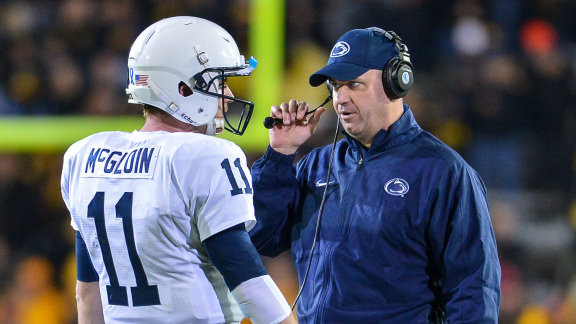
O'Brien teaches McGloin how to throw a football

O'Brien teaches McGloin how to throw a football.

Two weeks ago, Jeff Tuel became the Buffalo starting quarterback after Thaddeus Lewis (who was replacing an injured EJ Manuel) couldn’t play against the Chiefs due a ribs injury. Today, former Penn State quarterback Matt McGloin will start for the Raiders, as Terrelle Pryor will miss the game against the Texans due to an injured knee.

This is a mind-boggling development for fans of college football. McGloin was a walk-on at Penn State who co-starred with four-star recruit Rob Bolden in one of the least-competent quarterback battles in recent memory. In 2010 and 2011, the duo seemingly alternated every other week, which was about how long it took for one of them to lose the job. Among the 90 quarterbacks who threw for at least 3,000 yards over that two-year period, McGloin ranked 87th in completion percentage. Then, Bill O’Brien arrived, and McGloin turned into a real quarterback, and led the Big 10 in both passing yards and passing touchdowns.

McGloin joins Tuel, Max Hall, and Matt Moore as the only undrafted free agent rookies to start a game at quarterback in the last ten years. The table below is a bit overinclusive: it includes all undrafted quarterbacks who started a game during the first season in which they played a game. That’s not quite the same thing as starting as a rookie, of course, but it’s the best I can do. Brock Berlin, for example, went undrafted in 2005, so he wouldn’t count, but he appears on the list below. To help you filter through the “sat around for a few years but didn’t get into a game/played in another league” issue, I’ve included an age column.
[continue reading…]

{ 2 comments }

The NFC is stronger than the AFC, as expected

The expectation entering this year was that the NFC was the deeper and stronger conference than the AFC. That was certainly my expectation as well. Last year in the AFC, every team that had a winning record made the postseason. The NFC went 39-25 against the AFC teams, and the middle class of the AFC had plenty of questions.

That was the introductory paragraph to this article by Jason Lisk after week three of the season. Lisk was not alone in favoring the NFC — most observers felt the same way, and I said as much in my thoughts from the gut on NFC and AFC teams back in April. But when Lisk wrote that article, the AFC had gone an incredible 11-3 against the NFC. Here is how they did it:

WkDateWinnerH/RLoserPFPAWin CLos C
109/08Chicago BearsCincinnati Bengals2421NFCAFC
109/08New York JetsTampa Bay Buccaneers1817AFCNFC
209/15Denver Broncos@New York Giants4123AFCNFC
209/15San Diego Chargers@Philadelphia Eagles3330AFCNFC
209/15Buffalo BillsCarolina Panthers2423AFCNFC
209/15Kansas City ChiefsDallas Cowboys1716AFCNFC
309/22Seattle SeahawksJacksonville Jaguars4517NFCAFC
309/22Chicago Bears@Pittsburgh Steelers4023NFCAFC
309/22Cincinnati BengalsGreen Bay Packers3430AFCNFC
309/22Cleveland Browns@Minnesota Vikings3127AFCNFC
309/22Indianapolis Colts@San Francisco 49ers277AFCNFC
309/22Miami DolphinsAtlanta Falcons2723AFCNFC
309/19Kansas City Chiefs@Philadelphia Eagles2616AFCNFC
309/22New England PatriotsTampa Bay Buccaneers233AFCNFC

[continue reading…]

{ 3 comments }

The SEC is a dominant 8-6 against BCS teams

This year, the SEC is 8-6 against BCS conferences, courtesy of:

  • A 2-2 record against the AAC (South Carolina over Central Florida, Texas A&M over SMU; Kentucky lost to Louisville and Arkansas lost to Rutgers);
  • A 2-2 record against the ACC (Alabama over Virginia Tech; South Carolina over North Carolina; Clemson over Georgia, Miami over Florida)
  • A 1-0 record against the Big 10, courtesy of a Missouri victory over Indiana
  • A 2-1 record against the Big 12 (Ole Miss over Texas and LSU over TCU, while Oklahoma State beat Mississippi State)
  • A 1-1 record against the Pac-12 (Auburn over Washington State, Oregon over Tennessee)

But if we want to do an honest analysis, we should recognize that the AAC is a BCS conference in name only: those schools are 4-12 against the other BCS conferences and Notre Dame/BYU (for the rest of this post, I will refer to ACC, Big 10, Big 12, Pac-12, SEC, Notre Dame and BYU as BCS teams), and even that is misleading. Louisville, Central Florida, and Houston are the only AAC teams in the top 70 of the SRS. Outside of Louisville and Central Florida, the AAC is 1-12 against BCS teams, with the sole win being coming when Cincinnati beat Purdue (#110 in the SRS).

So let’s leave out the AAC and just look at how the ACC, B10, B12, P12, SEC, and Notre Dame/BYU have done in games against each other.

ConfACCB10B12SECP12INDTotal
ACC--0-21-02-20-22-15-7
B102-0--1-00-12-32-27-6
B120-10-1--1-20-01-12-5
SEC2-21-02-1--1-10-06-4
P122-03-20-01-1--1-27-5
IND1-22-21-10-02-1--6-6

[continue reading…]

{ 2 comments }

Ellington races for a long touchdown

Ellington races for a long touchdown.

Arizona is one of many teams in the NFL employing a running back by committee philosophy, but no team — now, or at any point in modern history — allocated time quite like the Cardinals. Through nine weeks, Rashard Mendenhall has 105 rushes for 323 yards, giving him a miniscule 3.1 yards per carry average. Mendenhall arrived in the desert this offseason, as part of a reunion with new Cardinals head coach Bruce Arians. The duo worked together for three years in Pittsburgh, where Mendenhall rushed for 3,309 yards and 29 touchdowns and averaged 4.2 yards per carry. But Mendenhall hasn’t been close to the best back added this offseason, as Clemson’s Andre Ellington — a sixth round of the 2013 Draft — has 388 yards this year on 54 carries. Thanks to his spectacular 7.2 yards per carry average, he has outgained Mendenhall despite seeing roughly half as many carries.

How crazy is it for one back in a committee to average more than four more yards per carry than the other back? I ran the following query for every team since 1970:

  • First, I noted the two running backs who recorded the most carries for each team
  • Next, I eliminated all running back pairs where the lead back had over 150 more carries than the backup.
  • I also eliminated all pairings where the lead back was a lead back in name only due to injury to the starter (otherwise, years where Maurice Jones-Drew and Darren McFadden ranked second on their team in carries would be inappropriately included). To do that, I deleted sets where the “lead” back — defined as the back with the most carries — averaged fewer carries per game than the second running back.

After running through those criteria, the table below shows all situations where the backup averaged at least one more yard per rush than the lead back. As always, the table is fully searchable and sortable. It is currently sorted by the difference between the YPC average of the backup and the starter, but you can sort by year to bring the recent instances to the top.
[continue reading…]

{ 8 comments }

Big Red

Big Red.

Kansas City is 9-0. Denver is 8-1. As far as resumes go, it’s hard to beat this matchup. But is it the best ever?

You can’t just average Kansas City’s 100% winning percentage with Denver’s 88.8% rate, since a matchup of teams with 3-0 records (like New Orleans-Miami earlier this year) would produce a better average winning percentage. One simple method would be to use Neil’s method of deriving a team’s “true winning percentage”, which adds 5.5 wins and 5.5 losses to each team’s record. At 3-0, a team has a true winning percentage of only 0.607, so this method rewards teams that have had longer stretches of success. Do the math, and Kansas City has a 0.725 true winning percentage, while Denver is at 0.675. That gives this game an even 0.700 average true winning percentage. So where does that rank?

Pretty darn high. Last year, the highest average true winning percentage in a game was at 0.674, occurring when the 11-2 Texans faced the 10-3 Patriots in that letter jacket game. Denver-Kansas City will be just the fifteenth game since World War II where the two teams have an average true winning percentage of at least 0.700. [1]Five pre-WW II games show up: In 1926, the 11-0-2 Bears lost 7-6 to the 12-1-1 Frankford Yellow Jackets. In the last game of that season, a 14-1-1 Frankford tied a 10-2-1 Pottsville Maroons. Three … Continue reading Let’s look at the first 14, ranked in order of average true winning percentage:
[continue reading…]

References

References
1 Five pre-WW II games show up: In 1926, the 11-0-2 Bears lost 7-6 to the 12-1-1 Frankford Yellow Jackets. In the last game of that season, a 14-1-1 Frankford tied a 10-2-1 Pottsville Maroons. Three years later, the 9-0-0 Packers traveled to New York and beat the 8-0-1 Giants, 20-6. In 1934, the 10-1 Lions lost 19-16 at home against the 11-0 Bears. A week later, the 10-2 Lions went to Chicago and lost 10-7 to the 12-0 Bears.
{ 4 comments }

Austin and the Rams blew out the Colts

Austin and the Rams blew out the Colts.

We have a new leader in the clubhouse for most lopsided game of the season. The St. Louis Rams pulled off one of the biggest blowouts by a heavy underdog in league history in week ten, defeating the Colts in Indianapolis, 38-8. In the process, the Rams also held an average lead of 23.2 points, the largest Game Script score of the season.

Indianapolis kept it close early, and the only first quarter score came via the St. Louis defense. On that play, Robert Quinn — who with 12 sacks through 10 games, is a legitimate Defensive Player of the Year candidate — stripsacked Andrew Luck, and Chris Long picked up the fumble and raced 45 yards for the touchdown. Incredibly, the Colts are lucky this game wasn’t even more one-sided. Late in the first quarter, Kellen Clemens and Zac Stacy botched the exchange on a handoff on the goal line with the Rams looking to go up 14-0, and Indianapolis recovered to end the scoring threat. That didn’t set back the Rams for long, however, as St. Louis scored 21 points in the third quarter to take a 28-0 lead into the locker room. Tavon Austin — who had a day for the ages — scored in the third quarter to give St. Louis a 35-0 lead early in the third quarter, effectively ending any hopes for another Luck comeback.

Three teams lost with positive Game Scripts in week 10, but unlike in week nine, there were no big comebacks, as all three games were back-and-forth affairs.  The Panthers won with the worst Game Script of the week, holding an average deficit of 2.6 points against the 49ers. San Francisco jumped out to a 9-0 early, but Carolina eventually won 10-9 on a late field goal. Since I wrote about how the 3-9 Panthers were about to turn things around, Carolina has gone 9-3. In an unrelated note, I recently injured my hand on my back.

The table below shows the Game Scripts data from week 10:
[continue reading…]

{ 19 comments }

New York Times: Post-Week 10, 2013

This week at the New York Times, I talk about the shocking development that follows after a bad offensive line loses two of its starters:

Off the field, the Richie IncognitoJonathan Martin dispute has dominated the headlines in Miami. On the field, the absence of the two allowed the Tampa Bay Buccaneers defensive line to dominate the Dolphins offense on Monday night.

Entering the game, no team in the N.F.L. had rushed for fewer than 18 yards this season, and no Dolphins team had ever rushed for fewer than 7 yards in a game. But those records were pushed aside Monday as Miami rushed 14 times for 2 yards against Tampa Bay in a 22-19 loss, the lowest production by an N.F.L. team on the ground since 2007.

Miami’s offensive line has been a weakness all year, making the team ill-prepared to replace the two men who started most of the season on the left side of the line. The absence of Incognito, a left guard, was particularly notable on one of the key plays of the game. Early in the second quarter, Miami called a run play to Daniel Thomas with the ball at the team’s 1-yard line. Tampa Bay linebacker Lavonte David shot into the backfield immediately after the snap, running free between the center and the backup left guard to tackle Thomas for a safety.

Those 2 points, combined with the extra point Miami eschewed for a failed 2-point conversion attempt later in the game as a result of the safety, provided the final margin in the game.

The Dolphins had a chance to win the game in the final minutes, but the offensive line again let the team down. Trailing by 3 with two minutes left, quarterback Ryan Tannehill was sacked on consecutive plays, thwarting the team’s comeback. Those were the only two sacks of the game, but the team’s pass blocking has been a problem all year, even when Martin and Incognito were in the lineup.

You can read the full article here, which closes with a review of the playoff picture in both conferences.

{ 0 comments }
Can you believe we get to play in the NFC East?

Can you believe we get to play in the NFC East?

Let’s pretend that each team in the NFC East is equal in strength. That’s probably not true, of course, but I wan to stipulate that Eli Manning = Robert Griffin III = Tony Romo = Nick Foles, and that goes for the other 52 players on each of their teams, too. If that’s the case, the schedules will play a big role in determining the eventual champion.

The Cowboys and Eagles are tied atop the division at 5-5, with Dallas having the easiest remaining schedule (opponents have a 0.435 winning percentage) and Philadelphia having the second easiest (0.472). Washington (0.508) and New York (0.533) are both 3-6, with even more challenging schedules the rest of the way than the two division leaders.  But I think it’s instructive to look at the schedules in a different way.

As you know, each team plays six games against the other three teams in the division. Of the remaining ten games, eight are the same — and this year, they come against the AFC West and NFC North. The final two games of the season are what I’ll call “Strength of Schedule” games, as they are determined by each team’s rank in the division in 2012. That means Washington, the #1 team in the division in 2012, is scheduled to play last year’s division winners from the NFC South and NFC West, the #2 team gets the runners up from those divisions, and so on. Let’s start there, because these “SOS” games already put one team behind the eight ball.

In the tables below, I’ll put a 1 in the cell if the team won the game, a 0 to represent a loss, and a 0.5 to indicate that the game has not yet been played.
[continue reading…]

{ 7 comments }

Last week, the top five was Florida State, Baylor, Oregon, Alabama, and Arizona State. Florida State won big (by 56), while Baylor and Alabama won big games (against Oklahoma and LSU) by comfortable margins. Arizona State won by a point at Utah, an underrated team (despite the record, Utah ranks 24th in the SRS). Of course, the big story of the week was Stanford (who lost to Utah earlier in the year) upsetting Oregon. Oregon understandably will drop in the rankings, but this late in the season, one game doesn’t swing the SRS nearly as much. After all, each game is given the same weight. Oregon gets credited with a 50.7 SRS score for losing in Palo Alto, which essentially says for one game, the Ducks were about the 20th best team in the country. Alabama gets 69.9 points for defeating LSU at home by 21. But while the Crimson Tide move up, and moves the Ducks down, Alabama did not pass Oregon in the SRS.

Say what? Yes, the SRS still has FSU, Baylor, and Oregon ahead of Alabama. I’ll explain more in a minute, but first, the SRS ratings through eleven weeks. As a reminder, you can read about the methodology here. As always, thanks to Dr. Peter Wolfe for providing the final scores for every college football game.
[continue reading…]

{ 1 comment }

Non-FBS College Football Ratings Through 11 Weeks

Every week, I publish my college football ratings for FBS teams. To generate those ratings – using this methodology — my program also generates ratings for non-FBS team.  So let’s take a look at the ratings through eleven weeks for all non-FBS teams. As always, thanks to Dr. Peter Wolfe for providing the final scores for every college football game. [continue reading…]

{ 0 comments }

Tavon Austin’s Record Setting Day

Fisher is introduced to Tavon Austin

Fisher is introduced to Tavon Austin.

The Tavon Austin breakout game is here. First, the #8 pick in the 2013 draft returned a punt off a bounce 98 yards for a second quarter touchdown. A few minutes later, Kellen Clemens hit him for a 57-yard touchdown pass. With St. Louis up 28-0 in the third quarter, Austin caught an 81-yard touchdown.

The third score made him just the 8th player in NFL history with three touchdowns of 50+ yards in the same game, joining Chris Johnson, Qadry Ismail, Randy Moss, Freddie Solomon, Gale Sayers, Billy Cannon, and Raymond Berry. That also means Austin has 236 yards of touchdowns today, the most of any player since 1970.

In fact, that’s the second most in NFL history. The table below shows all 78 players from 1940 to 2012 who recorded at least 160 yards worth of touchdowns in a single game.
[continue reading…]

{ 1 comment }

Benford’s Law in the NFL, Part II

Sometimes the best blog posts are ones that remind you of things you’ve forgot. Seven years ago, Doug wrote about Benford’s Law. Also known as the First Digit Law, it has been observed across many data sets, from street address to lengths of rivers to stock prices to the number of followers people have on twitter. A new Applied Economics Letters article states that “nonconformity with Benford’s law can be a useful indicator of poor data quality, which may be a result of fraud or manipulation.”

So what the heck is it? According to Wikipedia, this phenomenon

refers to the frequency distribution of digits in many (but not all) real-life sources of data. In this distribution, the number 1 occurs as the leading digit about 30% of the time, while larger numbers occur in that position less frequently: 9 as the first digit less than 5% of the time. Benford’s Law also concerns the expected distribution for digits beyond the first, which approach a uniform distribution.

For example, 131 players have caught a touchdown this year. As it turns out, the distribution pretty closely matches what Benford’s Law would predict:

Digit    #    Perc
1      39    29.8%
2      34    26.0%
3      29    22.1%
4      11     8.4%
5      6      4.6%
6      4      3.1%
7      5      3.8%
8      2      1.5%
9      1      0.8%

You might think that part of that is just an artifact of where we are in the year, and that may be true: a bunch of players have only one touchdown reception. Then again, Jimmy Graham is the only player with double digit touchdowns, and that’s likely to change, too. But as Doug noted, one of the neat things about Benford’s Law is that it (subject to some caveats) is unit agnostic. For example, what if we look at receiving touchdowns per minute of game time? Graham has played in eight games; if we assume 60 minutes for each game, that means Graham has scored 0.0208 receiving touchdowns per minute. That counts as a two (ignore the leading zeroes); if we do that for all 131 players, we get the following distribution:
[continue reading…]

{ 0 comments }

Is Ray Rice Already Washed Up?

Rice is averaging just over five feet, nine inches per carry

Rice is averaging just over five feet, nine inches per carry.

In many ways, the post-Ray Lewis Ravens have flown under the radar. The defending Super Bowl champions are just 3-5, thanks mostly to a mediocre offense. But unless you have Ray Rice on your fantasy team, you probably haven’t noticed just how rough a season the star running back is having. Of course, “Ray Rice” is just a euphemism for “Ray Rice, running behind the Ravens offensive line, playing alongside Joe Flacco and the rest of his Baltimore teammates.” Rice is averaging just 2.7 yards per carry on 97 carries, well below the 4.5 YPC career average he produced prior to 2013. Backup running back Bernard Pierce isn’t doing any better, putting up the same average on 85 rush attempts. As a team, Baltimore is averaging just 2.78 yards per rush, making the Ravens one of just six teams since the merger to average fewer than 2.80 yards per carry through nine games.

As you might expect, much of the blame falls on the Baltimore offensive line. In particular, tackles Michael Oher and Bryant McKinnie have been terrible, so much so that McKinnie was traded to Miami. Pro Football Focus also gives poor run-blocking grades to Ed Dickson, Dallas Clark (unsurprisingly), and Vonta Leach (very surprisingly). I haven’t watched enough of Baltimore to tell you why the Ravens have struggled so significantly to run the ball, but I can provide some perspective on how poorly Rice’s numbers are.

We don’t have play-by-play data going back to 1960, but we do have game-by-game data back that far. I went back and noted every running back who had a season-to-date yards per carry average below 2.80 following the game where he recorded his 97th carry. The table below shows the 43 players to do so from 1960 to 2012, sorted in reverse chronological order. The last player was former Raven Chester Taylor, and here is how his line reads: In 2010, playing for the Bears at age 31, Taylor had 105 carries for 252 yards, producing a 2.4 yards per carry average, following the game where he received his 97th carry of the year. The rest of the season, he had 7 rushes for 15 yards, a 2.14 YPC average.
[continue reading…]

{ 4 comments }

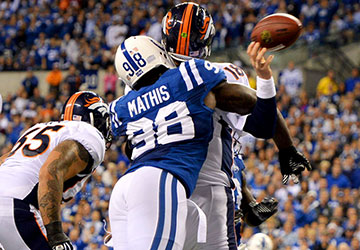
Mathis takes down Manning

Mathis takes down Manning.

Good stat courtesy of Bill Barnwell this week: Robert Mathis has 11.5 sacks, while the rest of his Indianapolis teammates have just 10.5 sacks. Jerrell Freeman is second on the team with 3.5 sacks, Cory Redding has a pair of sacks, and no other Colt has more than one sack. That’s obviously very impressive: no other defensive player in 2013 has even 40% of his team’s sacks, with only LaMarr Woodley (5 sacks), Mario Williams (11), and Robert Quinn (10) having more than one-third of their team’s sacks.

Since the sack became an official statistic in 1982, the record for percentage of team sacks by an individual player was set by right outside linebacker Tim Harris on the 1989 Packers. Green Bay ran a 3-4 defense under Hank Bullough, and Harris had 19.5 of the team’s 34 sacks.  That means 57.4% of all sacks by Packers players that year came from Harris; no other Green Bay player had more than three sacks.

Aldon Smith had 19.5 sacks, too, playing on the 2012 49ers. Last year, San Francisco recorded 38 team sacks, meaning Smith — playing that same ROLB position in the 3-4 defense — had 51.3% of his team’s sacks.  Two other players recorded exactly half of their team’s sacks.  In 1984, when Mark Gastineau (playing at left defensive end in New York’s 4-3 defense) set the sack record, he recorded 22 of the Jets 44 total sacks. Fifteen years later, Football Perspective All Underrated star Simeon Rice (who lined up at right defensive end) had 16.5 of the Cardinals 33 sacks.

Mathis was a star 4-3 defensive end, but he’s already matched his single-season career high in sacks. He’s having perhaps his best season playing as rush linebacker in the system devised by Greg Manusky and Chuck Pagano. And his numbers look even better as a percentage of team sacks. Below are the top 50 leaders from 1982 to 2012 in percentage of team sacks, which is a cut-off deep enough to bring in another Robert Mathis season:
[continue reading…]

{ 5 comments }

Luck leads the league with three fourth-quarter comeback wins

Luck leads the league with three fourth-quarter comeback wins.

Week eight brough us the two biggest blowouts of the season; in week nine, we saw the third most dominant win of the year and the biggest comeback of the season.

The first game involved Chip Kelly’s blitzkrieg offense. Nick Foles threw for seven touchdowns against the Raiders in one of the most lopsided (and surprising) games of the season. The Eagles held a 28-13 lead at halftime and 49-13 at the end of the third quarter; over the course of the game, Philadelphia held an average lead of 21.3 points.

At the other end of the spectrum, we have yet another Andrew Luck comeback victory. The Texans led 14-0 after the first quarter and 21-3 at halftime; on average, Houston held an 11-point lead throughout the game, but a 15-0 edge in the fourth quarter gave Indianapolis the win. That’s the highest Game Script of any team to lose a game in 2012, replacing…. Houston’s victory over the Chargers on opening week, when the Texans had a Game Script of -7.7 points.

In addition to the Colts-Texans game, the crazy comeback in Seattle now gives each of the Seahawks and the Bucs two of the five biggest comebacks/giveaways of the year. In week four, Seattle won in overtime against Houston despite trailing by, on average, 7.7 points in regulation. That was probably an even more crazy game than the win against Tampa Bay, where Seattle came back from a 21-0 deficit but only outscored the Bucs by 10 points in the fourth quarter. As for Tampa Bay, this was the fourth game of the season where the team lost despite having a 95% win probability at some point in the game. This was also the second time the Bucs lost a game with a Game Script of over 6.0 points, joining the come-from-ahead loss to Arizona.

Without further ado, the table below shows the week 9 Game Scripts data:
[continue reading…]

{ 10 comments }

New York Times: Post-Week 9, 2013

There are seven teams that have two or fewer losses this year. But that doesn’t mean those teams are without weakness: this week at the New York Times, I look at the biggest concern for each of the top teams in the NFL:

Seattle Seahawks (8-1)

Seattle has the best record in the N.F.C. and may have the most talented team in the N.F.L. The defense has allowed just 5.0 net yards per pass attempt and is tied for the lead league with 13 interceptions, thanks to a dominant secondary. A punishing running game is complemented by one of the game’s brightest stars at quarterback, Russell Wilson, who is 12-0 at home.

But … the offensive line could cost the team home-field advantage. The Pro Bowl left tackle Russell Okung has played in two games this year after injuring his foot; he is scheduled to come back at the end of the month. Right tackle Breno Giacomini, with a knee injury, should come back in December. The team’s other Pro Bowl lineman, center Max Unger, missed two games with an arm injury and left the game last week with a concussion. As a result, the Seahawks have been sacked on 10.2 percent of their pass plays this season, the third-worst rate in the league.

New Orleans Saints (6-2)

As long as Sean Payton and Drew Brees are around, the Saints will be defined by their offense. Tight end Jimmy Graham leads the league with 10 touchdowns despite playing with a partly torn plantar fascia for the last month. Darren Sproles and Marques Colston are battling injuries, but the long-term outlook is positive for both. Brees has thrown 21 touchdown passes, second in the league behind Peyton Manning. But that’s business as usual in the bayou. More notable is a revitalized defense that ranks fifth in points allowed per game.

But … New Orleans is allowing 4.9 yards per carry, the second-worst rate in the league. The defensive coordinator Rob Ryan can confuse quarterbacks, but he cannot cure the Saints’ tackling woes. The Jets rushed for 198 yards Sunday, providing a blueprint for Saints opponents. A path to the Super Bowl probably requires beating Seattle or San Francisco, or both, two of the league’s best rushing teams. And trouble may be just around the corner: the Saints have only a one-game lead in the N.F.C. South over the resurgent Panthers. In 2012, Carolina rushed for 492 yards in two victories against New Orleans; the Saints’ defense does not seem any better equipped to stop the Panthers this year.

You can read the full article here.

{ 2 comments }

Let’s start with the SRS ratings through nine weeks, excluding the Green Bay/Chicago Monday Night Football game:

RkTeamGMOVSOSSRSRecord
1Denver Broncos814.9-3.211.77-1
2Carolina Panthers812.3-2.89.45-3
3Green Bay Packers78.10.995-2
4Seattle Seahawks99.6-18.68-1
5San Francisco 49ers88.8-0.38.46-2
6Indianapolis Colts87.4-0.56.96-2
7Kansas City Chiefs911.2-4.36.99-0
8New Orleans Saints88.8-2.36.56-2
9Cincinnati Bengals96-0.55.56-3
10Dallas Cowboys95-0.14.95-4
11Detroit Lions82.513.55-3
12New England Patriots96.2-2.83.47-2
13Arizona Cardinals8-1.82.60.84-4
14Tennessee Titans80.8-0.20.54-4
15Baltimore Ravens80.30.20.43-5
16Miami Dolphins8-1.61.70.14-4
17San Diego Chargers83-3.1-0.14-4
18Chicago Bears70.6-1.4-0.84-3
19Philadelphia Eagles9-0.3-0.9-1.34-5
20Cleveland Browns9-3.11.8-1.34-5
21Buffalo Bills9-5.62.6-33-6
22Washington Redskins8-6.32.3-3.93-5
23St. Louis Rams9-4.80.4-4.43-6
24Atlanta Falcons8-5.30.2-52-6
25Houston Texans8-9.43.4-62-6
26Tampa Bay Buccaneers8-8.31.9-6.40-8
27Minnesota Vikings8-7.91.3-6.61-7
28New York Giants8-9.52.9-6.62-6
29New York Jets9-7.2-0.3-7.55-4
30Pittsburgh Steelers8-6.1-1.6-7.82-6
31Oakland Raiders8-7.4-0.7-8.13-5
32Jacksonville Jaguars8-21.93.7-18.10-8

[continue reading…]

{ 11 comments }

Jameis Wins a ton

Jameis Wins a ton.

The Florida State Seminoles have done everything a championship team should do. FSU obliterated a 4-0 Maryland team 63-0, the most dominant win of the first five weeks of the season. That performance has only been eclipsed by one game since: the Seminoles 51-14 victory on the road against Clemson, a team that is currently ranked 10th in this week’s version of the SRS. In week 10, FSU was a 21-point favorite against an undefeated but underwhelming Hurricanes team: the Seminoles and Jameis Winston struggled a bit early, but won 41-14. That win gives FSU three of the top nine single game performances of the season.

Of course, FSU is still on the outside looking in when it comes to the BCS. If Oregon and Alabama remain undefeated, that’s your national championship game, a matchup college football fans have been pining for each of the past few seasons. Obviously an undefeated FSU team would deserve to be in the title game, just like an undefeated Alabama and undefeated Oregon would, too. Such is life in (thankfully, the last year of) college football’s two-team playoff system. But if we’re forced to split hairs, is FSU better than Alabama and/or Oregon? And what do we make of an Ohio State team that’s now 21-0 under Urban Meyer?

Let’s start with the SRS ratings through ten weeks. As a reminder, you can read about the methodology here. As always, thanks to Dr. Peter Wolfe for providing the final scores for every college football game.
[continue reading…]

{ 4 comments }

Non-FBS College Football Ratings Through 10 Weeks

Every week, I publish my college football ratings for FBS teams. To generate those ratings – using this methodology — my program also generates ratings for non-FBS teams. Since there is less interest in those numbers, I rarely publish them, but here are the ratings through ten weeks for all non-FBS teams.
[continue reading…]

{ 5 comments }

After defeating the Saints 26-20, the Jets now own a 5-4 record. New York was ranked 32nd by ESPN in their pre-season power rankings, a fact Rex Ryan brings up during every other press conference. But while the record is a pleasant surprise, the Jets aren’t necessarily playing well. Or, at least, they play really, really badly in their losses. In fact, the Jets have the worst points differential of any team with a winning record after nine games in NFL history:
[continue reading…]

{ 1 comment }

Mid-Season Awards: Lowlights

The Browns reloaded in the first round of the 2012 Draft.

The Browns reloaded in the first round of the 2012 Draft.

Earlier this week, I named my best players and coaches of the first half of the season. Today, I name the worst/most underachieving.

Least Valuable Player: Tie: Blaine Gabbert, Jacksonville Jaguars and Brandon Weeden, Cleveland Browns; Dishonorable mention: Carson Palmer, Matt Schaub, Eli Manning, Josh Freeman

Blaine Gabbert has just 1 touchdown pass against 7 interceptions, and his awful 1.21 ANYA average puts him in the company of Caleb Hanie, Keith Null, Ken Dorsey, rookie Alex Smith, Kurt Kittner, and Spergon Wynn. On the other hand, Gabbert has thrown just 86 passes, so Brandon Weeden — who has been slightly better — has been arguably more not valuable due to accumulating more than twice as many pass attempts. The Jaguars have looked much better with Chad Henne at quarterback, while Cleveland’s offense looks much worse with Weeden than behind either Brian Hoyer or Jason Campbell. Gabbert and Weeden are former first round picks who appear to earn playing time out of obligation or hope rather than merit.

Really Offensive Player of the First Half (non-QB edition): Chris Johnson, Tennessee Titans. Dishonorable mention: Mike Wallace ($); Kenny Britt (brain); Jermaine Gresham (run blocking)

Johnson is the second most expensive running back in the NFL, and has produced the following stat line:

Rushing Receiving
Year G Att Yds TD Lng Y/A Y/G Rec Yds Y/R TD Lng YScm RRTD
2013 7 115 366 0 23 3.2 52.3 15 167 11.1 2 66 533 2

Johnson has not run for a touchdown this season. He’s run for one first down on third down all season. His yards per carry average is embarrassing for any runner, much less a player who is supposed to be one of the most explosive in the game. Tennessee invested heavily in the offensive line in the offseason, drafting Chance Warmack with the ninth pick in the draft and throwing big money at Andy Levitre. Jake Locker has progressed this season, but Johnson has held the offense back. Even Jackie Battle and Shonn Greene (40 runs for 146 yards) have higher YPC averages than Johnson.  The former 2,000-yard runner has rushed for fewer than 40 yards in each of his past four games.

Really Offensive Defensive Player of the First Half: DeMeco Ryans, Dishonorable mention: Cortland Finnegan (terrible against the run and the pass), Quinton Coples (former first round pick has disappeared in year three), Julius Peppers (little production, $16M cap value)

Ryans is one of the highest paid inside linebackers in the league, but he’s Pro Football Focus’ 2nd worst inside linebacker this year. The worst is his Eagles teammate, Mychal Kendricks, and the duo is one of several reasons the Eagles have struggled defensively this year. PFF has Ryans 5th in the league with 7 missed tackles (Kendricks is first), and he continues to be well-below average in both pass coverage and pass rushing. Ryans is the fifth highest paid Eagle, and with a base salary of $6.8M next year, it’s hard to imagine him returning in 2014.

Worst Offensive Coordinator: Tie: Mike Sullivan (Tampa Bay), Kevin Gilbride (New York Giants). Dishonorable mention: Todd Haley (just because), Brian Schottenheimer (have you watched the Rams?)

Sullivan learned under Gilbride for years in New York, and the Bucs and Giants run similar offensive systems. A lot of deep passes, one-on-one routes where you expect your wide receiver to beat their defensive back, and option routes where the quarterback and wideout have to be on the same page. That leads to a high-variance outcome on offense — think the opposite of what’s happening in Kansas City – and right now, the two teams are 2-15 in large part because of the struggles of their respective offenses. The Giants lead the league in interceptions, while the Bucs have the lowest completion percentage in the league.

Worst Defensive Coordinator: Tie: Alan Williams (Minnesota), Bob Babich (Jacksonville). Dishonorable mentionMike Nolan (Falcons), Jim Haslett (Redskins).

Babich isn’t working with much, but the Jaguars defense is so far below the baseline that you can’t justify those results. Opposing passers have a 106 passer rating against Jacksonville, while the Jaguars also rank 32nd in rushing yards and rushing touchdowns allowed (and 31st in yards per carry allowed). Jacksonville has allowed 210 points through the first three quarters of games this year, the most of any team since the merger. The Vikings defense isn’t as devoid of talent, but has been only slightly better. The Vikings are 31st in PFR’s Expected Points Added metric, and the Vikings rank in the bottom three in both points and yards allowed.  Minnesota ranks dead last in first downs allowed, too, a year after posting some pretty respectable defensive numbers.

Worst Head Coach: Greg Schiano, Tampa Bay Buccaneers. Dishonorable mention: Leslie Frazier (Vikings); Tom Coughlin (Giants)

One could spend hours reciting the career of Schiano in Tampa Bay, but that parade of horribles is too depressing to review on a Sunday. Tampa Bay is 0-7, Schiano has lost control of the team, and the only thing left to do is figure out when he will be fired. A week nine trip to Seattle should be a disaster, but this team is talented enough to put together a 2013 Chiefs run next year under new management. Relieved of his duties, Schiano will now be available to testify as an expert witness on how not to handle your quarterback situation.

Offensive Rookie: Three-way tie: Eric Fisher, Chiefs; Luke Joeckel, Jaguars; Lane Johnson; Eagles. Dishonorable mention: Tavon Austin (St. Louis)

Offensive tackles aren’t sexy picks, but they occasionally work their way into the top five because of how “safe” they are. This year, Fisher and Joeckel were the first two picks in the draft, while Johnson was the third offensive player selected, going fourth overall after Dion Jordan went to Miami. If you didn’t watch football, you might think Fisher is having a great year, as the number one overall pick went to a 2-14 team that has started 8-0. In reality, he’s been a disaster even at right tackle. He’s the third-lowest graded offensive tackle by Pro Football Focus, while Branden Albert has solidified the left tackle spot. Joeckel was playing poorly in Jacksonville at right tackle and then went down with a season-ending injury, proving that nothing can go right for the Jaguars this year. Johnson has allowed 7 sacks and 29 hurries this year according to PFF, and both marks put him in the bottom five among offensive tackles.

Defensive Rookie: Dee Milliner, New York Jets. Dishonorable mention: Barkevious Mingo (Cleveland), Jarvis Jones (Pittsburgh)

Milliner has been arguably the worst cornerback in the league this season. The Jets have seen much more bad (his play) and ugly (the multiple benchings) than good from the former Alabama star. In my preseason preview, I said that we shouldn’t expect much from Milliner right away, as Football Outsiders has pointed out several times that even the best rookie cornerbacks tend to struggle. Still, Milliner has been horrible through eight weeks, even if his future may still be bright (Kareem Jackson was another great Crimson Tide corner who was a disaster as a rookie, and has turned into a solid cornerback in Houston). For a top ten pick, there’s still a minimum amount of production one should expect, and being outplayed by undrafted free agent Darrin Walls falls below that bar.

{ 4 comments }

Calvin Johnson And Getting Tackled At the One

Johnson was tackled twice at the 1 against Dallas

Johnson was tackled twice at the 1 against Dallas.

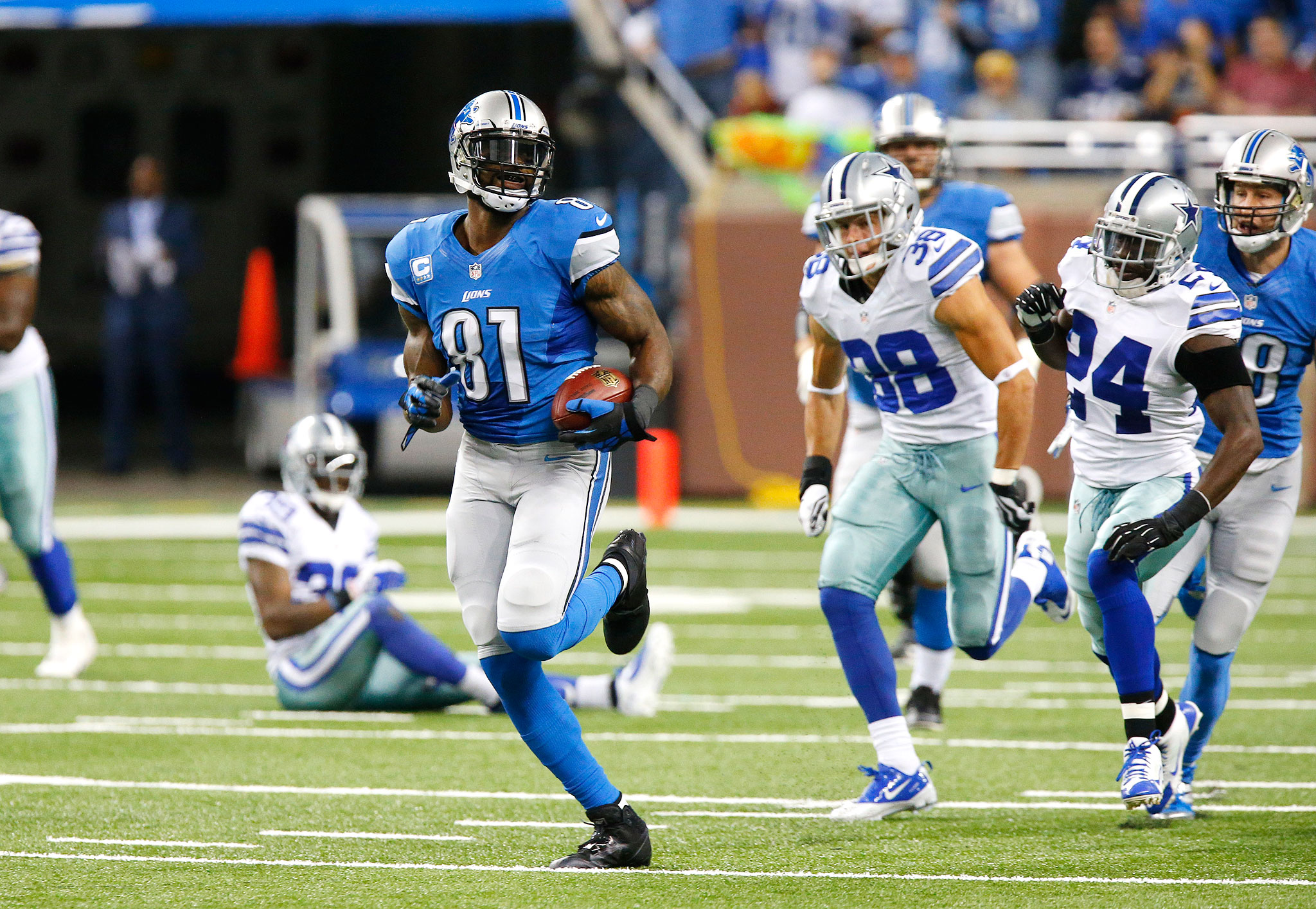
In the last two years, Calvin Johnson has been tackled at the one yard line an incredible seven times. Ronnie Brown is the only other player to record such a dubious feat even four such times since 2012, and Eric Decker, Roddy White, and Tony Gonzalez are the only other players to get tackled on three different receptions just shy of the goal line.

Johnson has the most receptions in the league over that time frame, but Wes Welker is only one catch behind him… and he has just one reception where he was tackled at the one-yard line. Of course, that’s only for data over the last year and a half.

Since 1999, 25 players have had at least seven receptions where they were tackled at the one-yard line. As it turns out, Brian Finneran fantasy owners have been the most unlucky, as Finneran was tackled seven times at the 1-yard line on 238 career receptions.
[continue reading…]

{ 2 comments }

Not too surprising, I suppose. This includes all rushing touchdowns, including in the postseason, but does not include rushing touchdowns for 2013, not that it matters very much for Chris Johnson. :rimshot:

All players with at least 30 rushing touchdowns are included since 1940.
[continue reading…]

{ 6 comments }

The 2013 Game Scripts record was broken not once but twice in week eight. In an unsurprising turn, the 49ers obliterated the Jaguars in London 42-10, holding an average lead of 21.3 points, breaking the largest average margin previously held by… Seattle against Jacksonville. But it was the Bengals demolition of the Jets in Cincinnati that set the new Game Scripts record.

The Bengals took a 14-0 lead with 4:26 left in the first quarter; by halftime, the score was 28-6. The first play from scrimmage in the second half was an interception of a Geno Smith pass that was returned for a touchdown by Chris Crocker, and Marvin Jones’ fourth touchdown reception of the day brought the Bengals lead to 42-9 before the end of the third quarter. The final score of the game was another pick six of Smith, this time by Adam Jones, at the start of the fourth quarter. The game was every bit as ugly as this paragraph makes it sound. For the record, both San Francisco and Cincinnati had Moral Margins of Victory of over 30 points, which puts them in the top five for the season.

Last week, the Patriots were the only team with a positive Game Script to lose; this week, New England is one of just two teams with a negative Game Script to win. That game was a pretty weird one: New England rushed on 37 of the team’s 59 plays from scrimmage against Miami. The Patriots threw just 22 passes, the lowest by New England in a game since a extremely windy week 17 visit to Buffalo in 2008. For Tom Brady, this was the fewest attempts in a game for him — excluding games where he was injured or meaningless games where he was benched — since 2005. And this came in a game where the Patriots had a negative Game Script! Brady and the passing game are really struggling — the Patriots rank 31st(!) in Net Yards per Attempt — but it’s still just weird to see New England be so run heavy. Then again, the Patriots had 100 net passing yards on 25 dropbacks against the Dolphins, while Stevan Ridley and LeGarrette Blount had 125 yards on 25 carries.

Below are the week 8 Game Scripts:
[continue reading…]

{ 2 comments }

New York Times: Post-Week 8, 2013

It’s mid-season awards time at the New York Times!

OFFENSIVE PLAYER OF THE FIRST HALF (NON-QB EDITION) Jamaal Charles, Kansas City Chiefs. Honorable mention: LeSean McCoy, Jimmy Graham, Calvin Johnson.

No offense is as dependent on one player as the Chiefs are on Charles. He leads the league in carries on first-and-10 and has produced a higher percentage of his team’s offensive yards than anybody else. He has scored eight of the Chiefs’ 16 offensive touchdowns and gained at least 100 yards from scrimmage and scored a touchdown in each of his first seven games, making him the second N.F.L. player to do so (O. J. Simpson, 1975). In Week 8, he did not score, but picked up 120 yards in a victory over Cleveland.

DEFENSIVE PLAYER J. J. Watt, Houston Texans. Honorable mention: Richard Sherman, Robert Mathis, Justin Houston.

Watt had one of the N.F.L.’s best defensive seasons in 2012. He has been nearly as productive this year despite not capturing headlines. According to Football Outsiders, he has eight tackles for loss on running plays in seven games (and five more tackles for no yards); this time last year he had nine tackles for loss and four more on runs for zero yards. His sack totals are down this year — although 4.5 is respectable for a 3-4 defensive end — but Football Outsiders credits him with 12 hits on quarterbacks (not including sacks), compared with six at this point in 2012.

OFFENSIVE COORDINATOR Ken Whisenhunt, San Diego Chargers. Honorable mention: Adam Gase, Jay Gruden.

Coach Mike McCoy and the offensive coordinator Whisenhunt have revived the career of quarterback Philip Rivers. Before the team’s Week 8 bye, San Diego ranked second in points per drive and trailed only Denver in first downs per game. Rivers has completed a league-leading 73.9 percent of his passes. More impressive is that the San Diego offense has endured key injuries and succeeded with castoffs. Running back Danny Woodhead (a former Jet and Patriot) has 40 receptions, and the former Broncos receiver Eddie Royal has six touchdowns, easing the loss of the starting wide receivers Danario Alexander and Malcom Floyd.

DEFENSIVE COORDINATOR Bob Sutton, Chiefs. Honorable mention: Rob Ryan, Dan Quinn.

The Chiefs (8-0) lead the league in points allowed (12.2 per game), third-down conversion rate (25 percent) and sacks (36). They are the first team since the 1977 Falcons to hold each of their first eight opponents to 17 or fewer points. This is Sutton’s first year in Kansas City after more than a decade with the Jets; in 2012, without Sutton, the Chiefs finished 25th in points allowed and last in passer rating allowed.

You can read the full article here.

{ 9 comments }

Cowboys defense know the back of their hands like the back of Megatron's jersey

Cowboys defenders know the back of their hands like the back of Megatron's jersey.

On Sunday, Calvin Johnson picked up 329 receiving yards against the Cowboys, the second most receiving yards in a single game after Flipper Anderson’s 336 yards in 1989 against the Saints. But when I think of the greatest games by a receiver of all time, my mind instantly goes to a performance by Kansas City’s Stephone Paige in a game in December 1985 against the Chargers. Regular readers will recall that this summer, Neil Paine and I developed a statistic known as True Receiving Yards. You can see a list of the leaders in TRY since 1950 here, but today I want to apply that same methodology on the single-game level. After crunching the numbers, Paige comes in at #2, Megatron’s performance comes in at #11, and Anderson is all the way down at #26. Why? How? Glad you asked. And I’ll keep the top spot a secret for now, in case anyone wants to guess.

1) First, we convert receiving yards into Adjusted Catch Yards by giving a five-yard bonus for receptions and a 20-yard bonus for touchdowns. Johnson had 419 ACY against the Cowboys, tied with Jerry Rice (against the ’95 Vikings) for the third highest mark since 1960.  The top spot belongs to Anderson at 431 (and personal favorite Jimmy Smith holds the number two spot for his performance against the 2000 Ravens). Paige — who produced an 8-309-2 stat line — totaled 389 Adjusted Catch Yards.

2) Next, we convert back to receiving yards by multiplying each receiver’s ACY by the league average ratio of receiving yards to Adjusted Catch Yards in that season. The point of using ACY instead of receiving yards is to include things other than receiving yards, but we still want to convert back into receiving yards. In 1985, the ACY/RecYd ratio was 0.66, in ’89 it was 0.66, and through eight weeks, that number is 0.65 in 2013, so not much is changing here. After step two, Anderson is at 286.6 receiving yards, Johnson 270.9 yards, and Paige 258.0 yards.

3) The third step is the pass attempts adjustment. The league average team team this year has averaged 38.7 attempts (including sacks) in 2013, while Matthew Stafford had 49 dropbacks yesterday. This means the Lions passed 26.6% more often than the average team. So what sort of adjustment do we make? In True Receiving Yards version 2.0, we split that number in half. I tried that here, and honestly, the numbers just didn’t look right — the top of the list was almost exclusively players on teams that had 10 or 12 pass attempts in that game. So instead of contracting the difference between pass attempts and league average pass attempts by two, I’m going to do it by three. So Johnson only gets downgraded to 91.1% of his production, or 246.9 yards.

Anderson’s record-breaking performance came in overtime in a game the Rams trailed by 14 entering the fourth quarter. As a result, Jim Everett had 57 dropbacks in a time period when 34.5 attempts was the norm.  So with Los Angeles having 65.3% more attempts than the average team that year, we have to lower Anderson from 286.6 to 224.1.

Paige, meanwhile, goes far in the other direction. The Chiefs took a 35-3 second quarter lead that day — in no small part due to Paige’s touchdown receptions of 56 and 84 yards — so Kansas City was limited to just 24 dropbacks. The average number of dropbacks in ’85 was 35.1, putting the Chiefs at just 68.4% of league average. Therefore, we bump up Paige by 15.4%, vaulting him from 258 yards to 297.9.

4) The final adjustment is the era adjustment. I’m going to use a different way to incorporate era adjustments here, because while passing yards have shot through the roof, the value of a team’s #1 wide receiver has been much less volatile. So I used the following baseline for each year: the number of Adjusted Catch Yards in the Nth best receiving game, when 2N = the number of team games in that season. So in modern times, with 512 games, this means the 256th highest ACY total in that season is the baseline; in 2011 and 2012, that was 135 Adjusted Catch Yards. From 1960 to 2012, the average was 124.3. [1]Note: I was lazy, and combined the AFL and NFL. I know, I know.

So what we do now is multiply each receiver’s score from step three by the baseline for that year, and divide by 124.3. I will use the same 135 as the baseline for 2013, which brings Megatron to 227. The baseline in ’89 was 130, so Anderson goes to 214.3, and in ’85, the baseline was 125, so Paige only drops to 296.2.

If you’ve made it this far, then maybe I’m not a complete idiot for putting the fine print up front. Without further ado, here are the top 250 [2]Note. I excluded two games during the 1987 strike played with replacement players: Anthony Allen had 262 TRY against the Cardinals, and Steve Largent had 260 TRY in Detroit. performances since 1960 using this formula:
[continue reading…]

References

References
1 Note: I was lazy, and combined the AFL and NFL. I know, I know.
2 Note. I excluded two games during the 1987 strike played with replacement players: Anthony Allen had 262 TRY against the Cardinals, and Steve Largent had 260 TRY in Detroit.
{ 7 comments }

Moral Margin of Victory

Debating whether Moral Margin of Victory is the most superior model ever devised

Our Moral Margin of Victory is what's important, Bill.

Suppose you watch an entire football game. Your job is to put a single number on the degree to which the winning team beat the losing team. Qualitatively, the scale runs from “had any number of things gone differently at the end, the winning team would have lost” to “the winning team was in control for most of the game” to “this game was never in question.”

I want to quantify that qualitative scale. And I want to do it in a retrodictive way. In other words, I’m not as interested in the degree to which the winning team outplayed the losing team as I am in the degree to which the winning team was in control of the game. To see the difference, imagine a game where one team opens up a 14-0 lead on a kickoff return touchdown and a fluke turnover that leads to a score, then cruises to an uneventful 31-17 win. The advanced stats might even show that the losing team was more efficient. The predictive measures might give the losing team a better grade, because the reasons the winning team won were not things that are likely to carry over to future games. I don’t care about any of that. The kick return happened, and the turnover happened, and the result was that the game was never in any serious doubt.

The easiest way to do this is to use margin of victory, and that works well in most cases, but there are obvious outliers. Consider the Green Bay – Washington game from week two, which was 24-0 midway through the second quarter and never really got any closer, and the Colts-49ers game, which was a one-score game with five minutes remaining. The latter game finished with a larger margin of victory. Again, if you’re interested in predictive measures, you probably do want to record that Robert Griffin III was able to generate a couple of late TDs and that the Colts were able to put away the 49ers so quickly and thoroughly. But I’m not interested in that here.

Another natural answer would be to use Chase’s game scripts. Or, if you wanted to fancy up the same concept, you could compute the average win probability throughout the game. This too would work in the majority of cases, but not always. If a game is tied with two minutes left, that’s really all I need to know: the game should be graded as “could’ve gone either way.” But game scripts (or average WP) would be sensitive to how the game progressed for its first 58 minutes. Whether one team went up 21-0 and then the other team came back to tie it, or the game was a seesaw affair, all that really matters that the game was still very much in question at the end.

In 2008, I borrowed an idea that the great Matt Hinton called Time of Knockout. Chase later refined the idea with these two posts. Those were a couple more attempts to get at what I’m trying to get at above. These are fun, but they are flawed in ways similar to margin of victory and game script. The comments to Chase’s posts contain a lot of the ideas in the discussion above.

Now I’m going to tell you my answer. Then you’ll use the comments to tell me how to improve it. [continue reading…]

{ 31 comments }

Shaw helped USC win the Battle of The Columbias Trophy. Yes, that is a real thing.

Shaw helped USC win the Battle of The Columbias Trophy. Yes, that is a real thing.

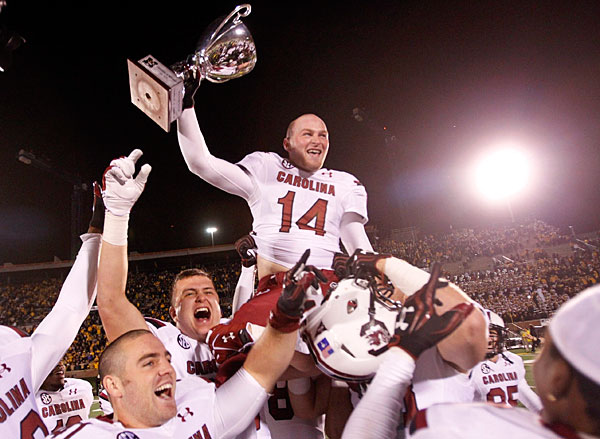
Last week, five teams emerged as the upper crust of college football. That number has dropped to four, after Missouri lost to South Carolina in typical heartbreaking style. The Tigers led 17-0 entering the fourth quarter, but that was before USC starting quarterback Connor Shaw — who had been held out due to injury — was inserted into the game. Shaw led the Gamecocks on a furious comeback to force overtime. After MIZZOU scored a touchdown on the first possession, Shaw threw his third touchdown pass on 4th-and-goal from the 16 yard line. On the second possession, USC was up first and kicked a field goal. Missouri looked to match South Carolina, but a 24-yard field goal bounced off the left upright, giving Tigers fans the gut punch loss of the season.

Elsewhere, most things went according to plan. Johnny Manziel played like a Heisman Trophy winner (25/35, 305 yards, 4 TDs, 1 INT), while Teddy Bridgewater (25/29, 344, 3, 0), Bryce Petty (20/32, 430, 3/0), and Jameis Winston (16/26, 292, 3/1) continued their dominant seasons. A couple of embattled schools pulled off impressive wins over conference rivals: Michigan State won 42-3 against Illinois, while Texas continued to put September in the rear-view mirror by stomping TCU, 30-7.

Below are the SRS ratings through nine weeks. As a reminder, you can read about the methodology here. As always, thanks to Dr. Peter Wolfe for providing the final scores for every college football game.
[continue reading…]

{ 5 comments }