≡ Menu

Which Four Teams Would Make a College Playoff in 2013?

We can officially declare the BCS dead (1998-2013). As it turns out, the final edition of the BCS rankings was not controversial. It took awhile, but with the losses by Ohio State and Northern Illinois, Florida State was the only team in the Football Bowl Subdivision to finish the year without a blemish. The champion of the Pac-12 had two losses, while the one loss champions of the Big 12 (blowout loss) and Big 10 (one win against a team in the SRS top 25) had unimpressive resumes compared to the one-loss SEC Champion (4-1 record against teams in the SRS top 25). No team distinguished itself from the AAC or any other the other conferences, nor did any of the independent teams. That left the voters with two easy choices to fill two slots.

But starting next season, there will be a four-team playoff in college football. In general and on average, a four-team playoff is preferable to a two-team playoff: leaving out the fifth best team is easier to stomach than leaving out the third place team. A four-team playoff may not be ideal, but it’s the system we will have. So which teams would be deserving of the third and fourth golden tickets if the playoffs began in 2013?

There are only four legitimate candidates: Alabama, Stanford (Pac-12 champion), Baylor (Big 12 champion), and Michigan State (Big 10 champion). Any other team could be dismissed quickly: Fresno State, Northern Illinois, Central Florida, and Louisville each lost just one game, but easy schedules make that accomplishment less impressive. Among two-loss teams, Stanford had the most difficult schedule and was the only to win its conference: South Carolina, Missouri, Oklahoma, Oklahoma State, and Clemson were good teams, but don’t have elite resumes. The two teams that could make the best case would be Oregon and Ohio State, but both teams can’t make credible arguments after losing their conference to another team in consideration. [1]I will leave the argument as to whether head-to-head is the best tiebreaker, particularly between Ohio State and Michigan State, for another day. Which team you would pick out of those four would say more about the voter than the team in question. But before we go through the criteria, first, the final college football SRS ratings. [continue reading…]

References

References
1 I will leave the argument as to whether head-to-head is the best tiebreaker, particularly between Ohio State and Michigan State, for another day.
{ 2 comments }

Recapping An Incredible Slate of 1:00PM Games

With nine games kicking off at 1:00, you had a feeling that it might be difficult to keep up. That would be true on a normal Sunday, but week 14 provided some of the craziest games in recent memory. So let’s bring everyone up to speed on what they might have missed:

Miami 34, Pittsburgh 28

  • The Steelers nearly pulled off the greatest multi-lateral play in NFL history. The play-by-play description: Ben Roethlisberger passed to Emmanuel Sanders to the right for 22 yard gain. lateral to Jerricho Cotchery. lateral to Le’Veon Bell. lateral to Marcus Gilbert. lateral to Ben Roethlisberger. lateral to Antonio Brown for 55 yards. Brown ran into the end zone, but the edge of his foot just barely touched the sidelines at the 13-yard line.
  • The game featured four lead changes in the second half, which would be impressive on a normal day but just blended into the background on this Sunday.  The Steelers shut down Mike Wallace in his return to Pittsburgh, but Charles Clay caught all seven of his targets for 97 yards and two touchdowns.
  • Troy Polamalu returned a Ryan Tannehill pass for a touchdown, missed an easy interception earlier in the game, and was part of a nearly spectacular missed field goal return to end the first half.
  • At 5-8 and with the Bengals on deck, the Steelers playoff hopes are on life support. If Pittsburgh can win out, though, they still have a chance since the Steelers win tiebreakers against the Jets, Ravens, and Chargers.
  • At 7-6, the Dolphins are in great position to take the AFC’s 6 seed. But Miami tends to struggle inside the division (8-13 since 2010), and the final three games are against the AFC East. The Jets would own the tiebreaker if they defeat Miami in week 17.

[continue reading…]

{ 14 comments }
pfr ravens vikings

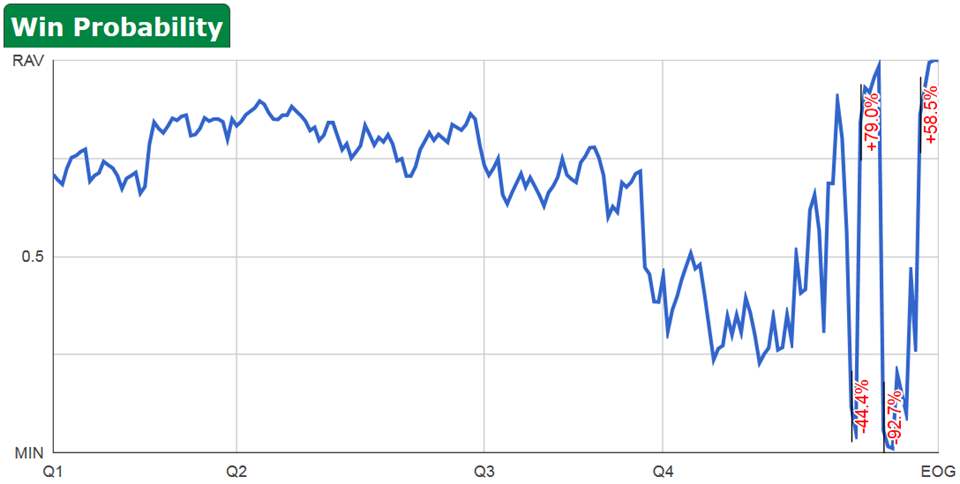
I don’t know if any of us have ever seen a game quite like the end of Baltimore-Minnesota. With 2:05 left in the game, Baltimore faced 4th-and-goal from the Vikings 1-yard line. The Ravens trailed 12-7.

In what looked to be the game-winner, Joe Flacco hit Dennis Pitta for a touchdown pass. A two-point conversion to Torrey Smith put the Ravens up, 15-12.

On the next play from scrimmage, Matt Cassel hit Jerome Simpson for 27 yards. With 1:27 left, Toby Gerhart rushed up the middle for a 41-yard touchdown, which looked to be the game winner. The Vikings now led 19-15.

But Jacoby Jones returned the ensuing kickoff for what looked to be a game-winning, 77-yard touchdown, to put Baltimore back on top, 22-19.

Matt Cassel then threw a couple of incompletions, before throwing a screen pass to Cordarrelle Patterson…. that the rookie to the house for a 79-yard touchdown. That looked to be the game-winner, as Minnesota now lead 26-22.

But then Joe Flacco drove the Ravens down the field, and hit Marlon Brown for a nine-yard touchdown with four seconds left, in what was actually the game-winner. Baltimore left with a very unlikely 29-26 victory.

Add in the Cassel-to-Simpson touchdown on the second play of the fourth quarter, and that means there were six touchdowns in the final quarter that were lead-changing scores. That’s an NFL record.

Prior to this game, only four games saw five lead-changing touchdowns in the fourth quarter. A Bills-Raiders Ryan Fitzpatrick/Jason Campbell shootout from 2011, a Bruce Gradkowski-fueled comeback win over Ben Roethlisberger and the Steelers in 2009, a Monday Night thriller between the great Mark Sanchez and Chad Henne earlier that same season, and a Giants-Cardinals shootout from 1962. Hat/tip to the great Scott Hanson for alerting me to the record.

{ 4 comments }

Just above these words, it says “posted by Chase.” And it was literally posted by Chase, but the words below the line belong to Steve Buzzard, who has agreed to write this guest post for us. And I thank him for it. Steve is a lifelong Colts fan and long time fantasy football aficionado. He spends most of his free time applying advanced statistical techniques to football to better understand the game he loves and improve his prediction models.


The way to win fantasy football games is to have players that score a lot of points.  Players tend to score more points when they get more touches.  One of the most important factors in determining how many touches each player is going to have is to determine the Game Script ahead of time.  As we all know positive game scripts result in more passing attempts and negative Game Scripts result in more rushing attempts.  But I am going to try to project the pass ratio using two key stats, Pass Identity rating and the Vegas spreads. We can use these projected pass ratios to build our own projections or at least look for outliers and figure out how to adjust players from their year to date averages.

Regular readers know what Pass Identity means. For newer readers, you can read here to see how Pass Identities are calculated.  But the quick summary is that Pass Identity grades allow us to predict the pass ratio of any game where the point spread is zero. This is because Pass Identity tries to eliminate the Game Script from the pass ratios.  For example since the Bears/Cowboys game is a pick’em this week, we can predict the pass ratio of the Bears by using the following formula.  League average pass ratio + (A + B) *C, where

    (A) = number of standard deviations above/below average the Bears are in Game Script (-0.49);


    (B) = number of standard deviations above/below average the Bears are in Pass Ratio (+0.53); and

(C) = the standard deviation among the thirty-two teams with respect to Pass Ratio (5.3%)

Of course, the product of (A) and (B) is the Pass Identity grade for each team; once we determine that, we multiply that number by the standard deviation of the pass ratios of all teams to get us a prediction for the pass ratio in a game with a Game Script of 0.0. Since the Bears have a Pass Identity of basically 100, the projected Pass Ratio for Chicago against Dallas is 58.9%.

We can then compare this projection to Chicago’s year-to-date pass ratio of 61.5% and predict that all else equal Jay Cutler and the passing game should score about 4% [1]Since 58.9% is 96% of 61.5%. less this week than their average week where as Matt Forte and the run game would score about 4% more.

[continue reading…]

References

References
1 Since 58.9% is 96% of 61.5%.
{ 2 comments }

Checkdowns: Tale of a Tailspin Graphic (NYT)

I contributed to this New York Times graphic regarding the Jets struggles.

{ 0 comments }

Let’s just assume that Auburn defeats Missouri this afternoon and Ohio State defeats Michigan State tonight. Which team would have pulled off the more impressive feat: Ohio State, going undefeated against a relatively easy schedule, or Auburn going 12-1 against a harder schedule? That’s a tricky question to answer, but here is one way to think about it.

To make the math easier for everyone — and the answer won’t be practically different otherwise — let’s eliminate the eight easiest games on each team’s schedule. For Ohio State, that means elminating wins over Florida A&M, Purdue, San Diego State, California, Buffalo, Illinois, Penn State, and Indiana. For Auburn, we remove wins over Western Carolina, Arkansas State, Florida Atlantic, Arkansas, Mississippi State, Washington State, Tennessee, and Mississippi. A team arguing that it should be the #2 team in the country is going to win those games over 95% of the time. Granted, this slightly disadvantages the Tigers as they had a slightly harder bottom eight, but you can include those games if you want to do more heavy lifting. For now, let’s just focus on each team’s toughest five games.

Ohio State will have gone undefeated against Wisconsin, Michigan State, Michigan, Iowa, and Northwestern. Is that more or less impressive than going 4-1 against Alabama, Missouri, LSU, Texas A&M, and Georgia? One way to can answer this question is by looking at a team’s win probability in each game.

Let’s assume that Ohio State has an SRS rating of 62.1. Why that number? You’ll see why in a minute. When the Buckeyes hosted the Badgers (SRS of 53.8), how likely was Ohio State to win? If we give three points for home field, that would make the Buckeyes 11.3-point favorites. And we can use the following formula to determine how likely an 11.3-point favorite is to win a given game:

(1-NORMDIST(0.5,-(home_fav),13.86,TRUE)) + 0.5*(NORMDIST(0.5,-(home_fav),13.86,TRUE) – NORMDIST(-0.5,-(home_fav),13.86,TRUE))

Based on this formula, an 11.3-point favorite would win 79.2% of the time. Against Michigan State (48.8), Ohio State would be a 13.3 point favorite if the Buckeyes had an SRS rating of 62.1, which translates into an 83.1% win probability. For Michigan, Iowa, and Northwestern, the spreads and win probabilities would be 15.4/86.7%, 20.3/92.8%, and 22.6/94.8%, respectively.

Now, what are the odds that Ohio State would win all five of those games? That is simply the product of 79.2%, 83.1%, 86.7%, 92.8%, and 94.8% — which is 50%. That’s not a coincidence, of course: the reason I picked 62.1 is because that’s what rating Ohio State would need to have in order to have a 50% chance of going undefeated against those five teams. In reality, the Buckeyes have a rating of 56.1, which indicates that — like just about every undefeated team — they were a little bit lucky to go undefeated (assuming, of course, that they beat Michigan State).

Now, let’s use that same 62.1 rating number to go through Auburn’s schedule. At home against Alabama (rating of 56.4), a team with an SRS rating of 62.1 would be a 5.7-point favorite, and have a 65.9% chance of winning. In Atlanta against Missouri (55.7), the team would be a 6.4-point favorite, and have a 67.8% chance of success. The team would be 8 point favorites in Baton Rouge — the game Auburn lost — against LSU (51.1), and have a 71.8% chance of winning. The games at Texas A&M (48.9) and at home against Georgia (48.5) would have 76.9% and 88.4% chances of victory.

Now, the odds of winning all five of those games is just 21.8%, which is a very long-winded, mathematical way of saying what we all know: Auburn faced a harder schedule. But what are the odds of going 5-0 or 4-1 against that schedule? Well, the odds of going 4-1 is just a bit more complicated.

    • The probability of beating Missouri, LSU, A&M, and Georgia, but losing to Alabama, is 11.3%;
    • The probability of beating Alabama, LSU, A&M, and Georgia, but losing to Missouri, is 10.4%;
    • The probability of beating Alabama, Missouri, A&M, and Georgia, but losing to LSU, is 8.6%;
    • The probability of beating Alabama, Missouri, LSU, and Georgia, but losing to A&M, is 6.6%; and
    • The probability of beating Alabama, Missouri, LSU, and A&M, but losing to Georgia, is 2.9%.

Therefore, the likelihood of going 4-1 is 39.6%; that means the likelihood of a team with an SRS rating of 62.1 going 4-1 or 5-0 against those five teams is 61.4%. While there are many assumptions implicit in this post, the conclusion is that it is harder to do what Ohio State will do if it wins tonight than what Auburn will do.  Adding in the bottom 8 opponents for each team won’t change the numbers much (you can run the numbers using the above formula).

What would change the numbers is changing the ratings of some of the team’s opponents.  If, for example, Alabama had a rating of 69 instead of 56.4, then a team of a a quality equal to 62.1 would win that game only 38.9% of the time, and the odds of going 4-1 or 5-0 against that schedule would be 50/50. But that’s a pretty significant increase to Alabama’s grade, of course.

For a team to have a 50% chance of winning at least four out of five games against Alabama, Missouri, LSU, A&M, and Georgia, they would need a rating of 59.8. But a team with a rating of 59.8 would only have a 40.5% chance of not dropping a game to Wisconsin, Michigan State, Michigan, Iowa, or Northwestern.

Of course, I’ve followed college football long enough to not wait until Sunday to make this post. That’s because there is only a 30% chance of both Ohio State and Auburn winning today. We could perform the same analysis for Missouri, but the results would only look worse for the SEC crowd, as those Tigers have had an easier schedule than Auburn.  Assuming a rating of 62.1, a team would have a 36.8% chance of beating Auburn, Georgia, South Carolina, A&M, and Ole Miss, and a 78.0% chance of winning at least four of those games. In fact, a team would only need a rating of 56.0 to have even odds of going 5-0 against those teams.

The more interesting case, however, is Florida State. Assuming a rating of 62.1, the Seminoles would have a 69.8% chance of winning in Clemson, and then over a 90% chance of winning every other game (Duke will be the second toughest game of the year for FSU). That means a 62.1 SRS team would have a 53.0% chance of going 5-0 against Clemson, Duke, Florida, Pittsburgh, and Boston College; a team that had only a 50% chance would need a rating of 61.4, slightly lower than what Ohio State has produced.

That doesn’t mean Ohio State is more deserving of a spot than Florida State in the BCS National Championship Game, as FSU’s dominance is an element that can’t be overlooked. But I wouldn’t argue with you if you said that it was easier for FSU to go undefeated than it is for Ohio State.

{ 5 comments }

Week 13 Game Scripts

For the second straight week, an NFC West team produced a monster game script. This week, it was Seattle dominating New Orleans and taking control of the NFC. The Seahawks can clinch homefield advantage throughout the playoffs by simply winning the team’s final two home games, and Seattle appears to be (again) getting hot just in time for the postseason. Among passers with at least nine starts, Russell Wilson has the second best ANY/A average behind Peyton Manning, and the team should have a healthy Percy Harvin for the playoffs. In other words, it’s going to take an incredible effort for a team to knock off the Seahawks, who also rank #1 in DVOA.

Six teams in week 13 won with negative Game Scripts, with Matt Ryan leading the biggest comeback of the week. In surprising twists, the Patriots and Cowboys trailed early before toppling the Texans and Raiders, while the Vikings came from behind late to defeat the Bears. The Jaguars won in the final minute in one of the more exciting games of the week, while the Giants won (in somewhat controversial fashion) after falling behind 14-0 early in Washington. Below are the Game Scripts data from each game in week 13: [continue reading…]

{ 4 comments }

Week 13 NFL Power Rankings

Nobody knows what power rankings are supposed to mean. And frankly, nobody cares. They just want to see lists. Are power rankings supposed to simply reflect records, in which case, what is the point of doing them? For example, I have cracked the code to ESPN’s power rankings:

  • Step 1 – Rank teams in descending order of wins.
  • Step 2 – Move San Francisco ahead of Kansas City (Chiefs are trending down!), San Diego ahead of Miami (even though Miami has won two straight, we had them really low two weeks ago, so we can’t move them that high), and move Tampa Bay ahead of Cleveland (Bucs are trending up, Browns are trending down!).
  • Step 3 – For team with same number of wins, rank randomly, or based on the the best way to generate discussion.

I don’t see the point in doing power rankings that read just like the NFL standings page. Are power rankings supposed to reflect which teams we think are the best going forward? Perhaps you would like Advanced NFL Stats’ ratings, but that leads to situations where a team like the Ravens is ranked 25th despite being in line for a playoff perth. Which, of course, is either totally acceptable or makes no sense at all, with no middle ground.

Are power rankings supposed to reflect which teams have the best odds of winning the Super Bowl? You might as well use Football Outsiders’ playoff report and call it a day.

Instead, I’m going to make power rankings based on this method of measuring how each team played in each game relative to the performance by the team’s opponents in the rest of its games. The lower the rating, the better. You can view the historical ratings using this formula here.

RkTeamPtsRecord
1Denver Broncos2.910-2-0
2Carolina Panthers3.59-3-0
3Seattle Seahawks3.911-1-0
4San Francisco 49ers4.18-4-0
5New Orleans Saints4.69-3-0
6New England Patriots4.79-3-0
7Kansas City Chiefs4.79-3-0
8Cincinnati Bengals4.88-4-0
9Dallas Cowboys5.57-5-0
10Arizona Cardinals5.97-5-0
11Indianapolis Colts68-4-0
12Detroit Lions67-5-0
13Green Bay Packers6.45-6-1
14St. Louis Rams6.55-7-0
15Tennessee Titans6.55-7-0
16Chicago Bears6.86-6-0
17Baltimore Ravens6.86-6-0
18Philadelphia Eagles6.87-5-0
19Miami Dolphins76-6-0
20San Diego Chargers7.15-7-0
21Pittsburgh Steelers7.25-7-0
22Tampa Bay Buccaneers7.23-9-0
23New York Giants7.85-7-0
24Cleveland Browns7.94-8-0
25Oakland Raiders7.94-8-0
26Buffalo Bills84-8-0
27Minnesota Vikings8.23-8-1
28Washington Redskins8.33-9-0
29Houston Texans8.32-10-0
30Atlanta Falcons8.73-9-0
31New York Jets8.85-7-0
32Jacksonville Jaguars9.33-9-0

[continue reading…]

{ 9 comments }

New York Times: Post-Week 13, 2013

This week at the New York Times, I look at what offensive records may be set this season.

Peyton Manning remains on schedule to break the single-season touchdown and passing records. With 41 touchdowns in 12 games, he needs 10 in his final four games to break Tom Brady’s single-season record of 50 passing touchdowns. The tougher record will be the yardage mark, set by Drew Brees in 2011 with 5,476 yards. Manning is on a pace for 5,500, leaving little margin for regression.

But we have come to expect superlative performances from Manning. Much more surprising is that Philadelphia’s Nick Foles has several records in his sights:

■ Foles, the Eagles’ backup quarterback to begin the season, has thrown for 19 touchdowns with no interceptions. The record for most touchdowns to start a season without an interception is 20, set by Manning this year.

■ Foles has thrown for a touchdown on 9.7 percent of his passes, the highest rate in the league. Since 1970, only three quarterbacks — Brady in 2010, Steve Young in 1992 and Ken Anderson in 1981 — have led the league in both touchdown rate and interception rate in the same season.

■ The highest touchdown rate in a season was produced by Sid Luckman of the Bears in 1943 (13.9 percent). Foles will not be able to get to that record, but he could set a post-World War II record (10.0 percent, set by another Eagle, Adrian Burk, in 1954) or a postmerger record (9.9 percent, by Manning in 2004).

■ The single-season passer rating record was set by Aaron Rodgers in 2011 at 122.5; Foles, remarkably, has a 125.2 rating with four games remaining.

■ The record for most pass attempts without an interception is 127, set by the Colts’ Paul Justin in 1996. Even if Foles throws one interception, he can set the record for interception rate among qualifying passers as long as he throws 245 or more passes. That record is held by Damon Huard, who threw one interception on 244 passes in 2006 (0.4 percent).

One other quarterback has a possible record in view: San Diego’s Philip Rivers has completed 70 percent of his passes this season. He would need a strong finish to break the record of 71.2 percent set by Brees in 2011. Even if he falls short of Brees, if Rivers continues to complete 70 percent of his passes, he will join Brees, Ken Anderson, Steve Young, Joe Montana and Sammy Baugh as the only quarterbacks to complete such a high percentage in a season.

You can read the full article here.

{ 1 comment }

Historical SOS-Adjusted Team Rankings

The GSOT looks good in this system

The GSOT looks good in this system.

A couple of weeks ago, I presented another way to do team rankings. The method implicitly incorporates strength of schedule and margin of victory without having to do any hard math. For example, assume Team A hosts Team B and wins by 7 points. After adjusting for home field, Team A gets credit for winning by 4 points. The next step is to measure how Team B fared in its other 15 games. If Team B lost by more than 4 points in 4 other games, and won (or lost by less than 4) in its other 11 games, that would mean Team A had the 5th best result of the season against Team B. Therefore, we give Team A 5 points for this game. It’s that simple. You get credit for beating your opponent by more than other teams beat that opponent.

I don’t have a cool name for this sort of system, but I’m sure someone out there has been using this methodology for a long time and has already given it a name. So if you know it, post it in the comments. But I thought it would be fun to run through this method for every team since 1932. That’s what I’ve done in the table below. Keep in mind, though, that it’s only appropriate to compare teams who played the same number of games in a season. In a 9-game season, a team is obviously going to produce a much lower grade than a team in a 16-game season.

Here’s how to read the table below, which shows each team since 1932. It lists the top team in 2012, then the top team in 2011, then the top team in 2010, and so on, but you can use the search or sort functions to run whatever queries you like. In 2012, the Broncos ranked 1st in this system playing in the NFL (yes, that means I’ve got AFL and AAFC teams in here, too). The Broncos had an average score of 4.4 points. Denver had a win percentage of 0.831 that season, while playing 16 games (useful information when sorting), a 13-3 record. What’s the GR1 column? That means there was 1 Game where the Broncos Recorded a 1 — i.e., by delivering the biggest beatdown of the season (I also included games in this category if one other team delivered an equally-dominant performance against them). The Broncos ratings each week had a Standard Deviation of 3.1. I’m not quite sure what to do with the standard deviation column, but it was easy enough to include and might help you identify great teams that sat players in week 17.
[continue reading…]

{ 7 comments }

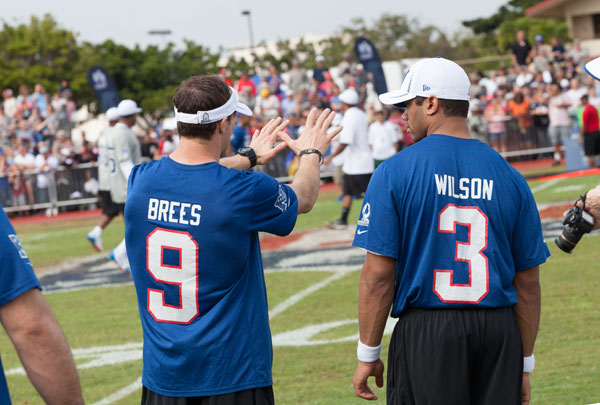
Brees and Wilson scheming to get on an amusement park ride

Brees and Wilson scheming to get on an amusement park ride.

New Orlean’s Drew Brees is officially listed as six feet tall. Seattle’s Russell Wilson is officially listed as 5’11. That means the average height of the starting quarterbacks in tonight’s game is 71.5 inches, tied for the shortest average in any game since 1964. In fact, it’s been twelve years since a game has featured two quarterbacks of such short stature, when in week two of the 2001 season, Doug Flutie (5’10) and the Chargers beat Anthony Wright (6’1) and the Cowboys.

The other two games since 1990 where the average height of the starting quarterbacks was below six feet also involved Flutie facing a 73-inch quarterback: a 24-21 win in 1999 against Pittsburgh and Kordell Stewart and a 17-16 win year earlier against Mark Brunell and the Jags.

Twenty-five years ago, two other Flutie vs. 6’1 Quarterback games make the list: this game against Jim McMahon and this one against Dave Krieg.

You have to go back to 1978 to find a game before tonight where (1) the average height of the starting quarterbacks was under six feet and (2) Doug Flutie was not involved. Fran Tarkenton (6’0) and Pat Haden (5’11) met five times in the mid-to-late ’70s, and Billy Kilmer (6’0) also faced Haden in the final game of the 1977 season.

Kilmer and 5’11 Bob Berry met three times in the early ’70s, and Sonny Jurgensen (5’11) faced Gary Cuozzo (6’0) and Tarkenton twice each. The only other games of the post-merger era were Len Dawson (6’0) vs. Berry in 1972 and Bill Nelsen and Edd Hargett in 1971. [continue reading…]

{ 7 comments }

Week 14 College Football SRS Ratings & The Iron Bowl

We are out of words. You should be dead, Auburn, because we saw you die. And here you are, breathing in the flesh, able to say this: you made the Alabama Crimson Tide kick the winning touchdown for you.

It’s hard to top that recap from EDSBS of one of the greatest games in college football history. Two weeks after pulling off the ending of the season — the Prayer at Jordan-Hare — Auburn gave us the ending of our lives. Entering week 14, Alabama had fielded the best special teams in the nation; on Saturday, all of the Tide’s goals were ripped from them following three missed field goals and a game-winning field goal return touchdown.

Toomer's Corner.

In a second, Alabama lost to its most bitter rival. With that, the Tide lost the SEC West division title, which means the team won’t have a chance to win the SEC Championship or the BCS Championship (barring the unthinkable). In an odd twist, the most dominant team of our era has now won just one division title in the last four years.

Of course, the SRS is not so sensitive to missed field goals that are returned for touchdowns. The Crimson Tide ranked third in last week’s SRS, a ranking which felt one spot too low. Following the Iron Bowl loss, Alabama’s rating dropped from 61.1 to 59.4, moving Nick Saban’s team down to… third. The beauty of a predictive system is that it need not change due to a close road loss to a top team, and that’s what happens here. Auburn jumps from 14 to 11 but no higher, as a 14-point road loss to LSU, a 4-point home win against MSU, and a 7-point home win against Washington State still count.

Ohio State, in fact, actually drops one slot, as the close win in Ann Arbor dropped the Buckeyes behind idle Oklahoma State. Does that mean the Buckeyes don’t deserve to be in the BCS National Championship Game if they defeat Michigan State? Of course not. Last year, Notre Dame was ranked 6th on December 9th in the SRS, but the Fighting Irish surely deserved a spot in the BCSNCG by virtue of being the lone undefeated (and eligible) team in college football. Ohio State deserves the same treatment this year.
[continue reading…]

{ 13 comments }

Josh Gordon sets two-game receiving record

Cleveland’s Josh Gordon caught 14 passes for 237 yards and a touchdown against the Steelers last week. Against the Jaguars this afternoon, Gordon caught 10 passes for 261 yards and two scores. In the process, he became the first player to ever record back-to-back 200+ yard receiving games, and set an NFL record with 498 receiving yards in two games.

The table below shows the 53 players to record 350 receiving yards in back-to-back games from 1960 to 2012. Until this year, Houston’s Andre Johnson had the modern record for receiving yards in consecutive games, set just last season. Then Calvin Johnson had 484 yards in two straight games, setting a record that stood for all of five weeks.

PlayerTeamyear_idrec ydsrecrectdGame 1 BoxGame 2 Box
Andre JohnsonHOU2012461231BoxscoreBoxscore
Calvin JohnsonDET2011455233BoxscoreBoxscore
Chad JohnsonCIN2006450175BoxscoreBoxscore
John TaylorSFO1989448163BoxscoreBoxscore
Jerry RiceSFO1995442263BoxscoreBoxscore
Miles AustinDAL2009421164BoxscoreBoxscore
Flipper AndersonRAM1989413191BoxscoreBoxscore
Terrell OwensSFO2000412262BoxscoreBoxscore
Jerry RiceSFO1995410203BoxscoreBoxscore
Stephone PaigeKAN1986402132BoxscoreBoxscore
Frank ClarkeDAL1962400145BoxscoreBoxscore
Sonny RandleSTL1962400193BoxscoreBoxscore
Don MaynardNYJ1968394162BoxscoreBoxscore
Drew BennettTEN2004393255BoxscoreBoxscore
Lance AlworthSDG1963390182BoxscoreBoxscore
Andre JohnsonHOU2009389202BoxscoreBoxscore
Eric MouldsBUF1999387191BoxscoreBoxscore
Wes ChandlerSDG1982385175BoxscoreBoxscore
Flipper AndersonRAM1989384171BoxscoreBoxscore
Art PowellOAK1964382175BoxscoreBoxscore
Raymond BerryBAL1960381154BoxscoreBoxscore
Charley HenniganHOU1961381171BoxscoreBoxscore
Charley HenniganHOU1961380172BoxscoreBoxscore
Wes ChandlerSDG1982378144BoxscoreBoxscore
Jerry RiceSFO1989378172BoxscoreBoxscore
Wes WelkerNWE2011375253BoxscoreBoxscore
Torry HoltSTL2003374182BoxscoreBoxscore
Qadry IsmailBAL1999373134BoxscoreBoxscore
Eric MouldsBUF1998373143BoxscoreBoxscore
Glenn BassBUF1964372142BoxscoreBoxscore
Isaac BruceSTL1995372184BoxscoreBoxscore
Qadry IsmailBAL1999371113BoxscoreBoxscore
Fred BiletnikoffOAK1968370144BoxscoreBoxscore
Webster SlaughterCLE1989370123BoxscoreBoxscore
James LoftonGNB1984368163BoxscoreBoxscore
Lance RentzelDAL1967368183BoxscoreBoxscore
Isaac BruceSTL1995364192BoxscoreBoxscore
Gary ClarkWAS1986364172BoxscoreBoxscore
James LoftonGNB1984364162BoxscoreBoxscore
Jerry RiceSFO1986360163BoxscoreBoxscore
Chris ChambersMIA2005359233BoxscoreBoxscore
Henry EllardWAS1994359162BoxscoreBoxscore
Del ShofnerNYG1962359171BoxscoreBoxscore
Stephone PaigeKAN1985358113BoxscoreBoxscore
Drew BennettTEN2004357156BoxscoreBoxscore
Charlie JoinerSDG1981357130BoxscoreBoxscore
Lance AlworthSDG1967355152BoxscoreBoxscore
Roy GreenSTL1984355142BoxscoreBoxscore
Pete RetzlaffPHI1965355143BoxscoreBoxscore
Lance AlworthSDG196435393BoxscoreBoxscore
Bill GromanHOU1960353123BoxscoreBoxscore
Jimmy SmithJAX1999352192BoxscoreBoxscore
Calvin JohnsonDET2012350172BoxscoreBoxscore
{ 13 comments }

You probably didn’t know it, but Cam Newton is having a down year, at least statistically.

Year GS Cmp Att Cmp% Yds TD TD% Int Int% Y/A AY/A Y/C Y/G Sk Yds NY/A ANY/A Sk%
2011 16 310 517 60.0 4051 21 4.1 17 3.3 7.8 7.2 13.1 253.2 35 260 6.87 6.24 6.3
2012 16 280 485 57.7 3869 19 3.9 12 2.5 8.0 7.6 13.8 241.8 36 244 6.96 6.65 6.9
2013 11 208 337 61.7 2353 17 5.0 9 2.7 7.0 6.8 11.3 213.9 31 235 5.76 5.58 8.4

Carolina’s defense has been outstanding, of course, so an 8-3 record and a seven-game winning streak have overshadowed any flaws in Newton’s game. The Panthers have held an average lead of 5.05 points per second this year, the third best rate in the league. As a result of that high Game Script, Newton is asked to do less on offense, but that doesn’t explain the declining efficiency numbers. Newton’s taking slightly more sacks and his rushing numbers are down across the board, but the biggest decline comes with respect to yards per completion.
[continue reading…]

{ 16 comments }

FCS Playoffs Preview

I’ll be honest: I know nothing about FCS football. But that’s what the SRS is for! If you want to read a real FCS playoff preview, SB Nation has a good one, as does the Sports Network, but let’s be honest, I have no idea how good those previews are. If you were to tell me that SB Nation just made up the name “Terrence West”, I couldn’t offer a counterargument.

That said, here is what the SRS says about the first round of the playoffs. Here’s how to read the table below: South Dakota State has an SRS rating of 30.1, the 8th best among FCS schools. In the first round of the playoffs, they go on the road to face Northern Arizona, which has an SRS rating of 23.5, the 27th best school in the FCS. As a result, the projected Margin of Victory – always shown from the perspective of the home team, is 3.6 points in the favor of the visitors. The table is sorted in terms of Game Quality, in case you need to determine which one of these games to watch. Game Quality is a proprietary statistic which meas… nah, even I’m not that crazy. The Game Quality rank is just a combination of the average SRS ratings of the two teams and the projected competitiveness of the game.

GQVisitorSRS RatingFCS RkHomeSRS RatingFCS RkProj MOV
1South Dakota St30.18Northern Arizona23.527-3.6
2Bethune-Cookman24.626Coastal Carolina27.5125.9
3Samford22.930Jacksonville St25.5215.6
4Furman18.943South Carolina St23.3297.4
5Southern Utah17.346Sam Houston St25.22310.9
6Lafayette16.352New Hampshire26.41613.1
7Sacred Heart15.354Fordham23.42811.1
8Tennessee St2524Butler8.973-13.1

[continue reading…]

{ 4 comments }

Checkdowns: How to Fix the Jets

What are the biggest problems facing the Jets? What should GM John Idzik do in the offseason? Should Rex Ryan be fired? Jets fan and friend of the program Jason McIntyre reached out to me, Jason of NYJetsCap.com and OvertheCap.com, and Brian Bassett of The Jets Blog for our thoughts.

One of the questions was whether Geno Smith was the quarterback of the future for the Jets. Here was my answer:

No question is harder than determining when to give up on a quarterback. There’s no right answer: give up too soon, and you miss out on Drew Brees; wait too long, and you have four years of Mark Sanchez. It’s not really “fair” to give up on a quarterback after one season, particularly one saddled with such a weak supporting cast. On the other hand, that’s exactly what the Jets did with Kellen Clemens. Drew Stanton was the 43rd pick in the draft and he’s started 4 games – is that “fair”?

My favorite part of Smith’s game is that (at least, when he’s not being neutered by the coaching staff) he’s a gunslinger at heart. Did you know that Smith’s average pass travels 9.7 yards in the air, the third highest number in the league? The average Smith completion travels 7.87 yards in the air and has 4.85 yards of YAC (which ranks only 24th); as a result, his 12.7 yards per completion ranks seventh in the league. I at least think there’s a chance that when his line is better and he has legitimate downfield weapons, he could be a very good quarterback. The issue, of course, is how long do you wait to find that out?

You can read the full article here.

{ 2 comments }

New York Times: Post-Week 12, 2013

This week at the New York Times, I analyze the Cardinals, the Steelers, and some record-setting points and yardage numbers.

Bruce Arians is doing it again. A year ago, he helped turn the Indianapolis Colts from the worst team in the N.F.L. in 2011 to a playoff team in 2012. Hired as the team’s offensive coordinator, he was named the Associated Press coach of the year for his work as the interim head coach after Chuck Pagano, who was found to have leukemia, took a leave of absence. The Arizona Cardinals hired Arians as their head coach after firing Ken Whisenhunt, and now Arians is a viable candidate for the same award with a different team.

After Kurt Warner retired in January 2010, Arizona’s passing attack crumbled. From 2010 to 2012, the Cardinals completed just 54.0 percent of all passes, the lowest rate in the league. Also, no team was sacked more often or threw more interceptions than Arizona. Arians was hired to fix an attack that was among the worst in the league, and while the team started slowly — Arizona began the year 1-2, then 3-4 — the Cardinals (7-4) have been red hot over the last month.

Over the last four games, quarterback Carson Palmer has completed 69.0 percent of his passes, averaged 8.9 yards per attempt and thrown 8 touchdowns and only 2 interceptions. Over that time, the team is averaging 30.25 points a game and is 4-0. And while Palmer and Larry Fitzgerald remain the stars in the desert, two young players have provided the missing spark to the offense.

You can read the full article here.

{ 1 comment }

Last year, I wrote about the best Thanksgiving Day Performances. Today, we get three games with serious playoff implications.

Green Bay (5-5-1) at Detroit (6-5)

Suh always does something nuts on Thanksgiving

Suh always does something nuts on Thanksgiving.

Come to see what Ndamukong Suh does this Thanksgiving, stay for a pivotal NFC North matchup. Matt Flynn gets the start in a must-win game for the Packers. Even if Aaron Rodgers returns next week and the Packers run the table, the Packers may still be left out in the cold with a loss today to the Lions. Beating the Packers would get the Lions to 7 wins, and Detroit will be favored in home games against the Ravens and Giants and in Minnesota in week 17. The good news for Green Bay? The last time Flynn started a game for Green Bay, it was against the Lions, and it went very well.

The game is nearly as important for the Lions. With a loss, Detroit would no longer control its own destiny for the NFC North title. Assuming the Bears beat the Vikings this weekend, the Lions would essentially be one-half game back of both Green Bay and Chicago (the Bears would be 7-5 but Detroit has the tiebreaker).  It’s not that hard to make up a half game in four weeks, but the Bears and Packers play in week 17. That means the winner of that game must lose one other game and Detroit would need to run the table in order to win the NFC North. Of course, the Lions could also get in as a 9-7 NFC North champ; the most likely path there is the Packers losing to the Bears and Cowboys, while Chicago loses in Philadelphia and to either the Cowboys at home or the Browns on the road. A loss today would be deadly for Green Bay, while a Detroit loss would put the Lions as the third-most likely team to win the division.

[continue reading…]

{ 3 comments }
It has not been a good week for these two

It has not been a good week for these two.

The game of the week 12 was obviously Brady/Manning XIV, and the Patriots comeback victory resulted in the second lowest Game Script by a winning team this year. Due to the big lead, Denver rushed 55% of the time, and Knowshon Moreno set NFL season-highs with 37 carries for 224 rushing yards. In regulation, the Broncos held an average lead of 10.5 points, although that still trails the Andrew Luck-fueled comeback by Indianapolis against Houston in week nine. The other big comeback in week 12 was by Cam Newton and the Panthers.  Carolina trailed 16-3 with one minute left in the second quarter in the 2nd quarter, but scored the final seventeen points of the game to steal the win from Miami.

The biggest blowout of the week was by the Cardinals, who clobbered the Colts, 40-11.  Arizona led 34-3 entering the fourth quarter, and this was the second time this season Indianapolis has held an average deficit of 18+ points. That, in my expert opinion, is not good. Things are even worse for the team that selected after the Colts in the 2012 draft: for the second week in a row, Washington posted a Game Script of less than -9.0. I don’t have any desire to talk about the RG3 drama, but I will point you in the direction of this interesting article written by my former co-blogger.

Below are the Game Scripts data from week 12. I’ve highlighted the Vikings/Packers row in blue, since I know of no other way to shame both teams (you can move your cursor over that row to see it more clearly, not that I know why you would want to). [continue reading…]

{ 5 comments }

Analyzing every Joe Flacco interception this year

Flacco has had more downs than ups this year

Flacco has struggled to regain his Super form.

Over the course of his six-year career, Joe Flacco has generally done an excellent job at avoiding interceptions. Remember that quarterbacks are much more likely to be intercepted on deep passes, and Flacco tends to throw deep. Flacco has the 5th highest average length of pass this year according to NFLGSIS, after ranking 3rd in 2012, and 8th in 2011. But despite attempting more risky throws, Flacco posted better-than-average interception rates in each of his first five seasons. And he did that despite completion percentages that were often at or below league average.

Before the Super Bowl, I asked if Flacco was simply lucky to keep avoiding interceptions. That seemed like a good explanation for how an inaccurate passer who throws often downfield could have such a low interception rate. But other quarterbacks, like Donovan McNabb, sustained those traits for a long time.

This year, Flacco ranks in the top 7 in both interceptions and interception rate. So has lady luck simply switched allegiances? I looked at all 14 of Flacco’s interceptions this season to determine the cause.

1) Denver, 2nd quarter, 11:47 remaining, 3rd-and-9 from the Baltimore 16, trailing 7-0

Brandon Stokley is the primary receiver on the play. He’s lined up in the slot to Flacco’s left, and ends up running across the middle of the field at the first down marker. He’s in single coverage, but Flacco’s throw is a little short, and Chris Harris makes an outstanding play diving across for the interception. You can view the play here.
[continue reading…]

{ 10 comments }

Presented below, without comment, is a table of every matchup featuring Tom Brady & Peyton Manning as the starting quarterbacks. Enjoy:

DateHome TeamFavoritePatriots PassingColts/Broncos PassingAdvantageOutcome
2001-09-30NWECLT -11.513-23, 159 yds, 0 TD, 0 Int, 6.63 ANYPA25-43, 240 yds, 1 TD, 3 Int, 2.72 ANYPA+3.91, NWE44-13, NWE
2001-10-21CLTCLT -10.517-21, 262 yds, 4 TD, 0 Int, 16.29 ANYPA22-34, 305 yds, 1 TD, 0 Int, 8.55 ANYPA+7.73, NWE38-17, NWE
2003-11-30CLTCLT -3.526-35, 226 yds, 2 TD, 2 Int, 4.76 ANYPA29-48, 272 yds, 4 TD, 1 Int, 6.14 ANYPA+1.38, CLT38-34, NWE
2004-01-18 (C)NWENWE -3.522-37, 237 yds, 1 TD, 1 Int, 5.73 ANYPA23-47, 208 yds, 1 TD, 4 Int, 0.94 ANYPA+4.79, NWE24-14, NWE
2004-09-09NWENWE -326-38, 320 yds, 3 TD, 1 Int, 8.38 ANYPA16-29, 244 yds, 2 TD, 1 Int, 7.97 ANYPA+0.41, NWE27-24, NWE
2005-01-16 (D)NWENWE -118-27, 115 yds, 1 TD, 0 Int, 4.50 ANYPA27-42, 230 yds, 0 TD, 1 Int, 4.30 ANYPA+0.20, NWE20-3, NWE
2005-11-07NWECLT -325-40, 254 yds, 3 TD, 0 Int, 7.48 ANYPA28-37, 321 yds, 3 TD, 1 Int, 9.08 ANYPA+1.60, CLT40-21, CLT
2006-11-05NWENWE -2.520-35, 201 yds, 0 TD, 4 Int, 0.60 ANYPA20-36, 301 yds, 2 TD, 1 Int, 7.59 ANYPA+6.99, CLT27-20, CLT
2007-01-21 (C)CLTCLT -321-34, 226 yds, 1 TD, 1 Int, 5.74 ANYPA27-47, 330 yds, 1 TD, 1 Int, 6.10 ANYPA+0.36, CLT38-34, CLT
2007-11-04CLTNWE -521-32, 237 yds, 3 TD, 2 Int, 6.09 ANYPA16-27, 210 yds, 1 TD, 1 Int, 6.17 ANYPA+0.08, CLT24-20, NWE
2009-11-15CLTCLT -1.529-42, 364 yds, 3 TD, 1 Int, 8.61 ANYPA28-44, 316 yds, 4 TD, 2 Int, 6.80 ANYPA+1.81, NWE35-34, CLT
2010-11-21NWENWE -4.519-25, 178 yds, 2 TD, 0 Int, 8.38 ANYPA38-52, 396 yds, 4 TD, 3 Int, 6.56 ANYPA+1.83, NWE31-28, NWE
2012-10-07NWENWE -623-31, 193 yds, 1 TD, 0 Int, 6.09 ANYPA31-44, 324 yds, 3 TD, 0 Int, 8.35 ANYPA+2.26, DEN31-21, NWE
2013-11-24NWEDEN -2.534-50, 324 yds, 3 TD, 0 Int, 7.25 ANYPA19-36, 132 yds, 2 TD, 1 Int, 3.34 ANYPA+3.90, NWE34-31, NWE
{ 6 comments }

Oklahoma State won one for the Drinen

Oklahoma State won one for Drinen.

Every year, a few mind-blowing upsets occur this time of year, and every year, we are shocked when it happens. Three of the top five single game performances of the season occurred on Saturday, including the best individual game rating of the year. Oklahoma State’s blowout win against Baylor produced an SRS score of 88.5, topping Florida State’s win at Clemson by three points. Meanwhile, Arizona shocked Oregon, giving the Wildcats (82.9 score) just the third 80+ point SRS rating in a game in 2013. And in less exciting but still noteworthy news: Washington crushed Oregon State (#27 in last week’s SRS ratings) in Corvalis, 69-27.

It looks like we’re headed for a Florida State-Alabama showdown in the BCS National Championship Game. FSU’s last two games should not pose any issues: the Seminoles are rated 27 points higher than Florida, and will be a three-touchdown favorite in the ACC Championship Game. In fact, the difference between the ratings of Florida and Georgia Southern is smaller than the difference between Florida and Florida State (you can view the ratings of FCS teams here). And we’ll get to that Georgia Southern game in a minute.

For Alabama, the schedule is a little more challenging. The Tide are “only” 9 points ahead of Auburn in the SRS, but that’s a little misleading. If we remove Alabama’s games against Colorado State, Georgia State, Chattanooga, Kentucky, and Tennessee — all games the Tide won by over 21 points — their rating would jump to 64.4. For Auburn, the only team they beat by more than three touchdowns that lowered their rating was Western Carolina; do that, and the Tigers are at 52.9. That puts Alabama 11.5 points better than Auburn. The Iron Bowl is in Auburn this year, and the Tigers are 10.5 point underdogs, so perhaps the SRS is still underrating the Tide by a point or two. An SEC Championship Game against Missouri would be another tough test, but first, those Tigers must defeat Johnny Manziel and the Aggies to earn a trip to Atlanta.

Below are the SRS ratings through 13 weeks. As always, thanks to Dr. Peter Wolfe for providing the final scores for every college football game. [continue reading…]

{ 2 comments }

Non-FBS College Football Ratings Through 13 Weeks

Every week, I publish my college football ratings for FBS teams. To generate those ratings – using this methodology — my program also generates ratings for teams at all other levels.  This week, I will separate out the non-FBS teams based on their levels of play (instead of just lumping all non-FBS teams together). As always, thanks to Dr. Peter Wolfe for providing the final scores for every college football game.

Let’s start with the FCS schools:
[continue reading…]

{ 2 comments }
Trestman hides from the timeout police

Trestman hides from the timeout police.

In week 11, the Bears led the Ravens by three with two minutes remaining. After the two-minute warning, Joe Flacco completed an 11-yard pass that brought Baltimore to the Bears’ 16-yard line. The Ravens next snap took place with 1:21 remaining, and Ray Rice picked up 11 yards to put the Ravens at the Chicago 5-yard line with 75 seconds left.

Baltimore then let the clock run, snapping the 1st-and-goal play with 36 seconds left (Ray Rice ran for three yards). After waiting a few seconds, the Ravens called timeout with 23 seconds remaining. On second down, the Ravens ran Rice again, but he lost a yard, and Baltimore used its final timeout with 11 seconds left. Flacco’s third down pass went incomplete, and Baltimore kicked a field goal to force overtime, giving Chicago the ball back with just three seconds.

This was the rare case where both teams managed to lower their odds of winning with poor clock management. Baltimore had two timeouts and 36 seconds to run three plays. The worst option would be to call timeout after the 1st down and 2nd down plays: the goal should be to keep a timeout for after the third down play. By saving that timeout, the team retains the option of running on 3rd down, and also has a safety net in the event of a sack. There’s no reason why a team needs to call one timeout after 1st-and-goal and another after 2nd-and-goal. For a man who sleeps at the office to get every edge he can, John Harbaugh lowered his team’s odds of winning by not knowing when to use his timeouts. This is not just an academic point, either: Flacco nearly lost the third down snap, which could have ended in an embarrassing loss for the Ravens. [1]Also, the predictable run-run-pass playcalling won’t win Harbaugh any awards, either. A second down pass to the end zone solves all of these problems, too.

But Harbaugh’s poor use of timeouts — while inexcusable — didn’t lower his team’s odds of winning significantly. That task was handled by Marc Trestman. After Rice ran down to the 5-yard line, Trestman should have called timeout with 75 seconds remaining — instead, he allowed Baltimore to run the clock all way to 36 seconds left (Baltimore snapped it with 3 seconds left on the play clock). On that play, Rice nearly ran for a touchdown, which shows how foolish this decision was by Trestman. The mere fact that Baltimore bled the clock for 39 seconds is prima facie evidence that the Bears erred by not calling timeout. Football is a zero-sum game, so if it was good for Baltimore to let the clock run down, it must have been bad for Chicago to allow the Ravens to do that. Think of it this way: would Ravens fans have been happy or sad to see Trestman call timeout in that situation?

The interesting part of this situation is we actually got to find out what Trestman was thinking. Adam Hoge transcribed the head coach’s Monday press conference, where he said:
[continue reading…]

References

References
1 Also, the predictable run-run-pass playcalling won’t win Harbaugh any awards, either. A second down pass to the end zone solves all of these problems, too.
{ 3 comments }

Comparing the schedules of Ohio State and Baylor

In the unlikely event that either Alabama or Florida State drop a game, Ohio State and Baylor will each have very good arguments that they deserve to move into the top two of the BCS standings. Through 12 weeks, Baylor ranks higher than Ohio State in the SRS ratings thanks to a higher margin of victory and strength of schedule. But I want to delve into the SOS argument a little bit more today.

First, let’s just assume each team wins out, even though that’s no sure thing. Ohio State defeated Indiana today, but still must beat Michigan and Michigan State. Baylor plays Oklahoma State tonight, and then has Texas Tech and Texas to close the year. But let’s assume both schools finish the year undefeated: who will have faced the harder schedule?

Baylor plays every team in the Big 12 — giving the Bears 9 conference games — and faced Buffalo, an FCS school, and a Sun Belt school (Louisiana-Monroe). Ohio State will also play 9 conference games, including the Big 10 championship — and conveniently also played Buffalo and an FCS school, along with a Mountain West team (San Diego State), and California.

We can obviously throw out the games against Buffalo and the FCS school. Louisiana-Monroe ranks 106th and Cal ranks 96th, so those two games are a wash. Since beating San Diego State (78th in the SRS) is nothing special, picking between Baylor and OSU predictably turns into a referendum on the Big 12 and Big 10. So let’s look at the SRS ratings of each of the conference opponents and San Diego State for the Buckeyes and Bears.

Here’s how to read the first line. The toughest opponent for Baylor (after adjusting for home field) is Oklahoma State, who Baylor plays tonight in Stillwater. The Cowboys have an SRS rating of 54.8. The toughest opponent for Ohio State was Wisconsin, who the Buckeyes played at home, and the Badgers have an SRS rating of 57.4. After accounting for home field, that means Baylor’s toughest game was 3.4 points harder than Ohio State’s (54.8 + 3 – (57.4 -3) ).

RkBaylor OpponentH/RSOSOSU OpponentH/RH/RDiff
1Oklahoma StRoad54.8WisconsinHome57.43.4 (Baylor)
2Kansas StRoad49.1Michigan StIndianapolis47.84.3 (Baylor)
3OklahomaHome46.3MichiganRoad42.72.3 (OSU)
4TCURoad40.1NorthwesternRoad38.61.5 (Baylor)
5Texas TechArlington42.4IowaHome43.42.0 (Baylor)
6TexasHome44.3IndianaHome39.35.0 (Baylor)
7West VirginiaHome34.6IllinoisRoad334.4 (OSU)
8KansasRoad27.7Penn StateHome36.52.9 (OSU)
9Iowa StHome29San Diego StHome31.22.2 (OSU)
100PurdueRoad19.9----

By this measure, Baylor’s toughest two games were harder than Ohio State’s toughest two games (although if you ignore home field, you’d argue that Ohio State faced the toughest opponent). Ohio State gets credit for having the third toughest game, but at each of the next three slots, the Bears have the SOS edge.

At the bottom of the schedule, the Buckeyes pick up some ground, but I don’t think the back end of the schedule is the appropriate mechanism to separate national title contenders. Yeah, Illinois, Penn State, San Diego State and Purdue is a tougher set than West Virginia/Kansas State/Iowa State, but any elite team should have no problem sweeping those games.

It’s very close, but if Baylor wins out, I’d vote for Baylor over Ohio State. The Bears clearly have the edge if you take style points into consideration, but even if you ignore margin of victory and all the statistics, I still think Baylor’s season is more impressive.  It’s close, but I’d say that an average great team would have had a harder time going undefeated against Baylor’s schedule than it would against Ohio State’s schedule.

{ 2 comments }

Denver has scored at a historic rate

Denver has scored at a historic rate.

Today’s insane statistic comes courtesy of RJ Bell: the difference between Denver and the #2 team in points per game is larger than the difference between the #2 and #31 teams. The Broncos are averaging 39.8 points per game this season, 11.6 points more than the (surprisingly second-ranked) Bears. And Chicago is averaging just 9.9 more points per game than the Jets, the #31 ranked scoring team.

That is, well, crazy. The record for points per game in a season is 38.8, set by the 1950 Rams. The 2007 Patriots are second at 36.8, and both of those teams scored slightly more points through ten games than the 2013 Broncos. So while Denver is on pace to break the scoring record, some regression to the mean over the final six games should be expected.

If the Broncos want to set the record for most points scored relative to the second highest scoring team in the league, Peyton Manning and company have some work to do. That mark is held by the ’41 Bears, who averaged 36.0 points per game, 12.5 more than the Packers that year. Second and third on that list are the ’07 Patriots (8.4) and ’50 Rams (8.3), so Denver has a realistic shot of setting the modern record.

I’ll be honest: as dominant as the Broncos offense has been, I’m a little surprised to see them so far ahead of the competition in points scored. After all, consider:

  • The Eagles have just 19 fewer yards than the Broncos, and Nick Foles actually leads Manning in both passer rating and Adjusted Net Yards per Attempt;
  • In PFR’s Expected Points Added, the Broncos offense is at 14.7 EPA-added per game, while the Saints offense is at 11.3. That’s a relatively small difference considering the fact that Denver has scored 12.1 more points per game than New Orleans.
  • The Chargers have a higher completion percentage than the Broncos and six fewer turnovers, but have averaged 17 fewer points per game.
  • The Packers are actually a hair ahead of Denver in yards per play (6.3531 to 6.3529), but have scored two fewer touchdowns per game.

So what’s going on? I’m perfectly fine with Denver being general run-of-the-mill dominant, but the team’s points scored numbers makes it seem like the Broncos might be the greatest offensive machine ever. I think I’ve identified the two reasons to explain the gap:

Red Zone success

Philadelphia has scored a touchdown just 46% of the time the Eagles made it into the red zone, which ranks 28th in the league. San Diego isn’t much better at 50% (22nd). The Saints are at 52.5% (20th), and the Packers are down at 30th at 43%. So some excellent offenses are really struggling in the red zone, which gives them disproportionately low points per game averages. Oh, and Denver? They’re at 79.1%, by far the highest rate in the league. It’s not unusual for a great offense to dominate in the red zone — the ’07 Pats were at 70% — but what is unusual is seeing the other top offenses struggle there.

I have red zone data going back to 1997, and the highest ever performance was set by Kansas City in 2003. The Trent GreenPriest HolmesTony Gonzalez Chiefs scored a touchdown on 77.8% of all red zone opportunities (42 out of 54), so the Broncos (34 out of 43) could break that record this year. More likely, though, is that the Broncos go from otherworldly in the red zone to just great, which would drop the team’s points per game average.

Number of Drives

The Broncos are averaging 2.85 points per drive, while the Saints are #2 at 2.46. That’s not a huge difference — the gap between #2 and #7 is slightly bigger. The difference, as you can deduce, is that the Broncos are averaging 13 drives per game while the Saints are at just 11.3 drives per game. Why is that? New Orleans’ average drive takes 2:56 minutes, the third-longest in the league (and San Diego is #1 at 3:13), while the Broncos are in the bottom five at 2:17 (the Eagles are last at 2:02). That Chip Kelly edge is erased, though, because Philadelphia’s opponents average 2:48 per drive, the third highest rate in the league. Denver’s opponents take just 2:18 per drive, the third lowest (just a second ahead of Detroit and eight seconds longer than Kansas City).

The Broncos defense is not great, but it does rank 6th in completion percentage allowed. Combine that with the fact that Denver ranks 4th in percentage of opponent plays that are passes, and incomplete passes occur on 25% of all plays run by Broncos opponents, the second-highest rate in the league behind Kansas City. That’s not surprising for a team with such a high Game Script, but it does stop the clock from running for long stretches, which gives Denver’s offense more possessions The Chargers are 28th in this statistic (18%), which is one reason why San Diego is dead last in offensive drives (10.2 per game).

But there’s another reason why Broncos’ opponents tend to have short drives: Denver leads the league in 20+ yard plays allowed at 54. As a result, teams don’t end up with many clock-chewing drives against Denver: opponents tend to gain big yards quickly or throw incomplete passes. That increases the number of drives for the Broncos, which (one could argue) inflates the success of the team’s offense. It’s all relative, of course — Denver is still #1 in points per drive by a wide margin — but it’s worth recognizing that Denver has scored 75% more points per game than an average of the other 31 teams, but “just” 62% more on a per-drive basis. That accounts for about 3 points per game. Add in the insane success in the red zone, and the lack of success there by the other top teams, and you have the reasons for the crazy stat at the top of today’s post.

Manning Record Watch Update

After six games, I analyzed how likely Manning was to break the single-season touchdown record. At the time, he had 22 touchdowns, and the formula projected him to throw 2.99 TDs/G the rest of the way to finish with 52 touchdowns, narrowly breaking Tom Brady’s record.

Now? Manning has 34 touchdowns, as his pace has only slightly declined. What does that mean? To calculate Manning’s odds using Bayes Theorem we need to know four things:

1) His Bayesian prior mean (i.e., his historical average): 2.38, as this number wouldn’t change from the original post.

2) His Bayesian prior variance (the variance surrounding his historical average): Again, no change here, so we use 0.0986.

3) His observed mean: Instead of 3.667, we will use 3.4.

4) His observed variance: This one involves just a little bit of work. What I suggested we do last time is calculate the number of passing touchdowns per game Manning averaged in the first six (now ten) games of each season since 2000, along with his average over the rest of the season (then, 8-10 games, now, 4-6 games). Then we take the difference of the variances of each column, as we did in step two.

YearTD/G Thru 10ROY GTD/G ROYDiff
20002.1620.1
20011.861.330.47
20021.961.330.57
20031.961.670.23
20043.552.80.7
20052420
2006261.830.17
20071.653-1.4
20081.751.8-0.1
20092.143-0.9
2010262.17-0.17
20122.462.170.23
Variance0.220.31

Manning’s variance over the rest of the season is 0.3052 TDs/G, while his variance through ten games is 0.2214; the differential there is 0.0838, which is the variance of our current mean.

Once you have your number for these four variables, then you substitute those numbers into this equation:

Result_mean = [(prior_mean/prior_variance)+(observed_mean/observed_variance)]/[(1/prior_variance)+(1/observed_variance)]

Or, using our numbers:

[(2.38 /0.0986) + (3.4 / 0.0838)] / [(1/0.0986) + (1/0.0838)]

which becomes

[24.14 + 40.57] / (22.08) = 2.93

This picture will never get old

This picture will never get old.

After averaging 3.667 TDs/G over 6 games, we projected Manning to average 2.99 TDs/G the rest of the year. Since he averaged “only” 3 touchdowns per game over his next four games, we downgrade him from 2.99 to 2.93. Of course, we already had a significant regression factored into his future projection — we dropped him by 0.67 TDs/game from his average, which is the point of using Bayes Theorem. So while he’s at “only” 3.4 TDs/G on the season after 10 games, since he’s played at that level for longer, he only loses about half a touchdown per game over his projection the rest of the way.

That gives Manning 17-18 touchdowns, which puts him at a season-ending projection of 51-52 touchdowns. He’s still more likely than not to break the record, although obviously this analysis ignores lots of elements like strength of schedule. And with a visit to Kansas City and a game against the Titans (who have allowed a league-low 7 touchdowns through the air), perhaps he’s actually an underdog to even tie Brady at 50.

{ 3 comments }

Last week brought us the most lopsided game of the year. The games were more competitive this week, with the largest Game Script belonging to Tampa Bay (yes, Tampa Bay) at 14.0. The Philadelphia-Washington game provides a good example of the information conveyed — and not conveyed — by Game Scripts. Philadelphia won by 8 points, but that would be misleading if you thought it was a close game throughout: the Eagles held an average lead of 12.8 points. On the other hand, Game Scripts don’t necessarily tell you how lopsided the game was: Washington had the ball with a chance to tie, at the Eagles’ 27-yard line, with 54 seconds remaining. The Eagles came away with a very low Moral Margin of Victory (5.8) but a high Game Script, with neither bit of information being right or wrong. On one hand, Philadelphia’s Win Probability was over 85% for the final 2.5 quarters, but it was also a game where Washington was not really out of it until the final seconds. I prefer a toolbox with lots of different tools over trying to find one do-it-all device.

Here are the week 11 Game Scripts data:

WinnerH/RLoserBoxscorePFPAMarginGame ScriptPassRunP/R RatioOp_POp_ROpp_P/R Ratio
TAMATLBoxscore41281314263840.6%462069.7%
PHIWASBoxscore2416812.8293346.8%383750.7%
BUFNYJBoxscore37142312.3293843.3%332260%
SEAMINBoxscore41202110.2222844%363252.9%
DENKANBoxscore2717108.1403553.3%482466.7%
CINCLEBoxscore4120218.1283147.5%601975.9%
NYGGNBBoxscore2713147.4392461.9%341964.2%
OAK@HOUBoxscore282355.5343152.3%512170.8%
CARNWEBoxscore242043.1302455.6%422562.7%
MIASDGBoxscore201641.9382065.5%372658.7%
ARI@JAXBoxscore2714131.6452465.2%441673.3%
PITDETBoxscore3727101.5462763%482466.7%
NORSFOBoxscore23203-0.5442365.7%342260.7%
CHIBALBoxscore23203-3.4332556.9%344145.3%
IND@TENBoxscore30273-4.6373253.6%302455.6%

[continue reading…]

{ 3 comments }

Fullback Report

The best exercise for fullbacks? One-handed push ups

The best exercise for fullbacks? One-handed push ups.

In May, I discussed how and why the fullback was being slowly phased out of the game. Some of the main reasons are:

  • The increase in the size of defensive linemen has made running up the middle less attractive.
  • The blocking fullback has been replaced by the slot receiver: A great blocking fullback will take a linebacker out of the play, but an average slot receiver will take a linebacker off the field.
  • Tight ends are now among the most athletic players in the game, and the fullback is essentially a shorter, slower, tight end. Teams aren’t looking to leave a multi-dimensional tight end or a slot receiver off the field for a six-foot lead blocker.
  • The pass-catching fullback is the option of last resort for an offense, not an element of design. No offensive coordinator is spending his time thinking about how he can get the ball into the hands of his fullback more often.
  • Fullbacks are being diverted into other career paths: a fast high school fullback becomes a running back, a tall fullback becomes a tight end, and a strong fullback puts on weight to become a linebacker.

But enough about theory: let’s analyze how teams are using fullbacks in today’s NFL, courtesy of Pro Football Focus. Let’s break the teams down into tiers:

Fullbacks need not apply: Arizona, Philadelphia, Denver, Dallas, Detroit, Cincinnati, and Miami

The Cardinals and Eagles have not had a fullback on the field this season. Philadelphia runs a lot of three-wide receivers sets with DeSean Jackson, Riley Cooper, and Jason Avant, and LeSean McCoy and/or Bryce Brown are always on the field. Add tight ends Brent Celek and Zach Ertz see significant playing time, too. You could classify James Casey as a fullback (PFF labels him a tight end), but he has just 60 snaps this year. For Arizona, tight ends Jim Dray, Rob Housler, Kory Sperry, Jake Ballard, and even D.C. Jefferson get on the field in lieu of any fullbacks. Head coach Bruce Arians does not see much of a need for a fullback, as Robert Hughes had just 28 snaps in Indianapolis last year.

Dallas, Denver, and Detroit all use 3-WR/1-TE as their base personnel, and little changes even when those teams are leading. Dallas will put TEs James Hanna and Gavin Escobar on the field with Jason Witten in run-heavy sets, and backup linebacker Kyle Bosworth is responsible for all 9 snaps taking by a Cowboys fullback this year. Wes Welker and Julius Thomas are textbook examples of why the fullback is becoming extinct. Welker’s prowess as a slot receiver far exceeds the value any fullback could add, while Thomas is the type of athletic superfreak teams are finding to play at tight end. Virgil Green, Joel Dreessen, and Jacob Tamme see time when the Broncos want to run, and defensive tackle Mitch Unrein (8 snaps) is the only fullback Denver has used. For the Lions, Joseph Fauria (and, prior to his release, Tony Scheffler) is used when the Lions want more blockers on the field, and the team will occasionally put Reggie Bush and Joique Bell on the field together, too, leaving just two snaps this season for fullback Montell Owens.

[continue reading…]

{ 6 comments }

New York Times: Post-Week 11, 2013

Eight teams fired their head coaches last year. How are those eight coaches doing in 2013? And will there be more firings next year because of the Reid effect? That’s what I’m writing about this week at the New York Times.

Andy Reid may be the worst thing to happen to struggling coaches. In 2012 under Romeo Crennel, the Chiefs appeared to be a talented team but finished 2-14. Even the biggest Kansas City optimists could not have expected the addition of Reid and quarterback Alex Smith to turn the Chiefs into a Super Bowl contender overnight. But Reid has all but locked up the coach of the year award and engineered one of the great turnarounds in league history. If general managers break close calls in favor of replacing their coaches in the off-season, call it the Reid effect.

Chip Kelly, who replaced Reid in Philadelphia, has done a superb job, too. The 2012 Eagles were a 4-12 team that relied on fourth-quarter comebacks to win each of those games. Philadelphia had an inconsistent offense and a terrible defense, which caused ownership to make the splashy hiring of the off-season by bringing in Kelly from Oregon.

The Eagles’ offense has come close to matching the hype that surrounded Kelly’s arrival. Philadelphia is in the top 10 in yards and points per game, and the Eagles are the only team to rank in the top three in both yards per pass attempt and yards per carry. Quarterback Nick Foles has 16 touchdown passes and no interceptions and leads the league in yards per pass attempt, and LeSean McCoy leads the N.F.L. in yards from scrimmage.

You can read the full article here.

{ 1 comment }

Another way to do team rankings

Wonders what good quarterback play looks like

Wonders what good quarterback play looks like.

The Jets lost by 40 points to the Bengals in Cincinnati; adjust for home field, and that is still a 37-point adjusted margin of victory, the best single game for the Bengals this year.

New York lost by 23 in Buffalo this weekend; that 20-point adjusted MOV was the best single game for the Bills this year.

Back in week four, the Jets lost by 25 in Tennessee, and as you can probably guess, that is the best single game for the Titans this year.

And in week six, at home against the Steelers, New York lost by 13, and that 16-point adjusted MOV was the top performance for Pittsburgh this year.

That’s pretty bad, of course. Four different teams had their best games of the season against the Jets. The only team that’s been worse is the Jaguars, who have seen five different opponents (San Francisco, San Diego, Kansas City, Indianapolis, and Arizona) post their best games against Jacksonville. But the Jets were close to matching the Jaguars: Tampa Bay’s best game of the year came on Sunday against Atlanta, making the Bucs’ second best performance in 2013 the game against the Jets in week 1. [1]How can the 2-8 Bucs have had only one game better than their loss to the Jets? Because Tampa Bay lost in New York by 1, which is an adjusted MOV of +2, while their home win against Miami of 3 points … Continue reading
[continue reading…]

References

References
1 How can the 2-8 Bucs have had only one game better than their loss to the Jets? Because Tampa Bay lost in New York by 1, which is an adjusted MOV of +2, while their home win against Miami of 3 points gets an adjusted MOV of 0.
{ 10 comments }