≡ Menu

Week 1 Quarterback Comparison

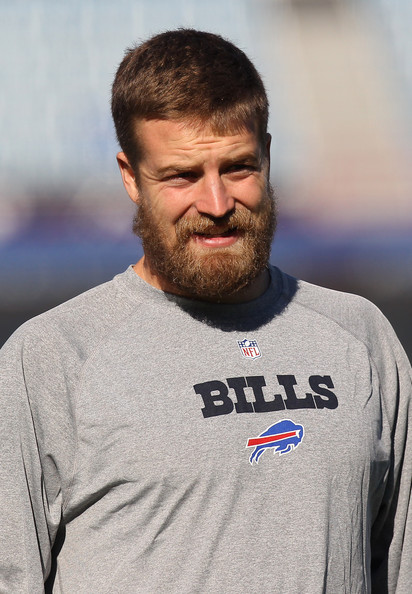
Am I going to update my stock Fitzpatrick photo now that he's on Houston? What do you think?

Am I going to update my stock Fitzpatrick photo now that he's on Houston? What do you think?

Ryan Fitzpatrick averaged 9.61 Adjusted Net Yards per Attempt in week 1, good enough for the 4th best grade of the week. But the Houston signal caller — who went 14/22 for 206 yards with 1 touchdown, no interceptions, and 1 sack — was not a very good fantasy quarterback. Using the Footballguys.com standard scoring system of 1 point per 20 yards passing, 1 point per 10 yards rushing, 4 points per touchdown pass, and -1 point per interception, Fitzpatrick had just 15.3 fantasy points (he rushed for 10 yards). That tied him for only the 25th best performance by a quarterback in week one.

Obviously there’s a big difference between ANY/A and fantasy points.  But while we use ANY/A as our main metric for lots of reasons, it’s always helpful to compare it to other statistics.  For example, RG3 ranked 17th in ANY/A in week 1, but only 27th in ESPN’s Total QBR. Why is that? Well, Griffin fumbled twice (losing one), and he completed a lot of very short throws (he had the third lowest air yards per throw and air yards per completion).  But another factor is that his third down performance was a bit misleading using conventional metrics, which is something Total QBR is good at identifying.

Griffin gained 75 net yards on 10 third down dropbacks in the game: that’s pretty good, but he only picked up first downs on 3 of 10 opportunities.   He had a 48-yard completion on a 3rd-and-7, which is great, but it also inflates his average gain; he also had a pair of 9 yard completions on third and very long that added little value.

We can also look at Football Outsiders’ main efficiency metric, DVOA, and compare that to other statistics.  Matt Cassel is an interesting player to analyze.  In DVOA, he ranked 5th.  In ANY/A, he ranked 10th.  In Total QBR, he was 15th, and in fantasy points, he was 21st!   So what gives?

As noted by Vince Verhei, Cassel’s “average pass traveled just 4.8 yards past the line of scrimmage, nearly a full yard shorter than the next shortest quarterback (Derek Carr, 5.6).” That would explain why QBR would be less high on Cassel than other statistics.  And since Cassel threw just 25 passes for only 170 yards, his fantasy value won’t be very high. Football Outsiders, on the other hand, gives Cassel credit for things like his a 9-yard pass on third-and-10 that created better field goal range.  Overall, comparing what Cassel did to the baseline, he looks really good according to FO, and just pretty good according to QBR.  As for ANY/A, it’s impressed by his 2 TD/0 INT ratio, but it’s hard to get a great ANY/A grade when you are averaging just 10.0 yards per completion.

The table below shows each quarterback’s stats in each metric.  For example, Matthew Stafford averaged 11.55 ANY/A in week 1, scored 31.5 fantasy points, had a Total QBR of 97.5, and a DVOA of 90.3%.  Those ratings, among the 33 quarterbacks in week 1 (curses, Rams!), ranked him 1st in ANY/A, 3rd in fantasy points, 1st in QBR, and 1st in DVOA, for an average rank of 1.5. [continue reading…]
{ 37 comments }

Advanced Football Analytics Podcast: Appearance #3

I was invited back for a third visit over at the Advanced Football Analytics (formerly Advanced NFL Stats) podcast. You can click here to listen to me and Dave Collins discuss the Jets, Game Scripts, some week three predictions, and more. Give it a listen; the AFA podcast is great, and I’d recommend listening to it every week (you can click the following links to subscribe for free to the AFA Podcast on iTunes or Stitcher.)

{ 2 comments }

Regular readers are familiar with the concept of Game Scripts, the term I’ve used to represent the average margin of lead or deficit over the course of every second of a game. Let’s use the Washington/Houston game (since it featured just four scoring plays) to explain how to calculate the Game Script score.

The first score of the game came with 6:11 left in the second quarter, when Darrel Young rushed for a touchdown (the extra point was blocked, of course, by J.J. Watt).  This means for the first 23 minutes and 49 seconds, the score was tied.  On Houston’s ensuing drive, Ryan Fitzpatrick hit DeAndre Hopkins for a 76-yard touchdown with 4:28 left in the half.  That means Washington held a 6 point lead for only one minute and 43 seconds.

After a three-and-out, Washington’s punt was blocked, and Alfred Blue recovered, giving Houston a 14-6 lead with 2:09 left in the half.  This means that Houston held a 1-point lead for two minutes and 19 seconds.

Then, the Texans held that 8-point lead for just over 30 minutes: Houston kicked a field goal right at the two minute warning, and ultimately won, 17-6.

Now, to calculate the Game Script, all you need to do is average the Texans’ margin over the course of the 3600 seconds in the game. As you can see in the table below, that number is 4.3. [continue reading…]

{ 7 comments }

The weekly New York Times posts are back! This week, I look at how unusual it is for the Patriots to occupy the AFC East cellar.

After seven months without meaningful football, it is easy to overreact over the first week of the N.F.L. season. This does not mean Week 1 is unimportant; it is as important as any other week.

Still, what happened Sunday, at least in the American Football Conference East, was not any less extraordinary. For only the third time in a single week since 2001, the Patriots lost while the Jets, the Dolphins and the Bills won. The other times that happened were Week 6 in 2012 and Week 15 in 2004. New England ran away with the division title in both of those years, so do not declare the king dead just yet. But to put that statistic in perspective, consider that there have been 17 weeks since 2001 when the Patriots won while the Jets, the Dolphins and the Bills lost.

To understand the A.F.C. East is to understand its history. New York, Buffalo and Miami finished with a better record than New England in 2000. Since then, none of them has. Recent history shows this to be a remarkably stable division: in fact, the 2013 A.F.C. East had the fewest changes in wins of any division from one year to the next since the N.F.L. realigned divisions in 2002. The Patriots have long been the overlord of the division; most expected more of the same in 2014, but it may be time to re-examine that narrative.

You can read the full article here.

{ 3 comments }

Temporary Archive Page

As regular readers know, the site is currently in somewhat of a transition period, at least from a tech standpoint. Rest assured, content will continue to flow on a daily basis (at a minimum) while we fix things on the back end.

One of the current casualties is the archive page, which is one of the favorite pages on the site both for me and many readers. The archive page provides a simple listing of every post ever published on the site. Well, I’ve created this temporary archive page, which includes every post (except this one) through September 9, 2014. Hopefully, this helps you folks out in the short-term, and thank you for sticking around during this maintenance period. [continue reading…]

{ 0 comments }

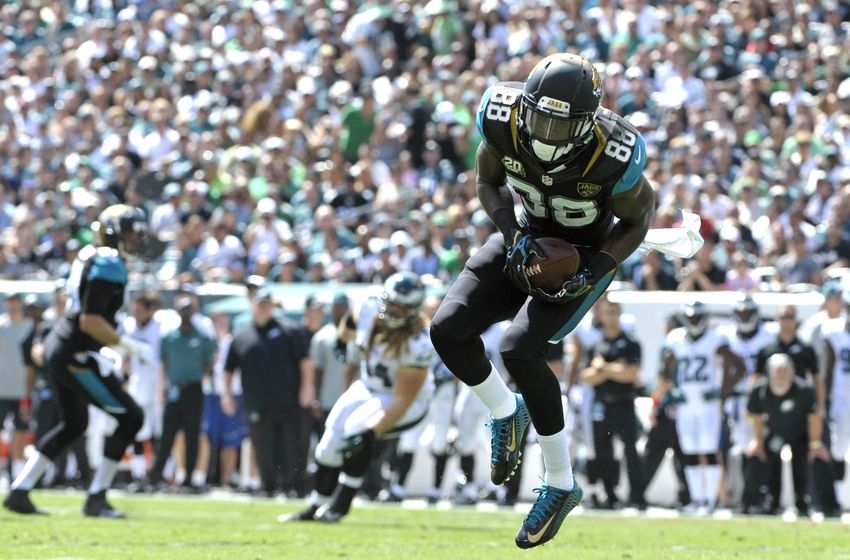
Hurns was part of a big Jaguars first quarter

Hurns was part of a big Jaguars first quarter

Jacksonville’s Allen Hurns led all players in the preseason with 232 receiving yards. The 6’3, 195 receiver had a breakout senior year with Miami(FL) — in fact, he set a school record for receiving yards in a season — but that was not enough to get him selected in May’s draft.

We know that the Jaguars spent some time watching tape of the Miami offense, since Jacksonville used a third round pick on Hurricanes guard Brandon Linder. Perhaps that tipped them off to Hurns, who provided immediate returns in week one. What sort of returns?

  • Hurns caught four passes for 110 yards and two touchdowns against the Eagles in week one. Prior to the Calvin Johnson explosion on Monday night, those numbers put Hurns tied for fifth in the league in receiving yards, and tied for second in receiving touchdowns.
  • Hurns became just the 5th player since 1970 to hit the 100-yard receiving mark and catch two touchdowns in week one of his rookie season.
  • Hurns produced the 2nd best performance by an undrafted rookie wide receiver in a season opener since the merger.

[continue reading…]

{ 9 comments }

Red Zone Diaries: Week 1 Review

Football is back. Oh my goodness gracious. Football is back.

The return of football also means the return of TV’s greatest channel and one of the five most important innovations of the 21st century. The Red Zone Channel has simultaneously rendered obsolete commercials, bad games, bad moments of good games, and halitosis. Let’s celebrate with a running diary. Below is what I was thinking as I watched the RedZone through the early games on Sunday.

Allow me to make one gambling note right off the bat. My stone-cold mega-lock of the week was a two-team tease of the Raiders (to +11.5) and the Bears (to -1). I feel completely queasy about the Bears part of this bet. I’m sticking with it, but every instinct in my body is crying out: “Why take Jay Cutler down to 1 point when I can take Peyton Manning down to 2? You know you will regret this.” So if I sound extra emotional about Raiders-Jets and Bills-Bears, that’s why.

One more note: I was writing this as the games were still going on so the time is approximate in some cases. You can pick most of those out by the times that are whole numbers that end in :00 or :30.

Week 1 Red Zone Diaries

Pregame: Ten years of redzone? I didn’t know about this until 2010 or so. Clearly I am getting old. Maybe I’m remembering that wrong, anyway, since I am getting old. Oh so good to see Andrew Siciliano. Is it possible he’s the median man in America? Dark hair, white, average handsomeness, only his ears seem anything other than completely average. If he’s the median man, here’s the Andrew Siciliano of restaurants and the Andrew Siciliano of American incomes. [continue reading…]

{ 4 comments }

2014 NFL Standings Prediction: Confidence Edition

Here are my NFL projected standings for 2014, but with a twist: I’m ranking the teams from most confident to least confident in their final records. In other words, these are rankings with implied variances, too. If you think this is just a way for me to have built-in excuses for missing on teams in the bottom ten, you are completely wrong and I would never do that.

1) Denver Broncos: 12-4

There may be no more exciting team to watch on the field than the Broncos. Of course, there’s no more boring team to talk about, which is why the Broncos take the place atop my confidence leaderboard. Absent a Peyton Manning injury, Denver will sleepwalk to 12 wins. Games against Seattle, San Francisco, and New England will be must-see television, and also serve to guard against predicting a 14-2 sort of season. The additions of DeMarcus Ware, T.J. Ward, and Aqib Talib, along with the return of Ryan Clady on offense, means the Broncos are fielding their deepest team of the Manning era.

2) New England Patriots: 12-4

Even when the Patriots aren’t very good, they still win 12 games. The offense has a lot of question marks at wide receiver, but Shane Vereen and Rob Gronkowski can mitigate those concerns when healthy. The defense has five Pro Bowl caliber players on defense with Vince Wilfork, Chandler Jones, Jerod Mayo, Darrelle Revis and Devin McCourty.  Three others — Rob Ninkovich, Dont’a Hightower, and Jamie Collins — look to be above-average starters, too. This should be the team’s best defense in a long time (and will be even better once Brandon Browner returns from suspension), which makes New England have a higher floor than any team in the NFL.

3) Seattle Seahawks: 12-4

Do you really need explanation here? The only reason I’ve got Seattle down at 3 instead of 1 is I see a bit more variance in their potential outlook.  The Seahawks are the clear best team in the league to me, so a 15-1 season isn’t out of the question; [1]For what it’s worth, while it’s a bit easier to be higher on Seattle after their strong performance in week 1, I did predict the Seahawks to win against Green Bay. of course, a very difficult schedule could lead to a 10-6 year, too.

[continue reading…]

References

References
1 For what it’s worth, while it’s a bit easier to be higher on Seattle after their strong performance in week 1, I did predict the Seahawks to win against Green Bay.
{ 3 comments }

Week 1 is Perfectly Average

Is week 1 a window into a team’s soul? Or is week 1 best left ignored by analysts, since results are skewed by teams that are still shaking off the rust from the summer? As it turns out, week 1 isn’t just like any other week: it’s more like any other week than, uh, any other week. What do I mean by that?

Let’s begin with a hypothesis. The best teams in the league are [more/less] likely to win in week 1 than they are normally. This is because the best teams are [at their best/rusty] in week 1. How would we go about proving this to be true?

One method would be to take a weighted average winning percentage of teams in week one, with the weight being on the team’s actual season-ending winning percentage. For example, the Patriots went 16-0 in 2007, which means New England was responsible for 6.25% of all wins in the NFL that season. That year, the Colts went 13-3, so Indianapolis was responsible for 5.1% of all wins that year. If we want to know whether good teams play [better/worse] in week 1, we care a lot more about how teams like the ’07 Patriots and Colts fared than the average team.

By using weighted average winning percentages, we place more weight on the results of the best teams, which is exactly what we want to do. So when the ’07 Patriots and ’07 Colts won in week one, rather than being responsible for 6.25% of the league, they are now are responsible for over 11% of the NFL’s weighted week 1 winning percentage. Of course, you can probably figure out pretty quickly that by using this methodology, we are ensuring that the “average” winning percentage over the course of the season will be quite a bit over .500, since the best teams will win more often than not. And that’s exactly what we see: the average weighted winning percentage across all weeks, using this methodology, was 0.574. As it turns out, that’s exactly what the average is in week 1, too. [continue reading…]

{ 5 comments }

Which team will be the biggest surprise in 2014? Last year, the Houston Texans shocked Vegas and analytics fiends alike. Before the season, the Texans’ over/under win total was 10.5. Football Outsiders Almanac projected them to have 9.3 wins and gave them a 67% chance of making the playoffs. Basically nobody saw the 2013 Texans’ implosion to 30th in DVOA coming. Interestingly, though, the Texans are part of a larger trend in the kinds of teams that have been having enormous drop-offs in performance.

Consider the graph below. It looks at the change in DVOA for good-but-not-great teams, those that ranked between 6th and 15th in the previous year. [1]Before 1989, I use Andreas Shepherd’s estimated DVOA. I thank him for sharing his data.

AH Fig 1

Historically, the good-but-not-great teams have regressed a little bit. From 1985 to 2010, those teams dropped on average between two and four points of DVOA. The trend was relatively stable for each five year period. While we would expect some regression from good teams, the size of that regression has changed since 2010. Over the last four years, the good-but-not-great teams have dropped an average of ten points of DVOA, the biggest regression by far since the merger. Note that if we drop 1983 to account for regression coming out of the strike-shortened 1982 season, we get a DVOA change for 1980-1984 of about four points of DVOA, making 2010-2013 even more clearly on its own island. This idea leads into my first prediction for the season. [continue reading…]

References

References
1 Before 1989, I use Andreas Shepherd’s estimated DVOA. I thank him for sharing his data.
{ 30 comments }

Projections: 2014 Awards

After 214 days off, we finally have real football again. Tonight, the Seahawks host the Packers, as Seattle begins its title defense.

Starting in 2004, the NFL now schedules the defending Super Bowl champion to take the field for the league’s opening night kickoff game.  For the first eight seasons, the defending champion hosted each of these Thursday night games, and won all eight times.  In 2012, the Giants lost the opening game to the Cowboys on a Wednesday night, as  President Barack Obama was speaking the following night at the Democratic National Convention.  And last year, a conflict with the Baltimore Orioles led to the Ravens/Broncos matchup moving to Denver, which the Broncos won, 49-27.

So the last two years, the defending champs have lost, although it’s worth noting that the Ravens were a 7.5-point underdog in 2013. Tonight, Seattle is a 6-point favorite, which has become the new norm for the team.  But it wasn’t that long ago that the Seahawks were far from a lock to win every home game.

In each of Russell Wilson’s first three home starts — against the Cowboys, Packers, and Patriots — the Seahawks were three-to-four point underdogs.  And, with an assist from the replacement referees, the Seahawks won each of those games.  For his career, Wilson is 17-1 in Seahawks home games, including a 2-0 mark in the playoffs (the one loss came to Arizona, in the last regular season game in Seattle).

That makes Wilson the fourth quarterback to win 17 of his first 18 starts, joining Daryle Lamonica, Kurt Warner, and Matt Ryan. But did you know that Danny White began his career as the Cowboys starter with 18 consecutive home wins (including playoffs)?

And now, before we kick off the season, I wanted to get in my 2014 projected award winners. [continue reading…]

{ 1 comment }

Just above these words, it says “posted by Chase.” And it was literally posted by Chase, but the words below the line belong to Adam Steele, a longtime reader and commenter known by the username “Red”. And I thank him for it. Adam lives in Superior, Colorado and enjoys digging beneath quarterback narratives to discover the truth; hey, who can blame him? One other house-keeping note: I normally provide guest posters with a chance to review my edits prior to posting. But due to time constraints (hey, projecting every quarterback in the NFL wasn’t going to write itself!), I wasn’t able to engage in the usual back and forth discussion with Adam that I’ve done with other guest posters. As a result, I’m apologizing in advance if Adam thinks my edits have changed the intent of his words. But in any event, sit back and get ready to read a very fun post on yards after the catch. When I envisioned guest submissions coming along, stuff like this is exactly what I had in mind.


Introducing Marginal YAC

A quarterback throws a two yard dump off pass to his running back, who proceeds to juke a couple defenders and run 78 yards into the endzone. Naturally, the quarterback deserves credit for an 80 yard pass. Wait, what? Sounds illogical, but that’s the way the NFL has been keeping records since 1932, when it first began recording individual player yardage totals. The inclusion of YAC — yards after the catch — in a quarterback’s passing yards total can really distort efficiency stats, which in turn may distort the way he is perceived.

In response, I created a metric called Marginal YAC (mYAC), which measures how much YAC a quarterback has benefited from compared to an average passer. Its calculation is very straightforward:

mYAC = (YAC/completion – LgAvg YAC/completion) * Completions

I have quarterback YAC data going back to 1992 for every quarterback season with at least 100 pass attempts. [1]This data comes courtesy of sportingcharts.com. It’s obviously unofficial, but there doesn’t seem to be any noticeable biases from one team to another. Some unofficial stats, such as … Continue reading That gives us a healthy sample of 965 seasons to analyze, and includes the full careers of every contemporary quarterback. But first, let’s get a sense of what’s average here. The table below shows the league-wide YAC rates since 1992: [continue reading…]

References

References
1 This data comes courtesy of sportingcharts.com. It’s obviously unofficial, but there doesn’t seem to be any noticeable biases from one team to another. Some unofficial stats, such as passes defensed or quarterback pressures, can vary wildly depending on the scorekeeper, but Sporting Charts’ YAC stats seem pretty fair, from what I can tell. Here is a link to the 2013 data. Chase note: I have not had the chance to compare these numbers to what is on NFLGSIS, but that’s a good idea.
{ 23 comments }

Tomorrow morning, you can hear me on SiriusXM Channel 111, the SiriusXM Internet Radio App, or online at siriusxm.com. I’ll be speaking with Shane Jensen, Eric Bradlow, Cade Massey, and Adi Wyner about the 2014 NFL season for about 25 minutes, despite my best efforts to turn it into a Don Maynard appreciation show. The program is live, so feel to call in if you have the time. Based on the program’s twitter feed, I surmise that the call-in number is 1-844-WHARTON.

I’ve been doing some radio spots this offseason, and that number will probably go up a bit over the next few months. I’ll do my best to post updates on here, but the best place for Football Perspective news would be on the twitter feed.

{ 0 comments }

Below are my 2014 projected quarterback rankings. Let me be very clear at the top of this post as to exactly what these rankings mean: they represent my projections of the order in which these quarterbacks will finish in my preferred measure of quarterback play. Everyone has their own measuring sticks when it comes to quarterbacks; for me, it’s Adjusted Net Yards provided above league-average. As a reminder, here is how we calculate that metric.

First, we start with Adjusted Net Yards per Attempt, which is calculated as follows:

(Passing Yards + 20 * PassTDs – 45 * INTs – Sack Yards Lost) / (Pass Attempts + Sacks)

Then, we take each quarterback’s ANY/A average, and subtract from that number the league average ANY/A metric, which should be around 5.9 ANY/A. Then, we multiply that difference by the quarterback’s number of dropbacks.

Last year, Peyton Manning led the league in this category, with 2,037 Adjusted Net Yards of value provided above average. The benefit to this approach to ranking passers is that the results are easy to test. At the end of the season, we can calculate the actual results, and then look back and laugh at this post.

So, ranking 1-32, here is how I project the top quarterback for each team to finish in 2014.

No, Peyton, you're the number one

No, Peyton, you're the number one.

1) Peyton Manning, Denver Broncos

There’s a reason Manning is the heavy favorite to repeat as NFL MVP. The Broncos lost Eric Decker and Knowshon Moreno, and Wes Welker’s concussion concerns only worsened this preseason. No matter: Manning remains the gold standard. Denver added Emmanuel Sanders in the offseason, and he caught five passes for 128 yards with two touchdowns against Houston in the preseason. Manning has led the NFL in sack rate in three of his last four seasons, and the return of Ryan Clady should make Manning even more difficult to sack in 2014. No need to over think this one: Manning is the clear favorite to again provide the most value of any quarterback in the league.

2) Aaron Rodgers, Green Bay Packers

3) Drew Brees, New Orleans Saints

Choosing between Brees and Rodgers is tough, but the return of a healthy Randall Cobb and the departure of Darren Sproles is enough to tip the scales towards Rodgers for me. Green Bay tends to forget about the little things — Corey Linsley, a fourth round pick, will be the team’s starting center — but Rodgers has a way of curing all ills. Brees turns 36 in January, which is yet another reason to break ties in favor of Rodgers. Since ’09, Rodgers is the league-leader in ANY/A, while over that period, Brees has thrown the most touchdowns and gained the most yards. If Manning isn’t the king in 2014, it’s a good bet that either Rodgers or Brees took the crown. [continue reading…]

{ 42 comments }

Friend of the program Stephanie Stradley (@StephStradley) interviewed me over at her blog at the Houston Chronicle to discuss quarterback stats.

Some folks have the point of view that rookie quarterbacks should sit and learn. Some folks have the point of view that the only way a young quarterback can learn is by getting a ton of first team reps in practice and then playing real games. Do the numbers say anything about this?

“This is always going to be an impossible question to answer. We don’t live in a counter-factual world, and nobody knows what would have happened to David Carr if he sat on the bench for a couple of years. Ryan Mallett might benefit from having sat behind Tom Brady for three years, or he might just be the next Curtis Painter (or Brian Hoyer or Jim Sorgi or Rohan Davey).

That said, I’m pretty skeptical of the idea that a quarterback needs to sit and learn. There’s nothing wrong with sitting and learning, but I don’t think it makes a quarterback better.  Aaron Rodgers was great right away after sitting for three years; had he started right away, he almost certainly would not have been that good, but I don’t doubt that he would have still turned into the superstar he is today.

One thing that isn’t really true: rookie quarterbacks aren’t really starting much earlier than they used to. In general, top picks always got a chance pretty early in their careers.”

You can read the full article here.

{ 0 comments }

Projecting Success for New Head Coaches

In 1995, Football Outsiders graded the Eagles special teams as the worst in the NFL. The next two years, Philadelphia ranked 20th and 26th, respectively. In 1998, after hiring a new special teams coordinator, the team still finished just 25th. But, over the next eight years, the Eagles’ special teams flipped dramatically, ranking as the second-best in football during that period. In fact, from 2000-2004, Philadelphia ranked in the top five in the Football Outsiders’ special teams ratings each season.

When the Ravens hired the coordinator of those special teams, John Harbaugh, as their head coach in 2008, Baltimore turned one of the more surprising coaching hires in recent history into one of the best. Based on where the team was when it hired him, Harbaugh’s first three years were about the best since 1990 of any coach not named Harbaugh, at least according to DVOA. The Ravens made the playoffs in Harbaugh’s first five seasons, winning the Super Bowl in the last of those. Harbaugh’s success even caused Chase to wonder whether it would change the way teams hired head coaches.

Since Harbaugh was so successful as a coordinator, does that mean he was a good bet to be a successful head coach? At first glance, you might think just about every coordinator who gets promoted or poached to become a head coach was very successful in his previous job. As it turns out, that’s not always the case. Once we correct for expectations, a little more than one in four hired head coaches actually underperformed in their previous jobs, at least according to DVOA.

Consider one man who performed particularly poorly as a coordinator: Eric Mangini. The 2005 New England defense had a DVOA that was 15.2 points lower than we would have predicted based on the Patriots’ performance in the preceding seasons. He was not so much of a (Man)genius to have a good defense in 2005, and that may have given some hint that he was not the greatest bet to succeed as a head coach, either. [1]Always a bonus when painful Jets memories come up organically. There are always other coaching greats like Joe Walton for Jets fans to remember fondly, at least for epic nasal invasions.

This leads to an obvious question: on average, have teams done better when they have hired head coaches who were actually good in their previous jobs (either as coordinators or head coaches)? Let’s take this to the data. [continue reading…]

References

References
1 Always a bonus when painful Jets memories come up organically. There are always other coaching greats like Joe Walton for Jets fans to remember fondly, at least for epic nasal invasions.
{ 10 comments }

A full one-quarter of all NFL teams have opening day starters who have won a Super Bowl: New England (Tom Brady), Pittsburgh (Ben Roethlisberger), Baltimore (Joe Flacco), Denver (Peyton Manning), New York Giants (Eli Manning), Green Bay (Aaron Rodgers), New Orleans (Drew Brees) and Seattle (Russell Wilson) all sport Super Bowl winning passers.

That’s pretty rare. In 1991, Jeff Hostetler was the only quarterback starting in week 1 who had a Lombardi Trophy on his resume. [1]Phil Simms was the team’s backup, Joe Montana missed the entire year with an elbow injury, Doug Williams had retired, Jim McMahon was the backup in Philadelphia, Jim Plunkett and Joe  … Continue reading From 1993 to 2012, an average of 4.0 week 1 starters had previously won a title. Having a Super Bowl winning quarterback is nice, but it doesn’t exactly make a team unique. At least not for 2014.

YearWk 1 SB QBsQuarterbacks
20148Tom Brady; Ben Roethlisberger; Peyton Manning; Eli Manning; Drew Brees; Aaron Rodgers; Joe Flacco; Russell Wilson
20137Tom Brady; Ben Roethlisberger; Peyton Manning; Eli Manning; Drew Brees; Aaron Rodgers; Joe Flacco
20126Tom Brady; Ben Roethlisberger; Peyton Manning; Eli Manning; Drew Brees; Aaron Rodgers
20115Tom Brady; Ben Roethlisberger; Eli Manning; Drew Brees; Aaron Rodgers
20105Brett Favre; Tom Brady; Peyton Manning; Eli Manning; Drew Brees
20096Brett Favre; Kurt Warner; Tom Brady; Ben Roethlisberger; Peyton Manning; Eli Manning
20086Brett Favre; Kurt Warner; Tom Brady; Ben Roethlisberger; Peyton Manning; Eli Manning
20074Brett Favre; Tom Brady; Ben Roethlisberger; Peyton Manning
20064Brett Favre; Kurt Warner; Tom Brady; Brad Johnson
20054Brett Favre; Kurt Warner; Trent Dilfer; Tom Brady
20044Brett Favre; Kurt Warner; Tom Brady; Brad Johnson
20034Brett Favre; Kurt Warner; Tom Brady; Brad Johnson
20023Brett Favre; Kurt Warner; Tom Brady
20012Brett Favre; Kurt Warner
20003Troy Aikman; Brett Favre; Kurt Warner
19993Troy Aikman; Steve Young; Brett Favre
19984Troy Aikman; Steve Young; Brett Favre; John Elway
19973Troy Aikman; Steve Young; Brett Favre
19962Troy Aikman; Steve Young
19953Jeff Hostetler; Troy Aikman; Steve Young
19943Joe Montana; Jeff Hostetler; Troy Aikman
19936Joe Montana; Jim McMahon; Phil Simms; Jeff Hostetler; Mark Rypien; Troy Aikman
19922Phil Simms; Mark Rypien
19911Jeff Hostetler
19902Joe Montana; Phil Simms
19893Joe Montana; Jim McMahon; Phil Simms
19884Joe Montana; Jim McMahon; Phil Simms; Doug Williams
19872Joe Montana; Phil Simms
19862Joe Montana; Jim McMahon
19853Jim Plunkett; Joe Montana; Joe Theismann
19843Jim Plunkett; Joe Montana; Joe Theismann
19834Ken Stabler; Jim Plunkett; Joe Montana; Joe Theismann
19824Terry Bradshaw; Ken Stabler; Jim Plunkett; Joe Montana
19813Terry Bradshaw; Ken Stabler; Jim Plunkett
19803Bob Griese; Terry Bradshaw; Ken Stabler
19794Roger Staubach; Bob Griese; Terry Bradshaw; Ken Stabler
19783Roger Staubach; Terry Bradshaw; Ken Stabler
19775Joe Namath; Roger Staubach; Bob Griese; Terry Bradshaw; Ken Stabler
19764Joe Namath; Roger Staubach; Bob Griese; Terry Bradshaw
19754Joe Namath; Roger Staubach; Bob Griese; Terry Bradshaw
19744Joe Namath; Len Dawson; Roger Staubach; Bob Griese
19734Joe Namath; Johnny Unitas; Roger Staubach; Bob Griese
19723Joe Namath; Len Dawson; Johnny Unitas
19711Len Dawson
19703Bart Starr; Joe Namath; Len Dawson
19692Bart Starr; Joe Namath
19681Bart Starr
19671Bart Starr

References

References
1 Phil Simms was the team’s backup, Joe Montana missed the entire year with an elbow injury, Doug Williams had retired, Jim McMahon was the backup in Philadelphia, Jim Plunkett and Joe Theismann had long been retired, and that takes us all the way back to 1979.
{ 10 comments }

Guest Trivia: High and Low Points Scored In a Season

Some trivia today from longtime commenter Jason Winter. Jason is a former sports blogger (http://jasonwinter.blogspot.com/) who’s shifted his focus to video games (http://jasonwinter.wordpress.com/).

1) In a 16-game regular season, what team has the highest low point total in their games? In other words, this is the only team to score 24 or more points in every game.

Trivia hint 1 Show


Trivia hint 2 Show


Trivia hint 3 Show


Click 'Show' for the Answer Show

2) After reading Jason’s first trivia, I decided to do some digging. Since 1940, only two other teams scored more than 20 points in every game, including the postseason. Both teams were from the ’50s.

Click 'Show' for the Answer Show

[continue reading…]

{ 7 comments }

Prop Joe’s Favorite NFL Prop Bets

I think I’m one of eight billion people who love “The Wire” and “Breaking Bad.” Those are the two best TV shows I’ve seen and it isn’t particularly close. [1]“Seinfeld” is all alone in third with a pretty big gap after that, too. “The Wire” had an amazing volume of unforgettably vivid characters. Below is my list of memorable “Wire” characters. To be a real test of unforgettableness, it’s got to be off the top of my head, so I’m sure I’m going to forget somebody, but here goes and I’ll include the first thought that jumps to mind:

Omar (“man’s gotta have a code”), Bunk (“f***”), McNulty (“f***”), DeAngelo (library), Stringer (mastermind), Avon (winner), Brother Mouzone (bow tie), Cedric (good posture), Garcetti (that’s actually the mayor of LA, I mean the Baltimore mayor), Clay Davis (“sheeeeeet”), Bunny (“New Hamsterdam”), Keisha (car chase scene), Lester (wood carving), Bodie (corner), Prop Joe (large), …

Ah, Prop Joe. Prop Joe was a very large and very reasonable drug kingpin. His name apparently stemmed from saying “I’ve got a proposition for you,” so we could certainly see him getting into prop bets. So, in honor of Prop Joe, I’ll cover some intriguing season prop bets. [2]The actor who played Prop Joe, Robert F. Chew, sadly passed away in January 2013. Most of these bets are only available online, which continues to be a legal gray area. Like Prop Joe, I would never directly touch anything slightly questionable, so I will be referring to bets made by my good friend Rawls. [3]Definitely not this Rawls who is the enemy of all that is good. We’ll start with his favorite prop bet for 2014 and go from there in descending order.

Rawls’s Prop Bet #1: $76 On Any Team To Win at Least 14 Games (Odds: 3/1)

At first glance this bet seems to have a lot of merit. Since the 1987 strike, at least one team won 14 games 15 out of 26 times (57.7%). In the last 15 years, it’s even better, hitting 10 out of 15 times (66.7%). The bet only needs to win 25% of the time to break even, so this looks fantastic.

But Chase brought up a point that Rawls missed: schedule strength. The years without a 14-game winner in the last 15 years include 2012 and 2013. Rawls dismissed that as a blip, but it comes in part from two of the best teams in football playing in the same division. Moreover, the last run of years without a 14-game winner (1993-1997) also happened during a time of NFC dominance, at least until ‘97. The Cowboys played the Packers and Niners every year during that span, for example. This season, the best teams in football may have it even tougher. The Niners and Seahawks have to play each other twice, and each has one of the four hardest schedules in football this year. The Broncos get the NFC West, the Saints have the sixth-hardest schedule, and the Packers have above-average schedule strength. Only the Patriots have an easy schedule amongst the main threats to win 14 games. [continue reading…]

References

References
1 “Seinfeld” is all alone in third with a pretty big gap after that, too.
2 The actor who played Prop Joe, Robert F. Chew, sadly passed away in January 2013.
3 Definitely not this Rawls who is the enemy of all that is good.
{ 8 comments }

Unstable Divisions

The AFC East was a very stable division over the past two years. The Patriots won 12 games in 2012 and 12 more in 2013. The Bills, with six wins in 2013, also repeated their 2012 win total. Miami won 7 games in 2012, and then 8 last year. And the Jets followed up a 6-10 season in 2012 with an 8-8 season last year. That’s about as stable as a division can get. The four teams saw their win totals move by an aggregate of just three wins, making the 2012-2013 AFC East the most stable division since realignment.

On the other end of the spectrum: the NFC South. The Falcons dropped from 13 wins in 2012 to just four last year. The Panthers jumped from 7 wins in 2012 to 12 last year, and it didn’t even take Bill Parcells to do it. New Orleans also won seven games in 2012, but jumped to 12 wins in 2013. The team that saw the least movement in the NFC South last year was Tampa Bay, but the Bucs still fell from 7 wins to 4 wins, matching the total movement by all AFC East teams. As a group, NFC South teams had a change of 21 wins from 2012 to 2013, the most of any division since realignment.

That’s hardly new for the NFC South, or for that matter, the AFC East. Since realignment, the NFC South has easily been the league’s most unstable division: the Falcons, Saints, Bucs, and Panthers have seen their win totals fluctuate by an average total of 18.8 wins per year, beginning with the 2002-2003 seasons. The AFC East has been incredibly stable: no team has ever finished with more wins than New England, while the Bills have finished last or tied for last eight times since realignment. As a result, the average movement among AFC East teams — in the aggregate — has been just 6.3 wins.

RkDivisionChange in Wins/YrChange # Wins/Tm Yr
1NFC South15.73.9
2NFC North13.33.3
3AFC West11.93.3
4AFC North11.93.0
5AFC South11.72.9
6NFC East11.32.8
7NFC West10.82.7
8AFC East10.82.7

[continue reading…]

{ 1 comment }

Great Offenses and Missing the Playoffs

A common sight on any fall Sunday in the early '00s.

A common sight on any fall Sunday in the early '00s.

From 2002 to 2005, Peyton Manning was the best quarterback in the NFL, at least statistically, by a wide margin. But the #2 quarterback in Adjusted Net Yards per Attempt was Trent Green, and there was a wide gap between Green and all other quarterbacks not named Manning.  Over that same period, Tony Gonzalez led all tight ends in receptions, receiving yards, and touchdowns. And the Chiefs rushed for 34 more touchdowns than any other team, in addition to ranking third in rushing yards and fourth in yards per carry.

Kansas City ranked 4th in Adjusted Net Yards per Attempt in 2002, 1st in 2003, 3rd in 2004, and 2nd in 2005.  In terms of Adjusted Yards per Carry, the Chiefs were 2nd in 2002, 3rd in 2003, 1st in 2004, and 3rd in 2005. That’s an incredible streak of not just dominance, but balanced dominance. And Kansas City missed the playoffs in three of those four years! (pours one out for Jason Lisk).

On Monday, we looked at some great defenses that missed the playoffs. Today, a look at some of the best offenses to stay home for the winter. And in the last 15 years, the 2002 Chiefs, 2004 Chiefs, and 2005 Chiefs are the only teams to rank in the top five in both ANY/A and AYPC and miss the playoffs.

What other teams since the merger met those criteria? [continue reading…]

{ 6 comments }

Just above these words, it says “posted by Chase.” And it was literally posted by Chase, but the words below the line belong to Bryan Frye, a longtime reader and commenter who has agreed to write this guest post for us. And I thank him for it. Bryan lives in Yorktown, Virginia, and operates his own great site at http://www.thegridfe.com/, where he focuses on NFL stats and history.


In February, Chase used a regressed version of Football Outsiders’ DVOA metric to derive 2014 expected wins. If you are reading this site, you probably have some familiarity with Football Outsiders and DVOA, FO’s main efficiency statistic. Given the granularity of DVOA, it is no surprise that Year N DVOA correlates more strongly with Year N + 1 wins (correlation coefficient of .39) than Year N wins does (correlation coefficient of .32).

By now, even casual NFL fans probably have at least heard of Pythagorean wins, and regular readers of this site are certainly familiar with the concept. Typically, an analyst uses Pythagorean records to see which teams overachieved and underachieved, which can help us predict next year’s sleepers and paper tigers. Well, I wondered what would happen if we combined the two formulae to make a “DVOA-adjusted Pythagorean Expectation” (or something cooler sounding; you be the judge).

Going back to 1989, the earliest year for DVOA, I used the offensive, defensive, and special teams components of DVOA to adjust the normal input for Pythagorean wins (points). Because DVOA is measured as a percentage, I adjusted the league average points per team game accordingly (I split special teams DVOA between offense and defense). Let’s use Seattle, which led the league in DVOA in 2013, as an example.

In 2013, the league average points per game was 23.4. Last year, Seattle had an offensive DVOA of 9.4% and a defensive DVOA of -25.9% (in Football Outsiders’ world, a negative DVOA is better for defenses).  The Seahawks also had a special teams DVOA of 4.7%.  So to calculate Seattle’s DVOA-adjusted points per game average, we would use the following formula:

23.4 + [23.4 * (9.4% + 4.7%/2)] = 26.15 DVOA-adjusted PPG scored

And to calculate the team’s DVOA-adjusted PPG allowed average, we would perform the following calculation: [continue reading…]

{ 14 comments }

538: NFC West Preview Articles

Yesterday, Neil Paine previewed the NFC East teams over at FiveThirtyEight. Today, yours truly is up with a look at the NFC West.

The Cardinals won 10 games last year, only the second time the team reached double digits in victories since moving to Arizona in 1988. Their run defense was the key. The Cardinals allowed just 1,351 rushing yards, the fewest in the NFL. They ranked first in rushing defense DVOA, Football Outsiders’ main defensive statistic, and stuffed opposing ball-carriers for no gain or a loss on 28 percent of runs, the most in the NFL.

But three of the key players responsible for that success are gone, including inside linebacker Karlos Dansby. Dansby was one of just two players in 2013 to record 100 tackles, more than four sacks, and more than four interceptions. He is a very good run defender, but he is also a strong pass-rusher and is excellent in pass coverage. Of course, that’s why the Cleveland Browns signed him to a four-year, $24 million deal on the first day of free agency.

The Cardinals were prepared for Dansby’s departure, but the other two exits left the team with little time to find a solution. In June, starting inside linebacker Daryl Washington was suspended for the season for (again) violating the league’s substance abuse policy. Like Dansby, Washington is a versatile player: He’s a great pass-rusher (his nine sacks in 2012 were the most by an inside linebacker since Bart Scott’s 9.5 in 2006) and above-average in coverage, in addition to being a strong run-defender.

And last Monday, defensive end Darnell Dockett was lost for the season after tearing the ACL in his right knee. Dockett is not just an above-average 3-4 defensive end against the run, but a team leader and — along with superstar wide receiver Larry Fitzgerald — the player on the team with the longest tenure.

You can read the full article here.

{ 7 comments }

Great Defenses and Missing the Playoffs

Lewis finds out his quarterback is Kyle Boller

Lewis finds out his quarterback is Kyle Boller.

Ten years ago, the teams with three of the four best defenses in football missed the playoffs. The Buffalo Bills ranked 1st in Adjusted Net Yards per Attempt allowed and 2nd in Adjusted Yards per Carry allowed. That year, Sam Adams, Takeo Spikes, Terrence McGee, and Nate Clements made the Pro Bowl, while Aaron Schobel had 8 sacks and London Fletcher was London Fletcher but younger. The team ranked 1st in DVOA by a good margin, but finished 9-7, narrowly missing the playoffs.

That year, Baltimore ranked 4th in ANY/A allowed, 3rd in AYPC allowed, and 2nd in DVOA. The Ravens weren’t quite as good on defense as the ’00 or ’06 iterations, but still had Terrell Suggs, Ray Lewis, Adalius Thomas, Chris McAlister, and Ed Reed (not to mention a 37-year-old Deion Sanders). Of course, this was the Ravens team that was one of the most one-sided team in NFL history. Baltimore also finished 9-7 in a year where six AFC teams won double-digit games.

Over in the NFC, Washington’s defense ranked 1st in Adjusted YPC and 3rd in ANY/A in Joe Gibbs’ first season back in D.C. Marcus Washington was the team’s only Pro Bowler, but the defense featured a rookie Sean Taylor, Ryan Clark, Shawn Springs, Antonio Pierce, and Cornelius Griffin. Despite ranking 4th in defensive DVOA, the team won just six games.

So why today are we looking at these three teams, nearly ten years later? It’s not to remind you that Drew Bledsoe, Kyle Boller, and Mark Brunell failed to guide those teams to the playoffs. As it turns out, these are the last three teams to finish in the top five in both ANY/A allowed and AYPC allowed and still miss the playoffs. In fact, since 1970, just nine other teams have managed to pull off that feat.

  • In 2002, Miami ranked 5th in both ANY/A and AYPC allowed, while the Panthers ranked 4th in both categories. Carolina was a year away from a Super Bowl appearance, while the Dolphins were nearing the end of their Jason TaylorZach ThomasSam Madison run.
  • In 1999, a year before The Year, the Ravens ranked 2nd in both metrics but finished just 8-8.
  • You know all about the 1991 Eagles, so of course they are on this list.
  • The 1987 Giants, a year after winning the Super Bowl, still produced a Super Bowl caliber defense behind Lawrence Taylor, Carl Banks, Pepper Johnson, and Harry Carson, but the team’s offensive line (3rd most sacks allowed, 2nd worst YPC average) torpedoed the offense.
  • In 1978, a year before nearly carrying the team to the Super Bowl, Lee Roy Selmon and Dave Pear helped Tampa Bay rank 1st in AYPC allowed and 3rd in ANY/A allowed. But a miserable offense led to a losing record in the franchise’s third season.
  • The 1974 Packers ranked 5th in both categories. The defense sent Ted Hendricks, Willie Buchanon, and Ken Ellis to the Pro Bowl, but if you think this is just a thinly-veiled reason to bring up John Hadl, you are a regular reader of this blog.

Since 2004, six teams have ranked 1st or 2nd in AYPC allowed but missed the playoffs. Two of those seasons occurred last year, with the Jets and Cardinals, respectively. The 2006 and 2007 Vikings also join that list, along with the 2007 Ravens (a year after a magnificent season) and the 2010 49ers (a year before a magnificent season).

Having a dominant pass defense is even more likely to send a team to the playoffs. Since 2004, only one team — the 2012 Bears — ranked 1st in ANY/A allowed but missed the playoffs. The 2009 Bills are the only team to rank 2nd in ANY/A allowed and miss the playoffs, while the 2013 Bills, 2010 Chargers, and ’05 Jets are the only teams since ’04 to rank 3rd in ANY/A allowed and still fail to make it to January.

Too Long; Didn’t Read

  • The 2004 season was kind of crazy.
  • Since 2002, 24 teams have ranked in the top five in both pass defense and rush defense; five of those teams missed the playoffs, although the last 16 teams pull off this feat have made the postseason.
  • Of the 36 teams to rank in the top 3 in Adjusted Yards per Carry allowed since 2002, only 19 of those teams made the playoffs. Although it’s worth noting that eight of the 17 teams to miss the playoffs out of this group ranked 20th or worse in ANY/A allowed.
  • 28 of the 36 teams to rank in the top 3 in ANY/A allowed made the playoffs.
{ 4 comments }

Call for Guest Writers

There’s no more enjoyable community than the Football Perspective community. Over the past few months, I’ve been devoting more time to my day job, which is a very good thing. The only downside, of course, is that it leaves less time for me to devote to Football Perspective. And while The Streak is still alive, it would be nice to have guest posts from time to time.

For awhile, I was lucky to have the uber-talented Neil Paine as a guest writer at Football Perspective, but then 538 snatched him away. Then, Andrew Healy emerged out of nowhere and has been a fantastic guest writer in his own right. Well, the ink isn’t dry, but I’m hoping that Andrew has leveraged his exposure here at Football Perspective into another great gig. I’ll be sure to let you know if that happens, although I hope regardless we’ll still be seeing some of Andrew around here. [1]Is this an unbashed way of saying contributing at Football Perspective is a good way to get noticed? Absolutely! But it sure wouldn’t hurt to have another writer or two who was willing to contribute.

To be clear, Football Perspective has always encouraged guest submissions: Steve Buzzard was a fan of the site and submitted a couple of guest posts. [2]And Steve has since been hired by Footballguys.com. And, of course, there was Shattenjager’s legendary post on the Swamp Fox. But in case you weren’t clear, Football Perspective willingly accepts guest post submissions. If you ever want to submit a guest post, all you need to do is write it and email it to me at chase[at]footballperspective[dotcom]. I don’t need a bio or an explanation for why you should be considered for a guest post: at Football Perspective, content trumps all.

References

References
1 Is this an unbashed way of saying contributing at Football Perspective is a good way to get noticed? Absolutely!
2 And Steve has since been hired by Footballguys.com.
{ 8 comments }

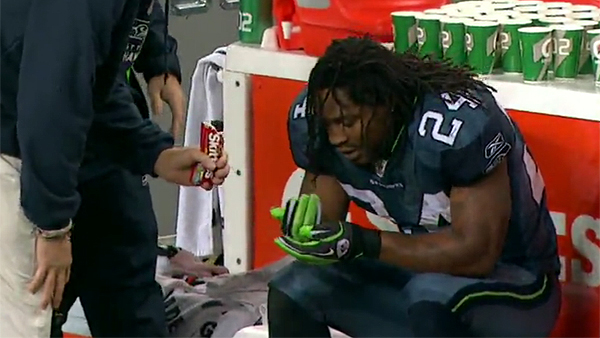
Lynch leads the league in Skittles eaten over average

Lynch leads the league in Skittles eaten over average.

Over the last three years, no player has recorded more carries than Marshawn Lynch. But while Lynch’s 901 carries may lead the league, that’s a pretty low number, at least in modern history. The 2011-2013 seasons very nearly became the first three-year period where no running back had 900 carries since 1989 to 1991, which was essentially the post-Eric Dickerson/pre-stud running back era. This jives with what we’ve seen on a broader level, in that the NFL is both veering away from rushing and towards running back committees, two factors which have combined to torpedo running back value.

The table below shows the leader in rush attempts for every three year period beginning with the AFL-NFL merger. Here’s how to lead the Lynch line: From 2011 to 2013, Lynch, who was 27 in 2013, led the NFL in carries. Over that period, he rushed 901 times for 4,051 yards, a 4.50 yards per carry average. [continue reading…]

{ 6 comments }

Sons of Anarchy

Sons of Anarchy.

I’ve already spent some time this off-season discussing the Rams fantastic front four. Robert Quinn made the Pro Bowl last season, and he’s a good bet to make the trip to Hawaii again this year as long as he stays healthy. Adding Aaron Donald to a line that also has Chris Long and Michael Brockers means St. Louis should have the best 4-3 defensive line in the NFL this year.

The best 3-4 defensive line? That honor probably belongs to the New York Jets. Muhammad Wilkerson made the Pro Bowl last year and would have been a second-team AP All-Pro choice if that organization knew anything about how to create a ballot. The other defensive end, Sheldon Richardson, was the AP Defensive Rookie of the Year. The nose tackle, Damon Harrison, was easily the top run-stuffing tackle in the NFL last year according to Pro Football Focus, and was PFF’s highest-graded nose tackle overall.  You will probably find this hard to believe, but Rex Ryan has said that he wants to have all three of the Jets starting defensive linemen make the Pro Bowl.

How rare is that? Pretty rare — in fact, a 3-4 line has never sent all three players to the Pro Bowl. But even among 4-3 teams, sending three defensive linemen to Hawaii is a very rare feat. Although you might be surprised about when it last happened.

Trivia hint 1 Show


Trivia hint 2 Show


Trivia hint 3 Show

Click 'Show' for the Answer Show

What other teams have sent three defensive linemen to the Pro Bowl during the Super Bowl era? [continue reading…]

{ 2 comments }

Mick Tingelhoff is the 2015 Senior Committee Nominee

Another HOF battery?

Another HOF battery?

Dermontti Dawson is the only Hall of Fame center to play in the NFL in the last 20 years. Go back 30 years, and the only other HOF centers are Mike Webster and Dwight Stephenson. Go back a few more years, and you only get to add Jim Langer. In fact, since 1975, the only teams to have Hall of Fame centers were the Steelers and Dolphins. [1]Yes, I know Webster’s career ended with the Chiefs and Langer’s with the Vikings. And that Bruce Matthews played a little bit of center, too.

Go all the way back to 1960, and the only other Hall of Fame centers to play in the NFL were Jim Ringo and Jim Otto. In other words, the Pro Football Hall of Fame has a center problem. And the nomination of Mick Tingelhoff for induction into the HOF is one small step towards fixing that problem.

This year, the Pro Football Hall of Fame has named Tingelhoff the 2015 Senior Committee Nominee.  Tingelhoff still needs to have 80% of the voters give him the thumbs up, but unlike other players, he won’t be “competing” against the rest of the field for the right to earn a bust. Tingelhoff’s candidacy will be handled via a simple yes or no vote.

Hall of Fame fans may wonder why I’m talking about the Senior nominee, because there are generally two nominees from the Senior Committee.  But things have changed for this year:

A bylaws modification to the selection process was approved earlier this month by which a Contributor – defined as an individual who has “made outstanding contributions to professional football in capacities other than playing or coaching” – will automatically be included among the annual list of finalists for election. The Contributor finalist will also be voted on for election independent of all other finalists.

The Hall of Fame’s Board of Trustees, in an effort to address the backlog of deserving Contributor candidates, also approved a temporary measure allowing for two Contributor finalists in years one (starting with the Class of 2015), three and five, of the next five years. In years two and four of that same period, there will be just one Contributor finalist. To keep the maximum number of nominees elected at no more than eight per year, the Senior finalists will be reduced from two to one per year in years one, three and five of the same five-year period. In years two and four and each year thereafter, there will be two Senior finalists.

[continue reading…]

References

References
1 Yes, I know Webster’s career ended with the Chiefs and Langer’s with the Vikings. And that Bruce Matthews played a little bit of center, too.
{ 29 comments }

Football Perspective/FanDuel Promotion

Football Perspective is teaming up again with the fine folks at FanDuel to provide another promotion for our readers. As you know, Football Perspective turns down just about advertising requests. But this is different, and frankly, this isn’t even advertising. Because we’ve got a great community here, FanDuel is happy to bring a fun promotion to those readers who may be interested in playing.

For the uninitiated, FanDuel is fantasy football with a twist: you compete for real money by selecting any player you want each week under a salary cap format. Each player has a price, so the goal is to figure out who are the undervalued players and fit nine starters under a salary cap. Instead of drafting a team for a season, you draft a team for a week, as frequently or infrequently as you like (i.e., you can enter every week, or play in week 1, week 3, and then every week the rest of the year starting in week 10 — and not be behind the curve). You can compete in games for as little as $1 or as much as $535 per game. Once you play around with the site, you’ll see all the different options: head-to-head games, 50/50 games, 3-man, 5-man, 10-man, 20-man, or big tournament games.

That’s cool, but what’s really cool is that because FanDuel is a fan of Football Perspective, the site is offering a great promotion. If you haven’t deposited money with FanDuel before, a 100% deposit bonus (for up to $200) will be provided to Football Perspective readers. Click here to sign up by clicking the orange “Play Now” button, and the promo code PERSPECTIVE will be entered for you.  If you put down $100, you’ll now have $200 to play with.  Deposit $200, and you’ll get $400. That’s a pretty sweet deal. If you have experience any problems, please post a note here in the comments or email support[at]fanduel[dot]com.

Another cool feature: if there’s enough interest, FanDuel has offered to set up some a weekly tournament among Football Perspective readers.  In any event, I plan on competing most weeks this year — and, of course, blogging about it — as I think the daily game space is one of the most exciting parts of fantasy football. I’ll be competing as ChasePerspective.

So how do you play? You pick 1 QB, 2 RB, 3 WR, 1 TE, 1 PK, and 1 DT each week. There’s a salary cap of $60K. And that’s pretty much all you need to know.  Of course, here are some of my thoughts on strategy: [continue reading…]

{ 7 comments }

Over at Five Thirty Eight, I look at whether the Broncos pass offense, or the Seahawks pass defense, is more immune from regression to the mean.

 As a general rule, elite offenses are further from league average than great defenses, so offensive regression isn’t as likely as defensive regression. It helps, too, that research has shown offenses to be more consistent from year to year than defenses. All else being equal, we would expect the Broncos to be the more likely team to repeat last year’s brilliant performance.But all else isn’t equal. Denver produced 2013’s record-breaking numbers while playing defenses from the AFC South and the NFC East; those will be replaced this year by the AFC East and the NFC West, divisions that present much more formidable challenges. That’s a significant change.

According to Football Outsiders, Denver played the third-easiest slate of opposing defenses in 2013. Based purely on adjusted net yards per attempt, the average defense Manning faced last year was 0.44 ANY/A below average, and that’s after adjusting those defenses’ ratings for the fact that they played Manning. Only Alex Smith and Robert Griffin III faced more cupcakes. Last year, Manning didn’t Omaha against a single defense that ranked in the top eight in strength-of-schedule ANY/A; this year, he’s set to face six opponents that ranked in the top eight in that metric in 2013.

You can read the full article here.

{ 20 comments }