≡ Menu

Smith struggled as a rookie; then again, so did many greats

Smith struggled as a rookie; then again, so did many greats.

In 2013, Geno Smith had the worst passer rating (66.5) in the NFL. The year before, Mark Sanchez had a passer rating of 66.9, which was very nearly the lowest in the league (Matt Cassel had a rating of 66.7). But while the Jets didn’t quite do it, a couple of teams have managed to have different quarterbacks in consecutive seasons finish with the lowest passer ratings in the NFL (minimum 14 attempts per game).

In 2000, a second-year Akili Smith was given the starting job and posted a miserable 52.8 passer rating. A year later, Jon Kitna took over for the Bengals, and his 61.1 rating was the worst among qualifying passers.

In 1993, Mark Rypien finished with the worst passer rating in the league two years after winning the Super Bowl. Washington drafted Heath Shuler the following year, and as a rookie, Shuler finished with the worst passer rating in the NFL.

The Seahawks almost pulled off this feat in the prior two years. In 1992, Stan Gelbaugh had the worst passer rating as part of the historically inept Seattle passing attack. In 1991, Jeff Kemp finished with the worst passer rating in the league. Kemp, the son of Jack , started the year with Seattle but finished it with Philadelphia. He didn’t have enough attempts with the Seahawks to qualify, so I probably wouldn’t include the ’91-’92 Seahawks in this category, although that may be pickin’ nits.

The table below shows the quarterbacks to finish with the lowest passer rating in the NFL in each year since the merger. For each passer, I’ve included his age as of September 1st of that season, his traditional metrics, and his passer rating. [continue reading…]

{ 21 comments }

Fantasy: Running Back Workload Part II (FBG)

Last week, I began my analysis of how to measure workload for running backs. Today brings Part II, another attempt to analyze workload and fantasy production.

Last year, Joique Bell finished as the 15th best running back in fantasy football. Prior to 2013, Bell had just 82 career carries, all of which came in 2012.  Meanwhile, Marshawn Lynch finished as RB5, but he had 1,452 carries prior to the 2013 season. Both players were 27 years old last year, but they had drastically different career workloads.

One obvious issue that comes up when comparing high-workload to low-workload players is that there is often a large talent gap, and Bell and Lynch present that quite clearly. Bell was an undrafted free agent out of Division II Wayne State, while Lynch was a first round pick who played in the Pac-10. What I’ll try to do today is control for “player ability” by looking at the player’s VBD in the prior season. For example, Lynch had 125 points of VBD in 2012, while Bell had 0.

From 1988 to 2013, there were 77 running backs who had a top-24 finish during their age 27 season. One thing we can look to see is whether these players “benefited” from having low mileage up to that point in their careers. I performed a regression analysis using three inputs — Carries in the player’s age 26 year (for example, 315 for Lynch), his career carries as of the end of his age 26 season (1,452 for Lynch), and his VBD in his age 26 season (125).  My output was VBD in the player’s age 27 year.  Here was the best-fit formula:

You can read the full article here. And if you have thoughts on how else to study this issue, leave them in the comments.

{ 2 comments }

A couple of weeks ago, I posted a list of the best rushing teams in 2013 using Adjusted Yards per Carry. That metric, you may recall, is calculated as follows:

Rushing Yards + 20*RushingTDs + 9*RushingFirstDowns

We can use the same formula to grade every team across history. To account for era and quantity (having more above-average rush attempts is better), I calculated each team’s AdjYPC average, subtracted the league-average AdjYPC average, and multiplied that difference by the team’s number of rush attempts.

The top team by this method isn’t even an NFL team: it’s the 1948 San Francisco 49ers. You may recall that the 49ers and Browns staged two epic battles that season, and may have been the best two teams in pro football. That season, San Francisco averaged 6.1 yards per carry and rushed for 35 touchdowns on 600 carries; along with 152 first downs, and the 49ers averaged 9.5 Adjusted yards per Carry. That’s the highest average ever, just narrowly topping the production of the franchise’s Million Dollar Backfield six years later. Joe Perry was on both teams because Joe Perry was the man.

The table below shows the traditional rushing data for the top 200 rushing teams of all time; the VALUE column represents the number of Adjusted Rushing Yards produced above average (i.e., relative to the league average AdjYPC). I’ve also listed the three most prominent rushers on each team. [continue reading…]

{ 8 comments }

Ellington races for a long touchdown

Ellington races for a long touchdown.

In November, I wrote about the unique running back by committee taking place in Arizona. At the time, Rashard Mendenhall was averaging 3.1 yards per carry, while backup Andre Ellington was averaging 7.2 yards per rush on 54 carries. I thought it would be fun to revisit the Ellington/Mendenhall time share now that the season is over, and to use a slightly different methodology.

Mendenhall ended the season with 687 yards on 217 yards, a 3.2 yards per carry average. Ellington finished his rookie year with 118 carries for 652 yards, producing 5.5 yards per rush. One way to measure the magnitude of the difference in the effectiveness of these two players — and boy was there a large difference — is to simply look at the delta in the players’ yards per carry averages. In this case, that’s 2.36 yards per carry.

Where does that rank historically? Some teams — I’m looking at the Lions in the early Barry Sanders years — gave only a handful of carries to their backup running backs. So one thing we can do is to take the difference in the yards per carry between the team’s top two running backs and multiply that number by the number of carries by the running back with the lower number of carries. In each instance, I’ve defined the running back with the most carries as the team’s RB1, and the running back with the second most carries as the RB2. In Arizona’s case, that would mean multiplying -2.36 (Mendenhall’s average, since he was the RB1, minus Ellington’s average) by 118, the number of carries Ellington recorded. That produces a value of -278. [continue reading…]

{ 28 comments }

Is Chris Johnson Better than Chris Ivory?

Over the last three years, Chris Johnson has rushed 817 times for 3,367 yards, a 4.12 yards per carry average. Over the last three years, the Jets have had running back seasons where a rusher recorded at least 150 carries: Bilal Powell and Chris Ivory in 2013, and Shonn Greene in both 2011 and 2012. Collectively, in those four seasons, the group rushed 887 times for 3,647 yards, a 4.11 yards per carry average.

If you put a lot of stock in yards per carry as a metric, it would seem as though Johnson won’t be bringing much to New York in the running game. But today we’re going to take a closer look at the production of Johnson and the Jets back. And I’ve created some graphs that I think are pretty interesting.

Because Johnson has 817 carries since 2011 and the Jets backs have 887, we can’t just compare things on a carry per carry basis (i.e., 20th best carry for each).  So instead, I’m going to look at their percentile ranks — i.e., how many yards they gained on X percent of their carries. This first chart looks at the percentile ranks for Johnson and the Jets backs over the last three years. For example, 22% of Johnson’s runs have gone for negative yards or no gain, while the 22nd percentile of Jets runs has been for one yard. In the table below, the X-axis represents percentile, and the Y-axis represents yards gained. In this chart, being higher is better, and the Jets green line is higher or even with Johnson’s blue line on about 75% of all runs. Then, at the end, things switch, with Johnson being more productive with respect to each group’s best runs. [continue reading…]

{ 11 comments }

Rushing EPA and Yards per Carry

Today I want to look at how traditional rushing statistics compare to rushing Expected Points Added, one of the main stats used over at Advanced Football Analytics. In my analysis, I used the EPA numbers for each team in each season from 2002 to 2013.

Stickiness from year to year

Yards per carry is not a sticky metric: by that, I mean, it is not very consistent from year to year. The correlation coefficient between a team’s yards per carry in Year N and yards per carry in Year N+1 was just 0.31. Sometimes the square of the correlation coefficient is described in terms of “explanatory power”: loosely speaking, this means roughly 10% of a team’s YPC average in Year N+1 can be explained by its YPC average in Year N.

Now, a lot of metrics aren’t sticky from year to year, because the NFL is a highly competitive league. In fact, Rushing EPA per play has a lower correlation coefficient from year to year at just 0.30. That’s a strike against EPA. On the other hand, Burke’s success rate metric has a CC of 0.39, which is more impressive. The CC for Net Passing Yards per Attempt year over year is 0.43. [continue reading…]

{ 29 comments }

One of my first posts at Football Perspective was one of my favorites: the top receivers and the men who threw it to them. I like referencing that post from time to time, so I decided to update the numbers through the 2013 season.

I looked at all regular season games since 1960 [1]Sorry, Don Hutson., and calculated the percentage of passing yards produced from each quarterback. Then, I assigned that percentage to the number of receiving yards for each receiver. For example, in this Raiders game from 1995, Vince Evans threw for 75% of the Raiders passing yards, and Jeff Hostetler was responsible for the other 25%. Therefore, since Tim Brown gained 161 yards, 121 of those yards are assigned to the “Brown-Evans” pairing and 40 to the “Brown-Hostetler” pairing. Do this for every game since 1960, and you can then assign the percentage of career receiving yards each receiver gained from each quarterback.

For example, 32% of Brown’s yards came from Rich Gannon, 26% from Hostetler, 12% from Jeff George, and 9% from Jay Schroeder. That breakdown isn’t too unique: in fact, of the six receivers with the most receiving yards since 1960, all six (including Brown) gained between 29% and 37% of their career receiving yards from their top quarterback.

The table below lists the top 7 quarterbacks for each receiver, although I only included quarterbacks who were responsible for at least five percentage of the receiver’s yards. It includes the 200 players with the most receiving yards since 1960. [continue reading…]

References

References
1 Sorry, Don Hutson.
{ 16 comments }

Fantasy: Running Back Workload (FBG)

Over at Footballguys.com, I try to unravel the relationship between workload and age. Eight years ago, Doug wrote three articles on the topic; sadly, I’m not sure we’ve come very far since then. So I decided to at least begin the process of measuring how much of an impact “mileage” really has on running backs.

Conventional wisdom suggests that, all else being equal, running backs with “low mileage” are more likely to age gracefully than running backs who have accumulated a significant number of carries.

This, unfortunately, is a very complicated issue to test. For example, new Giants running back Rashad Jennings is 29 years old, but he has just 387 career carries.  This makes Jennings a “young” 29, but is that better than being an “old” 28? The best way to test this question is to analyze running backs of similar quality as Jennings — but who had a lot of carries by the time they were 28 years old — and see how the rest of their careers unfolded.  The problem is that the list of running backs with a lot of carries through their age 28 season bear no resemblance to Jennings. The players with the most carries through age 28 are Emmitt Smith, Edgerrin James, Jerome Bettis, Barry Sanders, LaDainian Tomlinson, Curtis Martin, and Walter Payton, which basically serves as a who’s who of running backs who are not comparable to Rashad Jennings.

Generally speaking, the best running backs get the most carries: did you know that Jim Brown is the only player to lead the NFL in carries more than 4 times? He did it six times in his nine-year career. Along the same line of thinking, the running backs with the most carries are generally among the best running backs.  Running backs who haven’t had a lot of carries through age 28 generally either aren’t very good or have suffered multiple injuries, which makes it tough to find players who feel like true comparables to a player like Jennings.

One could argue that running back workload and running back quality are so inextricably tied that it’s impossible to accurately measure whether age or workload is more important.  But today, I want to take a step back from examining the specifics of a player like Jennings and look at the big picture.  There are some examples that appear to support the “running back mileage” theory.  Shaun Alexander had a significant number of carries through age 28, and was excellent at age 28; the fact that he then declined so significantly, so quickly, could be a sign that workload really mattered. After all, few players suffer such sharp declines when turning 29. But that’s just one data point.  What if we can bring in many more?

You can read the full article here.

{ 4 comments }

Over at Footballguys.com, I looked at which running backs have produced the most extreme fantasy splits in wins and losses.

With few exceptions, running backs generally score more fantasy points in wins than in losses.  For example, Adrian Peterson has averaged 22.2 FP/G over the last four years in wins, and 14.8 FP/G in losses, in a 0.5 PPR scoring system.  Those numbers rank Peterson in the top four in both categories, but obviously he’s been much more valuable in wins.

Some players, however, have particularly extreme splits. As Jason Lisk points out, Alfred Morris is one of those players.  Since Morris isn’t much of a receiver, he gets his value from carries and touchdowns, and both of those tend to be higher in wins. Over the past two seasons, Morris has averaged 17.1 FP/G in wins and 11.1 FP/G in losses. Marshawn Lynch is another player who is more valuable in wins: fortunately for him, those are more prevalent in Washington state than Washington, D.C. Since 2010, Lynch has averaged 17.3 FP/G in wins and 9.7 FP/G in losses.

So which running backs are most impacted by their team’s fortunes? I looked at the top 50 running backs in Footballguys.com rankings, and then excluded rookies and others players with small sample sizes.  I was left with 37 running backs, and I calculated their FP/G (using 0.5 PPR) in wins and losses since 2010.  Here’s how to read the table below. No running back fared so much better in wins relative to losses as Doug Martin.  The Tampa Bay back has played in seven wins and averaged 24.5 FP/G in those games, the highest average among the 37 running backs in this study.  Martin has played in 15 losses, and averaged just 12.1 FP/G in those games, the 10th best ranking. That’s a difference of 12.4 (24.5 – 12.1) FP/G.

You can read the full article here.

{ 0 comments }

2014 MVP Odds and Historical QB MVP Performance

On July 8th, Bovada released some early MVP odds, so I figured it would be fun to take a few minutes and examine which players seem like the best and worst bets. Bovada listed odds for 40 players. For example, Peyton Manning has odds of “3/1” which implies that he has a 25% chance of winning the MVP (if you bet $10 on Manning, you get your $10 back plus $30 from the casino). The odds for all 40 players sum to about 140%, which means there’s a healthy house cushion built into these odds. And it’s even worse than that, as Bovada did not include a “Field” category, so the 140% doesn’t even include all possibilities. In any event, I divided each player’s implied odds by 140% to get “adjusted” percentages (or vigorish-adjusted odds) of winning the MVP. Take a look: [continue reading…]

{ 20 comments }

Not-Entirely-Awful NFL Futures Bets

In the 1990s, there was a hedge fund called Long Term Capital Management that almost brought down the world economy. LTCM made enormous bets on very arcane things such as the spread between two kinds of bonds. Their whole reason-for-being was that they would find small inefficiencies in prices and borrow like crazy to take advantage of those brief opportunities. Other hedge funds did similar things, but these guys thought that they were smarter than everyone else. And, to some extent, they may have even been right. But they were also a little contradictory. What made this hedge fund interesting was not just that it employed two Noble Prize-winning economists, but two who made their name arguing that markets for financial assets were efficient. If their research was right, the inefficiencies on which they were betting should not have existed in the first place.

Now, these guys are way smarter than me, but you may have noticed that I recently wrote about how the NFL betting market appears to be pretty efficient. If that’s right, there shouldn’t be any chances to make profitable NFL bets. If the prices are right, all I’m doing is paying the commission every time I make a bet. Like the guys at LTCM, however, I think I’m smart enough to find bets that are mispriced and that offer some opportunity to make money. I’m probably overconfident and wrong about that, but it’s too much fun to try. And if I fail, which the LTCM guys spectacularly did when some of their billion dollar bets went wrong, at least the implications will not send shock waves to central bankers in Peru.

Bets I Sort of Liked But Decided Not to Pull the Trigger On

There were a series of bets on season win totals that I liked but decided did not quite make sense in the end. Some of the reasons were hard-headedly analytical and others were more visceral. Most notably, I couldn’t commit actual dollars to betting on Ryan Fitzpatrick, even though I came pretty close. [continue reading…]

{ 11 comments }

A few days ago, I was in Vegas with friends and without a car. So I took the chance to shop NFL futures odds to the extent that I felt it was worth it to walk to a given sportsbook. I decided the 3+ mile walk to the Superbook was not worth the opportunity cost in the 105 degree heat, so I didn’t get their numbers. But I did get numbers from three of the major oddsmakers: William Hill, Cantor Gaming, and MGM. Tomorrow, I’ll talk about some bets that seem potentially attractive. As I described recently, the numbers are pretty good now and don’t leave obvious opportunities for the most part, I think.

Yes, I still did like some bets. I only found one season win total I really wanted to bet on, and it’s not one of the ones I would have bet back in March. I made a few bets at the William Hill sportsbook, just a little hole in the wall at the Hooters’ Casino a little ways off the Strip, which could just as easily have been in Nevada towns forgotten by time like Laughlin or Mesquite as in Las Vegas. Then I made a few bets not too far from the beautiful people at the Cantor book in the Cosmopolitan. I spent way too much time thinking about all this stuff, which might not have been necessary if I only had that time machine and could have bet on the initial lines. But there’s also some cool stuff by looking at the teams’ odds that have changed the most in both directions.

Season Win Totals

Some interesting movements have happened in the numbers that Cantor Gaming released in March. Those changes reflect everything that happened in free agency and the draft, but also maybe some numbers that people would have bet on anyway even if nothing had changed personnel-wise.  Below are the opening numbers along with the numbers I gathered during the last week. The Cantor numbers are mostly from 6/18 because their books that I went to would only give me the numbers one at a time. I gathered about eight of those numbers because I was at least considering them as wagers. For those teams, the most recent line is the one that I posted. The other companies’ books gave me complete printouts of all their season win-total lines.

A note on the odds: Lines like -140 mean that you would wager $140 to win $100. Lines like +130 mean you wager $100 to win $130. The numbers are usually split by 20 on either side, which represents the vig, or Vegas’s commission. For example, Denver being at -115 for the over would usually go with -105 on the under. For bigger odds, the over and under can be split by more. Also, the MGM has a slightly larger vig, with a 30 split between the over and under. [continue reading…]

{ 2 comments }

There is no doubt that in modern times, passing is king. But until pretty recently, we were at the peak level in NFL history with respect to individual rushing performance. On the team level, rushing production ebbed and flows, with high points in the late ’40s, mid-’50s, and mid-’70s, but on the individual level, the 2006 season may have been the high point.

That year, Pittsburgh’s Willie Parker rushed 337 times for 1,494 yards and scored 13 touchdowns, but Parker ranked just sixth in rushing yards. He also caught 31 passes for 222 yards, but Parker ranked only 7th in yards from scrimmage. That season, the average leading rusher on the 32 teams gained 1,124 rushing yards. Again, that was average. Last year, the average leading rusher gained 912 yards. Consider that in 1991, after Emmitt Smith, Barry Sanders, and Thurman Thomas, the fourth-leading rusher was New York’s Rodney Hampton, and he gained 1,059 yards. In other words, 2006 and its surrounding seasons — even if it might not feel like it — really was a different era of football for running back statistics.

The graph below shows the average rushing yards gained by the leading rushing for each team in every season since 1932. All team seasons of fewer than 16 games were pro-rated to 16 games [1]But this does not pro-rate for injury.; the NFL line is in blue, while the AFL/AAFC line is in red. [continue reading…]

References

References
1 But this does not pro-rate for injury.
{ 22 comments }
Graham was flexed often in 2013

Graham was flexed often in 2013.

On July 3rd, arbitrator Stephen Burbank ruled that Jimmy Graham is a tight end for purposes of the NFL’s franchise tag. You can read a very good analysis of Burbank’s ruling from Jason Lisk here. But after reading Burbank’s full report, I wanted to add my thoughts. And let’s start with a high-level overview.

Football is not baseball: position designations are much more fluid in football, and they also hold less inherent meaning. You can have five wide receivers on the field in football, but you can’t play five third basemen. You can go without a tight end or fullback for long stretches in a game, but you don’t exactly see baseball teams going without a first basemen very often.

In baseball, emphasizing position distinctions make sense because of the rigidity of the designation and the inherent scarcity involved in building a team. A catcher that can hit is more valuable than a first baseman that can hit, because it’s much easier finding a first baseman that’s a productive offensive player. In football, those concepts don’t necessarily apply, which gets us to the Jimmy Graham issue. Four years ago, when writing about Art Monk, I referenced Sean Lahman’s section on Monk in Lahman’s fantastic Pro Football Historical Abstract:

Even though Monk lined up as a wide receiver, his role was really more like that of a tight end. He used his physicality to catch passes. He went inside and over the middle most of the time. He was asked to block a lot. All of those things make him a different creature than the typical speed receiver…. His 940 career catches put him in the middle of a logjam of receivers, but he’d stand out among tight ends. His yards per catch look a lot better in that context as well.

I haven’t heard anyone else suggesting that we consider Monk as a hybrid tight end, but coach Joe Gibbs hinted at it in an interview with Washington sportswriter Gary Fitzgerald:

“What has hurt Art — and I believe should actually boost his credentials — is that we asked him to block a lot,” Gibbs said. “He was the inside portion of pass protection and we put him in instead of a big tight end or running back. He was a very tough, physical, big guy.”

Monk said similar things:

“In [1981] we were pass oriented and that didn’t work so well. So we went to a ground game. About this period of time we shifted a little into more of a balanced offense. I was moved from being just a wide receiver to playing H back. I would come out of the backfield and do a lot of motion. And we had a lot of success with that.”

And here’s more from Coach Gibbs:

‘We used him almost as a tight end a lot,’ said Gibbs, ‘and not only did he do it willingly, he was a great blocker for us.’

Heck, Graham may be more “wide receiver” than Monk was. But identifying Graham a tight end or a wide receiver is  meaningless. Calling Graham a tight end doesn’t mean the Saints not “get” to put another wideout on the field, and calling him a wide receiver doesn’t mean the Saints “have” to put an extra tight end on the field.  His position classification has no impact on what the Saints do on the field.  Which left Burbank to ultimately decide something very meaningful — his compensation — based on something very meaningless. [continue reading…]

{ 19 comments }

A couple of weeks ago, Brian Burke of Advanced Football Analytics (formerly Advanced NFL Stats) wrote a great post on the value of a first down. From that post, we concluded that the marginal value of a first down is 9 yards, and we’ve previously determined that the marginal value of a touchdown is 20 yards. Therefore, we can create an Adjusted Yards per Carry statistic, which can be calculated as follows:

Adjusted Yards per Carry = (Rushing Yards + 20 * Rushing TDs + 9 * Rushing First Downs) / Rushes

If we use this metric to analyze the 2013 season, how would it look? Last year, the Eagles averaged 5.13 yards per carry and 8.29 Adjusted YPC, courtesy of the fact that the team led the NFL in rushing first downs. Philadelphia also ranked 1st in the NFL in both of those metrics and in overall rushing yards. [continue reading…]

{ 20 comments }

Last weekend, we looked at the team with the most Pro Bowlers to win a championship. Today, we look at the reverse: the team with the fewest Pro Bowlers to win it all.

As a technical matter, the Pro Bowl hasn’t always been around, so some pre-1950 teams and the 1960 Oilers (there was no Pro Bowl in the AFL’s first season) had zero Pro Bowlers. But only one team has had exactly one Pro Bowler and won the title. Here are some hints:

Trivia hint 1 Show


Trivia hint 2 Show


Trivia hint 3 Show

[continue reading…]

{ 5 comments }

Yesterday, I looked at the best AV-weighted winning percentages of offensive players. Today, we examine the same numbers but for defensive players and kickers since 1960. Again, players who entered the league prior to 1960 are included, but for purposes of this study, only their 1960+ seasons count (assuming they produced at least 50 points of AV). That’s a pretty important bit of detail to mention when it comes to the top player on the list. The player with the best AV-adjusted winning percentage since 1960 is Packers linebacker Bill Forester, who entered the NFL in 1953 but only gets credit for his 1960-1963 seasons in Green Bay (spoiler: those were pretty good ones). After him, of course, we have yet another Patriots lineman. Today it’s Vince Wilfork: [continue reading…]

{ 3 comments }

A true winner and Tom Brady

A true winner and Tom Brady.

Yesterday, I looked at the weighted career winning percentages for running backs, with the weight being based on each player’s yards from scrimmage in each season of his career. Today, I want to do the same thing but for all offensive players, using PFR’s Approximate Value ratings.

By this methodology, Dan Koppen has the highest AV-weighted career winning percentage of any offensive player since 1960. The table below shows his AV and team’s winning percentage in each season of his career. Because Koppen’s best season came in 2007, when the Patriots went 16-0, Koppen’s career winning percentage gets a big boost from that season (18.7% of his career winning percentage comes from ’07 since 18.7% of his career AV comes from that year). On the other hand, Koppen played in just one total game for the 13-3 Patriots (2011) and the 13-3 Broncos (2013), so he gets almost no credit for those performances. Of course, he doesn’t need it, because his average season, after adjusting the weights based on his AV grades, was a 13-3 season.

YearTmGGSAVRecord% of Car AVWtWin%
2003NWE161570.8758%0.07
2004NWE1616100.87511.5%0.101
2005NWE9950.6255.7%0.036
2006NWE1616100.7511.5%0.086
2007NWE151516118.4%0.184
2008NWE1616100.68811.5%0.079
2009NWE1616100.62511.5%0.072
2010NWE1616110.87512.6%0.111
2011NWE1110.8131.1%0.009
2012DEN151270.8138%0.065
2013DEN000.8130%0
Total0100%0.813

The table below shows the top 500 career AV-adjusted winning percentages among all offensive player since 1960 (minimum: 50 points of AV). As always, players who entered the NFL before 1960 are included but only their seasons beginning in 1960 count. The table below is fully sortable and searchable, so get to searching and leave your thoughts in the comments. [continue reading…]

{ 3 comments }

Steven Jackson and Running Back Records

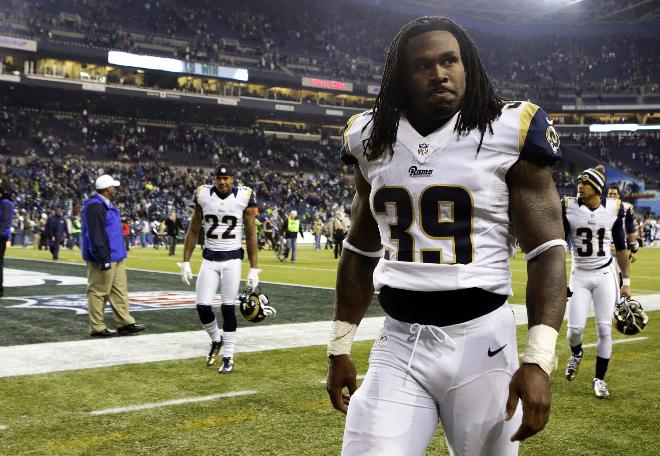
Jackson, presumably walking off the field after a loss

Jackson, presumably walking off the field after a loss.

One of my very first posts at Football Perspective looked at the weighted career winning percentages of various running backs. You can calculate a player’s weighted career winning percentage in lots of ways, but here’s what I did:

  • Calculate the percentage of yards from scrimmage a running back gained in each season as a percentage of his career yards from scrimmage. For example, if a player gained 10% of his yards from scrimmage in 1999 and the team went 15-1 that season, then 10% of the running back’s weighted winning percentage would be 0.9375. This is designed to align a running back’s best seasons with his team’s records in those years. For example, Emmitt Smith played 2 of his 15 seasons with the Cardinals. But since he gained only 6.5% of his career yards from scrimmage in Arizona, the Cardinals’ records those years count for only 6.5% — and not, say, 13.3% — of his career weighted winning percentage.
  • Add the weighted winning percentages from each season of the player’s career to get a career weighted winning percentage.

At the time, Steven Jackson had the lowest average adjusted winning percentage of any running back in my study. Since then, Jackson played for the 7-8-1 Rams in 2012 and the 4-12 Falcons in 2013. That upped his adjusted winning percentage from 0.292 to 0.307. Among the 129 running backs in NFL history with at least 7,000 yards from scrimmage, only James Wilder had a worse career adjusted winning percentage.

The running back with the highest adjusted winning percentage is Lawrence McCutcheon, who spent the majority of his career with the Rams before end-of-career cups of coffee with Denver, Seattle, and Buffalo. The table below shows the first and last year for each running back, the teams he played for, his career yards from scrimmage, and his adjusted winning percentage. McCutcheon played on those great Rams teams of the ’70s, gaining the bulk of his yards from ’73 to ’77. As a result, his adjusted winning % is an incredible 0.741: [continue reading…]

{ 10 comments }

Thoughts on the value of a rushing first down

Last week, Brian Burke provided some excellent data on the value of a first down. I began working on today’s post last offseason, but as you’ll see in a few minutes, I wasn’t quite comfortable with the results. But here’s what I did.

For all teams from 1989 to 2012, I recorded for each team’s average:

  • Yards per carry;
  • Touchdowns per carry;
  • First downs per carry;
  • Rush VOA from Football Outsiders (DVOA is FO’s main statistic, but it is adjusted for SOS; VOA is the unadjusted metric).

Then, I ran a series of regressions to help better understand the “proper” weights on the running game. [1]Longtime readers may recall that Neil did something similar with passing metrics. First, I used yards per carry and touchdowns per carry as my input, and VOA as my output. The best-fit formula was:

-0.647 + 0.128 * YPC + 4.615 * TD/Carry

Understanding that formula isn’t important. [2]Although if you’re curious… Suppose a team averaged 4.50 YPC and rushed for 12 TDs on 450 carries. That team would have a VOA of 5.21%, slightly above average. What we care about is the correlation coefficient (0.65) and the relationship between the YPC variable and the TD/carry variable.

Here we run into our first problem: 4.615 is 36 times as large as 0.128. This would imply that a touchdown is 36 times as valuable as a regular yard (or 35, if you subtract the yard gained on the score). That seems very high, as 20 is the generally accepted standard conversion rate for a touchdown.

What if we introduce first downs per carry into the equation? Then we get this best-fit formula:

-0.761 + 0.081 * YPC + 2.954 * TD/Carry + 1.593 * FD/Carry

Here, the R^2 is 0.72, which is an indication that first downs matter (or, to put it another way, DVOA gives rewards for first downs, as it should). Unfortunately, the TD variable remains very high (it’s now nearly 37 times as large as the YPC variable), but we get the bit of insight I was looking for: a first down is worth 0.54 touchdowns.

The first down variable is about 20 times as large as the YPC variable, but that seems way off to me.  Instead, if we think a TD is really worth 20 yards, this puts the value of a first down at about 10.8 yards. That’s not too far off from Brian’s 8.7 average, which I think makes sense to round to 9.0 once you remember that a few first downs happen on 4th downs, which was ignored in Brian’s analysis.

What helps bridge the gap between the two valuations?  Burke’s method looks at the marginal value of a first down based on an Expected Points model.  What I did with Football Outsiders’ numbers was to try to correlate first downs with rushing value.  But that could lead to overstating the value of a first down, if first downs are correlated with other things (like say, short-yardage success in general).  Teams that are good at rushing for first downs might be better at X, Y, and Z than other teams, and being good at X, Y, and Z could lead to a higher DVOA grade.  As a result, I like Brian’s result better, and I think FO’s numbers serve as a good gut check.  And while the number is a few yards higher, that’s arguably the correct result, and at least the number is higher in the right direction.

As for the idea that touchdowns are worth 36 yards and first downs are worth 19 yards? Well, I’m not so sure about that.  My hunch though, is that Football Outsiders (wisely) cares a lot more about say, success rate, than just generic yards per carry.  So perhaps this represents a devaluation of YPC as much as anything else.

But I’ll open it up to the crowd: what thoughts do you guys have for finding the value of a first down?

References

References
1 Longtime readers may recall that Neil did something similar with passing metrics.
2 Although if you’re curious… Suppose a team averaged 4.50 YPC and rushed for 12 TDs on 450 carries. That team would have a VOA of 5.21%, slightly above average.
{ 9 comments }

Average margins in Wins and Losses

Okay, some fun trivia to kick off the week. Do you know which team last year had the worst points differential in games they lost? I’ll put the answer in spoiler tags.

Click 'Show' for the Answer Show


Where does that rank historically? I thought it would be fun to look at the teams since 1950 with the worst average margin of defeat looking exclusively at performance in losses. This was a bit of a tricky one, but Scott Kacsmar was able to guess it on twitter. The answer?

Show' for the Answer Show


The table below shows the 100 teams with the worst average points differential in losses since 1950. As always, the tables in this post are fully sortable and searchable. For viewing purposes, I’m displaying only the top 20, but you can change that in the dropdown box on the left. [continue reading…]

{ 5 comments }

Trivia: Pro Bowlers on NFL Champions

Yesterday, we looked at the team with the most Hall of Famers in a single season in NFL history. That team, which won the NFL championship, had 8 of its players make the Pro Bowl. That’s a very high number, of course, but over 30 teams have won it all and had eight or more players make the Pro Bowl.

Three teams have had twelve players make the Pro Bowl in a championship season. Two of them came in the AFL. In 1961, QB George Blanda, HB Billy Cannon, FB Charley Tolar, WR Charley Hennigan, TE Bob McLeod, LT Al Jamison, C Bob Schmidt, DE Don Floyd, DT Ed Husmann, MLB Dennit Morris, and cornerbacks Tony Banfield and Mark Johnston, all made the Pro Bowl for the Houston Oilers.  Somehow, Bill Groman, who led the league with 17 touchdowns and was a first-team All-Pro selection, was not a Pro Bowler.

A year later, another Texas team won the AFL championship and sent a dozen players to the Pro Bowl. Lamar Hunt’s Dallas Texans fielded QB Len Dawson, HB Abner Haynes, FB Curtis McClinton, TE Fred Arbanas, LT Jim Tyrer, LG Marvin Terrell, RT Jerry Cornelison, DE Mel Branch, DT Jerry Mays, LLB E.J. Holub, MLB Sherrill Headrick, and CB Dave Grayson en route to an 11-3 record.

But only one NFL champion has sent 12 players to the Pro Bowl.  Can you guess who?

Trivia hint 1 Show


Trivia hint 2 Show


Trivia hint 3 Show
[continue reading…]

{ 3 comments }

Most Hall of Famers on an NFL Team

Today’s trivia is a straightforward one: only one team in NFL history has fielded 11 players who are currently members of the Pro Football Hall of Fame. Can you name that team?

Trivia hint 1 Show


Trivia hint 2 Show


Trivia hint 3 Show


Click 'Show' for the Answer Show
[continue reading…]

{ 18 comments }

Predictions in Review: NFC East

During the 2013 offseason, I wrote 32 articles under the RPO 2013 tag. In my Predictions in Review series, I review those preview articles with the benefit of hindsight. Previously, I reviewed the AFC West, the NFC West, the AFC South, the NFC South, the AFC North, the NFC North, and the AFC East. Today, we finish the series with a look at the NFC East.

Eli Manning was about as good in 2012 as he was in 2011, July 15, 2013

On the surface, Eli Manning’s numbers dropped significantly from 2011 to 2012; after further review, his “decline” was entirely due to two factors: attempting fewer passes and lower YAC by his receivers. And since Victor Cruz and Hakeem Nicks were largely responsible for those declines, it seemed fair to wonder how much of the blame should go to Manning. [continue reading…]

{ 6 comments }

Last off-season, I looked at passing performance on “third downs”, and I thought it would be fun to revisit that idea this summer. As before, I am putting that term in quotes because I’m including fourth down data in the analysis, but don’t want to write third and fourth down throughout this post.

To grade third down performance, I included sacks but discarded rushing data (again, just in the interest of time). The first step in evaluating third down performance is to calculate the league average conversion rate on third downs for each distance. Here were the conversion rates I calculated last year.

To GoPassesFirst DownsRateSmoothed Rate
130915851.1%50.8%
241520850.1%48.5%
348720742.5%46.2%
451222744.3%43.9%
555922640.4%41.6%
654122842.1%39.2%
752118134.7%36.8%
842614333.6%34.5%
936511631.8%32%
1072822030.2%29.6%
112137133.3%27.2%
121533925.5%24.7%
131352417.8%22.2%
141072220.6%19.7%
151432215.4%17.2%
166258.1%14.6%
17681217.6%12%
185036%9.5%
195335.7%6.8%
204836.3%5%

[continue reading…]

{ 16 comments }

The Value of a First Down

What is the value of a first down? By that I mean, how many marginal yards is a first down actually worth? Here’s another way to word the question: If 3 first downs and 80 yards are worth X, then 2 first downs and [???] many yards are equal to X?

Calculating the marginal value of a yard isn’t easy. In fact, it’s been bugging me for years, because I’ve never quite been sure how to derive them. Then, a light bulb went off in my head: I needed to reach out to Brian Burke. I had an idea, but not the data or the means to execute.

Burke, of course, runs the fantastic website Advanced Football Analytics (formerly Advanced NFL Stats). I asked him if he would run some queries, and Brian was kind enough to do so. Fortunately, Brian’s not just a guy with access to lots of data, but one of the smartest minds in the industry. I wholeheartedly endorse his methods below, and I’m very thankful for his help. On top of running the numbers, he also provided an excellent writeup on his work. What follows are Brian’s words and analysis.


To estimate the value of achieving a 1st down without counting any of the value of the yardage gained, we can use the Expected Points model. The value of the 1st down itself minus yardage value will be the discontinuity in EPA when a play’s gain crosses the threshold for a 1st down. That discontinuity represents the value of the conversion apart from any yardage gained.

For example, on 2nd and 10, the EPA would increase smoothly for each yard gained up to 9 yards gained, then jump to a much higher EPA crossing the 10-yard mark where the conversion occurs. After that point, the EPA should increase smoothly again with each marginal yard gained above what was needed for the conversion.

Here is an illustration. The Y-axis represents Expected Points Added, the X-axis the amount of yards gained on the play.

EPA 2nd 10

The EPA for a 9-yd gain is 0.57, and the EPA for a 10-yd gain is 1.04. That’s a discontinuity of 0.47 EP, meaning that the 1st down itself is nearly equivalent to the 9-yards gained up to the point of conversion.

But we also need to correct for the yardage value of that 10th yard. One yard of field position is generally worth 0.064 EP. So in this case the discontinuity itself is worth 0.47 – 0.064 = 0.41 EP.

If we wanted to assign a “bonus” of yards to a player who is credited with achieving the conversion over and above the yardage itself, we could use this value’s yardage equivalent. 0.41 EP / 0.064 EP/yd = 6.4 yds. That’s the bonus for 2nd down and 10, but there are many other down and distance situations to consider.

For example, on 3rd and 10, the discontinuity is 1.57 EP, equivalent to nearly 25 yds. First and 10 is very strange because the discontinuity is negative. This makes sense, however, because an offense should prefer a 2nd & 1 to a 1st & 10 anywhere on the field. It would be silly to penalize a player for gaining the extra yard to convert, so my opinion would be to say the EP bonus for a conversion on 1st down is zero.

3rd 10

After examining a smattering of 2nd and 3rd down situations, the 2nd-down bonus EP is about 0.35 and 3rd-down bonus EP is roughly 1.4.

4th down conversions would obviously mean a very large bonus EP. They essentially have the value of a turnover–close to 4 EP or so. Since 4th downs are qualitatively different (and relatively rare) I’m going to set them aside.

In general, 32% of conversions come on 1st down, 38% come on 2nd down, and 30% come on 3rd down. So the weighted value of a conversion alone would roughly be:

[0.32 * 0] + [0.38 * 0.35] + [0.30 * 1.4] = 0.55 EP

The conversion bonus of 0.55 EP can be translated into yards by dividing by 0.064 EP/yd, which ultimately makes the equivalent yardage bonus for a conversion: 8.7 yards.


Figuring out the value of a first down will have many applications for Football Perspective going forward. Please leave your thoughts in the comments, as I’d love to hear what you guys have to say. And thanks again to Brian for his great work.

{ 21 comments }

The Coryell Index

Yesterday, we looked at the Billick Index, a measure of coaches who managed teams that were good at preventing offensive touchdowns and bad at creating them. Today, the reverse, which is appropriately named after Don Coryell. Coryell’s teams were slanted towards the offense even when he was in St. Louis, but the situation exploded when he went to San Diego. Here’s a look at Coryell’s year-by-year grades in the Coryell Index: for example, in 1981, his Chargers scored 23.1 more offensive touchdowns than the average team, while opposing offenses against San Diego scored 10.1 more touchdowns than average. Add those two numbers together, and there were 33.3 more offensive touchdowns scored in San Diego games than in the average game in 1981 (this is the same information presented as yesterday, but now the “Grade” column reflects the number above average).

YearRecordOFFDEFGRADE
19734-9-11.8-11.813.5
197410-43.52.51
197511-36.50.55.9
197610-44.8-1.86.6
19777-76.6-6.613.1
19788-46.8-1.68.4
197912-412.46.65.8
198011-51119.9
198110-623.1-10.133.3
19826-314.3-0.314.6
19836-105.1-16.121.1
19847-96.4-13.419.8
19858-819.8-15.835.6
19861-72.4-2.95.3
Total111-83-1124.4-69.6194

[continue reading…]

{ 10 comments }

The Billick Index

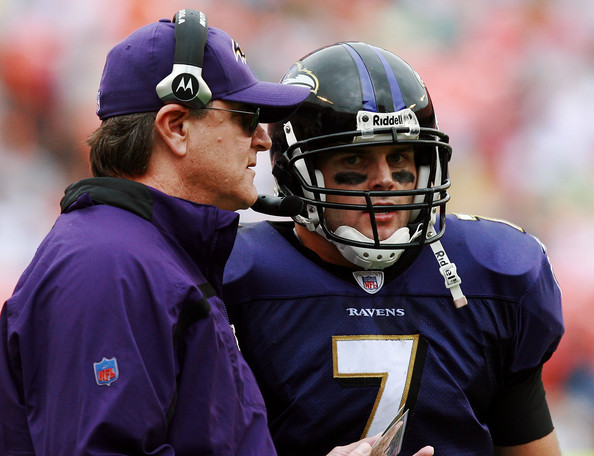
Touchdowns were at a premium in Billick's games

Touchdowns were at a premium in Billick's games.

The 2004 Ravens were hardly Brian Billick’s most interesting team. But those Ravens serve as a shining example of what you envision when you think of Baltimore in the 2000s: terrible on offense and great on defense. The team went 9-7 despite the Kyle Boller-led offense producing just 24 touchdowns, tied for the second fewest in the league. But Ray Lewis, Ed Reed, Terrell Suggs, Chris McAlister, and even Deion Sanders were on a defense that allowed only 23 touchdowns, the second best mark in the NFL. So Baltimore was +1 in net offensive touchdowns, but that doesn’t really demonstrate the type of team the Ravens were.

Here’s a better way: the average team in 2004 produced 35.9 offensive touchdowns. This means the Baltimore offense fell 11.9 touchdowns shy of average, while the defense was 12.9 touchdowns above average. So if you don’t like watching offensive touchdowns, the 2004 Ravens were the team for you: 24.8 fewer offensive scores came in Ravens games than in the average game that season.

That’s the 4th largest negative differential in NFL history, behind…

  • The 2002 Bucs (-25.1), who allowed 18.1 fewer touchdowns than average while scoring 7.1 fewer offensive touchdowns;
  • The 2005 Bears (-26.2), who allowed 14.6 fewer offensive touchdowns to opponents, and produced 11.6 fewer offensive touchdowns than average; and
  • The 1967 Oilers (-28.7), who allowed 17.3 fewer offensive touchdowns than average and scored 11.3 fewer offensive touchdowns than the rest of the AFL.

[continue reading…]

{ 15 comments }

At the end of my Seahawks-Saints playoff preview, I came up with (what I thought was) a pretty neat bit of trivia:

New Orleans gained 4918 passing yards and allowed only 3105 passing yards. That 1813 yard difference is largest by any NFL team in history. The 1961 Oilers, led by George Blanda, Bill Groman, and Charley Hennigan, actually gained 2,001 more passing yards than they allowed, but Houston of course was an AFL team. And there’s a bit of an asterisk here because of the games played: the 1943 Bears, 1951 Rams, and 1967 Jets also had a larger passing yards differential on a per-game basis. But regardless, that puts the Saints in some pretty impressive company. The Oilers, Bears, and Rams all won their league’s championships that season, and Joe Namath’s Jets won the Super Bowl the next season. The team with the fifth largest passing yards differential on a per-game basis, prior to the Saints, was the 2006 Colts, also a Super Bowl champion.

I never ran the same numbers but for rushing yards, because I just assumed it would be dominated by the ’72 Dolphins and other similar teams.  But as it turns out, the undefeated Dolphins rank only third in net rushing yards in a single season since 1950, even on a per-game basis.  In 1972, Miami rushed for an amazing 2,960 yards, but allowed 1,548 yards on the ground to opposing teams. That comes out to a 1,412 yard difference, or a +100.9 rushing yards per game differential.

The 2001 Steelers, with Kordell Stewart, Jerome Bettis, and a suffocating defense, finished with a +98.7 differential, the fifth best differential since 1950.  The ’84 Bears, behind Walter Payton and their own dominant defense, checks in at #4 at +99.8.  The second best performance is owned by the ’76 Steelers, who finished with a +108.1 differential.  That was the year Pittsburgh allowed just 28 points over the team’s final 9 games, and Franco Harris and Rocky Bleier both hit the 1,000-yard mark (they were the second duo to do so, behind Larry Csonka and Mercury Morris on the ’72 Dolphins).

None of those teams caused me any surprise, which I guess is why I never ran the numbers until today.  But it would have taken me quite a few more guesses to come up with the number one team on the list.  That’s why I’ll give you guys some hints. [continue reading…]

{ 6 comments }

For the eleventh straight years, I’ve written an Quarterback By Committee article for Footballguys.com. Here’s a quick peak at this year’s article:

The general rule for QBBC fans is that the first six rounds of your draft should be used to assemble a wealth of talent at running back, wide receiver, and, if the draft unfolds in such a way, tight end. By going the QBBC route, you can save those high picks in your draft and still get solid fantasy production by grabbing two QBs who face bad defenses nearly every week of the year. That’s what the QBBC system is all about.

Of course, in some leagues, QB10 can now be had as late as the seventh round, and your fifth-ranked quarterback could still be available that late. One could argue that the best strategy is 2014 is to wait until the first ten quarterbacks are off the board and then draft a couple of quarterbacks at a nice discount. Colin Kaepernick, Tony Romo, and Russell Wilson have ADPs of QB11, QB12, and QB13, and all have high upside for 2014. That’s one option, but another option is to wait even longer and implement a quarterback-by-committee strategy.

The first key, of course, is to rank the defenses. I always start by adjusting last season’s data on defenses for strength of schedule. I started with the adjusted FP rankings for each defense listed in the Rearview QB article. Then, I made some adjustments to the defenses based on their efficiency numbers from 2013 and what’s happened since the end of last season. The table below lists my rating for defenses for fantasy quarterbacks, listed from the toughest (the Seahawks) to the easiest (Dallas).  Quarterbacks facing Seattle should expect to produce about five fantasy points below average, while passers facing the Cowboys will be projected to score three more points than average.

You can check out the full article here, which includes rankings of each defense and each quarterback’s strength of schedule.

{ 1 comment }