by Chase Stuart
on July 4, 2012
Happy 4th of July! Before you head to your barbecue, I’d recommend you take a look at the incredible document our founders signed 236 years ago.
As far as football goes, today’s a good time for a data dump. The table below shows the career passing leaders for each franchise, organized by when the current leader last played for that team.
[continue reading…]
Tagged as:
Ben Roethlisberger,
Eli Manning,
Jay Cutler,
John Elway,
Mark Sanchez,
Matt Stafford,
Mike Vick,
Peyton Manning,
Robert Griffin III,
Sam Bradford,
Tim Tebow,
Tony Romo
{ }
by Chase Stuart
on July 3, 2012
Let’s flash back to December 1, 2011. At the time, Chicago Bears star Matt Forte was having the best season of his career and making a claim to being one of the league’s top five running backs. He was leading the league in yards from scrimmage. He was averaging 5.0 yards per rush. He also ranked in the top three in both receptions and receiving yards by a running back. He had gained 1,475 yards from scrimmage through 11 games, the second most in Bears history.
Forte sprained the medial collateral ligament in his right knee in week 13, costing him the remainder of the season. He has been in disputes with the Bears over his contract for the last two years, but that’s not the focus of this article today. For whatever reason, I’ve often struggled with the notion of Forte being an elite player.
Actually, I know the exact reason. There are two of them. First, Forte was not an elite running back prospect and seems to have average physical skills for a starting running back. He wasn’t a high draft pick and doesn’t have elite measurables (his 40-yard dash time was good, but his metrics in the other tests were underwhelming). This, of course, is just about meaningless when discussing a player who has been in the league for four years. Plenty of players have had average measurables and great careers at the running back position, and it’s not difficult to think of players drafted later than Forte who have turned into great backs.
[continue reading…]
Tagged as:
Bears,
Matt Forte
{ }
by Chase Stuart
on July 2, 2012
Frank Gore is 29 years old and has been the featured back of the 49ers since 2006. Steven Jackson turns the same age in three weeks, and has been beaten and bruised while playing on bad teams his whole career. Michael Turner had his 30th birthday in February, and has accumulated 300 carries in three of the last four years. Fred Jackson (31) and Willis McGahee (31 in October) have had varying degrees of wear and tear during their careers, and are both competing with younger backs on their roster.
We know the wheels will fall off for these players. But do we know when? And how severe the drop-off will be? Each running back is unique, with his own genetics, history, and supporting cast. It’s difficult to find true comparisons to any one running back, let alone a group of runners. Still, we can try to identify the general aging pattern of top tier running backs.
I looked at all running backs who entered the league in 1990 or later, rushed for at least 5,000 rushing yards, averaged at least 40 rushing yards per game for their careers, and are retired. There were 36 such running backs.
Now we need a metric to measure running back productivity. Generally, I don’t think people worry about running backs failing to be factors in the passing game as they age; Kevin Faulk set a career high in receiving yards at age 32. I don’t think the focus is on touchdown production, either, and we all remember Jerome Bettis still being a short-yardage force even when he was well past his prime. No, when people discuss running backs hitting a wall and deteriorating, the focus is on declining rushing yards and rushing yards per carry. One metric I’ve used before is called “Rushing Yards Over 2.0 Yards Per Carry” or RYO2.0, for short. As the name implies, a running back gets credit for his yards gained over 2.0 yards per carry, so 300 carries for 1000 yards is worth 400 marginal yards, as is 1,060 yards on 330 carries. Essentially, we’re looking at just rushing yards with a small adjustment depending on the player’s yards per carry average.
I calculated the RYO2.0 for each of the 36 running backs at ages 22 through 34. The red line represents the average RYO2.0 for the group at each age for all 36 backs; the green line represents the average RYO2.0 only for those backs who were active in the league at that age.

Running Back production by age
Tagged as:
Eddie George,
Emmitt Smith,
Priest Holmes,
Shaun Alexander,
Tiki Barber,
Warrick Dunn
{ }
by Chase Stuart
on July 1, 2012
The first 3,000 yard passer, the first 4,000 yard passer, and some baseball player.
Green Bay’s Arnie Herber (1936) and Cecil Isbell (1942) were the first players to ever throw for 1,000 and 2,000 yards in a season, respectively. In 1960, Johnny Unitas became the first quarterback to throw for 3,000 yards in a season. That same year, Frank Tripucka and Jack Kemp each topped the 3,000 yard mark in the 14-game AFL season (the NFL switched from 12 to 14 games the next year). In 1967, Joe Namath threw for 4,000 yards for the Jets in the AFL. Do you know who was the first quarterback to throw for 4,000 yards in the NFL?
| Trivia hint 1 |
SelectShow |
He is a Hall of Fame quarterback.
|
| Trivia hint 2 |
SelectShow |
No NFL quarterback threw for 4,000 yards until the NFL expanded to 16 games in 1978.
|
| Trivia hint 3 |
SelectShow |
A star at the University of Oregon, he was drafted in 1973.
|
| Click 'Show' for the Answer |
SelectShow |
Dan Fouts threw for 4,082 yards in 1979, becoming the first quarterback since Joe Namath to reach that mark. He again broke the single-season passing yards record in 1980 with 4,715 yards, and set the mark a third time in 1981 with 4,802 yards.
|
Tagged as:
Weekend Trivia
{ }
by Chase Stuart
on June 30, 2012

The Jets and Giants both play in MetLife Stadium.
There are 31 stadiums that NFL franchises call home. MetLife Stadium is shared by New York’s Jets and Giants, and the two teams
opened the stadium together in a pre-season, Monday night game in 2010. But did you know that one NFL team still plays its home games in a stadium that another NFL team once called home? Can you guess which stadium that is?
Three hints below; as always, the honor system will be strictly enforced.
| Trivia hint 1 |
SelectShow |
Both franchises that played in this stadium are current franchises still in existence.
|
| Trivia hint 2 |
SelectShow |
The current tenant first played its home games in this stadium in 1971.
|
| Trivia hint 3 |
SelectShow |
The cities that these two franchises represent are less than 20 miles away from each other.
|
| Click 'Show' for the Answer |
SelectShow |
Candlestick Park in San Francisco, California. The San Francisco 49ers spent the first 25 years of their existence playing in Kezar Stadium. When the Oakland Raiders and the American Football League were established, the Raiders actually spent their first season at Kezar Stadium, too. Then in 1961, Oakland spent the season at Candlestick Park, which had long been home to baseball’s San Francisco Giants. In 1962, the Raiders moved to Oakland’s Frank Youell Field for four seasons, before moving to the Oakland-Alameda County Coliseum in 1966. The 49ers left Kezar Stadium after 1970, and become the second professional football team to call “The Stick,” home.
|
Tagged as:
Weekend Trivia
{ }
by Chase Stuart
on June 29, 2012
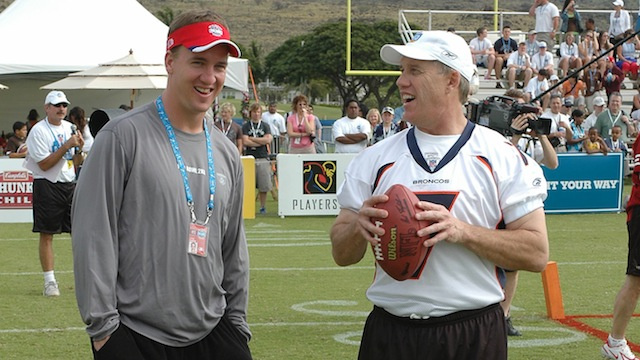
And then John said to Peyton, 'Tim Tebow.'
Fifteen days into its infancy, Football Perspective has published fifteen posts. If you are enjoying the site, be sure to check back every day for a new post. You can also become one of the 850+ people to “like” Football Perspective on Facebook. You can also follow me on twitter. Enough of a site update: on to today’s post.
Unlike most sports writers, I don’t know a lot about what will happen this season. But there’s one thing I do know: the Denver Broncos aren’t going to rank 32nd again in pass attempts again. The Tebow Broncos, an offense with an inexperienced quarterback and a confused offensive coordinator, completed just 217 passes last season. That was the lowest in the league, and the lowest since the ’09 Jets, a team that boasted the number one rushing attack and defense in the league — and Mark Sanchez.
Setting aside those years where the league scheduled more games in the following season, the table below shows the teams with the largest increase in completions from one year (that’s the year listed in the table) to the next:
[continue reading…]
Tagged as:
Bill Walsh,
Broncos,
Peyton Manning,
Tim Tebow
{ }
by Chase Stuart
on June 28, 2012
[Five years ago, my friend and Pro-Football-Reference.com founder Doug Drinen wrote the predecessor to todaay’s article, but refused to go with this title. The principles remain fundamental to advanced analysis of any sport, so today I’ll be revisiting them with current examples.]
Our brains are really good at making connections and finding patterns. In The Believing Brain, Michael Shermer argued that we’ve made it to where we are today precisely because of our ability to do just that:
A human ancestor hears a rustle in the grass. Is it the wind or a lion? If he assumes it’s the wind and the rustling turns out to be a lion, then he’s not an ancestor anymore. Since early man had only a split second to make such decisions, Mr. Shermer says, we are descendants of ancestors whose “default position is to assume that all patterns are real; that is, assume that all rustles in the grass are dangerous predators and not the wind.”
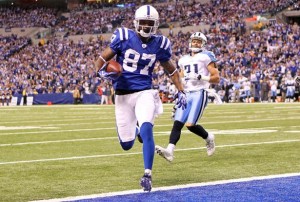
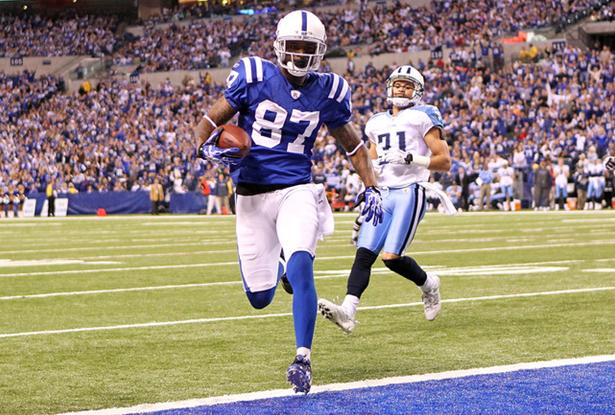
Reggie Wayne dominates when seeing blue.
Of course,
not all patterns are real, and sometimes that rustle is just the sound of the wind. Just because you see a surprising split — maybe a player dominated the second half of the season after a slow start — doesn’t mean that the “trend” is real. For example, here are some splits from the 2011 season:
Reggie Wayne was much better against teams that wear the color blue than when facing teams that have no blue in their uniforms. Here is his weekly production (the last column represents his fantasy points) when playing against teams that do not have blue as a color in their uniform:
| Week | Opp | Rec | Yd | TD | FP |
| 17 | jax | 8 | 73 | 0 | 15.3 |
| 5 | kan | 4 | 77 | 0 | 11.7 |
| 6 | cin | 5 | 58 | 0 | 10.8 |
| 2 | cle | 4 | 66 | 0 | 10.6 |
| 4 | tam | 4 | 59 | 0 | 9.9 |
| 14 | rav | 4 | 41 | 0 | 8.1 |
| 9 | atl | 4 | 30 | 0 | 7.0 |
| 7 | nor | 3 | 36 | 0 | 6.6 |
| 3 | pit | 3 | 24 | 0 | 5.4 |
| 10 | jax | 3 | 13 | 0 | 4.3 |
| Avg | | 4.2 | 47.7 | 0 | 9.0 |
[continue reading…]
{ }
by Chase Stuart
on June 27, 2012
Gene Stallings coached in the NFL in the late ’80s, in between the Jim Hanifan and Joe Bugel eras of Cardinals football. He was the man who led the team as the franchise relocated from St. Louis to Phoenix. He coached under Tom Landry for over a decade in Dallas. But Gene Stallings will always be remembered for working under Bear Bryant and for embodying what it meant to coach Alabama football.
Stallings played on Bryant’s famous Junction Boys team at Texas A&M, and coached under Bryant when the Crimson Tide won national championships in ’61 and ’64. After his failed stint in the NFL, Stallings returned to Alabama, this time as the head coach. His crowning achievement was winning the 1992 national championship, capping a 13-0 season.
So why the background on Stallings today? One of the fun things about owning a website is seeing where your traffic comes from. I noticed a bunch of hits were coming from RollBamaRoll.com. So I went to the site to see what was driving the traffic (as it turns out, a random link to this passer rating article) and I found this great quote by Stallings on another page:
Everyone keeps talking about our game with Miami [in the 1993 Sugar Bowl]. The reason we won against Miami is this: We had the ball 15 minutes more than they did. We ran the ball for 275 yards against Miami. They ran the ball for less than 50 yards. When the game was over, we won. After a game, it may not look good. The alumni may be asking why we are not entertaining them. Let me assure you that our job is to win football games. You win football games by running the ball, stopping the run and being on the plus side of giveaway-takeaways.
You get five pass attempts and no more.
I think every coach at every level has, at some point, uttered a phrase to essentially the same effect. It is quintessential Alabama football, but it could have just as easily come out of the mouth of
Greasy Neale or
Bill Cowher or
Vince Lombardi. Of course, whenever I read a quote like that, two immediate questions come to mind. Is it true? And how can I determine if it’s true?
[continue reading…]
Tagged as:
Alabama,
Crimson Tide,
Gene Stallings
{ }
by Chase Stuart
on June 26, 2012

Now just hold on. I never said you are what your record in close games says you are.
Which coaches have the best records in close games? That’s a complicated question that either means everything or nothing, depending on whom you ask. But putting aside what it means, what are the actual results?
I defined a close game as one where a team was trailing or leading by three points entering the 4th quarter since 1940.
The table below shows the coaching records in close games for all coaches who were head coaches in at least 20 close games. You can use the search box below to search for any individual coach. Note that coaches who coached prior to 1940 are included, but only their performances in games beginning in 1940 are listed below.
[continue reading…]
Tagged as:
Bill Belichick,
Bill Parcells,
Norv Turner,
Vince Lombardi
{ }
by Chase Stuart
on June 25, 2012
Jimmy Graham's invisible mirror displays his uniform as aesthetically pleasing
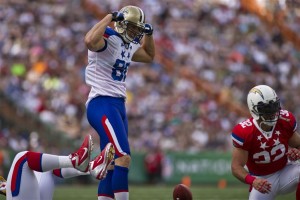
Last year, Jimmy Graham broke Kellen Winslow’s record for receiving yards in a single season by a tight end. Winslow gained 1,290 yards as a second-year player in 1980 for the San Diego Chargers. Last year, Graham finished with 1,310 receiving yards in his second season, while also catching 99 passes and scoring 11 touchdowns. Graham broke Winslow’s 31-year-old record, but Graham was leapfrogged in about fifteen minutes. By the end of the last Sunday of the regular season, Rob Gronkowski had upped his total to 1,327 yards, making him the new single-season leader in receiving yards and receiving touchdowns by a tight end.
Jason Witten and Aaron Hernandez each topped 900 receiving yards in 2011, and Tony Gonzalez, Antonio Gates and Vernon Davis remain among the game’s elite at the position. It would not be difficult to argue that we’re in a golden age of tight ends. There’s no doubt that passing has increased in both quantity and quality; have tight ends been the biggest beneficiaries of that change?
I examined every season in the NFL since 1970, when the AFL and NFL merged. I then calculated the percentage of receiving yards for each team that went to its running backs, tight ends and wide receivers. The table below shows those results.
[continue reading…]
Tagged as:
1978 Rules Changes,
Jimmy Graham,
Rob Gronkowski,
Tight Ends
{ }
by Chase Stuart
on June 24, 2012

Hines Ward chokes up once he realizes he's no longer the active leader in career receiving yards
and
Derrick Mason had been the wide receivers with the most receiving yards in the league among active players. Both topped the 12,000 yard mark, and both subsequently retired this off-season. Who is the current active leader in receiving yards at the wide receiver position (
Tony Gonzalez is the current leader among all players)?
| Trivia hint 1 |
SelectShow |
He is now playing for his 5th team.
|
| Trivia hint 2 |
SelectShow |
He’ll be catching passes from a former #1 overall pick this season.
|
| Trivia hint 3 |
SelectShow |
He went to Marshall University.
|
| Click 'Show' for the Answer |
SelectShow |
Indianapolis Colt Reggie Wayne is the current active leader with 11,708 career receiving yards. Thanks to Pat in the comments, who looks to be better at trivia than me. The correct answer is Randy Moss, who missed the entire 2011 season but is signed with the San Francisco 49ers for this upcoming year. You can see a full list of career receiving yards among players who were active in 2011 here
|
Tagged as:
Weekend Trivia
{ }
by Chase Stuart
on June 23, 2012
Peter Read Miller won the Dave Boss Award of Excellence for the 2005 Action Photo of the Year with this outstanding photo of Tomlinson.
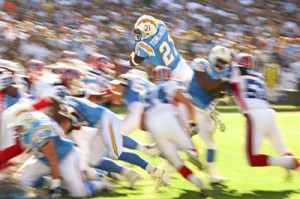
On the eve of LaDainian Tomlinson’s retirement announcement, SI’s Peter King named his top-five most versatile runners of the last 30 years. Declaring Walter Payton just outside the time period, King selected Marshall Faulk, Tomlinson, Thurman Thomas, Darren Sproles, and Marcus Allen as his most versatile running backs since 1982.
There are many ways to quibble with his list, but let’s turn this into a bit of trivia. Defining versatile is subjective, but for purposes of this trivia question, I’ll define versatile as any season by a running back where he:
- Caught at least 50 passes
- Gained at least 1400 yards from scrimmage
- Averaged at least 4.5 yards per carry
Tomlinson (4), Faulk (3) and Thomas (2) each had multiple seasons where they reached all three bench marks. Marcus Allen did it once, in 1985; Sproles has never done it (he had only 1313 yards from scrimmage last year, a career high).
Tomlinson ranks 2nd over the past 30 years in most “versatile” seasons. But one running back reached all three benchmarks in six different seasons. Can you guess who?
| Trivia hint 1 |
SelectShow |
He played in, but did not win, a Super Bowl.
|
| Trivia hint 2 |
SelectShow |
He retired early, at the age of 31.
|
| Trivia hint 3 |
SelectShow |
He was drafted in 1997 out of Virginia.
|
Tagged as:
LaDainian Tomlinson,
Weekend Trivia
{ }
by Chase Stuart
on June 22, 2012
On Tuesday, I looked at running back records and argued that Steven Jackson had taken the mantle from Ollie Matson as the most prominent elite running back to have toiled for losing teams for the majority of his career. It’s easy to feel bad for a player like Jackson, relegated to consistent attack as the focal point of opposing defenses for a decade, continuously grinding out yardage while playing for bad teams.
Things are a little different for wide receivers. In fact, it’s often easier for wide receivers to produce better stats while playing for bad teams, since trailing teams are forced to throw later in games. Further, wide receivers don’t face the constant pounding that running backs encounter, making them slightly less sympathetic figures. Still, it’s an interesting question, and one that’s easy enough to answer. Which wide receivers have played for the best and worst teams? Any guesses? The results, after the jump.
[continue reading…]
Tagged as:
Billy Howton,
Dante Lavelli,
Fred Biletnikoff,
Jerry Rice,
Reggie Wayne
{ }
by Chase Stuart
on June 21, 2012
Yesterday, I began looking at how the 12 expansion teams of the modern era fared during their first 13 years of existence. Today, the bottom half of the list:
#6 Cincinnati Bengals (1968-1980)
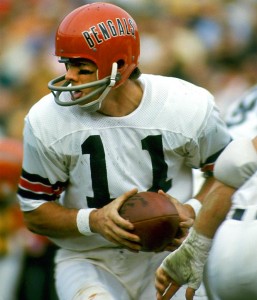
Art Modell purchased the Browns in 1961; Modell and Paul Brown, the only coach the franchise had ever known, clashed almost immediately. In January 1963, Modell fired Brown, who began plotting his revenge almost immediately. At the time, the AFL was gaining traction, but Brown had no desire to be in a “lesser” league. By the time the AFL had decided to add Cincinnati as an expansion franchise, the AFL and NFL had already agreed to merge prior to the start of the 1970 season. Brown was part of the ownership group that brought the Bengals into professional football, and became the team’s first head coach. One of his first decisions? Hiring a young Bill Walsh.
The Bengals played like a typical expansion team in 1968, but their hopes seemed to change the following season. With the 5th pick in the 1969 draft , Brown didn’t have to look far: he selected Cincinnati signal caller Greg Cook. The former Bearcat was an immediate star: his 9.4 yards per attempt average remains the highest ever by a rookie quarterback with at least 175 pass attempts. Cook led the AFL in completion percentage, yards per attempt and quarterback rating, but was mostly known for his powerful arm. His 17.5 yards per completion average that season has only been bested once since, and it remains the 12th highest mark in league history. Making the season more incredible was that Cook tore his rotator cuff against the Chiefs… in week three. Following surgery to repair his shoulder, Cook threw just three more passes, prompting many to wonder how great he could have been.
They're never going to expect the shallow cross.
Tagged as:
Browns,
Expansion
{ }
by Chase Stuart
on June 20, 2012
Thirteen years ago, the Cleveland Browns were preparing for their return to the NFL. The Browns were the dominant team of the ’50s and were a consistent playoff contender for much of the ’60s and ’80s. In 1996, Art Modell took the Browns to Baltimore and renamed them the Ravens. Three years later, the NFL gave the city of Cleveland an expansion franchise; unfortunately, the new Browns have struggled to find an identity or a direction for much of their first thirteen seasons.
Consider: since 1999, the Browns have the second worst record in football, trailing only the Detroit Lions. Cleveland has scored the fewest points in the league and been outscored by the most points since returning to the NFL. The Browns have been shutout 12 times, by far the most in the league over that span. The Browns and the Bills are the only teams to appear in only one playoff game since 1999, with neither team being victorious.
Symptomatic of the Browns’ failure to build a competitive team is the constant turnover at the most important positions. Assuming rookie Brandon Weeden starts in week one, he’ll be the 11th quarterback to start the season opener for the new Browns, and the sixth in six years. Pat Shurmur is Cleveland’s sixth head coach since returning to the league; Brad Childress is now their ninth offensive coordinator/play caller.
How do the Browns rank compared to other expansion teams? The Bears, Cardinals, Packers, Giants, Lions, Redskins, Steelers, Eagles and Rams all entered the league before 1940, making an apples-to-apples comparison impossible. The 49ers and Browns (v.1.0) entered the NFL from the All America Football Conference, so they weren’t expansion teams when they joined the NFL. The Baltimore Colts and their complicated history are probably best left off this list.
[continue reading…]
Tagged as:
Browns,
Expansion
{ }
by Chase Stuart
on June 19, 2012
Steven Jackson is the Ollie Matson of the 21st century. What does that mean? Before we answer that, take a look at Steven Jackson’s impressive career:
| Year |
Age |
Tm |
Att |
Yds |
TD |
Y/A |
Rec |
Yds |
Y/R |
TD |
YScm |
RRTD |
| 2004 |
21 |
STL |
134 |
673 |
4 |
5.0 |
19 |
189 |
9.9 |
0 |
862 |
4 |
| 2005 |
22 |
STL |
254 |
1046 |
8 |
4.1 |
43 |
320 |
7.4 |
2 |
1366 |
10 |
| 2006* |
23 |
STL |
346 |
1528 |
13 |
4.4 |
90 |
806 |
9.0 |
3 |
2334 |
16 |
| 2007 |
24 |
STL |
237 |
1002 |
5 |
4.2 |
38 |
271 |
7.1 |
1 |
1273 |
6 |
| 2008 |
25 |
STL |
253 |
1042 |
7 |
4.1 |
40 |
379 |
9.5 |
1 |
1421 |
8 |
| 2009* |
26 |
STL |
324 |
1416 |
4 |
4.4 |
51 |
322 |
6.3 |
0 |
1738 |
4 |
| 2010* |
27 |
STL |
330 |
1241 |
6 |
3.8 |
46 |
383 |
8.3 |
0 |
1624 |
6 |
| 2011 |
28 |
STL |
260 |
1145 |
5 |
4.4 |
42 |
333 |
7.9 |
1 |
1478 |
6 |
| Career |
|
|
2138 |
9093 |
52 |
4.3 |
369 |
3003 |
8.1 |
8 |
12096 |
60 |
[continue reading…]
Tagged as:
Ollie Matson,
Rams,
Steven Jackson
{ }
by Chase Stuart
on June 18, 2012
Which stats should be used to analyze quarterback play? That question has mystified the NFL for at least the last 80 years. In the 1930s, the NFL first used total yards gained and later completion percentage to determine the league’s top passer. Various systems emerged over the next three decades, but none of them were capable of separating the best quarterbacks from the merely very good. Finally, a special committee, headed by Don Smith of the Pro Football Hall of Fame, came up with the most complicated formula yet to grade the passers. Adopted in 1973, the NFL has used passer rating ever since to crown its ‘passing’ champion.
Nearly all football fans have issues with passer rating. Some argue that it’s hopelessly confusing; others simply think it just doesn’t work. But there are some who believe in the power of passer rating, like Cold Hard Football Facts founder Kerry Byrne. A recent post on a Cowboys fan site talked about Dallas’ need to improve their passer rating differential. Passer rating will always have supporters for one reason: it has been, is, and always will be correlated with winning. It is easy to test how closely correlated two variables are; in this case, passer rating (or any other statistic) and wins. The correlation coefficient is a measure of the linear relationship between two variables on a scale from -1 to 1. Essentially, if two variables move in the same direction, their correlation coefficient them will be close to 1. If two variables move with each other but in opposite directions (say, the temperature outside and the amount of your heating bill), the CC will be closer to -1. If the two variables have no relationship at all, the CC will be close to zero.
The table below measures the correlation coefficient of certain statistics with wins. The data consists of all quarterbacks who started at least 14 games in a season from 1990 to 2011:
| Category | Correlation |
| ANY/A | 0.55 |
| Passer Rating | 0.51 |
| NY/A | 0.50 |
| Touchdown/Attempt | 0.44 |
| Yards/Att | 0.43 |
| Comp % | 0.32 |
| Interceptions/Att | -0.31 |
| Sack Rate | -0.28 |
| Passing Yards | 0.16 |
| Attempts | -0.14 |
As you can see, passer rating is indeed correlated with wins; a correlation coefficient of 0.51 indicates a moderately strong relationship; the two variables (passer rating and wins) are clearly correlated to some degree. Interception rate is also correlated with wins; there is a ‘-‘ sign next to the correlation coefficient because of the negative relationship, but that says nothing about the strength of the relationship. As we would suspect, as interception rate increases, wins decrease. On the other hand, passing yards bears almost no relationships with wins — this is exactly what Alex Smith was talking about last month:
[continue reading…]
Tagged as:
Correlation Coefficient,
Passer Rating,
Regression
{ }
by Chase Stuart
on June 17, 2012
Happy Father’s Day to all the dads out there. Check back tomorrow for a post on quarterbacks, but first, here are a couple of trivia questions you can use at your barbeque, centering around the most famous father in the NFL.

The Mannings, lined up from most to fewest rings
As you may know,
Archie Manning has the lowest winning percentage of any quarterback in NFL history (minimum 50 games started). Manning finished his career with a 35-101-3 record, including an 0-10 record as a member of the Oilers and Vikings in the early ’80s.
Since Manning retired, three more quarterbacks have lost at least 100 games. Can you name them?
| Player 2 Hint |
SelectShow |
This player was drafted by the Falcons.
|
| Player 3 Hint |
SelectShow |
This player was coached by Bill Belichick.
|
But Peyton and Eli’s dad wasn’t the first quarterback to record 100 losses. So today, see if you can stump your dad with this trivia question: Who was the first NFL QB to lose 100 regular season games?
| Trivia hint 1 |
SelectShow |
He was a 9-time Pro Bowler.
|
| Trivia hint 2 |
SelectShow |
He finished and started his career with the same team, but played for a different franchise for five years in the middle of his career.
|
| Trivia hint 3 |
SelectShow |
He lost his 100th game in 1977, in week 1 against the Cowboys.
|
Tagged as:
Archie Manning,
Weekend Trivia
{ }
by Chase Stuart
on June 16, 2012
Every once in awhile, I’ll post some random trivia. I’ll include three hints, each making the answer progressively easier to guess. See how early you can guess the answer, and post your results in the comments. As always, the honor system will be strictly enforced.
Can you name the only team to never have a player record 90 receptions in a season?
| Trivia hint 1 |
SelectShow |
The team’s single season receptions record was set by a tight end.
|
| Trivia hint 2 |
SelectShow |
Not only that, but another tight end tied the record over two decades later.
|
| Trivia hint 3 |
SelectShow |
This team has not made the playoffs since 2002.
|
Tagged as:
Weekend Trivia
{ }
by Chase Stuart
on June 15, 2012
Justin Blackmon was the first receiver selected in April’s draft. What are the odds that the former Oklahoma State Cowboy will be the best rookie receiver in 2012? And how likely is it that Blackmon will ultimately be the best receiver out of his class?
In some ways, it’s an unfair question. There were 33 receivers selected, including six in the first two rounds. The likelihood of Blackmon being the most productive is certainly greater than 1 out of 33, but how much greater is it?
We don’t know, and we won’t know until his career (and the careers of his draft mates) ultimately unfolds, but we can speculate based on historical results.
Since the NFL merger, how frequently has the top drafted receiver ended up being the best rookie? Five out of 42 times, the top-selected rookie led his draft class in receiving yards that season. Believe it or not, before A.J. Green did it last season, Chicago’s Willie Gault in 1983 was the last to do so. The table below lists the top rookies selected in each of the last 42 drafts, along with their overall draft pick, and the number of receiving yards they recorded as rookies. The last two columns list the top rookie receiver (by receiving yards) and what percentage of that number of receiving yards the highest drafted rookie achieved.
[continue reading…]
Tagged as:
Jaguars,
Justin Blackmon
{ }