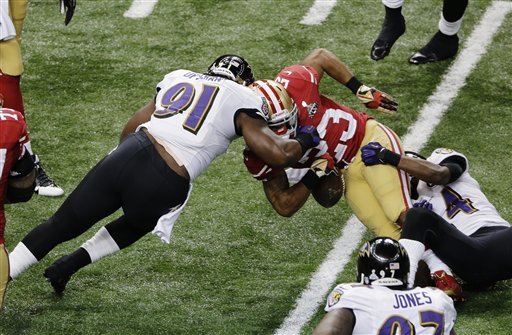
by Chase Stuart
on February 17, 2013

Those are some clutch shirts.
We all know that
Tom Brady set the single-season passing touchdowns record in 2007, when he threw 50 touchdowns as the New England Patriots went 16-0. That broke
Peyton Manning‘s mark of 49 touchdowns in 2004. And I think most of us know that prior to Manning,
Dan Marino had set the NFL record with 48 touchdowns in 1984.
Marino’s touchdown record stood for 20 years, but do you know who held the record before Marino? Believe it or not, the previous record stood for even longer. Before we get to the hints, here are two freebies.
The quarterback still holds his franchise’s record for passing touchdowns in a season. And he is the last quarterback to set the single-season passing touchdowns record twice in his career.
| Trivia hint 1 |
SelectShow |
The quarterback in question threw 36 touchdowns. It’s worth pointing out that George Blanda threw 36 touchdowns in 1961 in the AFL, but I am excluding him for the purposes of this trivia question.
|
| Trivia hint 2 |
SelectShow |
The record was set in 1963.
|
| Trivia hint 3 |
SelectShow |
He played for the New York Giants.
|
| Click 'Show' for the Answer |
SelectShow |
In 1963 Y.A. Tittle threw 36 touchdown passes, breaking the NFL record of 33 set by… Tittle in 1962. Prior to that, Sonny Jurgensen (32, 1961) and Johnny Unitas (32) had been the only quarterbacks in NFL history to throw for 30 touchdowns in a season (and only Unitas did it before the NFL expanded to a 14-game schedule.)
|
Tagged as:
Weekend Trivia
{ }
by Chase Stuart
on February 16, 2013

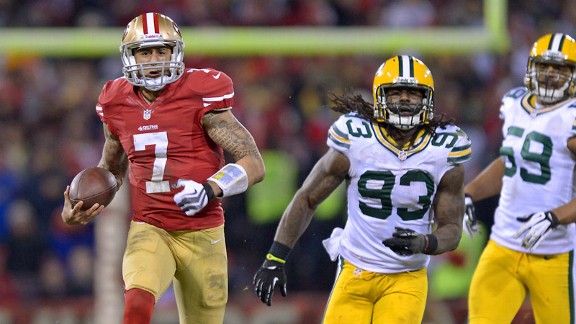
The Packers forgot to tackle the quarterback.
It’s hard not to be amazed by the seasons that
Colin Kaepernick,
Robert Griffin III and
Russell Wilson had as first-year starters in 2012. It’s playing around with the cut-offs to an absurd degree, but prior to 2012, only six men in NFL history had ever:
- Averaged 7.9 yards per attempt on at least 200 passes
- Average at least 5.0 yards per carry on at least 50 rushes
You probably wouldn’t be surprised to know that Fran Tarkenton, Steve Young, Daunte Culpepper, Michael Vick, and Aaron Rodgers were five of the players to accomplish this feat. Then, in 2012, Kaepernick, Griffin, and Wilson joined the list, as did Cam Newton.
But can you name the remaining member of the 7.9/200/5.0/50 club?
| Trivia hint 1 |
SelectShow |
He was the second member to join, doing so in 1971.
|
| Trivia hint 2 |
SelectShow |
No, it wasn’t Bobby Douglass, but he played in the same division as the former Bears quarterback.
|
| Click 'Show' for the Answer |
SelectShow |
Greg Landry made his only Pro Bowl in 1971, when he threw for 2,237 yards (averaging 8.6 yards per attempt) and 16 touchdowns, while also rushing 76 times for 530 yards (7.0 YPC average) and 3 touchdowns.
|
Tagged as:
Weekend Trivia
{ }
by Chase Stuart
on February 15, 2013
On Monday, I argued that target data has some predictive value. I wanted to update that post with a few observations.
Wide Receiver Targets
In the original post, I looked at year-to-year data for all players with at least 500 receiving yards in Year N and at least 8 games played for the same team in Years N and N+1. But it makes more sense to limit the sample to only wide receivers if we want to predict how wide receivers project in the next season.
There are 554 pairs of wide receiver seasons that meet the above criteria. The best fit formula to project future receptions based on prior receptions and prior targets is:
Year N+1 Receptions = 14.0 + 0.547 * Yr_N_Rec + 0.124 * Yr_N_Tar
The R^2 is 0.39, and while the receptions variable is statistically significant by any measure, the targets variable just barely qualifies (p = 0.044) as such. Still, this tells us that for every 8 additional targets a receiver sees in Year N, we can expect one more reception in Year N+1, holding his number of receptions equal.
If we want to project receiving yards instead of receptions, we get:
Year N+1 Receiving Yards = 180.3 + 0.434 * Yr_N_RecYd + 2.55 * Yr_N_Tar
The R^2 is 0.33, implying a slightly less strong relationships, which makes sense: yards are more variable to large outliers than receptions, so you would expect receiving yards to be slightly harder to predict. Another interesting note: the targets variable here is statistically significant at the p = 0.0003 level, and as expected, the receiving yards variable is statistically significant at all levels. Holding receiving yards equal, a receiver would need an additional 19 targets to increase his projected number of receiving yards by 50, so the practical effect may not be all that large.
Addressing the multicollinearity problem
[continue reading…]
Tagged as:
Calvin Johnson,
Targets,
WR Project
{ }
by Chase Stuart
on February 14, 2013
There have been 35 quarterbacks in NFL history to throw for at least 30,000 yards. Given enough time, you could probably guess that Drew Bledsoe, Jim Kelly, and Steve McNair are three of them. All three have something else in common: they were all born on February 14th.
If we drop the cut-off to 16,000 yards, we jump to 125 quarterbacks but get to include David Garrard, another Valentine’s Day baby. With 366 possible birthdays, it’s pretty incredible that four out of a random group of 125 people would have the same birthday. Consider that no one born on any the following seven days — January 30th, March 4th and 30th, April 9th and 13th, and June 12th and 21st — has ever gained a single passing yard in NFL history.
But wait, there’s more: If we drop the threshold to 3,500 passing yards, we get to include Patrick Ramsey and Anthony Wright. Those guys may not impress you, but consider that only 310 players have thrown for 3,500 yards. That means dozens of days have zero quarterbacks with 3,500 yards, so slotting in Ramsey and Wright as QB5 and QB6 on your birthday dream team is pretty damn good. February 13th, for example, has Jim Youel as its top passer, and he only collected 849 yards. Yesterday’s number two slot goes to the greatest receiver of all-time to ever play with Aaron Brooks (106 yards), outpacing Drew Henson and his 98 career yards. Clearly, passing yardage is for lovers.
[continue reading…]
Tagged as:
Parenting Advice
{ }
by Chase Stuart
on February 13, 2013
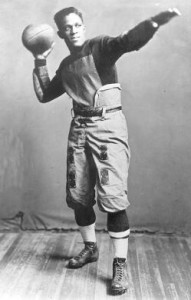
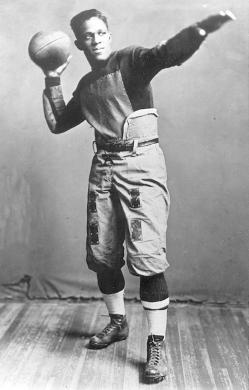
Fritz Pollard, the first African American coach and quarterback in the NFL.
Five years ago, I wrote a
four part series detailing the
history of the black quarterback. With February being Black History Month and Super Bowl XLVII marking the 25th anniversary of
Doug Williams becoming the first black quarterback to win a Super Bowl, I figured it was worth another trip down memory lane.
The history of black quarterbacks in professional football is complicated. As recently as 2007, the New York Giants had never had a black quarterback throw even a single pass. On the other hand, as far back as 1921, Frederick Douglass “Fritz” Pollard not only quarterbacked the Akron Pros, but was also the first black head coach in NFL history. A year earlier, Pollard and Bobby Marshall were the first two black players in professional football history and helped the Pros win the championship in the NFL’s inaugural season. The Pros ran the single-wing, and Pollard was the player lined up behind the center who received the snaps. At the time the forward pass was practically outlawed, so Pollard barely resembles the modern quarterback outside of the fact that he threw a few touchdown passes during his career.
According to the great Sean Lahman, at least one African American played in the NFL in every year from 1920 to 1933, although Pollard was the only quarterback. Beginning in 1934, that there was an informal ban on black athletes largely championed by Washington Redskins owner George Marshall. It wasn’t until 1946 that black players were re-admitted to the world of professional football, when UCLA’s Kenny Washington and Woody Strode were signed by the Los Angeles Rams; in the AAFC, Bill Willis and Marion Motley were signed by Paul Brown’s Cleveland Browns that same season.
[continue reading…]
{ }
by Chase Stuart
on February 12, 2013
Reggie Wayne led the NFL in targets last year, but that’s a little misleading since the Colts ranked 6th in pass attempts. As a percentage of team targets, Wayne ranked second in the league, but he was a distant number two to Brandon Marshall, who saw two out of every five Bears passes in 2013.
But that doesn’t make him the best receiver. It was easier for Marshall to receive a high number of targets because the rest of the Chicago supporting cast was weak, so Jay Cutler consistently looked Marshall’s way. Chicago ranked 25th last year in Adjusted Net Yards per Attempt, so essentially we have a player on a bad passing offense receiving a ton of targets. It’s not all that obvious how you compare a player like that to Roddy White, who deserves credit for being in a great passing offense but loses targets because of the presence of Julio Jones and Tony Gonzalez (of course, without them, would Matt Ryan start looking like Jay Cutler?)
I identified the leader in targets for each team, and then calculated the percentage of team targets each leading receiver had in 2012. The table below lists that percentage on the Y-Axis; the X-Axis represents the number of ANY/A that player’s team averaged. Someone like Marshall (represented by the first four letters of his last name and the first two letters of his first name, MarsBr) will therefore be high and to the left, while Randall Cobb is low and to the right:

[continue reading…]
Tagged as:
Brandon Marshall,
Calvin Johnson,
Michael Crabtree,
Targets,
WR Project
{ }
by Chase Stuart
on February 11, 2013
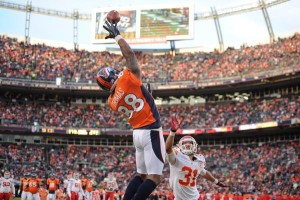
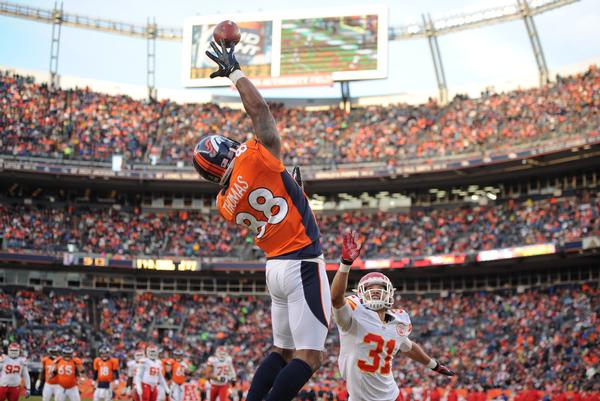
Demaryius Thomas made the most of his targets in 2012.
In 2007, Doug Drinen and I wrote a
pair of
articles discussing our views on targets. I’m working on a
wide receiver project this off-season, and a complete discussion of receiving statistics includes a discussion of targets.
Let me start with the prevailing few: targets are important, and if two receivers have the same production on a different number of targets, the one who produced on fewer targets is better/more valuable. Similarly, if all else is equal, the receiver with a higher catch rate — calculated as catches/target — is the better/more valuable one.
There are some problems with the prevailing view. By placing targets in the denominator of a formula, we’re implying that targets are a bad thing, or at a minimum, an opportunity wasted. But targets aren’t like pass attempts. Pro Football Focus has a stat called yards per pass route run, and that actually is the receiver version of yards per pass attempt.
But targets don’t help identify the player who deserves blame: on a random incomplete pass, assume three receivers are running routes, and one of them is targeted. Absent a drop, I have a hard time saying that of the three wide receivers, the targeted one did the worst of the three. If we grade a receiver by his yards per route run, each receiver is equally penalized with one route run on the play; if we grade a receiver by yards per target, the two wide receivers that did not get open are not penalized, while the one that was targeted is penalized. That seems fundamentally wrong to me.
Here’s another problem: In a broad sense, the player with more targets (or percentage of his team’s targets) is in a very real sense a bigger part of his team’s offense. Either he’s open more often, or the quarterback is throwing in his direction even when he’s not open (whether because the coaches call more plays for him or because he’s earned the quarterback’s trust). In any event, the target itself is an indicator of quality, and penalizing a player — which is what you do when you place targets in the denominator — for an event that is highly correlated with quality is not something I’m comfortable doing.
[continue reading…]
Tagged as:
Targets,
WR Project
{ }
by Chase Stuart
on February 10, 2013
San Diego’s Danario Alexander caught 37 passes for 658 yards and 7 touchdowns in 10 games last year. Those might not look like great numbers, but when Philip Rivers looked his way, Alexander tended to produce. Alexander only saw 62 targets last season, but led the league with a 10.6 yards-per-target average (minimum 50 targets). Since 2000, there have been 21 receivers to average at least 11 yards per target on 50 targets.
I’ve blanked out the first two rows, because the same player has recorded the two highest yards/target seasons over the last thirteen years. Can you guess who it is?
[continue reading…]
Tagged as:
Danario Alexander,
Targets,
WR Project
{ }
by Chase Stuart
on February 9, 2013
In an effort to prove that bloggers actually go to bars and to reassure you that you know more about football than your average bar patron…
I was at a bar the other night when it was revealed that it was Trivia Night. Once I heard that the first category was NFL, I decided to throw my hat into the ring. The topic was “2013 Hall of Fame candidates.” (this was before the 2013 Class was announced.)
I feel pretty confident that the average Football Perspective reader would have no trouble answer these questions, although I will admit that they struck me as slightly harder than the level of questions I would expect at a typical bar trivia night.
Question 1: Which six-time Pro Bowl running back started his career in Los Angeles and ended it in the Super Bowl?
Question 2: Which eleven-time Pro Bowler played his entire career with the Baltimore Ravens?
{ }
by Chase Stuart
on February 8, 2013
NFL.com posted an article yesterday looking at the strength of schedule for each team in 2013. We have known each team’s opponents since the end of the regular season, and while the full schedule won’t come out until April, it’s simple to calculate a team’s strength of schedule for 2013. Usually, the media reports this by looking at the win-loss record of each opponent from the prior season. Here are the projected SOSs for each team next season:
| Team | SOS | Opponent record |
| Carolina Panthers | 0.543 | 138-116-2 |
| Detroit Lions | 0.539 | 138-118-0 |
| New Orleans Saints | 0.539 | 137-117-2 |
| St. Louis Rams | 0.539 | 137-117-2 |
| Baltimore Ravens | 0.535 | 137-119-0 |
| Green Bay Packers | 0.533 | 136-119-1 |
| Arizona Cardinals | 0.52 | 131-121-4 |
| Miami Dolphins | 0.52 | 133-123-0 |
| San Francisco 49ers | 0.52 | 132-122-2 |
| Minnesota Vikings | 0.516 | 132-124-0 |
| Seattle Seahawks | 0.516 | 130-122-4 |
| Cincinnati Bengals | 0.508 | 130-126-0 |
| Jacksonville Jaguars | 0.508 | 129-125-2 |
| New England Patriots | 0.508 | 130-126-0 |
| Atlanta Falcons | 0.504 | 128-126-0 |
| Chicago Bears | 0.502 | 128-127-1 |
| Tampa Bay Buccaneers | 0.5 | 127-127-2 |
| Washington Redskins | 0.498 | 127-128-1 |
| New York Jets | 0.496 | 127-129-0 |
| Philadelphia Eagles | 0.496 | 127-129-0 |
| Cleveland Browns | 0.492 | 126-130-0 |
| Pittsburgh Steelers | 0.496 | 126-130-0 |
| Tennessee Titans | 0.488 | 124-130-2 |
| New York Giants | 0.48 | 123-133-0 |
| Dallas Cowboys | 0.48 | 121-134-1 |
| Buffalo Bills | 0.473 | 121-135-0 |
| Houston Texans | 0.473 | 120-134-2 |
| Kansas City Chiefs | 0.473 | 121-135-0 |
| Oakland Raiders | 0.469 | 120-136-0 |
| Indianapolis Colts | 0.461 | 117-137-2 |
| San Diego Chargers | 0.457 | 117-139-0 |
| Denver Broncos | 0.43 | 110-146-0 |
[continue reading…]
Tagged as:
SOS
{ }
by Chase Stuart
on February 7, 2013
The table below lists every retired number for each of the 32 franchises. It also lists each player’s career AV (starting in 1950), position(s), and years with the team. Each column is sortable, and you can use the search box to search by team (or uniform number, or position, or anything else); you can also change how many rows are shown by clicking on the dropdown box on the left.
[continue reading…]
Tagged as:
Player deaths,
uniforms
{ }
by Chase Stuart
on February 6, 2013
The off-season is here.
But Football Perspective isn’t going anywhere. I prefer off-season writing to in-season writing, as football theory and history is more compelling to me than figuring out whether to rank the Lions ahead of the Bills. At the old Pro-Football-Reference Blog, we did some of our best work in the off-season, and I hope for the same results here.
Evan Silva just published a great piece detailing what each team needs in the off-season, but you’re not going to find that type of article here in the off-season. I will have some draft articles, but I don’t intend on staying topical all that often. My first big off-season project is to come up with a wide receiver ranking system.
I won’t bore you with all the details yet, but I think grading wide receivers (or for that matter, receiving tight ends) is much, much more complicated than people realize. I hope you guys are excited to participate the discussion, as I am in the early stages of this project and will go where the research takes me. One possible result I envision: the ultimate wide receiver ranking system does not exist, but a series of four or five ranking systems might give us the complete picture of a wide receiver.
Let me start with a question: which team had a better passing offense last year, Houston or Detroit? For now, try to ignore what we saw out of Matt Schaub in the post-season and just focus on the regular season results.
[continue reading…]
Tagged as:
Andre Johnson,
Calvin Johnson,
WR Project
{ }
by Chase Stuart
on February 5, 2013

A year after having a sack in the BCS National Championship Game, Upshaw forced a key fumble in the Super Bowl.
Aaron Wilson
of the Baltimore Sun pointed out an interesting bit of trivia today:
Courtney Upshaw has now won back-to-back titles in college and the NFL. Back in October 2009, the Minnesota Vikings were 5-0, and new additions
Brett Favre and rookie
Percy Harvin were a big part of their success. Harvin had won the
national championship with Florida and
Tim Tebow in 2008, and I wondered: how often
does a player win a national championship in college and then win the Super Bowl the next season?
As of that post, only three players had won a college championship their last season in college and then were starters on a Super Bowl champion the following year: Randall Gay (LSU 2003, New England 2004), William Floyd (Florida State 1993, San Francisco 1994) and Tony Dorsett (Pittsburgh 1976, Dallas 1977).
So, has that changed? In 2009 the Saints won the Super Bowl, but they had no rookies from Florida. Alabama won the BCS Championship in 2009 and had seven players drafted in April 2010, but none of them landed on the Packers. The next year Cam Newton and Nick Fairley helped the Auburn Tigers win the championship, but none of their players found themselves as New York Giants a year later. In 2011, the Crimson Tide won another national title, and Courtney Upshaw was named the Defensive MVP of the game. Alabama defeated LSU in the Super Dome, the site of where Upshaw’s Ravens just won the Super Bowl.
With nine starts, Upshaw qualifies as a “starter” on the Ravens, so he joins Dorsett, Floyd, and Gay as the only players to to start for a Super Bowl champion a year after winning the national championship. In an odd twist, if we require a player to start for the two teams, Gay drops off the list: he was a nickel back on the 2003 LSU Tigers, behind future NFL cornerbacks Corey Webster and Travis Daniels. Dorsett has the most impressive two-year run, as he ran for for 1,948 yards and 21 touchdowns and won the Heisman Trophy for the Panthers in ’76 and then rushed for 1,007 yards and 12 touchdowns for the Cowboys a year later.
[continue reading…]
Tagged as:
Alabama,
Courtney Upshaw,
Randall Gay,
Ravens,
Tony Dorsett,
William Floyd
{ }
by Chase Stuart
on February 5, 2013
“He’s the best coach in football right now.”
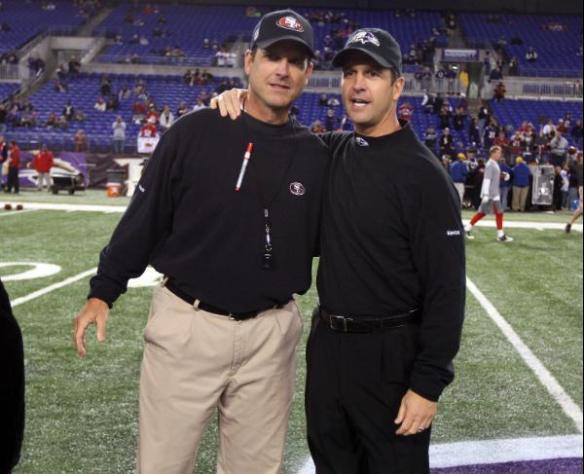
That was what John Harbaugh said about his little brother after the game. It’s hard to argue: I’ve said a few times that I think Jim Harbaugh is the best coach in the league, too. (Although I gave my mythical COTY vote to Pete Carroll.)
It was a classy thing to say by the winning coach, especially on a day where he outcoached his little brother. Actually, the more accurate way of putting it would be to say that “John Harbaugh made fewer bad decisions than Jim Harbaugh.” Let’s go through the game in chronological order
The First Snap
I’ve watched enough Jets games to know that there’s a certain level of horribleness that comes with having a pre-snap penalty at the start of a quarter or half. Maybe you don’t want to blame Jim Harbaugh for the 49ers lining up in an illegal formation on the first snap of the game, but let’s just say this: that’s not how the New York media would react if Rex Ryan’s team did that. Jim Harbaugh would be the first to tell you that it was inexcusable to have such a penalty on the first snap of the game, and the team didn’t look any more prepared on snap two, when Colin Kaepernick and Frank Gore were on the wrong page of a fake-handoff that instead went to Lennay Kekua.
[continue reading…]
Tagged as:
2-point conversions,
4th down,
Jim Harbaugh,
John Harbaugh,
Super Bowl
{ }
by Neil Paine
on February 4, 2013
Now that we live in a world where Joe Flacco and Eli Manning have quarterbacked 3 of the last 6 Super Bowl-winning teams, you might be tempted to think that winning a Super Bowl as a QB doesn’t mean what it used to. After all, the playoffs are getting more random — as Aaron Schatz pointed out last night, four of the last six Super Bowl champs have finished the regular season with 10 or fewer wins. So it stands to reason that, as the championship teams themselves post less-remarkable seasons, so too would their quarterbacks not be the cream of the crop. And for all of his postseason brilliance, Flacco was just the league’s 17th-best quarterback during the regular season. Does his ascendancy, coming on the heels of Manning’s, signal a new trend?
To answer that question, I turned to a methodology I’ve used many times before. The basic premise is that, to put modern and historical quarterbacks on an even playing field (no pun intended), you must translate their stats into a common environment. To do this, you take the quarterback’s stats from a given season, pro-rate to 16 scheduled games, and multiply by the ratio of the league’s per-game average during the season in question to that of a common reference season. For instance, if I’m adjusting Terry Bradshaw’s 1977 passing yards to the 1991-2012 period, I would multiply his actual total of 2,523 by (16/14) to account for the shorter season that year, then multiply that by (225.1/162.2) to account for the change in the league’s passing environment, giving an adjusted total of 4,001 yards.
After doing that for every QB season since the merger, I then plugged the translated stats into a regression formula that predicts Football Outsiders’ Yards Above Replacement based on the QB’s box score stats (including the standard cmp/att/yds/td/int, plus sacks, fumbles, and rushing stats). This gives us Estimated Yards Above Replacement (eYAR) a measure of total value for each QB season, adjusted for schedule length and league passing conditions, which is perfect for historical analysis.
To get an idea of what we’re talking about, here are Flacco’s career translated stats and eYAR numbers:
[continue reading…]
{ }
by Chase Stuart
on February 4, 2013
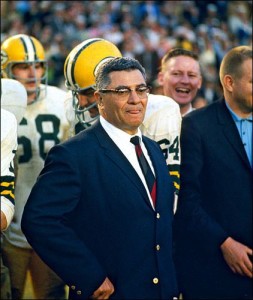
The winner of the first Super Bowl.
Congratulations to
Ray Lewis,
Ed Reed,
Joe Flacco, and the Baltimore Ravens on winning Super Bowl XLVII. The Ravens and 49ers treated us to an exciting Super Bowl, and
the Hall of Fame chances of
Terrell Suggs,
Haloti Ngata,
Matt Birk,
Anquan Boldin, and yes,
Joe Flacco, are a lot better today than they were 24 hours ago. And while most writers today will focus on the champions, I’m going to go in a different direction.
Two years ago, the 49ers were 6-10 and floundering; they had the 5th worst record in the league from 2004 from 2010 in the pre-Jim Harbaugh era. Today, San Francisco possesses arguably the NFL’s most talented roster and best coaching staff, but is coming off a painful loss in the title game.
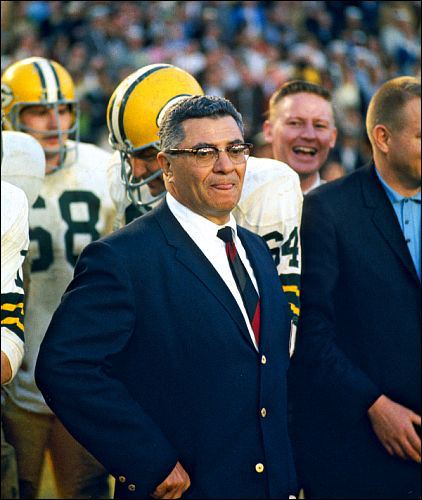
When I look at the 49ers, it’s hard not to see the striking similarities to an incredible turnaround executed 52 years ago. From 1953 to 1958, the Green Bay Packers were one of the league’s most poorly-run franchises. The team won just 20 games over that six-year period, the second fewest in the league. Vince Lombardi arrived in 1959, and the Packers won the NFL’s West Division in 1960, losing in the final seconds in the title game that year to Philadelphia. It was a heartbreaking loss, but the Packers used that game as motivation to win NFL titles in ’61, ’62, ’65, ’66, and ’67, with the latter two coming in the Super Bowl.
In 2011, I read and reviewed John Eisenberg’s excellent book That First Season: How Vince Lombardi Took the Worst Team in the NFL and Set It on the Path to Glory. Eisenberg looked at a subject that always fascinated me: the 1958 Packers, despite being the worst team in the league, had seven future Hall of Famers.
[continue reading…]
Tagged as:
49ers,
Jim Harbaugh,
Packers,
Vince Lombardi
{ }
by Chase Stuart
on February 3, 2013
Before we get to my preview, I feel the need to point you to some excellent Super Bowl previews I saw this week:
The Ravens can stop the zone read, but at what cost?
In Colin Kaepernick’s nine starts, the 49ers have averaged 159 rushing yards per game on 4.9 yards per rush and have rushed for 14 touchdowns; at the same time, they’ve averaged 8.1 ANY/A through the air. That makes them close to unstoppable, much like the Seahawks when Russell Wilson and Marshawn Lynch were dominating defenses over that same stretch.
The Packers chose to let Kaepernick beat them on the ground. He did.
For San Francisco, their dominance starts up front, and their offensive line needs only sustained success to rival what the lines of the ’90s Cowboys or ’00 Chiefs delivered. According to Pro Football Focus, left tackle
Joe Staley is the best tackle in the league, while right tackle
Anthony Davis is the second best run-blocking tackle in the league (behind only Staley). PFF ranks both
Mike Iupati and
Alex Boone as top-five guards in the league, and places both of them in the top three when it comes to run blocking. Center
Jonathan Goodwin also ranks as an above-average center, and the 34-year-old veteran is more than capable of anchoring a line filled with Pro Bowl caliber players. As if that wasn’t enough,
Vernon Davis is one of the top two-way tight ends in the league, while TE/H-Back/FB
Delanie Walker and FB
Bruce Miller provide excellent support in the run game.
Without any schematic advantage, the 49ers have enough talented beef up front to have a dominate running game. But add in what Jim Harbaugh and Greg Roman have been able to do with the Pistol formation and the zone read, and you have a running game that borders on unstoppable.
We saw that against the Packers, as Colin Kaepernick broke the single-game rushing record by a quarterback. The beauty of the zone read is that it gives the offense an extra blocker, an advantage the 49ers didn’t need. After the Packers were shredded by Kaepernick, the Falcons focused on containing the quarterback. Take a look at the photograph below, courtesy of Ben Muth of Football Outsiders.
[continue reading…]
Tagged as:
49ers,
Colin Kaepernick,
Frank Gore,
Joe Flacco,
Navorro Bowman,
Patrick Willis,
Playoffs,
Randy Moss,
Ravens,
Ray Lewis,
Super Bowl,
Torrey Smith
{ }
by Chase Stuart
on February 2, 2013

You are what your bust says you are.
The process took over eight hours this year, and according to Rick Gosselin, over one hour was spent on
Bill Parcells alone. Another HOF voter,
Tony Grossi, said that Parcells took 55 minutes and Art Modell was discussed for over a half hour, while
Cris Carter and
Jerome Bettis were the two most heavily-debated players.
When the committee concluded, they chose the following men as the newest members of the Pro Football Hall of Fame:
That means owners Art Modell and Edward Debartolo, Jr., along with Jerome Bettis, Charles Haley, Kevin Greene, Will Shields, Andre Reed, Tim Brown, Aeneas Williams, and Michael Strahan will have to wait at least one more year. When the committee narrowed the list from fifteen modern-era candidates to ten, Modell, DeBartolo, Shields, Brown and Greene were the five eliminated. Perhaps the biggest surprise is Strahan, but the pain is likely short-lived: I suspect he’ll be pretty happy getting inducted next year when the Super Bowl is his old stomping grounds.
A note about Carter. There have been 22 wide receivers to enter the NFL since World War II and wind up in the Hall of Fame. It took Carter six years to finally make the HOF, but that places him right in the middle of the pack:
{ }
by Chase Stuart
on February 2, 2013

Emmitt Smith was a product of the system, except when the system failed without him.
A week before the Super Bowl, I asked if you could
name the seven wide receivers to start for two different teams that reached the Super Bowl. In the comments to that post, JWL alerted me to a pretty cool piece of Super bowl trivia.
Eight different men have been the leading rusher in multiple Super Bowls. Seven of these men (Ahmad Bradshaw, New York Giants; Antowain Smith, New England Patriots; Terrell Davis, Denver Broncos; Emmitt Smith, Dallas Cowboys; Tony Dorsett, Dallas Cowboys; Franco Harris, Pittsburgh Steelers; and Larry Csonka, Miami Dolphins) pulled off this feat while playing for the same team.
However, one running has been the leading rusher in two Super Bowls for two different teams. He’s the subject of today’s trivia question. Can you name him?
| Trivia hint 1 |
SelectShow |
He rushed for 6,378 and 50 touchdowns in his career.
|
| Trivia hint 2 |
SelectShow |
He rushed for only 125 yards in his two Super Bowl appearances.
|
| Trivia hint 3 |
SelectShow |
He only played for two teams in his career: the Rams and the 49ers.
|
| Click 'Show' for the Answer |
SelectShow |
In 1979, Wendell Tyler rushed for 1,109 yards for the Rams and then 60 yards in Super Bowl XIV against the Steelers. Five years later, Tyler rushed for 1,262 yards for the 15-1 49ers. Then in Super Bowl XIX, he rushed for 65 yards, edging Joe Montana (59 yards) and Roger Craig (58) to lead the game in rushing.
|
Tagged as:
Super Bowl,
Weekend Trivia
{ }
by Chase Stuart
on February 1, 2013
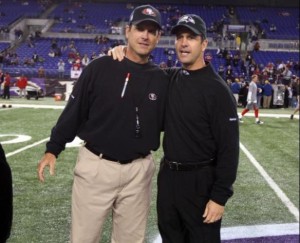
The puns this week are horribaughl.
I’m going to hold off until Sunday morning to post my Super Bowl preview, but today, I’m going to look at a possible hidden key to the game. In most playoff games, each coach is faced with a critical fourth down decision. Often times the conservative coach delays the decision to go for it in favorable circumstances early in the game only to be forced to do so in less optimal situations in the final minutes. We also know that in general, coaches frequently fail to go for it early in games when the down and distance dictate a more aggressive approach: even
Bill Belichick has been known to cost his team points with conservative fourth-down decisions, as he
did in the AFC Championship Game. Which leads to today’s post: Is one Harbaugh more or less aggressive than the other?
Let’s start with how each coach has performed in the regular season, beginning with Jim.
[continue reading…]
Tagged as:
Jim Harbaugh,
John Harbaugh
{ }
by Chase Stuart
on January 31, 2013
 In 2009, Doug produced a Super Bowl Squares post, itself a revival of his old Sabernomics post eight years ago. In those posts, Doug derived the probability of winning a squares pool for each given square (or set of numbers). Unsurprisingly, he found that those lucky souls holding the ‘7/0’ squares were in good shape, while those left holding the ‘2/2’ ticket were screwed. You can download the Sports-Reference Super Bowl Squares app here, which is free, and should help you taunt your guests at your Super Bowl party.
Let’s say that this year, your Super Bowl squares pool allows you to either pick or trade squares: if that’s the case, this post is for you. I looked at every regular season and postseason game from the last ten years. The table below shows the likelihood of each score after each quarter, along with three final columns that show the expected value of a $100 prize pool under three different payout systems. The “10/” column shows the payout in a pool where 10% of the prize money is given out after each of the first three quarters and 70% after the end of the game; the next column is for pools that give out 12.5% of the pool after the first and third quarters, 25% at halftime, and 50% for the score at the end of the game. The final column is for pools that give out 25% of the pot after each quarter — since I think that is the most common pool structure, I’ve sorted the table by that column, but you can sort by any column you like.
[continue reading…]
Tagged as:
Games,
Super Bowl
{ }
by Chase Stuart
on January 31, 2013
Ever wondered which Super Bowl teams were the oldest or youngest? I went and calculated the AV-adjusted age of every team to appear in the Super Bowl. (AV stands for Pro-Football-Reference’s Approximate Value system, which assigns an approximate value to each player in each season; you can read more about it here.) You can probably guess who the oldest team was, but the youngest might be a bit of a surprise. Baltimore and San Francisco both come in roughly in the middle of the pack, with the Ravens slightly older than the 49ers. This also jives with Football Outsiders’ snap-adjusted ages article.
Bill Barnwell wrote a good article yesterday summarizing the success of Ozzie Newsome, the Baltimore Ravens general manager. That made me curious to see what percentage (based on AV, not total players, naturally) of the players on each Super Bowl team had never before played for another team. Great general managers do more than build their teams through the draft (and Barnwell specifically praised Newsome for that, including the trade for Anquan Boldin), but the question of what percentage of the team is “homegrown” is still an interesting one.
For the Ravens, 73% of their players (as measured by AV) have never played for another team, with Boldin, Cary Williams, Jacoby Jones, Bryant McKinnie, Matt Birk, Bernard Pollard, Corey Graham, and Vontae Leach being some notable exceptions. On the other side, 75% of the 49ers have only worn the red and gold, although Justin Smith, Jonathan Goodwin, Randy Moss, Donte Whitner, Carlos Rogers, Mario Manningham (at least, in the regular season) were key contributors who are not home-grown 49ers.
When it comes to AV-adjusted age or measuring how ‘home-grown’ each team is, neither team really stands out from the pack. The ’78 and ’79 Steelers featured 22 starters that were all home-grown, although making placekicker Roy Gerela the lone outlier (and since AV does not include kickers, both Pittsburgh teams were at 100%).
In addition to the AV-adjusted ages and “home-grownness” of each Super Bowl participant, the table below includes where each team (since 1970) ranked in points for, points allowed, yards, and yards allowed, and whether or not the team won the game. The table is fully sortable and searchable, and the rows for San Francisco and Baltimore will remain highlighted after sorting.
[continue reading…]
Tagged as:
49ers,
AV,
Playoffs,
Ravens,
Super Bowl
{ }
by Chase Stuart
on January 30, 2013
I was planning on ignoring the latest Randy Moss news, using that word liberally as it applies to things said on media day. In case you missed it, Moss said yesterday that he believes he is the greatest receiver of all time. Moss is an obvious future Hall of Famer, but Jason Lisk gave Moss’ comments the appropriate treatment yesterday.
Today, though, Moss upped the ante by noting that “Jerry Rice had two Hall of Fame QBs his whole career. Give me that and see where my numbers are.” Yes, Rice was fortunate to play with Joe Montana and Steve Young, , but there is a pretty simple response to that. I wrote that response when Rice was a finalist for the Hall of Fame three years ago. You can read the full HOF profile I wrote on Rice, but I’ve reprinted Part III below:
[continue reading…]
Tagged as:
Jerry Rice,
Randy Moss
{ }
by Chase Stuart
on January 30, 2013

Not doing a squirrel dance.
On Sunday, I looked at how the
football legacies of certain Ravens would be affected by a win in Super Bowl XLVII; today I will do the same for the 49ers. And the best place to start is with the only surefire Hall of Famer on the team.
Randy Moss turns 36 in a couple of weeks, and he’s caught just 56 passes over the last three years. Super Bowl XLVII may not be his final game, but it probably will be Moss’ last chance to give us one final “Randy Moss” moment. Moss will one day be in the Hall of Fame, despite the fact that he rubbed many fans, sportswriters, teammates, coaches, owners, and a few referees the wrong way. But Moss is a six-time Pro Bowler, a four-time first-team AP All-Pro, and ranks 9th in career receptions, 3rd in career receiving yards, and 2nd in career receiving touchdowns. He’s had 64 100-yard games in his career, second only to Jerry Rice. He’s produced despite a relatively unstable quarterback situation for much of his career (admittedly, some of this was due to Moss): over one-third of his career receiving yards came from Daunte Culpepper, and no other single quarterback was responsible for even twenty percent of his yards. When he finally got a HOF-caliber quarterback, Moss broke the single-season record for receiving touchdowns in a season. But even before New England and Tom Brady, Moss had established himself as one of the greatest receivers in NFL history. If the 49ers win on Sunday, he’ll be like a modern Lance Alworth, who won a forgettable ring with the Dallas Cowboys in 1971.
It’s fitting that Patrick Willis and Ray Lewis are in the Super Bowl together. Willis was only 11 years old when Lewis entered the NFL, and Willis has modeled his game and his uniform number after Lewis. And in turn, if any linebacker has resembled Lewis over the last decade, it’s Willis, and there will be a figurative passing of the torch on Sunday. Even if he isn’t the next Ray Lewis, Willis has paved his own path towards Canton: he has been a first-team All-Pro choice by the Associated Press in five of his first six seasons. Lawrence Taylor, Eric Dickerson, Jerry Rice, Gale Sayers, and Reggie White are the only other NFL players since 1960 to be selected as a first-team AP All-Pro five or more times in their first six seasons. Absent a serious injury or a shocking career turn, Willis will one day be a Hall of Famer himself, but it sure can’t hurt to add a Lombardi Trophy to the resume.
[continue reading…]
Tagged as:
Aldon Smith,
Colin Kaepernick,
Jim Harbaugh,
Patrick Willis,
Randy Moss,
Super Bowl
{ }
by Chase Stuart
on January 29, 2013
Marty inquires as to whether Felix Wright's pilot light is out.
Last week, Neil brought us the latest iteration of
the Manning Index, showing which quarterbacks have overachieved in the playoffs relative to expectation (based off of the Vegas line). I’m going to do the same today for coaches. A couple of introductory notes:
Neil described the exact methodology in his quarterbacks post, so I won’t waste time repeating it. However, I wanted to look at coaches over an even longer period, and 1950 sounded like a good cut-off. Since we don’t have point-spread data for games from 1950 to 1977 , I simply used the projected point spread based on the differential between each team’s SRS ratings and by awarding the home team three points. So for pre-1977 games, coaches are credited with wins over expectation based on the SRS, and for post-1977, for wins over expectation based on the Vegas line. Here are the results.
[continue reading…]
Tagged as:
Bill Belichick,
Bill Parcells,
Joe Gibbs,
John Harbaugh,
Marty Schottenheimer,
Paul Brown,
Playoffs,
Tom Coughlin
{ }
by Chase Stuart
on January 28, 2013

Flaccoing?
In September,
I started a post by asking you to make this assumption:
Assume that it is within a quarterback’s control as to whether or not he throws a completed pass on any given pass attempt. However, if he throws an incomplete pass, then he has no control over whether or not that pass is intercepted.
If that assumption is true, that would mean all incomplete pass attempts could be labeled as “passes in play” for the defense to intercept. Therefore, a quarterback’s average number of “Picks On Passes In Play” (or POPIP) — that is, the number of interceptions per incomplete pass he throws — is out of his control.
After doing the legwork to test that assumption, I reached two conclusions. One, interception rate is just really random, and predicting it is a fool’s errand. Two, using a normalized INT rate — essentially replacing a quarterback’s number of interceptions per incomplete pass with the league average number of interceptions per incomplete pass — was a slightly better predictor of future INT rate than actual INT rate. It’s not a slam dunk, but there is some merit to using POPIP, because completion percentage, on average, is a better predictor of future INT rate than current INT rate.
So, why am I bringing this up today, at the start of Super Bowl week? Take a look at where Sunday’s starting quarterbacks ranked this year in POPIP (playoff statistics included, minimum 250 pass attempts):
[continue reading…]
Tagged as:
49ers,
Colin Kaepernick,
Donovan McNabb,
Joe Flacco,
POPIP,
Ravens
{ }
by Chase Stuart
on January 27, 2013

Lewis looks to cement his legacy.
Being a Super Bowl champion is a pretty nice bullet to place on your Hall of Fame resume. For players like
Jerry Rice or
Peyton Manning (or say,
Steve Largent or
Dan Marino), the failure to acquire a ring wouldn’t have prevented their induction; on the other hand, would
Lynn Swann or
Paul Hornung or a host of quarterbacks have made the HOF without a Super Bowl ring (or two, or three, or four?)
Just winning a Super Bowl guarantees nothing — Charles Haley and his five rings are on the outside looking in, as is Fuzzy Thurston, winner of six NFL titles. The borderline cases are the ones most helped or hurt by that Lombardi Trophy (or lack thereof) on the resume, and that class of players seems to be among the largest growing segment each year. So today, I’m going to take a look at how winning the Super Bowl could impact the legacies of certain Ravens.
Ray Lewis is a first ballot Hall of Famer regardless of what happens in Super Bowl XLVII, although his status as the game’s best inside linebacker of all-time might be boosted with a second Lombardi. The Ravens have been on a magical “Ride with Ray” and he’s been the face of a defense that’s turned from average in the regular season to excellent in the playoffs.
Ed Reed is another obvious Hall of Famer, even though unlike Lewis he was not a member of the 2000 Ravens teams that won the Super Bowl. Still, considering Troy Polamalu has appeared in three and won two of these games, Reed’s resume will look slightly less glamorous if he never is able to win a Super Bowl. And while it isn’t particularly relevant here, but I’ll just note that from 2005 to 2007, Bob Sanders made them a “Big Three” at the position, when Sanders won both a Super Bowl and a Defensive Player of the Year award. All three have battled injuries, showing just how dangerous the safety position can be in the NFL.
[continue reading…]
Tagged as:
Ed Reed,
Haloti Ngata,
Joe Flacco,
John Harbaugh,
Ray Lewis,
Ray Rice,
Super Bowl,
Terrell Suggs
{ }
by Chase Stuart
on January 27, 2013

Yes, that's a picture of the Lions in a Super Bowl post.
is back in the Super Bowl. Four years ago, Boldin and the Cardinals lost to the Pittsburgh Steelers in
Super Bowl XLIII. That season, Boldin was one of the game’s best wide receivers, catching 89 passes for 1,038 yards and scoring 11 touchdowns in just 12 games. His production was slightly less impressive in 2012 — 65/921/4 in 15 games — but he was still a valuable member of the Ravens offense.
He signed with Baltimore in the 2010 offseason, and after a few heartbreaking post-seasons, Boldin and the Ravens are back in the Super Bowl. Since he was one of the team’s starting receivers this year, that makes him the 7th wide receiver to start for two different teams that reached a Super Bowl.
How many of the first six can you name (either with or without any hints)? For each receiver, the one hint shows the two Super Bowl franchises. Let us know how you did in the comments: as always, the honor system will be strictly enforced.
| Trivia hint for WR1 |
SelectShow |
San Francisco and Oakland
|
| Click 'Show' for the Answer for WR1 |
SelectShow |
Jerry Rice (San Francisco – 1988, 1989, 1994; Oakland – 2002)
|
| Trivia hint for WR2 |
SelectShow |
Green Bay and Minnesota
|
| Click 'Show' for the Answer for WR2 |
SelectShow |
Carroll Dale (Green Bay – 1967; Minnesota – 1973). Dale also was on the Packers in 1966 but played tight end.
|
| Trivia hint for WR3 |
SelectShow |
Baltimore and Washington
|
| Trivia hint for WR4 |
SelectShow |
San Diego and New England
|
| Trivia hint for WR5 |
SelectShow |
Carolina and Chicago
|
| Trivia hint for WR6 |
SelectShow |
Pittsburgh and Tennessee
|
Tagged as:
Anquan Boldin,
Cardinals,
Ravens,
Super Bowl
{ }
by Chase Stuart
on January 26, 2013
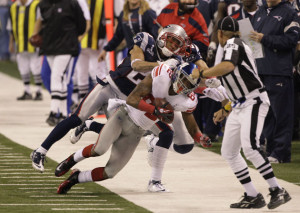
Manningham won't be a Super Bowl hero this year.
Last year,
Mario Manningham was one of the stars of
Super Bowl XLVI, as his great sidelines catch helped the Giants defeat the Patriots (although it wasn’t even his most meaningful catch
in that game). As a member of the 49ers this season, Manningham has been placed on injured reserve, but that doesn’t make him ineligible to earn a second straight Super Bowl ring.
Brandon Jacobs, who was waived by the 49ers in December, is in the same boat.
How rare is that? Believe it or not, only four players in NFL history have ever won back-to-back Super Bowls with different teams. Guard Russ Hochstein was drafted by Tampa Bay in 2001 and played in one game in 2002; he was waived in October and signed by the Patriots a week later. He stayed in New England through 2008, so Hochstein picked up a Super Bowl ring for his cup of coffee with the Bucs and then earned two more the next two seasons in New England. Hochstein was also a freshman with Nebraska in 1997, when the Cornhuskers were named national champions by USA Today and ESPN.
Defensive back Derrick Martin was drafted by Baltimore in 2006 and has already spent time with four distinguished franchises. He made the AFC Championship Game with the Ravens in 2008, won the Super Bowl with the Packers in 2010, won another super Bowl with the Giants in 2011, and nearly made it back there this year with New England.
Those are the two obscure names. The other two? Well, let’s see if you can guess.
| Trivia hint 1 |
SelectShow |
One player was a defensive back, the other a linebacker.
|
| Trivia hint 2 |
SelectShow |
Both players earned these rings in the ’90s.
|
| Trivia hint 3 |
SelectShow |
One played another sport; the other had a famous father.
|
| Click 'Show' for the Answer |
SelectShow |
Deion Sanders and Ken Norton Jr. were part of the 1994 San Francisco 49ers team that won the Super Bowl. For the prior six years, Norton was with the Cowboys, so he won Super Bowls in 1992 and 1993 with Dallas. Sanders left the 49ers after one season, joining the Cowboys the following year, making him part of the 1995 Dallas team that won the Super Bowl.
|
Tagged as:
AV,
Brandon Jacobs,
Mario Manningham,
Super Bowl
{ }
by Chase Stuart
on January 25, 2013
Want to see how passing has changed in the NFL over the last 63 years? A picture is worth at least 1,000 words in this case. The graph below shows the number of interceptions per dropback (red), sacks per dropback (purple), non-INT incomplete passes per dropback (yellow) and completions per dropback (green). Of course, a dropback is simply a pass attempt or a sack. The information is stacked on top of each other for ease of viewing.

[continue reading…]
{ }