≡ Menu

This week at the New York Times, a look at the second straight “historically great offense vs. historically great defense” Super Bowl:

Last year’s Super Bowl pitted one of the greatest single-season offenses in N.F.L. history against one of the greatest single-season defenses. Using slightly different time frames, this year’s Super Bowl can boast similar claims.

Both the New England Patriots and the Seattle Seahawks had slow starts in 2014. After New England’s 41-14 loss to the Kansas City Chiefs in Week 4, pundits wondered if we were witnessing the end of the Tom Brady/Bill Belichick-era Patriots. But since that game, the offensive line emerged as a cohesive unit, Rob Gronkowski’s health improved and Brady became red-hot. Since that game, New England has averaged 35.3 points per game, including the playoffs (but excluding the meaningless Week 17 finale, in which the Patriots benched many starters).

From Games 5 to 15 of the regular season, New England scored 379 points, the seventh most during such a stretch of any team since 1970. Then, the Patriots scored 35 points in the team’s first playoff win over the Baltimore Ravens, and 45 last weekend against the Indianapolis Colts. New England joins the 1994 San Francisco 49ers and the 1990 Buffalo Bills as the only Super Bowl participants to average 40 points per game through multiple playoff games before the Super Bowl.

You can read the full article here.

{ 2 comments }

Guest Post: Marginal YAC, 2014 in Review

Adam Steele is back to discuss Marginal YAC, this time in the context of the 2014 season. You can view all of Adam’s posts here.


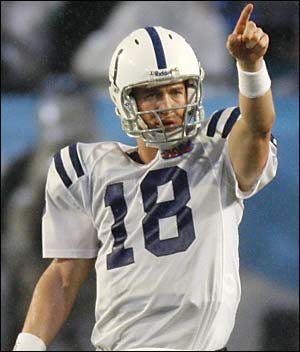
Manning is more of a downfield thrower than you think

Manning is more of a downfield thrower than you think

Back in September, I posted a three part series introducing Marginal Air Yards and Marginal YAC. Today, I’m going to update the numbers for 2014 and analyze some interesting tidbits from the just completed season. [1]A big thanks to Chad Langager at sportingcharts.com for helping me compile this data.

League-wide passing efficiency reached an all-time high in 2014 with a collective 6.13 Adjusted Net Yards per Attempt average. However, this past season was also the most conservative passing season in NFL history; 2014 saw the highest completion rate ever (62.6%), the lowest interception rate ever (2.5%), and also the lowest air yards per completion rate ever (5.91 Air/C). Passing yards were comprised of 51.4% yards through the air and 48.6% yards after the catch, the most YAC-oriented season in history. [2]Even though YAC data only goes back to 1992, I feel safe in using the phrase “all-time” with regard to YAC dependency. The offensive schemes of yesteryear emphasized downfield passing, which … Continue reading This trend shows no sign of reversing itself, so expect more of the same in 2015.

Here are the 2014 Marginal Air Yards (mAir) and Marginal YAC (mYAC) for quarterbacks with at least 100 pass attempts. The 2014 leader in Marginal Air Yards is…Peyton Manning? Yes, the noodle-armed, duck-throwing, over-the-hill Peyton Manning averaged 4.54 Air Yards per pass Attempt; given that the average passer on this list averaged 3.70 Air Yards per pass Attempt, this means Manning averaged 0.84 Air Yards per Attempt over average. Over the course of his 597 attempts, this means Manning gets credited with 500 marginal Air Yards, the most of any quarterback in the NFL. [continue reading…]

References

References
1 A big thanks to Chad Langager at sportingcharts.com for helping me compile this data.
2 Even though YAC data only goes back to 1992, I feel safe in using the phrase “all-time” with regard to YAC dependency. The offensive schemes of yesteryear emphasized downfield passing, which generated far less YAC than the short passing games of today.
{ 12 comments }

Probably was picked off

Probably was picked off

I still can’t quite comprehend what happened. Leading 19-7 with less than three minutes remaining, Green Bay somehow lost the NFC Championship Game. It was the most remarkable comeback in conference championship game history since at least 2006, when Peyton Manning and the Colts came back from the dead against the Patriots.

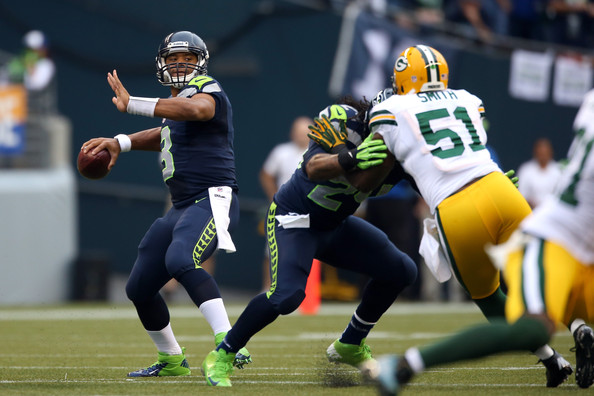
But this game had the added element of Russell Wilson looking like he had no idea what he was doing out there. With four minutes remaining, Wilson had one of the ugliest stat lines in playoff history: he was 8/22 for 75 yards with no touchdowns, four interceptions, and four sacks for 24 yards. He was averaging -4.96 Adjusted Net Yards per Attempt. It was worse than Ryan Lindley against Carolina, a performance that would rival Kerry Collins in the Super Bowl against the Ravens for worst playoff passing performance ever.

Wilson’s stat line was straight out of a 1976 boxscore featuring a rookie quarterback against the Steelers. Yet, somehow, minutes later, the game would be in overtime. Wilson ended regulation with a still miserable stat line of 11/26 for 129 yards, with 0 touchdowns (to be fair, he did run one in), 4 interceptions, and 4 sacks for -24 yards. That translates to an ANY/A average (which gives a 45-yard penalty for interceptions, and a 20-yard bonus for touchdowns, while penalizing for sacks) of -2.50.

If the Seahawks returned the overtime kickoff for a touchdown, the game would have easily gone down as the worst performance by a playoff-winning quarterback in history. But in overtime, Wilson did his best work: first, he found Doug Baldwin for ten yards. Then, after taking a one-yard sack, he hit Baldwin on 3rd-and-7 for 35 yards. The next play, Wilson hit Jermaine Kearse for a 35-yard touchdown, and Seattle was headed back to the Super Bowl.

Wilson finished 14/29 for 209 yards, with 1 touchdown, 4 interceptions, and five sacks for -25 yards. That translates to an anemic ANY/A average of +0.71. How does that compare historically? I thought it would be worthwhile to compare the ANY/A average of every winning quarterback in a playoff game to the league average ANY/A that season. So, in 2014, the NFL averaged 6.13 Adjusted Net Yards per Attempt per pass. This means Wilson finished 5.42 ANY/A below average. And given that Wilson had 34 dropbacks, it means that Wilson produced -184 Adjusted Net Yards over average. As it turns out, that’s only the … third worst ever by a winning quarterback. [continue reading…]

{ 19 comments }

Thoughts on the Championship Games

On conference championship Sunday, it’s easy to pick the home teams, particularly when they are the number one seeds and touchdown favorites. That logic is further supported in a case like 2014, where the favorites have histories of success against these particular underdogs.

But conference championship game Sunday is not immune to upsets. The graph below shows the average point spread of each winner in a conference championship game since 1978. Based on the line data I have (which comes from PFR), there have been a pair of touchdown underdogs in recent memory: the 2012 Ravens and 2007 Giants.

ccg hist

In recent history, conference championship games have been viewed as much closer than what we see in 2014, where the Seahawks are 8-point favorites and the Patriots are currently at -6.5. To find a semifinal weekend where both favorites were giving at least six points, you have to go back to 2007, when the Patriots and Packers were also playing. That day, the Giants pulled off the huge upset in Green Bay, while New England handled San Diego. [continue reading…]

{ 0 comments }
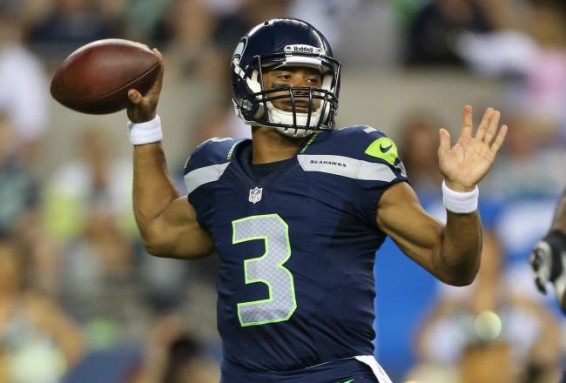
The Seahawks have met high expectations this year, thanks to #3

The Seahawks have met high expectations this year, thanks to #3

Nobody is surprised to see the New England Patriots or the Seattle Seahawks hosting games on championship Sunday. The Patriots are in the AFC title game for the 9th time in 14 years — NINE times! That is insane. Only six other teams — the Steelers, 49ers, Cowboys, Raiders, Broncos, and Rams — have been to nine conference championship games since 1970, a feat New England has matched since 2001.

Perhaps even more incredibly: on Sunday, Foxboro will be the site of the AFC title game for the 7th time in 14 years. Since 1970, just two other cities — Pittsburgh and San Francisco — can match that claim. For some perspective, New York has hosted just two conference title games — the Giants in ’86 and ’00.

Oh, and if you’re counting at home, this will also be the fourth straight year with the Patriots in the AFC Championship Game. Ho hum.

As for Seattle? The Seahawks are the defending champions, and were arguably the top team in football by the end of the 2012 season, too. Seeing Seattle in the NFC Championship Game is no surprise to any football fan.

The Packers and Colts are only slightly more surprising participants. At the start of the season, Green Bay was tied with New Orleans for having the third best odds (behind Seattle and San Francisco) for winning the Super Bowl; the Colts were a distant third behind the Denver/New England tier in the AFC, but still, no other AFC team was as clear a Super Bowl contender after the Broncos and Patriots as Indianapolis. The table below shows the odds (from Bovada) each team was given to winning the Super Bowl at various points in the off-season; the final two columns display what percentage those odds convert to, both before and after adjusting for the vigorish: [continue reading…]

{ 0 comments }

Guest post: Expected Touchdowns

Munir Mohamed, a reader of Football Perspective, is back for another guest post. And I thank him for it.


Methodology: I looked at the expected touchdown rate on each yard line from inside the five-yard line in goal-to-go situations, then assigned touchdowns over expectation based on the number of scores above or below average the expected rate. For example, passes from the 1-yard line score a touchdown 50% of the time. Therefore, if a quarterback throws a touchdown when the line of scrimmage is the one, he receives +0.5 touchdowns over expectation. If he didn’t throw a touchdown, he is credited with -0.5 touchdowns over expectation. The numbers in this article are from 1998-2014. Note that touchdowns, like nearly every other statistic in football, is a reflection of not just a player, but his team. A player who scores highly in this metric may simply be great at scoring touchdowns, may have played with coaches or teammates who significantly aided his production, may be lucky over a small sample size, or a combination of several of those factors. But we can discuss the reasons behind the data in the comments: let’s get to the data, and begin with passing touchdowns. [continue reading…]

{ 1 comment }
Brady was happy to have the game put in his arm on Saturday

Brady was happy to have the game put in his arm on Saturday

Every week during the season, I compile Game Scripts data, which measures the average points margin during every second of every game. Since most people don’t have a chance to watch every game, it’s helpful to have this information.

During the playoffs, most of us are watching each game, so we know what’s going on. But after two weeks, I thought it was still worthwhile to check in on the numbers. There have been two big comebacks during the playoffs: the Cowboys against the Lions during the wildcard round, and the Patriots against the Ravens last weekend.

The Dallas comeback against Detroit would rank as the 4th biggest comeback of 2014, or the 4th worst Game Script produced by a winning team. Those with longer memories may recall that in 2011, the Lions beat the Cowboys despite having a Game Script of -9.4, and last year, the two teams scored 41 combined fourth quarter points. In other words, don’t turn off the game early when the Lions and Cowboys are playing.

The Patriots also pulled off a big comeback. New England trailed 14-0 and for most of the first half, and entered the locker room down seven. The Patriots are no strangers to these sorts of comebacks, though: since 2001, New England has the third best winning percentage when trailing at halftime by between 7 and 14 points.

Here are the full numbers from the first two rounds of the playoffs:

TeamH/ROppBoxscorePFPAMarginGame ScriptPassRunP/R RatioOp_POp_ROpp_P/R Ratio
INDCINBoxscore2610167.8452564.3%382164.4%
CARARIBoxscore2716115.8333945.8%321568.1%
SEACARBoxscore3117145.8242747.1%382956.7%
BAL@PITBoxscore3017134.6302554.5%531973.6%
IND@DENBoxscore2413113.8432860.6%482070.6%
GNBDALBoxscore26215-0.4362955.4%232845.1%
NWEBALBoxscore35314-4.8531380.3%452861.6%
DALDETBoxscore24204-8.1372163.8%452267.2%

[continue reading…]

{ 0 comments }

John Fox went 13-3 in 2012, 13-3 in 2013, and then 12-4 in 2014 as head coach of the Denver Broncos. But with a 2-3 playoff record during that time, John Elway shockingly fired the head coach.

As Bill Barnwell noted, it’s very rare for a coach as successful as Fox to be fired. While Barnwell took a big picture view, I thought it would be interesting to look at coaches who were fired immediately after a successful season: in this case, winning 12 or more games. As it turns out, it’s happened just two times before in NFL history. Marty Schottenheimer was fired by San Diego after going 14-2 in 2006, but losing in the team’s first playoff game to New England. And Jimmy Johnson was allowed to move on despite going 12-4 and winning a second consecutive Super Bowl in 1993.

The table below shows all coaches who won at least 10 games (or had a winning percentage of at least 0.625) in a season from 1970 to 2013, but who were not patrolling the same sidelines a year later: [continue reading…]

{ 14 comments }

This week at the New York Times, a look at the two matchups this weekend, arguably pitting the most valuable quarterbacks against the most talented teams.

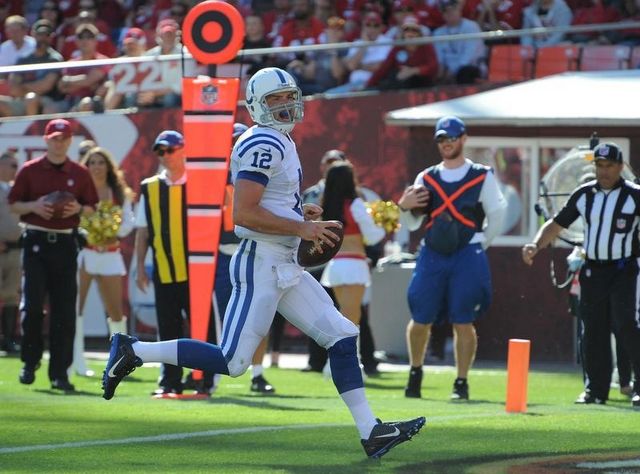
At Stanford, Andrew Luck was immensely hyped as the next great quarterback prospect. The Indianapolis Colts selected him with the first overall pick in 2012, and remarkably, Luck has managed to meet even the highest of expectations. After helping turn a 2-14 team in 2011 into a playoff team in 2012, Luck won his first playoff game during the 2013 season and has now guided the Indianapolis Colts to the A.F.C. championship game.

Just 25 years old, Luck threw for a league-high 40 touchdowns during the regular season. On Sunday, against the heavily favored Denver Broncos, he delivered another strong performance, throwing for two touchdowns and guiding an offense centered on the passing game.

Luck is perhaps the most important person to his franchise of any player in the N.F.L. But it is Green Bay quarterback Aaron Rodgers, and not Luck, who is likely to be named the league’s most valuable player this month. Rodgers averaged 7.68 net yards per attempt during the regular season, the highest in football. Rodgers also led the N.F.L. in interception rate (a minuscule 1.0 percent) and finished second to Dallas’s Tony Romo in touchdown rate (7.3 percent).

You can read the full article here.

{ 2 comments }

Guest Post: Are Interceptions Overrated?

Guest contributor Adam Steele is back again. You can read all of Adam’s articles here.


Are Interceptions Overrated?

There’s nothing worse than throwing an interception. Everyone seems to agree on this, from fans to media to advanced stats guys. But is it really true? In this quick study, I looked at the tradeoff between interception avoidance and aggressive downfield passing to see which strategy has a larger impact on winning. To measure this, I created two categories of quarterbacks: Game Managers and Gunslingers.

First, the Game Managers, which includes all post-merger quarterback seasons with an INT%+ of at least 110 [1]Which means the player was at least 0.67 standard deviations better than league average at avoiding interceptions. and a NY/A+ of 90 or below (min 224 attempts). [2]Which means the player was at least 0.67 standard deviations worse than league average in net yards per attempt. These guys avoided picks but failed to move the ball efficiently, the hallmark of a conservative playing style.

[continue reading…]

References

References
1 Which means the player was at least 0.67 standard deviations better than league average at avoiding interceptions.
2 Which means the player was at least 0.67 standard deviations worse than league average in net yards per attempt.
{ 27 comments }

Manning returns to face his former team

Manning returns to face his former team

Today, Peyton Manning will face off against his former team, the Indianapolis Colts, in a playoff game. This is actually the 3rd time Manning has played in a Colts/Broncos playoff game — Manning is 2-0 — but the first time he is facing his former team in the playoffs. This will be just the 4th time that has happened in NFL history.

In 1960 and 1961, Jack Kemp quarterbacked the Chargers to the AFL Championship Game, ultimately losing both times to the Houston Oilers. Then, in 1964 and 1965, Kemp reached the AFL Championship Game again, only this time, the San Diego Chargers were his opponent! Both times! That’s right, in four of the first six seasons, Kemp started in the AFL title game either for or against the Chargers. And in all four games, San Diego went 0-4, as Kemp’s Bills defeated the Chargers, in both games, on the strength of some dominant Buffalo defenses. San Diego did win the AFL title in 1963, otherwise that would go down as one of the saddest stretches in championship game history. [continue reading…]

{ 1 comment }

My from-the-gut thoughts on this weekend’s games, which of course will also flavor my fantasy decisions.

Seattle/Carolina: It’s easy to get burned by being too cute. Sometimes, things are so obvious that we start to look for contrarian takes. To review: Seattle finished with the best record in the NFC, atop the 538 Elo Ratings, and first in Football Outsiders’ DVOA ratings. As the defending champions, the Seahawks obviously pass the eye test. The defense seems to be playing at 2013 levels, while the offense remains quietly effective.

Carolina is one of the worst playoff teams in NFL history. The Panthers won a terrible division with a 7-8-1 record; Carolina went two full months without winning a game. It is hard to come up with a larger mismatch, at least on paper. Seattle is favored by “only” 10.5 points, but that’s a reflection of Seattle not being a high-scoring team, not indecision about the Seahawks ability.

There have been 25 games in NFL playoff history where a team was favored by double digits and the over/under was also less than 45 (the over/under here is actually quite a bit lower, at 40). The favorites have gone 23-2 in those games, with both upsets being memorable: the 2001 Patriots winning in the AFC Championship Game against the Steelers, and the Jaguars shocking the Broncos in the second round of the ’96 playoffs. That is the sort of enormous upset it would be if Carolina could win, and let’s not forget that the Seahawks are also 24-2 at home over the last two years.

These home teams are 17-8 against the spread, too. I’ll be taking Seattle, and frankly, a blowout win is much more likely, in my opinion, than a Panthers win. The only question that remains: do you take Russell Wilson or Marshawn Lynch in your FanDuel lineups? Wilson has more paths to success, of course, and Lynch has struggled against Carolina over the past three years. On the other hand, a dominant home win typically means big numbers for Lynch. In tournaments, you probably don’t want both, but in 50/50s or cash games, I don’t have a huge issue with that strategy. The other must-play in FanDuel this week, due to salary, is the Seattle D. The Seahawks are $5200, and every other defense is at least $4500; given that Seattle is such a strong play this week, it’s hard to imagine it making sense to keep them out of a lineup. [continue reading…]

{ 0 comments }
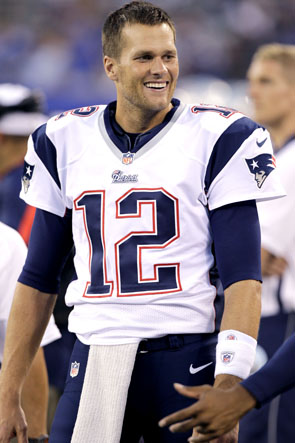
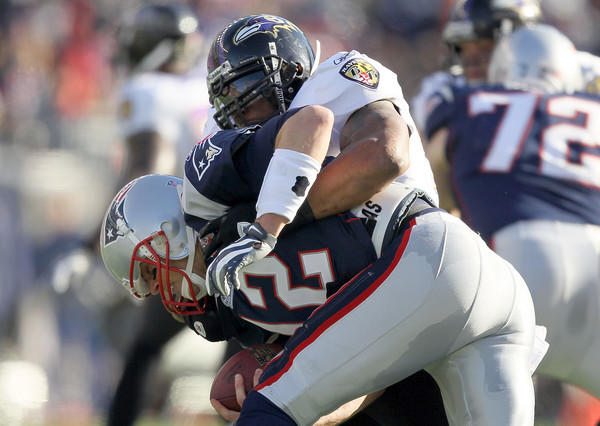
Tom Brady has been known to wear Suggs

Tom Brady has been known to wear Suggs

Disclaimer: Quarterbacks don’t have records, teams do. A quarterback’s “record” is simply shorthand for saying “the record of a quarterback’s teams in all playoff games started by that quarterback.” Please forgive me for using that shorthand for the remainder of this post.

Eight years ago, Doug Drinen wrote a fun post in advance of the 2006 AFC Championship Game. At the time, Peyton Manning had gone 0-2 in playoff games against Tom Brady, so Doug looked at quarterbacks who had gone winless against another particular quarterback in the postseason.

Manning wound up beating Brady in that game, and evened his record against Brady in the 2013 playoffs. No pair of quarterbacks have ever met as starters five times in the playoffs, so Brady/Manning are tied for the most playoff meetings. Joining them on Saturday will be Brady and Joe Flacco. This weekend’s game will be the fourth time since 2009 that the Ravens have traveled to Foxboro in the postseason, and Brady and Flacco have been under center for each game. [continue reading…]

{ 7 comments }

It’s Time for the Cowboys To Fire Jason Garrett

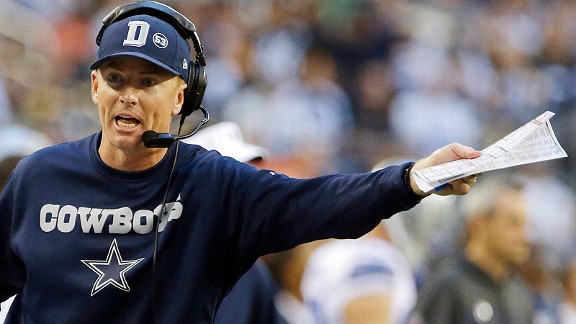
Garrett should be handing in his letter of resignation if he had any honor

Garrett should be handing in his letter of resignation if he had any honor

I waited patiently all week, but it appears no one else has the guts to write what needs to be written: it’s time for the Cowboys to fire Jason Garrett.

On Sunday, the Dallas Cowboys hosted the Detroit Lions in the first round of the playoffs. The Cowboys were the more talented team, and were favored by 6.5 points to win the game. And, despite Garrett’s best efforts, the Cowboys did manage to escape with a victory. But Garrett’s blunders nearly cost the team not once, but twice, and there’s little evidence to indicate that Garrett has learned from his mistakes.  If the Cowboys ever want to win a Super Bowl, the team needs to move on from Garrett.

Mistake #1

With just under four minutes left in the 3rd quarter, the Cowboys trailed the Lions, 17-7. On 3rd and goal from the 1-yard line, Garrett called a running play for DeMarco Murray, who was stuffed by Ndamukong Suh for no gain. Given that the Lions have the best run defense in football, this isn’t too surprising.

Trailing by 10, the Cowboys obviously still needed two scores, so the correct move, of course, is to take the three points. Yet despite this being the sort of basic math that a third grader could decipher, Garrett essentially took the three points off the board and chose to go for it on 4th down. [continue reading…]

{ 61 comments }

The Steve Smith Postseason Post

Today’s guest post comes from Adam Harstad, who is also part of the Smitty Fan Club. You can follow Adam on twitter at @AdamHarstad.


One of the greatest playoff receivers ever

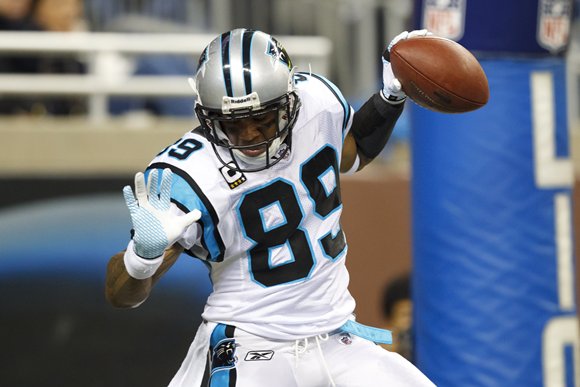
Smith considers letting the chip roll off his shoulder.

IS STEVE SMITH THE GREATEST POSTSEASON WR IN HISTORY?

Prior to this last weekend’s slate of games, I remarked to several friends what a treat it was that we got to watch Calvin Johnson, Larry Fitzgerald, and Steve Smith all playing on the same weekend. In addition to being three of the best receivers of the last decade, all three could lay claim to the best per-game postseason numbers in history, depending on where you set the cut-offs.

Calvin Johnson had only appeared in one postseason game prior to this season, but he made it count with 12/211/2 receiving in a losing effort. Calvin was actually the fourth player in history to top 10 receptions, 200 yards, and 2 touchdowns in a single playoff game, [1]Oddly, all four receivers to reach those marks were active this past weekend; in addition to Calvin Johnson, they were Reggie Wayne, Steve Smith, and T.Y. Hilton. but each of the three previous have played additional games to bring their per-game numbers down. Among players who appeared in at least one playoff game, Calvin’s 211-yard “average” was the best by a mile.

If you moved the cutoff to 6 games, Larry Fitzgerald’s postseason averages took over the spotlight. Following the 2008 NFL season, Fitzgerald had arguably the greatest postseason run by a wide receiver, hauling in 6/101/1, 8/166/1, 9/152/3, and 7/127/2 in his four games, including what would have been the Super Bowl-winning touchdown and a likely MVP performance if not for some heroics from Ben Roethlisberger and Santonio Holmes. Fitzgerald followed that up with a strong showing in the 2009 playoffs, catching 12/159/2 over two games. All told, Fitzgerald had 53/705/9 receiving in just six postseason appearances, for a per-game average of 8.8/118/1.5. [continue reading…]

References

References
1 Oddly, all four receivers to reach those marks were active this past weekend; in addition to Calvin Johnson, they were Reggie Wayne, Steve Smith, and T.Y. Hilton.
{ 1 comment }

Packers, Cowboys, and Undefeated Home/Road teams

The Packers went 8-0 at home this year. Green Bay scored 318 points in home games in 2014, the 3rd most by a team in NFL history. Aaron Rodgers threw 25 touchdowns and 0 interceptions in those games, and his 133.2 passer rating at home is the highest in a single season in NFL history.

A couple of minor notes for the anti-Green Bay crowd: the 2011 Packers scored 321 points en route to an 8-0 home record, while Rodgers’ 128.5 home passer rating is now the second highest ever. And the Packers lost their first playoff game, at home, to the NFC East champion that season.

This year, the NFC East champion Cowboys scored 275 points in road games, the 4th most ever. Dallas also went 8-0 on on the road, making this weekend’s matchup just the 3rd time in NFL history that an undefeated road team traveled to the site of an undefeated home team for a playoff game. [continue reading…]

{ 9 comments }

It is not a reach to predict Beckham taking home OROY despite missing three games.

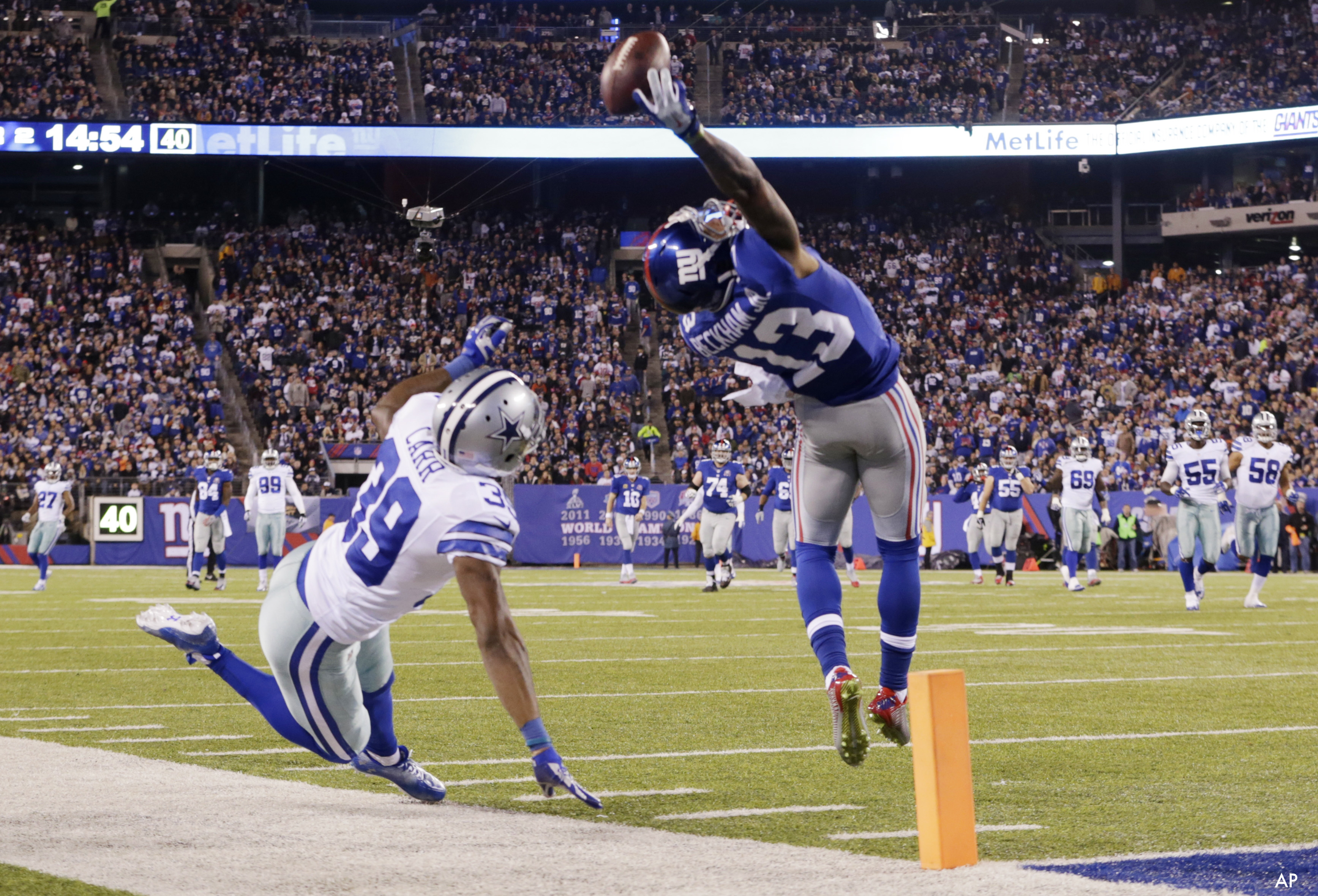
It is not a reach to predict Beckham taking home OROY despite missing three games.

Odell Beckham was the best rookie in the NFL this year despite missing a quarter of the season. Over the last eleven weeks of 2014, he led the NFL in receiving yards, and finished second in receptions and receiving touchdowns. He will very soon be named the Offensive Rookie of the Year, which made me wonder: how often has a player won a major award despite missing at least three games in a season?

If we exclude the Walter Payton Man of the Year, the Super Bowl MVP, and Comeback Player of the Year awards, [1]For those curious, Tedy Bruschi, Greg Ellis, Doug Flutie, Tommy Kramer, Jim McMahon, Joe Montana, Jim Plunkett, and Michael Vick have all won that award despite missing games — or, perhaps in … Continue reading my database identifies six players who have won an award despite missing at least three games. [2]This excludes the 1987, when just about every player missed three games due to the players’ strike. Four of them won the defensive rookie of the year award, while the other two were quarterbacks.  In reverse chronological order… [continue reading…]

References

References
1 For those curious, Tedy Bruschi, Greg Ellis, Doug Flutie, Tommy Kramer, Jim McMahon, Joe Montana, Jim Plunkett, and Michael Vick have all won that award despite missing games — or, perhaps in some cases, because of missing those games.
2 This excludes the 1987, when just about every player missed three games due to the players’ strike.
{ 5 comments }

This week at the New York Times, an early look at the division round of the playoffs:

In 1990 the N.F.L. switched to its current playoff format, featuring six teams from each conference, with the top two seeds earning first-round byes.

For the first 15 years, this structure appeared to provide an enormous edge for the top two seeds: Teams coming off byes won 81.7 percent of all games in the division round of the playoffs from 1990 to 2004.

Then, over the next six seasons, the rested teams were 12-12 and it seemed as though being “hot” negated any advantage teams gained from a week off. In the last three postseasons the pendulum has swung back, with three bye teams winning each year. Last year, all four favorites were victorious in the division round of the playoffs, with the road 49ers winning at Carolina as 1-point favorites.

This year projects to mark a return to the old days. For the first time since 2007 all four home teams in the division round are favored by at least 4 points, and any more than one upset would qualify as shocking. So while the home teams are heavily favored this weekend, here is one tidbit to keep in mind for each game.

You can read the full article here.

{ 0 comments }
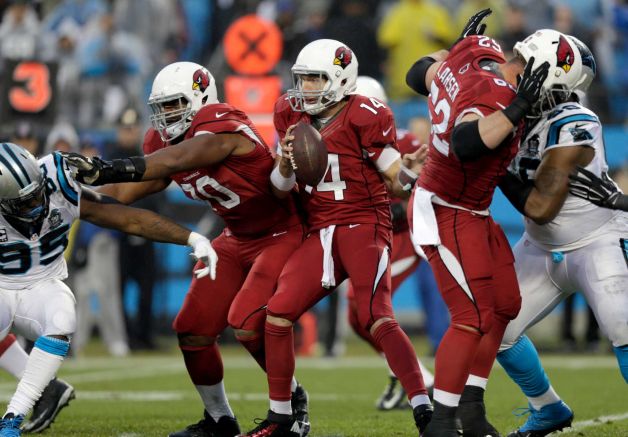
Ryan  Lindley imploded against the Panthers in the Wildcard Round

Ryan Lindley imploded against the Panthers in the Wildcard Round

Ryan Lindley had a very, very bad day against the Carolina Panthers on Saturday. He completed 16 of 28 passes for just 82 yards, with one touchdown and two interceptions. He was also sacked four times and lost 31 yards. Assigning 20 yards per passing touchdown and -45 per interception, and including the sack data, this means Lindley produced -19 adjusted net yards. Given his 32 dropbacks, that translates to a -0.59 ANY/A average.

Which, of course, is really bad. The fact that it came in the most pass-friendly era in history makes it look even worse, although that’s slightly tempered by the fact that the Panthers have an above-average defense. We can combine the era- and SOS-adjustments in one step by noting that Carolina allowed 5.84 ANY/A to opposing passers this year. As a result, this means Lindley fell 6.45 ANY/A short of what we would expect, given the Panthers defense and this era. Over the course of 32 dropbacks, that means Lindley produced 206 Adjusted Net Yards below expectation.

Using that methodology for every playoff game since 1950, Lindley’s mark is the 9th worst in playoff history. The worst? That belongs to Kerry Collins in Super Bowl XXXV. Here’s how to read the table below. Collins averaged -2.19 ANY/A against the Ravens over the course of 43 dropbacks; the Baltimore defense, of course, was very good against the pass, allowing just 3.88 ANY/A. Still, that means Collins fell 6.07 ANY/A short of expectation. Over 43 dropbacks, that’s -261 ANY below what we would expect given the Ravens defense, the worst ever.

One final note: in the table below, you can click on the “Year” cell for each player to go to the boxscore for that game. [continue reading…]

{ 13 comments }

Luck's Colts won big early in the year, but are small favorites today

Luck’s Colts won big early in the year, but are small favorites today

In week 7, the Bengals lost 27-0 to Indianapolis. What does that mean? I looked at all playoff rematches where:

  • The teams only played once during the regular season (as, I think, division rivals represent a different equation)
  • The rematch occurred in the same location as the original game
  • The home team won the regular season meeting

This happened once last year, where the Saints also lost by 27 points on the road to the Seahawks during the regular season, and then revisited Seattle in the playoffs. Obviously Seattle won that rematch, too, which is not unusual. There have been 11 situations where the home team won by at least 27 during the regular season, and the home teams went 9-2 in the rematch. (And, it’s worth noting, that one of the wins came with Joe Montana starting the playoff game for the Chiefs, after Dave Krieg started the regular season loss.) The table below shows all playoff rematches between teams that met the above criteria.

Here’s how to read the second entry. In 1991, the Lions traveled back to Washington for the Conference Championship Game. Detroit was a 14-point underdog, and point spread data is included for all games since 1978. In the game, Detroit lost, 41-10. In the regular season, the teams met in Washington (remember, all games in this table were rematches at the same site) in week 1, and Detroit lost 45-0 (remember, all games in this table occurred from the perspective of the road team, and the road team lost in the first game). That -45 points differential was the 2nd most ever; the table is sorted by points differential in the regular season. [continue reading…]

{ 0 comments }

These guys are back in the playoffs

These guys are back in the playoffs

At FanDuel, you start 1 QB, 2 RBs, 3 WRs, 1 TE, 1 K, and 1 defense, with a salary cap of $60,000. The scoring system is pretty standard, with 0.5 points per reception being the most notable feature to keep in mind.

Given that there are just four games this week, predicting the game flow (and subsequent Game Script) of each matchup is a vital part of determining which fantasy players will do the best. My thoughts:

Arizona at Carolina

The Panthers have been hot the last four weeks, although part of that was due to playing poor teams. Fortunately for Carolina, another poor team is on the horizon in Arizona. The Panthers defense should be able to contain Ryan Lindley, making them a strong play. The forecast is for rain in Charlotte, making the matchup even tastier.

Another notable development: Arizona’s run defense has fallen from 5th in yards per carry allowed over the first 11 weeks, to 32nd over the last six. The Cardinals defense allowed 278 rushing yards in four games to Colin Kaepernick and Russell Wilson, which makes Cam Newton a potential threat for a big game today. The downside to Newton: Patrick Peterson shutting down Kelvin Benjamin and the Panthers getting up early could limit Newton’s passing stats. A 16/25, 160 yard day with 50-60 rushing is one possible outcome, and probably more likely than Newton throwing for 300+ yards. If you want play Newton, you’re likely banking on a rushing touchdown. [continue reading…]

{ 0 comments }

John Idzik Fired, and Rebuilding in New York

A very unhappy marriage

A very unhappy marriage

After two seasons on the job, Jets general manager John Idzik was fired on Black Monday. Idzik has been loudly criticized for his personnel decisions — more on this in a bit — but even the anti-Idzik crowd would recognize that firing a general manager after just two years is unusual. Firing a general manager who drafted the defensive rookie of the year in one of those two seasons, and who never was permitted to hire his own head coach, only adds to the perception that Idzik’s tenure in New York was unique.

In retrospect, the decision that may wind up ruining Idzik’s career was the one to agree to take the vacant Jets job. Recall that Jaguars GM Dave Caldwell chose Jacksonville over New York, in a move that foreshadowed some of the problems Idzik would encounter. Chief among them: rebuilding in New York — and in particular, with the Jets — is just not like rebuilding in other places.  The Jets were 6-10 and coming off back-to-back seasons without the playoffs when Idzik was hired.  New York was in a clear rebuilding situation: the Jets cap situation was in terrible shape, and the talent had been depleted.  This was going to take some time.

Idzik came from Seattle, where John Schneider took the Seahawks from 5-11 to 7-9 and 7-9 in his first two seasons.  Now recognized as one of the best GMs in football, Schneider may well have been fired after two years had he compiled that resume in New York and had the same strained relationship with the media that Idzik had.  At a high level, Idzik planned to do in New York what Schneider did in Seattle, or Ted Thompson has done in Green Bay: build through the draft, spend money wisely, and patiently construct a roster.  With the Jets — and in particular, due to the media that covers the team — that plan leaves very little margin for error. [continue reading…]

{ 16 comments }

Post Your 2014 Playoff Predictions here

Post your playoff predictions in the comments. Here are mine:

Wild Card Round

(4) Indianapolis over (5) Cincinnatip
(6) Baltimore over (3) Pittsburgh
(4) Carolina over (5) Arizona
(6) Detroit over (3) Dallas

Divisional Round

(1) New England over (6) Baltimore
(2) Denver over (4) Indianapolis
(1) Seattle over (6) Detroit
(2) Green Bay over (4) Carolina

Conference Championships

(1) New England over (2) Denver
(2) Green Bay over (1) Seattle

Super Bowl

(1) New England over (2) Green Bay

{ 30 comments }

There are lots of bad things one could write about the NFC South. But for the most part, the Atlanta Falcons had been a competitive team this year, and not just by NFC South standards. Entering week 17, Atlanta had posted an average Game Script of +0.7; sure, that’s not very good, but it’s above average! The Falcons had not been embarrassing, and in fact, had outscored opponents by 40 points through three quarters.

Sure, Atlanta had issues maintaining leads in the fourth quarter, but they were rarely soundly beaten from start to finish. The Falcons had (prior to Sunday) four bad Game Scripts this year. Three of them came on the road: -12.8 in Baltimore, -10.6 in Green Bay, and -8.5 in Cincinnati, and all three of those teams are notable for being much stronger at home in recent years. The fourth was a -8 against the Steelers, but even then, Atlanta had the ball down by just seven with 6 minutes remaining.

Then, week 17 came. The Panthers led by 10-0 after the first quarter, the largest deficit Atlanta faced after one quarter all year. Carolina upped that margin to 21 points at halftime, the second largest halftime lead an opponent had against the Falcons this year (Green Bay was up by 24 points). The 31-point margin after three quarters was easily the largest margin, too. It was a start-to-finish beating by the Panthers, who posted a Game Script of 16.4 in the process.

That was the second largest Game Script for Carolina this year, and by quite a large margin. Other than another December blowout over a division rival (New Orleans), the Panthers didn’t have a Game Script of over +7. But are the Panthers peaking at the right time, or just beating up on NFC South opponents? Tune in next week: actually, never mind. The Cardinals are an NFC West team in name only; with Ryan Lindley under center, Arizona is actually the fifth member of the NFC South. [continue reading…]

{ 1 comment }

New York Times, Post Week-17: Reviewing the Surprises

This week at the New York Times, a look at the bigger over- and under-achievers with respect to the pre-season Vegas lines:

Every year, Las Vegas sets forth a projected number of wins for each N.F.L. team. Most years, the majority of teams finish within a couple of games of that projection; this year, 20 of the league’s 32 teams finished within two wins of their projected wins total from before the season. But every year, there are also a few outliers; today, a review of the two biggest overachievers and two largest underachievers of the 2014 season.

Dallas Cowboys (Projected wins: 8. Actual: 12.)

Projecting an eight-win season for the Cowboys seemed like a safe bet: Dallas finished with an 8-8 record in 2011, 2012 and 2013, and there was little reason for optimism in 2014. The defense allowed the most yards in the N.F.L. in 2013, then lost three of its best players: DeMarcus Ware moved on to the Broncos, Jason Hatcher signed with the Redskins, and Sean Lee tore an anterior cruciate ligament in May. The expectation was that the offense would be good, but that the defense could be one of the worst in history.

But the defensive coordinator Rod Marinelli turned a unit short on talent into a respectable on-field product. Marinelli got the most out of linemen like Jeremy Mincey, Tyrone Crawford and Henry Melton. Inside linebacker Rolando McClain isn’t just a candidate for comeback player of the year: His production was one of the more shocking developments of the season. A former draft bust, McClain officially retired in May 2013. More than a year later, the Cowboys traded a sixth-round pick to Baltimore for McClain and a seventh-round pick. But he was the Cowboys’ most dependable linebacker in 2014 and finished as a top 10 inside linebacker, according to Pro Football Focus.

You can read the full article here.

{ 1 comment }

Quick Reactions From Week 17 of the 2014 season

Some quick thoughts on all the week 17 action.

Baltimore 20, Cleveland 10

The Ravens ranked 5th in DVOA entering week 17, so it sure felt like Baltimore was a worthy playoff team. But Baltimore looked horrible in week 16 against Houston and then trailed 10-3 entering the third quarter against a Browns team starting Connor Shaw at quarterback.

How good are the Ravens? Baltimore swept the NFC South, and beat the Titans and Jaguars. The four other Ravens wins: a split with the Steelers, a sweep of the Browns, and an impressive-at-the-time win over Miami. That means the Ravens finished the year with just one win teams with a winning record. The losses were all to good teams: Pittsburgh, a sweep by the Bengals, the Colts, the Texans, and the Chargers. So the 2014 Ravens went 1-6 against teams with winning records, and 9-0 against the rest of the NFL.

Given what happened with Joe Flacco and the team in 2012, I don’t think anyone is going to brand Baltimore as a team that can’t beat good teams. But you can be sure that if, say, the Bengals had this split, that narrative would dominate the headlines. On the other hand, the Ravens are one of just six teams to finish 2014 with a +100 points differential. The silver living here is that the Ravens didn’t just beat bad teams, but that Baltimore tended to do so convincingly. [continue reading…]

{ 16 comments }

Rex Ryan Fired

This article should have been written two years ago. At the latest, it should have been written last year. Technically, we’re still a few hours away from the title of this article being accurate and/or breaking news, but there’s no drama left in New York. Ryan is going to be fired as the Jets head coach.

The Jets went “all in” from 2009 to 2011 in the hopes of winning a Super Bowl. New York got very, very close, reaching consecutive AFC Championship Games in 2009 and 2010. After the 2008 season, the Jets had a talented roster but were in need of a new head coach and a new quarterback. Then general manager Mike Tannenbaum tabbed Rex Ryan as that man. Ryan retained offensive coordinator Brian Schottenheimer, and then New York traded up to acquire Mark Sanchez.

At that point, the fates of Tannenbaum, Ryan, Schottenheimer, and Sanchez were aligned. Other than the owner, the general manager, head coach, offensive coordinator [1]Particularly when the head coach has a defensive background., and the quarterback may be the four most important men in any football organization. Together, the quartet began a new era of Jets football. And it was very successful… for two seasons.

The 2011 season was very disappointing, with a cherry on top being a disaster of a finale in Miami. The Jets then decided to move on from Schottenheimer, which made sense: things roll downhill in all walks of life, and the NFL is no different. Sure, Sanchez had turned into a bust, and maybe Ryan had lost control of the team, and perhaps Tannenbaum’s drafting had taken a turn for the worse, but maybe, just maybe, the team’s troubles were all the fault of the offensive coordinator! As a first step, keeping the nucleus intact but with a new coordinator made sense: it was the path of least change.

Unfortunately, Schottenheimer’s replacement turned out to be Tony Sparano, so you can imagine how that ended. After the 2012 season, the Jets fired Tannenbaum, and Sparano, and the majority of the defensive coaches moved on, too. ((DC Mike Pettine went to Buffalo,while Ass. HC/LB coach Bob Sutton, Ass. DB coach Jim O’Neil, OLB coach Mike Smith, and Ass. DL coach Anthony Weaver all left, too.) Sanchez was only retained because of his enormous cap figure, but he had also played his last regular season game for the Jets. At that point, firing Rex made a lot of sense. [continue reading…]

References

References
1 Particularly when the head coach has a defensive background.
{ 2 comments }

A massively disappointing quarterback and Josh  McCown

A massively disappointing quarterback and Josh McCown

Passer rating is a stupid stat. But my interest in trivia trumps my disdain for passer rating, so let’s move on.

Josh McCown had a passer rating of 109.0 last year, the third best in the NFL in 2013. With one game left in the 2014 season, McCown has a passer rating of 70.5, and he is in a tight three-way race with Geno Smith and Blake Bortles to see who finishes the season with the worst passer rating. Update: McCown had a passer rating of 70.0 in week 17, and finished the year with a 70.5 passer rating. A decline of 38.5 points in a quarterback’s passer rating is enormous, but not unprecedented. In fact, eight other players (minimum 200 pass attempts both years) have seen larger declines:

#8) Daunte Culpepper (2004-2005)

In 2004, Culpepper set an NFL record with 5,123 yards of total offense.  I wrote about Culpepper’s great ’04 season and his subsequent decline at the PFR blog back in 2007, and I maintain that Culpepper was a very underrated quarterback during his time in Minnesota.  In 2004, he finished with a passer rating of 110.9; the next year, his final with the Vikings, he threw 6 touchdowns against 12 interceptions in seven games, before an ACL year ended his season.  He finished with a 72.0 passer rating, representing a 38.9 point drop from his lofty ’04 standard. [continue reading…]

{ 6 comments }

With their season on the line, the San Diego Chargers chose to dig deeper. Into a hole, that is.  On Saturday night, the 49ers jumped out to a 21-0 lead just 20 minutes into the game, and San Francisco took a 28-7 record into halftime. Even with six minutes left, San Diego still trailed by two touchdowns.

Down to their final drive, the Chargers needed to convert a 4th-and-8 (on a 17-yard pass to Eddie Royal) and a 4th-and-10 (to Dontrelle Inman), just to set up an 11-yard touchdown from Philip Rivers to Malcom Floyd with 32 seconds remaining.

Through 60 minutes, the Chargers had a Game Script of -11.3, which would tie the Lions/Falcons game for the most negative Game Script by a winning team all season. Because the game went to overtime, that Game Script number ended at -10.5, but that’s still easily the biggest comeback since the Detroit/Atlanta contest.

The other notable comeback of week 16 was in Miami, where the Vikings and Dolphins staged a crazy affair that resulted in a whopping 41 fourth quarter point. But Minnesota jumped out to an early lead and led 17-7 at the break, so the Vikings ended up with a Game Script of +4.3.

On the other end of the spectrum, there was only one large blowout: the Cowboys dominated the Colts by a score of 42-7, producing a Game Script of +23.9 in the process. The table below shows the week 16 Game Scripts data: [continue reading…]

{ 2 comments }

Rushing Defense and the Lions, Ravens, and Steelers

Earlier this year, I noted that the Seahawks were operating at a historic level when it came to yards per carry differential. Seattle hasn’t slowed down since then: through 15 games, the team has rushed 491 times for 2,630 yards, a 5.36 YPC average. Defensively, the Seahawks have allowed just 1,262 yards on 362 carries, which translates to an anemic 3.49 YPC average. As a result, the team is averaging 1.87 more yards per carry than its opponents, which would place them second since 1950 behind the 2007 Vikings.

Over the last 30 NFL seasons, just one team has rushed for 2800 yards: the 2006 Atlanta Falcons, in the year where Michael Vick rushed for over 1,000 yards. Seattle has a good chance of being the second such team, thanks in no small part to Russell Wilson and his 842 rushing yards. Seattle’s rushing offense has been absurdly dominant this year, but that’s fodder for another day. Today I want to look at rush defense, and there’s another NFL team having a dominant season in that regard.

The Detroit Lions haven’t allowed a 100-yard rusher this year. Through 15 games, 31 NFL teams have allowed at least 1200 rushing yards, while Detroit has given up just 957 yards on the ground. That’s only 63.8 rushing yards per game, which would rank 4th among all teams since 1950, behind only the 2000 Ravens, 2006 Vikings, and 2010 Steelers. Detroit would need to allow just 46 yards against the Packers to pass the Steelers for 3rd place, 27 yards to pass the Vikings for 2nd, or 12 yards to pass the Ravens for first place. Okay, that probably won’t happen, but Detroit has been outstanding against the run this year. The Lions have been even better in the second half of the season against the run, allowing just 52.1 yards per game on the ground over the team’s last seven games.

And here’s a bit of good news for NFL fans: we could be heading towards a tremendous showdown or two in the postseason.  Assuming the Packers beat the Lions on Sunday, Detroit will fall to the sixth seed in the NFC, which would likely mean a trip to Dallas — and NFL leading rusher DeMarco Murray — in the first round. And if the Lions win that game, the second round would have them headed to Seattle to face the Seahawks unstoppable rushing attack, if Seattle beats the Rams in week 17.

Detroit is one of just two teams this year that has not allowed a 100-yard rusher; the other is Baltimore, and the Ravens have not allowed a 100-yard rusher in 25 games, dating back to week six of the 2013 season (when Eddie Lacy rushed for 120 yards). That makes the Ravens just the 34th team since 1960 to go 25 games without allowing a 100-yard rusher; of course, for Baltimore, they need to extend the streak into the 2016 season to break the franchise record of 46 straight games.

It feels as though the Ravens have had a great run defense for the team’s entire history, courtesy of Ray Lewis and a host of talented rush defenders. As it turns out, Baltimore has allowed just 44 100-yard games since entering the league in 1996, but that’s only the second best mark. Over that same time period, the Steelers have allowed just 36 100-yard rushing games.

Baltimore’s run defense was nothing special in the early days of the franchise, while the mid-’90s Steelers run defense was dominant. If we look back just to 1999, the Steelers have allowed 33 100-yard rushers, while the Ravens have allowed only 32. Then again, change the cut-off to 2000, and Pittsburgh drops to 28, with Baltimore staying at 32.

Undoubtedly the most impressive part of the streak from either franchise belongs to Pittsburgh. From 2004 to 2010, the Steelers allowed just five 100 yard rushers. That’s mind-boggling. Among all teams since 1978, the only team other than Pittsburgh to allow fewer than ten 100-yard rushers over any seven-year period was the ’82 to ’88 Bears, who allowed nine.

Rudi Johnson hit the century mark in week four of the 2004 season; over Pittsburgh’s next 53 games, only Edgerrin James (124 yards in a 26-7 Colts win in 2005) rushed for 100 yards against the Steelers. In 2007, Thomas Jones and Fred Taylor each did it in the second half of the year, and then that was it until Ray Rice in week 16 of the 2009 season.  No 100-yard rushers allowed in either the 2008 or 2010 season.

{ 2 comments }